
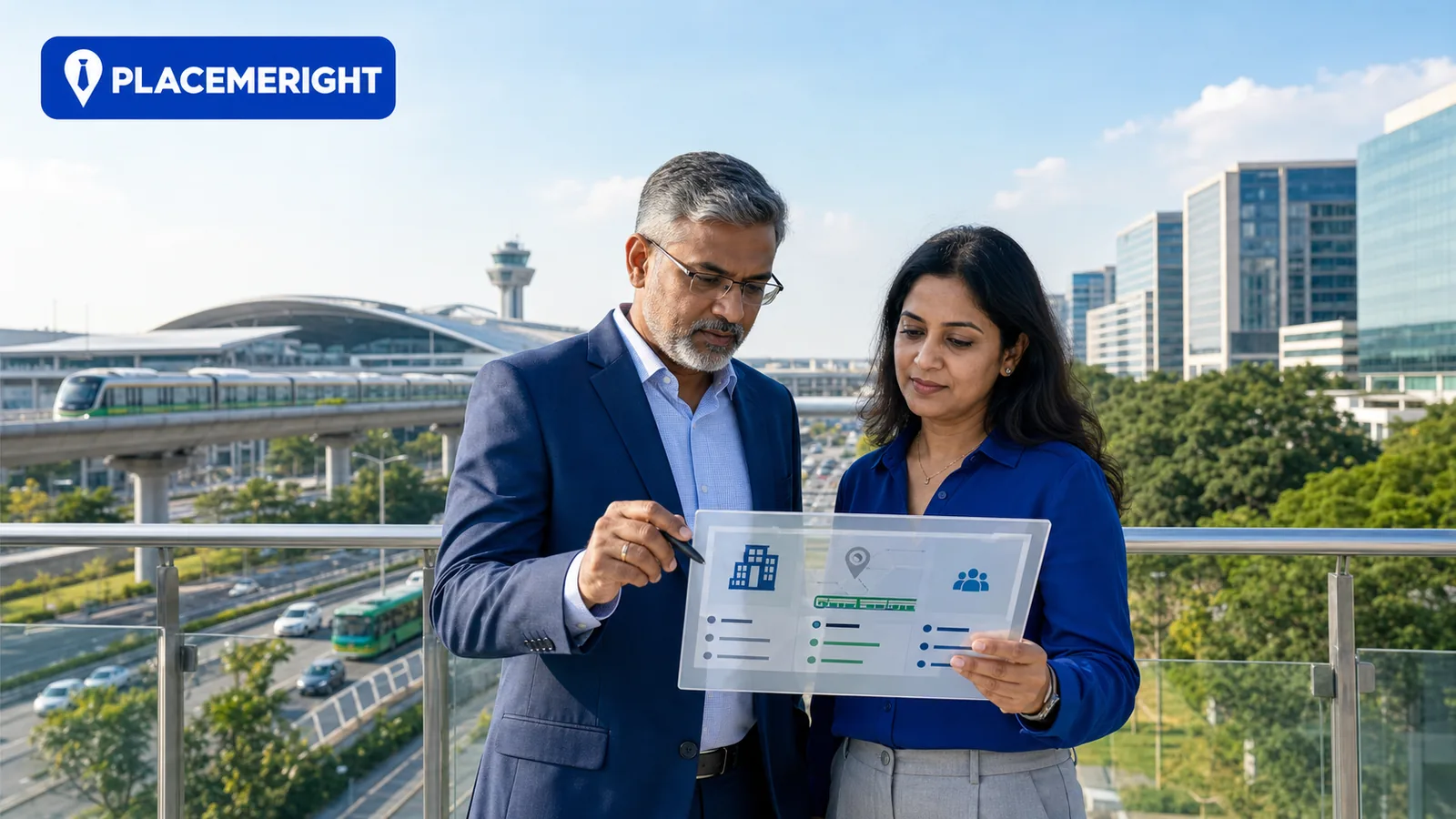
A company recruits a senior engineering leader for a North Bangalore role. The job description says "airport corridor" and "hybrid." During interviews, one person describes an office near Hebbal, another mentions a Devanahalli site, and a third says the leader will visit an aerospace facility and the airport when customers arrive.
The candidate is not choosing one commute. They are being asked to absorb an undefined travel system.
For a senior role, the burden is not only distance. It includes recurring decision events, irregular operating windows, site access, airport-linked work, incidents, team distribution, and the consequences of being unavailable. The employer should create an event-value versus travel-debt ledger before deciding attendance or evaluating candidate feasibility.
The ledger asks two questions:
1. Which in-person events genuinely improve the role's decisions? 2. What recurring burden does the work arrangement transfer to the person?
Name the exact North Bangalore system
"North Bangalore" can refer to distinct places and work patterns, including Hebbal, Nagavara, Yelahanka, Jakkur, Thanisandra, Devanahalli, the airport, KIADB industrial areas, and the Aerospace and Defence Park.
Record every required site:
| Site fact | Employer disclosure | | --- | --- | | exact destination | building, gate, campus, or facility | | function | engineering, office, plant, lab, customer, airport, or partner | | recurring events | decisions or work that occur there | | expected cadence | regular, scheduled, launch, incident, or exceptional | | working window | normal hours, shift, customer arrival, test, or support | | access | badge, escort, security, device, vehicle, or safety condition | | transport support | current employer-provided support, if any | | change owner | person authorised to alter site or cadence |
PlaceMeRight's Bangalore technology recruitment guide provides broader market context. This article stays with the work arrangement for senior roles connected to North Bengaluru and the airport corridor.
Separate operating and future transport
The employer should maintain a dated transport note.
BMRCL's 2026 parking-policy document states that Phase 2B from KR Puram to Kempegowda International Airport is under construction. It must not be presented to candidates as an operating airport-metro commute.
K-RIDE describes the planned Sampige suburban-rail corridor from KSR Bengaluru City to Devanahalli and publishes current project material and tenders. The official source establishes a project, not a current employee journey.
The official Bengaluru Airport site lists current passenger transport options, including intercity bus information. Employers should verify relevant city services, schedules, stops, and operating status directly on the date of use. An airport passenger service is not automatically suitable for a daily office or industrial-site commute.
Write three separate fields:
- available and employer-verified now;
- under construction or implementation;
- proposed, planned, or unresolved.
Do not combine them into one connectivity claim.
Build the event-value ledger
List every reason the senior hire is expected to be present.
Examples:
- architecture or design decision;
- laboratory or prototype review;
- supplier or manufacturing issue;
- customer workshop;
- executive planning;
- team coaching;
- incident command;
- security-restricted activity;
- airport-linked delegation visit;
- routine status meeting.
Score each event internally across:
| Dimension | Question | | --- | --- | | consequence | What decision or outcome improves through presence? | | interaction richness | Is direct observation, physical artefact, trust, or rapid negotiation needed? | | authority | Does the person have a decision to make there? | | substitutability | Can approved remote evidence produce the same result? | | recurrence | How often can the event reasonably occur? | | predictability | Can it be scheduled with useful notice? | | burden | What travel, waiting, access, and recovery does it create? | | failure mode | What happens if the person cannot attend? |
Do not turn the fields into a universal numeric index. The organisation should discuss the evidence and remove events that do not justify their burden.
Define travel debt
Travel debt is the accumulated cost of an operating model that repeatedly moves a person because the work, authority, or evidence has not been designed clearly.
It can include:
- journey and waiting time;
- unpredictable start or finish;
- switching between office, plant, laboratory, and airport events;
- access queues and device restrictions;
- recovery after late or disrupted travel;
- inability to plan focused work;
- reduced availability to distributed teams;
- personal arrangements repeatedly changed;
- unplanned expense or safety concern;
- attendance that produces no decision.
Travel debt is not a candidate weakness. It is a property of the employer's role design.
The candidate decides personal feasibility. The employer decides whether each work event deserves the burden it creates.
Distinguish role patterns
Airport-facing commercial or customer leader
Airport proximity may support visiting delegations or regional travel, but the brief should record actual frequency and destination. "Global exposure" is not enough.
Ask which meetings occur at the office, customer site, airport, or another city, and who can combine or reschedule them.
Aerospace or hardware engineering leader
Invest Karnataka identifies a Hi-tech Aerospace and Defence Park in Devanahalli and broader aerospace activity in Bengaluru Rural. A role may need access to physical products, laboratories, manufacturing, quality evidence, suppliers, or controlled environments.
The employer must identify the exact facility. A state cluster does not prove that the advertised role sits inside the park.
Platform or software leader
Software work may still require customer, hardware, security, operations, or executive events. Test those dependencies. Do not assume a software title makes site presence unnecessary or that a North Bangalore address makes it necessary.
Multi-site operations leader
If the role spans Hebbal, Yelahanka, Devanahalli, and another Bengaluru site, publish a multi-site charter. Name the primary site, secondary sites, expected sequence, transport ownership, and event authority.
Run the value test
Take one recurring office day and decompose it.
Suppose the leader attends:
1. a weekly architecture review; 2. a team status meeting; 3. a supplier-quality escalation; 4. an executive update; 5. individual coaching sessions.
Ask what changes in person.
The supplier escalation may require physical evidence and rapid negotiation. Coaching may benefit from periodic presence but not necessarily a fixed weekly day. Architecture may need a shared whiteboard for an early decision and asynchronous records thereafter. Status reporting may not justify travel at all.
The result is not "remote" or "office." It is a redesigned event calendar.
Document:
- events retained in person;
- events made remote;
- events grouped on one day;
- events moved to another site;
- events made conditional;
- events eliminated;
- evidence required after each event.
Price the quarterly operating calendar
A representative week can hide concentrated periods. Build a quarterly calendar before calling the arrangement stable.
Mark:
- recurring team and leadership events;
- customer and supplier visits;
- laboratory, manufacturing, or certification windows;
- product or programme milestones;
- planned business travel;
- release and support periods;
- predictable seasonal pressure;
- events at other Bengaluru sites.
For every event, record the site, notice, essential participants, decision, fallback, and recovery expectation. Then look for collisions.
A senior leader may reasonably attend a physical design review and a supplier-quality decision in Devanahalli. The model becomes weaker when a routine executive update forces a separate journey the next day, followed by an airport-linked customer event whose time is known only after booking.
Use three calendar views:
Baseline quarter: expected work under normal planning.
Launch quarter: temporary customer, test, or release events with a stated end.
Disrupted quarter: one site becomes unavailable, a programme slips, or travel demand increases.
The employer should decide which burden is permanent, which is temporary, and which is not yet supported by evidence. Temporary intensity needs an owner, start condition, end condition, and review date.
This calendar also exposes whether the role needs local deputies or distributed decision authority. The answer may be better team design rather than more travel by one senior person.
Record who can redesign the calendar when the evidence changes.
Test airport-linked exceptions
Airport-corridor roles often contain irregular exceptions.
Use four scenarios:
Visiting-customer day
A delegation lands early and requests an afternoon technical review. Who must attend? Can the company provide transport, secure meeting space, preparation time, and a decision agenda?
Late operational event
A test or customer cutover extends beyond the normal window. What safe return, rest, next-day, and escalation arrangements apply?
Site-access failure
The leader reaches a controlled facility but access or required equipment is unavailable. Is there a fallback decision path?
Consecutive travel
The person returns from business travel and is expected at a North Bangalore site the next morning. Who can change the event?
The employer should have current HR, safety, security, travel, and operational policies reviewed by qualified owners. Recruitment should not invent exceptions during closing.
Calibrate seniority correctly
A senior candidate may be willing to travel for meaningful authority and unwilling to travel for ceremonial attendance. That is not lack of commitment.
The role brief should connect presence to:
- decision scope;
- physical or controlled evidence;
- stakeholder authority;
- team development;
- customer outcome;
- incident consequence;
- organisational learning.
Assess the candidate's ability to run these events, not their enthusiasm for an unspecified corridor.
Use an event-redesign exercise. Give the candidate a month containing twelve in-person commitments across three sites. Ask them to protect the essential outcomes while reducing unnecessary movement.
Strong evidence includes:
- preserving high-consequence physical work;
- grouping compatible events;
- assigning local authority;
- using durable decision records;
- creating remote evidence;
- defining incident exceptions;
- avoiding personal assumptions;
- measuring whether the redesign works.
Do not reward a candidate for accepting every event unchanged. The assessment is about operating judgement, not endurance.
Give candidates a decision pack
Before the final interview, provide:
- exact primary and secondary sites;
- current expected cadence;
- recurring decision events;
- known irregular events;
- working windows;
- current transport support;
- controlled-access conditions;
- travel and expense policy;
- current operating transport facts;
- under-construction infrastructure labelled clearly;
- who can approve exceptions;
- date the arrangement was last verified.
Ask the candidate whether the stated model is feasible. Let them ask questions privately and avoid requesting unnecessary household or health details.
If the site or cadence changes during hiring, issue a revised pack.
Avoid location proxies
Do not infer feasibility from:
- current home locality;
- previous office location;
- vehicle ownership;
- family status;
- age or seniority;
- willingness to attend one interview;
- one test journey;
- a future infrastructure project.
Candidate-provided constraints can inform a consented discussion, but the employer should not create personal profiles unrelated to the work.
Keep location feasibility separate from technical and leadership scoring.
Measure the operating model
After hiring, review employer-controlled signals:
- in-person events that produced a recorded decision;
- attendance events with no clear outcome;
- site changes communicated late;
- exceptions requiring executive approval;
- incident response delayed by access;
- travel clustered or removed;
- handoffs improved through local authority;
- candidate or employee corrections to location information.
Do not turn attendance into a proxy for contribution. The purpose is to improve the work design.
Quick checklist
- Replace "North Bangalore" with exact sites.
- Record the function and access conditions of every site.
- Separate operating transport from projects under construction.
- List each recurring in-person event.
- State the decision or evidence that makes presence valuable.
- Calculate burden qualitatively through the travel-debt ledger.
- Remove, combine, relocate, or digitise low-value events.
- Test airport-linked and late-operating exceptions.
- Connect senior presence to genuine authority.
- Provide a dated candidate decision pack.
- Let candidates confirm feasibility without personal assumptions.
- Reissue the pack when a material work condition changes.
Frequently asked questions
Is the airport metro operating for North Bangalore candidates?
The cited BMRCL 2026 source describes Phase 2B to the airport as under construction. Employers must verify current operating status before publication or candidate communication.
Does living near Hebbal make a Devanahalli role feasible?
Not automatically. The person needs the exact site, working window, cadence, access, transport, and exception facts before deciding feasibility.
Should senior candidates attend more office events?
Seniority does not justify attendance by itself. Presence should support decisions, physical evidence, customer outcomes, team development, or operating consequence that cannot be achieved appropriately another way.
Can airport proximity be a role benefit?
It can be relevant for genuine travel or visiting-customer work. State the actual pattern and do not convert an airport-corridor label into a universal advantage.
Should future rail projects appear in the job brief?
They may appear as clearly dated future context, never as a current commute option or promised completion. The current work arrangement must stand on current facts.
What if the role has emergency site attendance?
Define the event, authority, frequency evidence, safe travel, access, escalation, and fallback under approved employer policies. Do not leave "as needed" unlimited.
Related reading
- Plan senior technology recruitment
- Build specialised engineering teams
- Review PlaceMeRight's employer credentials
Conclusion
Senior candidate decisions in North Bangalore depend on the work system behind the address.
The event-value versus travel-debt ledger shows which office, industrial, customer, airport, and incident events deserve physical presence and which exist because authority or evidence is poorly designed. It also keeps current transport separate from future projects.
That produces a more credible role, a fair feasibility discussion, and a senior operating model built around decisions rather than attendance.
CTA
Hiring senior talent for a North Bangalore or airport-corridor role? Discuss the work model with PlaceMeRight for employer-side role calibration, specialised sourcing, and evidence-led candidate conversations.
References
- Invest Karnataka: Bengaluru Rural district
- Invest Karnataka: Aerospace and defence
- BMRCL: 2026 Metro Parking Policy and Phase 2B status
- K-RIDE: Bengaluru Suburban Rail Project corridors
- K-RIDE: Bengaluru Suburban Rail Project documents
- Bengaluru Airport: Official transport and intercity bus information
Related PlaceMeRight resources
Our Tech Recruitment Services by City
Looking to hire vetted software engineers or scale your engineering teams in India's leading tech hubs? Explore our localized recruitment services: