
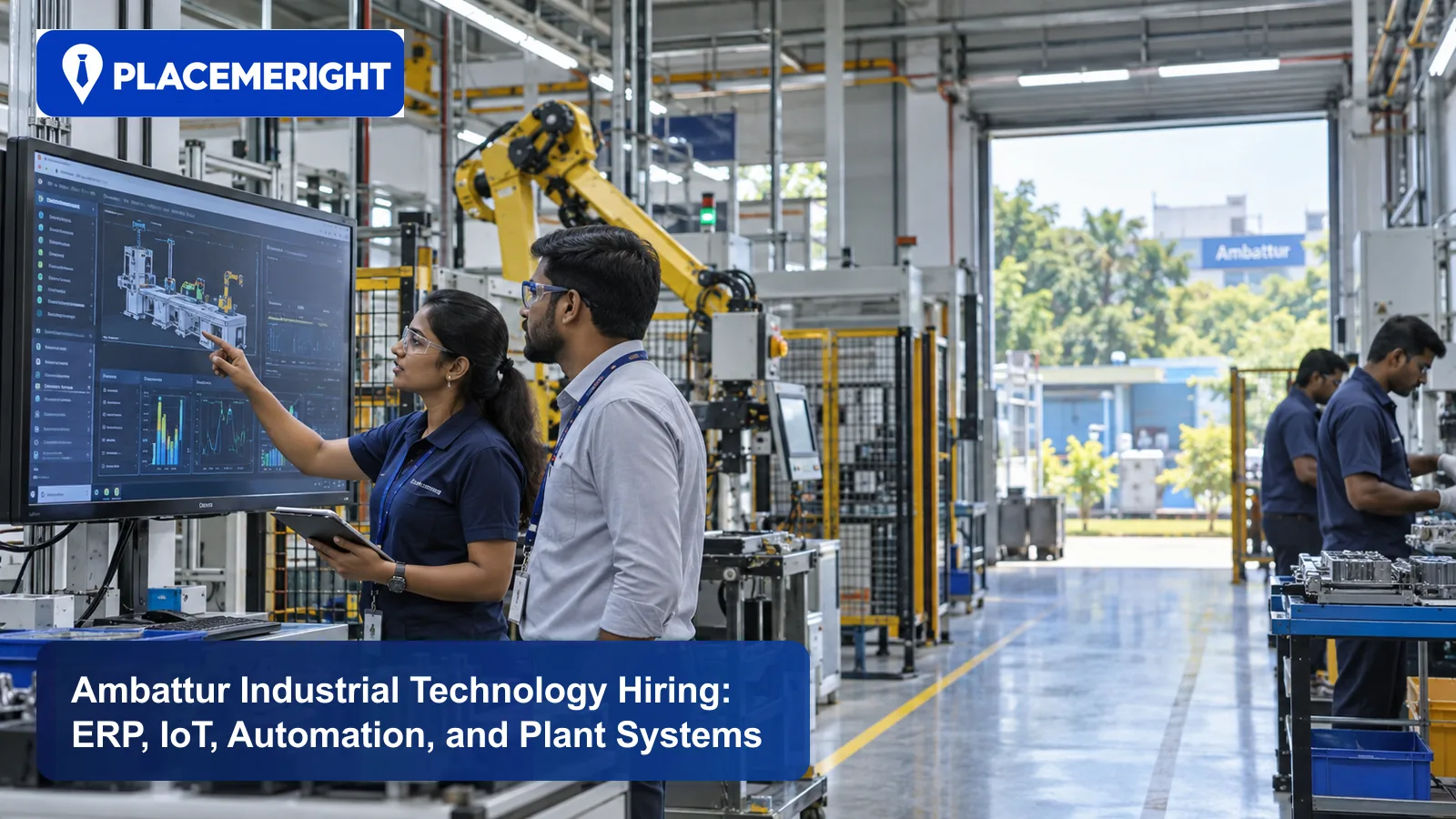
Ambattur employers often describe an industrial technology vacancy with one sentence: "We need someone who understands ERP, IoT, and automation."
That sentence can hide six different jobs.
An ERP consultant may configure procurement and production processes. A manufacturing execution specialist may connect orders with shop-floor activity. An automation engineer may work with PLCs, robots, drives, and safety logic. An industrial IoT engineer may move equipment data through edge and cloud systems. A plant data engineer may establish trustworthy operational datasets. An infrastructure specialist may protect networks, identities, endpoints, and uptime.
These people collaborate, but they are not interchangeable. Ambattur hiring becomes more accurate when the employer first maps the plant technology stack and then assigns ownership at each boundary.
Why Ambattur needs an industrial technology lens
TANSIDCO's official estate list identifies Ambattur Industrial Estate, while planning material permits IT and IT-enabled activity within the Ambattur and Guindy industrial estates. Tamil Nadu's investment guidance describes a wider state economy with substantial automotive, auto-component, electronics, engineering, and advanced-manufacturing activity.
Ambattur also sits inside west Chennai's wider employment and residential network. Korattur, Padi, Mogappair, Anna Nagar, Avadi, Koyambedu, Porur, and other western localities can matter to a search. Sriperumbudur and Oragadam belong to the broader industrial geography, but they are separate work destinations and should not be presented as if they were inside Ambattur.
Current Chennai employer listings also show that industrial technology can include robotics software, autonomy, cloud-connected systems, enterprise automation, embedded work, and quality engineering. Such city-wide listings are examples of role variety, not a count of Ambattur vacancies.
For broader city sourcing, use PlaceMeRight's Chennai technology recruitment context.
Draw the six-layer plant technology stack
Before approving a title, place the work in this stack.
| Layer | Main purpose | Typical ownership | | --- | --- | --- | | Business ERP | finance, procurement, sales, materials, planning | process owners, ERP functional and technical teams | | Plant planning and execution | production orders, dispatch, traceability, quality, genealogy | MES and manufacturing systems specialists | | Control and automation | machine control, sequences, safety, motion, robotics | controls and automation engineers | | Edge and industrial connectivity | device data, protocol conversion, buffering, local applications | OT, IoT, and edge engineers | | Data and applications | operational models, dashboards, analytics, integration | data, application, and product teams | | Infrastructure and security | network, identity, servers, endpoints, backup, monitoring | IT and OT infrastructure teams |
A hiring manager should mark which layer the new employee owns, which layers they influence, and where they only coordinate.
The difference changes the search brief. A candidate who has configured SAP production planning may understand production concepts but still lack machine integration. A PLC engineer may troubleshoot equipment but have no experience designing governed cloud data products. An IoT developer may move telemetry without understanding safety logic or plant maintenance.
Run a boundary workshop before opening the role
Bring together the plant head, production or quality representative, IT owner, automation lead, and recruiter for 45 minutes.
Answer these questions:
1. What event starts the workflow? 2. Which system records the official production, quality, or inventory state? 3. Which machine or application creates data? 4. Where is data transformed, buffered, or enriched? 5. Which action can affect physical production? 6. Who approves changes at each layer? 7. Who responds during a failure? 8. What can the new hire decide without waiting for a vendor?
The output should be one role card, not a larger tool list.
If the unresolved problem is data crossing several systems, the employer may need an integration or manufacturing-systems lead. If the problem is equipment uptime, an automation or maintenance profile may be more relevant. If the problem is planning accuracy, the role may sit in ERP or supply-chain systems. If the problem is trustworthy plant analytics, data modelling and stewardship matter.
Role card 1: ERP and business systems
An industrial ERP role should name the process, system boundary, and project stage.
For example:
> Own the production-planning and materials workflow connecting forecasts, purchase inputs, production orders, inventory movements, and plant reporting during an ERP rollout.
Clarify whether the role involves configuration, custom development, integration, testing, master data, user support, or product ownership. Distinguish implementation from application management and support.
Interview evidence can include:
- a process map with exceptions;
- one configuration or design decision;
- master-data dependencies;
- integration with warehouse, quality, or manufacturing systems;
- testing and cutover ownership;
- a post-go-live issue and its root cause;
- communication with plant users.
Do not call routine transaction support "ERP transformation." Candidates should know the real operating model.
Role card 2: MES and plant applications
MES work connects planned production with the actual sequence of making, checking, and recording a product. It may involve work orders, routing, recipes, operator instructions, traceability, genealogy, quality checks, downtime, or performance data.
The vacancy should specify the plant process and whether the person owns a product, implementation, integration, site rollout, or support service.
Use a case in which an order exists in ERP but the shop-floor system receives incomplete routing or material data. Ask the candidate to identify source ownership, validation, safe handling, operator communication, reconciliation, and recovery.
Strong answers preserve operational continuity and record integrity. They do not merely retry an interface until it turns green.
Role card 3: controls and automation
Automation work may cover PLC programming, human-machine interfaces, SCADA, robotics, drives, motion, sensors, machine vision, instrumentation, commissioning, troubleshooting, and preventive improvement.
The employer must disclose:
- equipment and control environment;
- new-project versus maintenance balance;
- site and shift expectations;
- safety responsibility;
- commissioning or travel;
- vendor coordination;
- documentation standards;
- authority during a line stoppage.
For a practical interview, present intermittent equipment behaviour after a change. Ask how the candidate would isolate electrical, mechanical, logic, sensor, network, and process causes while keeping safety and evidence intact.
A software coding test alone cannot assess this role.
Role card 4: industrial IoT and edge
"IoT engineer" is one of the easiest titles to overload.
Define the actual chain: device, protocol, gateway, edge processing, connectivity, event model, storage, application, and user decision. State whether the system observes production or controls it. The latter requires a much stronger safety and authority model.
Ask candidates to design data movement for equipment with unstable connectivity. Introduce out-of-order events, clock drift, duplicate messages, a failed gateway, and a plant team that still needs local visibility. Assess buffering, identity, data quality, remote management, observability, and recovery.
Tool names matter less than evidence that the candidate understands physical and digital failure together.
Role card 5: plant data and analytics
Plant dashboards can look precise while combining incompatible definitions.
An employer hiring a plant data engineer or analyst should define the decision being supported: production attainment, downtime, energy, quality, maintenance, material flow, or traceability. Then identify the system of record and data owner.
The work may require:
- timestamp and event modelling;
- equipment and product master data;
- data quality and lineage;
- historian, MES, ERP, and sensor integration;
- anomaly handling;
- contextual models for lines, shifts, products, and batches;
- governed metrics;
- feedback from operators and engineers.
Use an interview case where two teams calculate downtime differently. Ask the candidate to establish definitions, source events, exclusions, reconciliation, and adoption. A technically correct model has limited value when production and maintenance do not trust it.
Role card 6: plant IT, OT infrastructure, and security
Industrial infrastructure roles can include segmented networks, servers, virtualisation, endpoints, identity, backup, patching, remote vendor access, monitoring, asset inventory, and incident response.
State whether the employee owns corporate IT, operational technology, or the interface. Availability and controlled change may differ from an office environment.
Test a remote-access request for a machine vendor. The candidate should consider identity, least privilege, approval, time limits, network path, logging, session control, rollback, and operational coordination.
Avoid writing a cybersecurity vacancy that quietly includes all desktop support, network administration, server maintenance, audit evidence, and plant availability.
Screen for plant evidence, not manufacturing vocabulary
Ask every candidate to choose one system they personally improved and draw:
- users and physical process;
- upstream and downstream systems;
- data or control flow;
- their decisions;
- failure modes;
- change and release method;
- evidence of improvement.
Then introduce one boundary failure.
For an ERP candidate, break a master-data dependency. For an automation candidate, create a sensor fault. For an IoT candidate, disrupt connectivity. For a data candidate, change a source definition. For an infrastructure candidate, introduce a security control that conflicts with uptime.
The response shows whether the person can work across operations, not merely recite a product.
Calibrate seniority through consequence
Industrial titles often inherit years-of-experience bands without explaining responsibility.
A senior role may be expected to:
- approve architecture or control standards;
- plan commissioning and rollback;
- coordinate production, quality, maintenance, IT, and vendors;
- make decisions during operational disruption;
- maintain technical documentation;
- mentor specialists;
- manage technical debt across a long-lived system.
Ask about the highest-consequence decision the candidate owned and which safeguards surrounded it. A person can have many years of support exposure without owning design or recovery.
Build the Ambattur worksite record around attendance
The exact gate matters more than the word "Chennai."
An Ambattur Industrial Estate employee may evaluate travel from Ambattur, Korattur, Padi, Mogappair, Anna Nagar, Koyambedu, Avadi, or Porur differently depending on shift time, company transport, and last-mile access. Candidates from Guindy, OMR, Tambaram, Sriperumbudur, or Oragadam may be technically relevant but face a different journey.
Chennai Metro's ongoing Phase II programme, including Corridor 5, is relevant to the city's future network. Employers should still describe current travel using presently usable routes and company arrangements, not future infrastructure as if it already solves the commute.
Disclose:
- precise site and entrance;
- day, shift, or rotational schedule;
- callout and shutdown work;
- company bus or transport coverage;
- commissioning travel;
- work-from-home limits;
- whether the role supports one or several plants.
This information belongs in the first recruiter conversation.
Avoid the all-purpose industrial digital hire
One vacancy should not require deep SAP configuration, PLC programming, robotics, cloud architecture, Python data engineering, cybersecurity, project management, and 24-hour support.
If several capabilities are needed, choose an operating model:
Specialist model: hire separate ERP, automation, data, and infrastructure owners.
Product-team model: create a manufacturing technology team with shared outcomes and explicit layers.
Lead-plus-partners model: hire an internal systems lead who owns architecture and vendors while specialists deliver components.
Site-and-central model: let site engineers own operational context and a central team own reusable cloud, data, or security services.
The job description should state which model exists. Otherwise candidates cannot judge their authority or workload.
Quick checklist for Ambattur employers
- Draw the six-layer plant technology stack.
- Choose one primary layer for the vacancy.
- Name the physical process and system of record.
- Separate observation from automated control.
- Distinguish implementation, product ownership, and support.
- Test one real boundary failure.
- Assess personal decisions, not manufacturing keywords.
- Define safety, uptime, validation, and change responsibility.
- State the exact Ambattur site, shift, and transport plan.
- Split an impossible full-stack industrial role before sourcing.
Frequently asked questions
Is an ERP consultant also a plant systems specialist?
Not automatically. ERP experience can include production and materials processes, but MES, equipment integration, controls, edge systems, and OT operations require different evidence. Test the actual boundary.
What should an industrial IoT job description include?
Name the devices, protocols, gateway or edge environment, connectivity, data model, destination, user decision, security boundary, and whether the system observes or controls production.
Should automation engineers be screened with software coding tests?
Code can be relevant, but the interview should also test controls, equipment behaviour, safety, diagnostics, commissioning, and production recovery. A general algorithm round is not sufficient evidence.
Which localities can support an Ambattur search?
Ambattur, Korattur, Padi, Mogappair, Anna Nagar, Koyambedu, Avadi, and Porur are useful geographic contexts to record against the exact site and schedule. Wider Chennai and industrial-corridor journeys require an individual commute check.
When should an employer hire a manufacturing systems lead?
Hire one when the main problem is ownership across ERP, MES, automation, data, infrastructure, and vendors. Define which specialist decisions remain outside the lead's role.
Related reading
- Ambattur and Sriperumbudur ERP transaction-spine guide
- Taramani technology hiring map
- Guindy enterprise applications hiring guide
- Hire software developers across India
- PlaceMeRight technical recruitment services
- Dedicated hiring and RPO support
Conclusion
Ambattur industrial technology hiring works when employers stop treating ERP, IoT, automation, and plant systems as one profile. Map the plant stack, assign consequence and authority, test one real handoff, and make the worksite conditions visible before outreach begins.
CTA
PlaceMeRight helps Chennai industrial employers calibrate ERP, MES, automation, IoT, plant data, and infrastructure roles. Share your Ambattur hiring requirement to build the role boundary, evidence screen, interview case, and local sourcing radius.
References
- Tamil Nadu Small Industries Development Corporation, Industrial estate list
- Tamil Nadu Small Industries Development Corporation, TANSIDCO home and Ambattur facilities
- Chennai Metropolitan Development Authority, Guidelines for IT and ITES activity in industrial estates
- Guidance Tamil Nadu, Automobile, auto components, and electric vehicles
- Guidance Tamil Nadu, Tamil Nadu industry policy material 2026
- Chennai Metro Rail Limited, Phase II project status
- Caterpillar, Path Planning Senior Autonomy Engineer in Chennai
Related PlaceMeRight resources
Our Tech Recruitment Services by City
Looking to hire vetted software engineers or scale your engineering teams in India's leading tech hubs? Explore our localized recruitment services: