
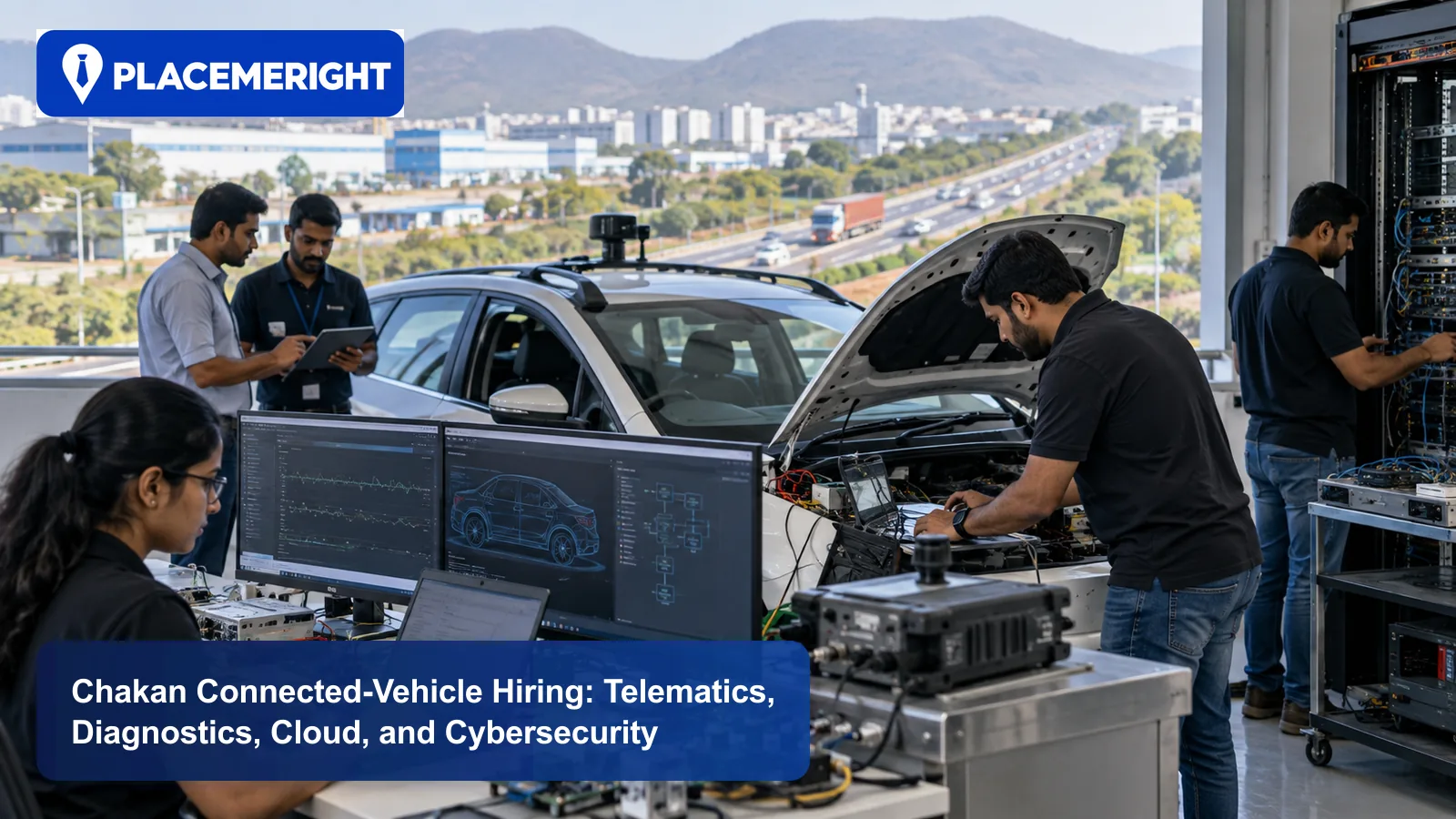
A connected vehicle is a distributed production system that moves.
An electronic control unit records an event. A gateway interprets it. A telematics unit sends it across an uncertain network. A cloud service identifies the vehicle. An application turns the event into a driver, service, fleet, or engineering action. An update service may later change vehicle software.
Each boundary can lose context, delay data, reject a message, duplicate an action, or create a security risk.
That is why "connected-car engineer" is too broad for a Chakan or Pune hiring brief.
Ground the Chakan-Pune market in verified evidence
MIDC identifies Pune and Pimpri-Chinchwad as a major automotive and ancillary ecosystem and names automotive research, testing, and certification infrastructure in the region. ZF's current India careers and location material identifies its Chakan facility, Pune headquarters, automotive technology work, embedded software, cloud, cybersecurity, validation, and systems engineering.
ARAI's Pune and Chakan programmes cover autonomous and connected vehicles, software-defined vehicles, functional safety, and automotive cybersecurity. The Ministry of Road Transport and Highways' AIS-189 draft provides a concrete Indian reference for vehicle cybersecurity and cybersecurity management systems.
Current employer roles add operating detail. Tata Motors has published a Pune connected-car cloud architecture role covering use cases, backend applications, validation, deployment, and critical issue resolution. A current Mercedes-Benz onboard data-collector role is Bangalore-based but identifies MBRDI's Pune presence and illustrates data collection, security architecture, observability, and maintainability work. KPIT's current careers material connects Pune with software-defined vehicles, centralised architectures, over-the-air updates, cybersecurity, and integration.
These sources show role breadth. They do not prove candidate availability, salaries, or time to hire.
Use PlaceMeRight's Pune technology recruitment context for the city search. Then state whether the work is in Chakan, Talegaon, Pimpri-Chinchwad, Hinjawadi, Baner, Kharadi, another Pune location, or a split plant-and-office model.
Trace the vehicle-to-cloud signal path
Use one diagnostic event across seven boundaries.
Boundary 1: ECU and in-vehicle source
The event begins in a control unit, sensor, domain controller, or infotainment system.
Relevant work may include:
- signal definition;
- embedded software;
- diagnostics;
- fault codes;
- timing;
- calibration;
- memory and compute constraints;
- functional and safety context.
Ask candidates which state produced the signal and what would make it invalid, stale, or unsafe to use.
Boundary 2: vehicle network and diagnostics
CAN, LIN, automotive Ethernet, FlexRay, UDS, OBD, and vendor toolchains may connect systems and expose diagnostic evidence.
Assess:
- message and diagnostic protocols;
- identifiers and addressing;
- timing and bus behaviour;
- diagnostic sessions;
- flashing and bootloaders;
- log interpretation;
- simulation and test tools;
- fault reproduction.
Tool names are not enough. Ask the candidate to reconstruct a failure from traces.
Boundary 3: telematics gateway and edge policy
The telematics control unit decides what to collect, transform, buffer, secure, and transmit.
Work can include:
- data acquisition;
- filtering and aggregation;
- local storage;
- retry;
- connectivity state;
- device identity;
- certificate handling;
- resource constraints.
The candidate should explain what happens during intermittent coverage, low battery, clock drift, or a gateway restart.
Boundary 4: cellular transport and cloud ingest
Messages cross mobile networks and enter backend systems.
Roles may own:
- secure connection;
- device authentication;
- message brokers;
- ingestion APIs;
- ordering;
- deduplication;
- rate control;
- regional routing.
Ask how the service distinguishes a delayed event from a duplicate, replay, or new vehicle state.
Boundary 5: connected-car platform and data
The platform may maintain vehicle identity, state, commands, trips, health, service events, and partner integrations.
Work can include:
- vehicle registry;
- digital state models;
- command workflow;
- event processing;
- stream and batch data;
- APIs;
- analytics;
- access control.
An ordinary cloud engineer can transfer into this layer, but the interview should test physical-system uncertainty and irreversible command consequences.
Boundary 6: driver, service, fleet, and engineering applications
The same data may feed:
- owner applications;
- fleet portals;
- service tools;
- roadside support;
- warranty analysis;
- product engineering;
- operational dashboards;
- partner services.
The application engineer must know which data is advisory, which triggers action, and which is subject to delay or correction.
Boundary 7: OTA, operations, and cybersecurity
Over-the-air update services and remote commands can change vehicle behaviour.
Work may cover:
- campaign definition;
- package signing;
- compatibility;
- staged rollout;
- download and installation state;
- rollback or recovery;
- cyber threat analysis;
- monitoring and incident response.
The AIS-189 draft framework makes the security consequence concrete: vehicle communication, telematics, remote operations, malware, unauthorised access, and manipulated messages need governed controls.
Separate connected-vehicle role families
Embedded connectivity engineer
This person may build gateway, telematics, protocol, or edge data software.
Require evidence of embedded constraints, vehicle networks, connectivity loss, secure identity, diagnostics, testability, and release discipline.
Vehicle diagnostics engineer
The role may own diagnostic requirements, UDS or OBD behaviour, ECU flashing, trace analysis, service workflows, or certification support.
Define whether the work is development, validation, support, tool engineering, or regulatory evidence.
Telematics platform engineer
This person may own secure device ingestion, messaging, vehicle state, APIs, commands, or partner integration.
Test distributed-systems depth plus understanding of delayed, duplicated, and partially trusted edge data.
Connected-car cloud architect
The role should connect use cases, logical architecture, platform standards, backend applications, validation, critical issues, and product roadmap.
Ask for trade-offs across reliability, security, cost, data volume, vehicle lifecycle, and backward compatibility.
OTA engineer
Specify whether the person owns campaign services, package and compatibility controls, in-vehicle update clients, validation, or operations.
The interview should cover partial installation, power loss, connectivity, staged rollout, recovery, and evidence.
Automotive cybersecurity engineer
Work may include threat analysis and risk assessment, secure design, cryptography, identity, vulnerability management, penetration testing, incident response, or management-system evidence.
Do not merge cybersecurity with functional safety. The domains interact but have different hazards, methods, and artefacts.
Connected-mobility data engineer
This role can own vehicle-event schemas, telemetry pipelines, quality, fleet features, anomaly detection, and engineering datasets.
Test provenance, consent, identity, late events, device versions, retention, and whether a signal is fit for the product decision.
Validation and systems engineer
This person may integrate components, design test environments, operate rigs, simulate connectivity, validate interfaces, and coordinate release evidence.
Look for system-level fault injection and requirements traceability, not only manual test execution.
Write a charter around one remote capability
Use eight fields:
1. Vehicle or platform: product family and lifecycle stage. 2. Remote capability: telemetry, health, command, diagnostics, OTA, fleet, or another outcome. 3. Owned boundary: primary part of the signal path. 4. Vehicle interfaces: ECUs, networks, gateway, and physical constraints. 5. Cloud interfaces: ingest, state, applications, and data. 6. Security and safety constraints: required controls and escalation. 7. Authority: changes permitted during development and incidents. 8. Proof: logs, traces, tests, rollout evidence, and field measures.
For example:
> Own reliable ingestion and vehicle-state processing for remote diagnostics. Define event contracts, authenticate telematics units, handle delayed and duplicate messages, expose traceable service APIs, coordinate with ECU diagnostics and service applications, and prove recovery during regional connectivity loss.
That brief is more precise than "AWS engineer with automotive experience."
Use an intermittent OTA and diagnostic incident
Give every candidate the same case:
> During a staged software-update campaign, a subset of vehicles reports a diagnostic fault after download. Some vehicles later report success, some remain in "installing," and others stop sending telemetry. The campaign system groups them as one failure. The affected vehicles span two gateway software versions and several mobile-network regions.
Ask for a state reconstruction
The candidate should request:
- campaign and package version;
- vehicle and ECU compatibility;
- gateway and update-client version;
- diagnostic codes and timestamps;
- download, verification, install, and reboot states;
- connectivity and retry history;
- backend event ordering;
- command and acknowledgement identifiers;
- security validation results.
Strong candidates separate missing telemetry from failed installation.
Add a second fact
Reveal that some success events arrived after the campaign service had already timed out, while one gateway version reused an acknowledgement identifier after restart.
The candidate should revisit the fleet status. Look for idempotency, event-time reasoning, duplicate protection, version-specific cohorts, and a safe way to reconcile vehicle truth with backend state.
Ask for containment
Possible actions include:
- pausing the affected cohort;
- allowing a validated version to continue;
- preventing repeat commands;
- requiring a local service path for uncertain vehicles;
- increasing telemetry for a bounded group;
- revoking or replacing a package only with evidence.
Do not reward an automatic fleet-wide rollback. Score consequence, reversibility, authority, and vehicle safety.
Ask for recovery proof
The answer should cover:
- vehicle state confirmation;
- diagnostic resolution;
- update integrity;
- fleet reconciliation;
- command deduplication;
- monitoring after reconnect;
- customer or service communication;
- retained regression tests.
The vehicle, cloud, and campaign system must agree for a reason.
Score evidence across five dimensions
Vehicle-system understanding
- 4: connects ECU state, diagnostics, gateway behaviour, and physical constraints;
- 3: understands the primary vehicle layer and interfaces;
- 2: knows protocols but cannot reconstruct state;
- 1: treats the vehicle as a stable internet client.
Distributed-system reasoning
- 4: handles event time, retries, ordering, idempotency, disconnection, and reconciliation;
- 3: identifies key message and state issues;
- 2: focuses on API availability alone;
- 1: assumes the latest backend row is vehicle truth.
Cybersecurity judgement
- 4: integrates identity, integrity, authorisation, threat, evidence, and controlled response;
- 3: applies sound controls with one limited area;
- 2: mentions encryption without system reasoning;
- 1: treats cybersecurity as a final penetration test.
Validation discipline
- 4: proposes reproducible fault injection, interface tests, cohort checks, traceability, and field proof;
- 3: provides a credible validation plan;
- 2: relies on happy-path simulation;
- 1: uses production as the main test environment.
Incident and stakeholder judgement
- 4: separates facts from uncertainty, protects vehicles and users, preserves evidence, and coordinates engineering, service, cyber, and operations;
- 3: reaches a defensible action with a minor handoff gap;
- 2: restarts services before defining vehicle consequence;
- 1: assigns the incident to another layer.
Collect scores before panel discussion.
Keep Chakan and Pune work models explicit
Connected-vehicle roles may split time between a plant, proving ground, laboratory, vehicle fleet, engineering office, and remote platform environment.
State:
- primary worksite;
- required plant or vehicle access;
- Chakan or Talegaon travel;
- office days in Pimpri-Chinchwad, Hinjawadi, Baner, or Kharadi;
- test-vehicle and driving requirements;
- shift, release, or incident coverage;
- transport and late-work arrangements;
- remote access and data restrictions.
Do not label every workplace "Pune" and leave the physical expectation until the offer.
Measure acceptance and withdrawal by the real operating pattern.
Onboard through one traceable vehicle event
Provide:
- vehicle and cloud architecture;
- signal and diagnostic dictionaries;
- protocol and API contracts;
- security model;
- OTA or command state machine;
- test environments;
- field incident reviews;
- ownership and escalation map.
Assign one bounded task, such as tracing a diagnostic event to a service application, reconciling delayed vehicle state, adding a fault-injection test, or improving a campaign alert.
At the first-month review, ask the hire to explain the physical event, signal, transformation, decision, security control, user consequence, and proof.
Quick checklist
- Define one connected-vehicle capability.
- Name the owned boundary in the vehicle-to-cloud path.
- Separate embedded, diagnostics, telematics, cloud, OTA, cyber, data, and validation roles.
- Test loss, delay, duplication, restart, and reconnection.
- Treat the vehicle as a constrained physical system.
- Include security and safety interfaces without merging them.
- Use a versioned fleet incident in interviews.
- Score state reconstruction and recovery proof.
- State the exact Chakan or Pune work pattern.
- Recheck current employer roles and standards before publication.
Frequently asked questions
Can a cloud engineer move into connected-vehicle platforms?
Yes, when distributed-systems depth is strong and the employer tests device identity, intermittent connectivity, delayed events, command consequence, vehicle lifecycle, security, and domain learning.
Is telematics the same as connected-car cloud engineering?
They overlap. Telematics can centre on the in-vehicle unit and connectivity, while cloud engineering can centre on ingestion, state, APIs, commands, data, and applications. Define the ownership boundary.
Must a diagnostics engineer know every vehicle protocol?
No. State the product, ECU, toolchain, protocol, and depth required. Strong diagnostic reasoning and transferable trace analysis may matter more than a complete acronym list.
How should employers interview automotive cybersecurity candidates?
Use a connected feature and ask for assets, trust boundaries, threats, controls, verification, evidence, incident response, and lifecycle maintenance. Do not stop at standards recall.
Are Chakan roles always plant-based?
No. Some work requires plant, laboratory, vehicle, or supplier access; other platform work may be office-based or hybrid. Publish the actual pattern.
Do local automotive facilities prove connected-vehicle talent availability?
No. They establish ecosystem and role context. The employer's funnel must show candidate relevance, availability, worksite acceptance, and compensation alignment.
Related reading
- Hire embedded, cloud, and platform engineers
- Explore employer-side technical recruitment
- Discuss a Chakan connected-vehicle role
Conclusion
Connected-vehicle hiring becomes precise when the employer follows one signal from the vehicle to the action it enables.
Trace ECU state, diagnostics, telematics, connectivity, cloud processing, applications, updates, and cyber controls. Give the role one boundary and one accountable remote capability.
Then interview through disconnection, version differences, and uncertain fleet state, because that is where real connected systems reveal engineering depth.
CTA
PlaceMeRight helps Chakan and Pune employers separate connected-vehicle role families, calibrate interface depth, and build evidence-based technical interviews.
Share your connected-vehicle hiring requirement
References
- MIDC: Maharashtra automobile-sector and Pune ecosystem
- ARAI: autonomous, connected, and software-defined vehicle programme
- ARAI: automotive cybersecurity and connected-vehicle programmes
- Ministry of Road Transport and Highways: draft AIS-189 cybersecurity management standard
- Tata Motors Careers: Pune connected-car cloud architecture role
- Tata Motors Careers: current Pune engineering and R&D opportunities
- Mercedes-Benz Careers: onboard data-collector architecture
- ZF India Careers: Chakan, Pune, software, cybersecurity, cloud, and validation
- KPIT Careers: connected and software-defined vehicle engineering
Related PlaceMeRight resources
Our Tech Recruitment Services by City
Looking to hire vetted software engineers or scale your engineering teams in India's leading tech hubs? Explore our localized recruitment services: