
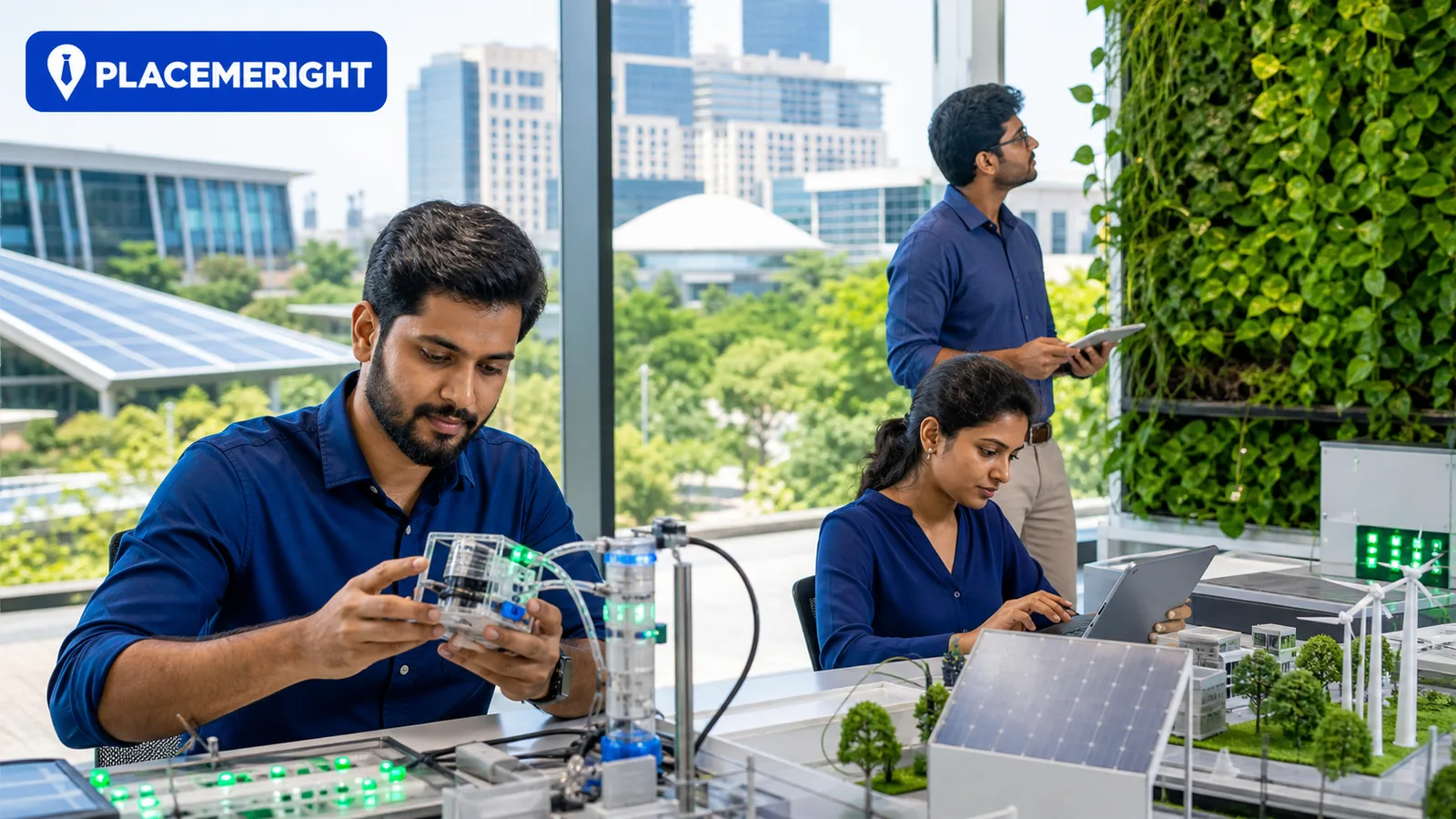
A Bangalore climate-tech company asks for a full-stack engineer who understands IoT, energy, machine learning, carbon accounting, hardware, field deployment, and sustainability.
That description crosses several kinds of truth.
A sensor produces an observation. Firmware and connectivity transport it. Software turns it into a usable record. A model may estimate a condition. An operator may act. A qualified method determines whether the intervention changed energy use, emissions, water, waste, or another physical outcome.
Recruiting should preserve those distinctions.
Build a physical-digital impact chain before sourcing. It links the physical system to measurement, telemetry, data processing, decision logic, operational action, and verified outcome, with an owner and uncertainty statement at every boundary.
Ground the role in Bangalore without exaggeration
Karnataka Digital publishes state technology and startup policy material that includes clean energy, sustainability, climate change, and circular-economy themes. Its recent innovation reporting includes climate tech among Karnataka's startup domains.
This is useful ecosystem context. It is not proof that every Bangalore software engineer has climate-domain experience or that a startup's product creates a particular environmental benefit.
State:
- exact office, laboratory, workshop, test site, plant, customer site, or field base;
- whether work is in Peenya, Electronic City, Whitefield, Mahadevapura, Koramangala, HSR Layout, another Bengaluru area, or outside the city;
- equipment and physical process involved;
- field, travel, shift, weather, and safety conditions;
- remote-access boundaries;
- location of hardware, software, data, operations, energy, sustainability, finance, and verification owners;
- customer industries and operating environments;
- what the employer may measure, claim, control, or only influence.
PlaceMeRight's Bangalore technology recruitment guide covers the wider market. This guide focuses on engineering work where software touches physical and environmental systems.
Define the physical system first
Start with the equipment or process:
- electrical load, generation, storage, or charging;
- heating, cooling, pumping, compressed air, or refrigeration;
- building controls;
- industrial machine or production line;
- fleet, vehicle, or route;
- water treatment or distribution;
- agricultural equipment or controlled environment;
- material recovery, waste handling, or circular workflow;
- supply-chain activity;
- environmental monitoring.
The role should name the physical variables that matter and who understands their engineering meaning.
Draw the physical-digital impact chain
Use nine linked fields.
1. Physical boundary: equipment, site, process, time period, and operating condition. 2. Observation: meter, sensor, manual record, external dataset, or transaction. 3. Telemetry: firmware, gateway, protocol, network, clock, identity, and buffer. 4. Data state: units, quality, transformation, storage, lineage, and correction. 5. Inference: rule, model, baseline, forecast, classification, or optimisation. 6. Decision: recommendation, alert, automated control, or human approval. 7. Action: field, operational, maintenance, commercial, or customer response. 8. Outcome evidence: measured or estimated change with method and uncertainty. 9. Authority: people qualified to approve engineering, safety, accounting, and public claims.
If an employer cannot complete the chain, the vacancy may be combining unresolved product and measurement questions.
Separate engineering role families
Embedded and firmware engineer
Works close to sensors, controllers, device identity, local state, timing, power constraints, updates, and failure recovery.
Hardware or electrical systems engineer
Defines instrumentation, circuits, equipment interfaces, protection, test conditions, and physical safety within their qualified scope.
IoT and edge engineer
Connects devices, gateways, protocols, provisioning, telemetry, commands, and fleet operations. The role should state intermittent-network and field-maintenance realities.
Backend and platform engineer
Builds ingestion, identity, storage, workflows, APIs, observability, and tenant boundaries. Clarify data volume, latency, retention, and control consequence.
Data or machine-learning engineer
Develops quality pipelines, forecasts, anomaly detection, optimisation, or analytical products. Define labels, ground truth, drift, and who interprets results.
Energy or domain engineer
Explains physical behaviour, operating constraints, baselines, intervention logic, and measurement context. Do not replace this authority with a software title.
Product and field-operations engineer
Connects customer workflow, installation, commissioning, support, maintenance, and product feedback. State travel and site conditions early.
Sustainability data or measurement specialist
Works with inventories, activity data, factors, boundaries, methods, assurance, and reporting. Qualified finance, legal, sustainability, engineering, and assurance owners should retain their decisions.
Test the chain with one field scenario
Use an employer-created exercise:
> A product monitors electricity use for distributed cooling equipment and recommends operational changes. Some devices lose connectivity, site staff override settings, and monthly savings vary.
Ask the candidate to:
1. define equipment and time boundaries; 2. identify measured and unmeasured variables; 3. explain meter and sensor quality checks; 4. handle clocks, buffering, gaps, and duplicate telemetry; 5. distinguish observed use from an estimated baseline; 6. record overrides and operational context; 7. define safe recommendation and control boundaries; 8. identify who may approve automation; 9. show how field action is confirmed; 10. describe uncertainty; 11. separate product telemetry from a verified saving; 12. name qualified reviewers.
Different roles will answer different parts. Score the expected scope, not total coverage.
Evaluate field reliability
Climate-tech software often meets dust, heat, moisture, unstable power, intermittent networks, device replacement, calibration drift, manual workarounds, and inconsistent installation.
Ask:
- What state is retained when connectivity fails?
- How are device, sensor, site, and asset identities linked?
- What happens when a reading arrives late or out of order?
- How is a replaced sensor distinguished from a changed physical condition?
- Which faults can be diagnosed remotely?
- What evidence does a field technician need?
- How are firmware and configuration versions recorded?
- Can commands be retried safely?
- What happens when cloud and device state disagree?
- Who decides whether equipment may continue operating?
A cloud architecture diagram alone cannot answer these questions.
Inspect data lineage and units
Give a sample flow from sensor to dashboard.
Ask the candidate to mark:
- original observation;
- timestamp source and time zone;
- physical unit and conversion;
- calibration and quality metadata;
- site, device, and equipment hierarchy;
- filtering and aggregation;
- missing-data treatment;
- manual adjustment;
- external factors;
- model version;
- corrected record;
- retention;
- downstream report or control.
Unit errors and lost operating context can produce plausible but unusable numbers. A strong candidate makes uncertainty visible.
Distinguish estimation from measurement
The Bureau of Energy Efficiency publishes monitoring and verification resources. The Central Electricity Authority maintains the CO2 Baseline Database for the Indian power sector. The GHG Protocol publishes standards and Scope 2 guidance.
These sources illustrate why method, boundary, factor, version, and evidence matter. They do not authorise a recruiter or software engineer to certify an energy saving or emissions statement.
In the hiring brief, label outputs as:
- directly measured;
- calculated from measured inputs;
- modelled or estimated;
- externally sourced;
- user reported;
- verified under a named process;
- not yet suitable for a public claim.
The employer's qualified energy, sustainability, finance, legal, and assurance owners choose applicable methods.
Test model responsibility
For anomaly, forecast, optimisation, or control roles, ask:
- What is the target and ground truth?
- How representative is the training data?
- Which sites or operating states are absent?
- What cost follows a false positive or false negative?
- Can an operator understand the recommendation?
- What guardrail prevents unsafe action?
- How are drift and seasonal change detected?
- What happens when required data is missing?
- Can the system fall back to a safe state?
- Who approves model use and material change?
- How are versions and decisions reconstructed?
Do not accept model accuracy as the only measure.
Separate software security from physical safety
Connected equipment creates overlapping concerns.
Security questions include:
- device identity and provisioning;
- credentials and key rotation;
- signed or controlled updates;
- network and tenant separation;
- command authorisation;
- logs and incident response;
- supplier access;
- secure decommissioning.
Safety questions depend on the actual equipment, environment, standards, and qualified engineering authority. A cybersecurity engineer can identify attack paths, but should not be presented as the person who certifies physical safety.
Assess intervention thinking
Some climate products only measure. Others recommend. Others control.
Ask the candidate to place the product on this ladder:
1. observe; 2. explain; 3. forecast; 4. recommend; 5. request approval; 6. schedule; 7. control within limits; 8. detect exception; 9. restore or stop safely; 10. document outcome.
For every step, record the human, system, and qualified authority.
Evaluate customer economics carefully
A technically possible intervention may fail operationally.
The candidate should ask about:
- installation and commissioning cost;
- device and connectivity maintenance;
- equipment warranty;
- downtime and production constraints;
- operator incentives;
- tariff or contract context;
- customer approval cycle;
- data access;
- persistence of the intervention;
- support burden;
- who receives financial value;
- how uncertainty is communicated.
Recruitment should test commercial awareness without asking the engineer to make finance or legal decisions outside the role.
Source through evidence lanes
Build separate searches for:
- embedded, electronics, and firmware talent;
- electrical, controls, and energy engineers;
- IoT, edge, and device-platform engineers;
- cloud, backend, and data-platform engineers;
- geospatial and remote-sensing specialists where relevant;
- data science, forecasting, and optimisation engineers;
- field deployment and reliability staff;
- product managers with physical-system experience;
- sustainability data and measurement specialists;
- security engineers for connected systems.
Candidates from mobility, industrial automation, building systems, telecom, utilities, manufacturing, logistics, agriculture, and scientific instrumentation may bring transferable evidence.
Calibrate seniority by boundary ownership
Component boundary
Owns a device function, service, pipeline, model, or test within established constraints.
Chain boundary
Connects several stages, diagnoses cross-boundary failure, and coordinates field and software teams.
System boundary
Makes architecture and operating trade-offs across product, equipment, data, security, and support.
Impact boundary
Helps qualified owners define evidence, uncertainty, intervention, and claim controls across customers or programmes.
Do not infer these scopes from years alone.
Build a cross-disciplinary interview
Use:
1. recruiter alignment on worksite, field travel, compensation, notice, and communication; 2. role evidence review; 3. physical-digital impact-chain exercise; 4. domain and software discussion; 5. field reliability or data-quality scenario; 6. safety, security, measurement, product, or commercial review where relevant; 7. final boundary confirmation.
Tell interviewers which decisions they score. No candidate should be expected to impersonate every discipline.
Confirm Bangalore and field feasibility
After capability assessment, confirm:
- exact office, lab, workshop, and field locations;
- frequency and duration of customer-site travel;
- transport of tools or equipment;
- working hours and release windows;
- field safety and access preparation;
- weather and physical conditions;
- remote diagnostic access;
- relocation and hybrid terms;
- candidate-confirmed feasibility.
Residence near Electronic City, Whitefield, Peenya, Mahadevapura, Koramangala, or HSR Layout is not evidence of climate-tech ability.
Quick checklist
- [ ] Name the physical system and operating boundary.
- [ ] State exact Bangalore and field locations.
- [ ] Draw the nine-part physical-digital impact chain.
- [ ] Separate hardware, firmware, IoT, cloud, data, domain, and measurement roles.
- [ ] Define original observations, units, time, and quality metadata.
- [ ] Distinguish measurement, calculation, estimation, and verification.
- [ ] Test intermittent connectivity and field failure.
- [ ] Assess model ground truth, guardrails, and fallback.
- [ ] Separate software security from physical safety authority.
- [ ] Map observe, recommend, approve, control, and restore rights.
- [ ] Define outcome evidence without making unsupported claims.
- [ ] Calibrate seniority by boundary ownership.
- [ ] Confirm field feasibility independently.
- [ ] Recheck current official measurement sources.
Frequently asked questions
Must every climate-tech software engineer have an energy degree?
No. The need depends on the product and role. Software expertise can transfer, but employers should preserve access to qualified physical, energy, safety, and measurement expertise.
Can IoT telemetry prove energy savings?
Telemetry can contribute evidence. A saving depends on boundary, baseline, method, data quality, operating context, and qualified review.
Should a data scientist own carbon accounting?
The data scientist may implement calculations and controls. Applicable methodology, inventory boundary, assurance, finance, legal, and public claims need named qualified owners.
How should employers test field awareness?
Use a scenario with power loss, intermittent connectivity, sensor replacement, manual override, and uncertain ground truth. Ask for diagnosis and safe operating boundaries.
Can PlaceMeRight source beyond Bangalore?
Yes. Searches can include relevant Indian engineering markets where relocation, remote work, and field coverage are feasible. Worksite and travel facts should remain explicit.
Is climate interest enough for hiring?
Interest is useful but not proof. Evaluate evidence in the required engineering boundary and the candidate's ability to work honestly with uncertainty.
Related reading
- Use the Bangalore guide linked earlier for broader city and corridor context.
- Review the employer's physical-system diagrams, instrumentation, data dictionary, model documentation, field procedures, security controls, measurement method, and claims process.
- Recheck Karnataka Digital, BEE, CEA, GHG Protocol, customer-site, and equipment sources before publication.
Conclusion
Climate-tech engineering hiring in Bangalore becomes more rigorous when employers trace the complete path from physical state to claimed outcome.
The physical-digital impact chain shows where hardware, IoT, software, data, models, operations, and qualified measurement meet. It helps employers recruit each discipline for its actual boundary while testing whether candidates can collaborate across the chain and state uncertainty honestly.
This approach cannot certify safety, energy savings, emissions, or environmental impact, and it cannot guarantee a hire. Those decisions remain with qualified owners using applicable methods.
CTA
PlaceMeRight helps Bangalore employers calibrate climate-tech firmware, IoT, platform, data, machine-learning, field, energy-systems, product, security, and measurement-related searches. Share the physical-digital impact chain, exact workplace and field conditions, work arrangement, compensation band, and interview process to begin an employer-side search.
References
1. Karnataka Digital 2. Karnataka Digital: innovation and startup ecosystem 3. Karnataka Digital: Karnataka innovation report 2025 4. Karnataka Digital: state digital-economy policies 5. Bureau of Energy Efficiency: reports and monitoring resources 6. Bureau of Energy Efficiency: monitoring and verification guidelines 7. Central Electricity Authority: CO2 Baseline Database 8. GHG Protocol: Corporate Standard 9. GHG Protocol: Scope 2 Guidance
Related PlaceMeRight resources
Our Tech Recruitment Services by City
Looking to hire vetted software engineers or scale your engineering teams in India's leading tech hubs? Explore our localized recruitment services: