
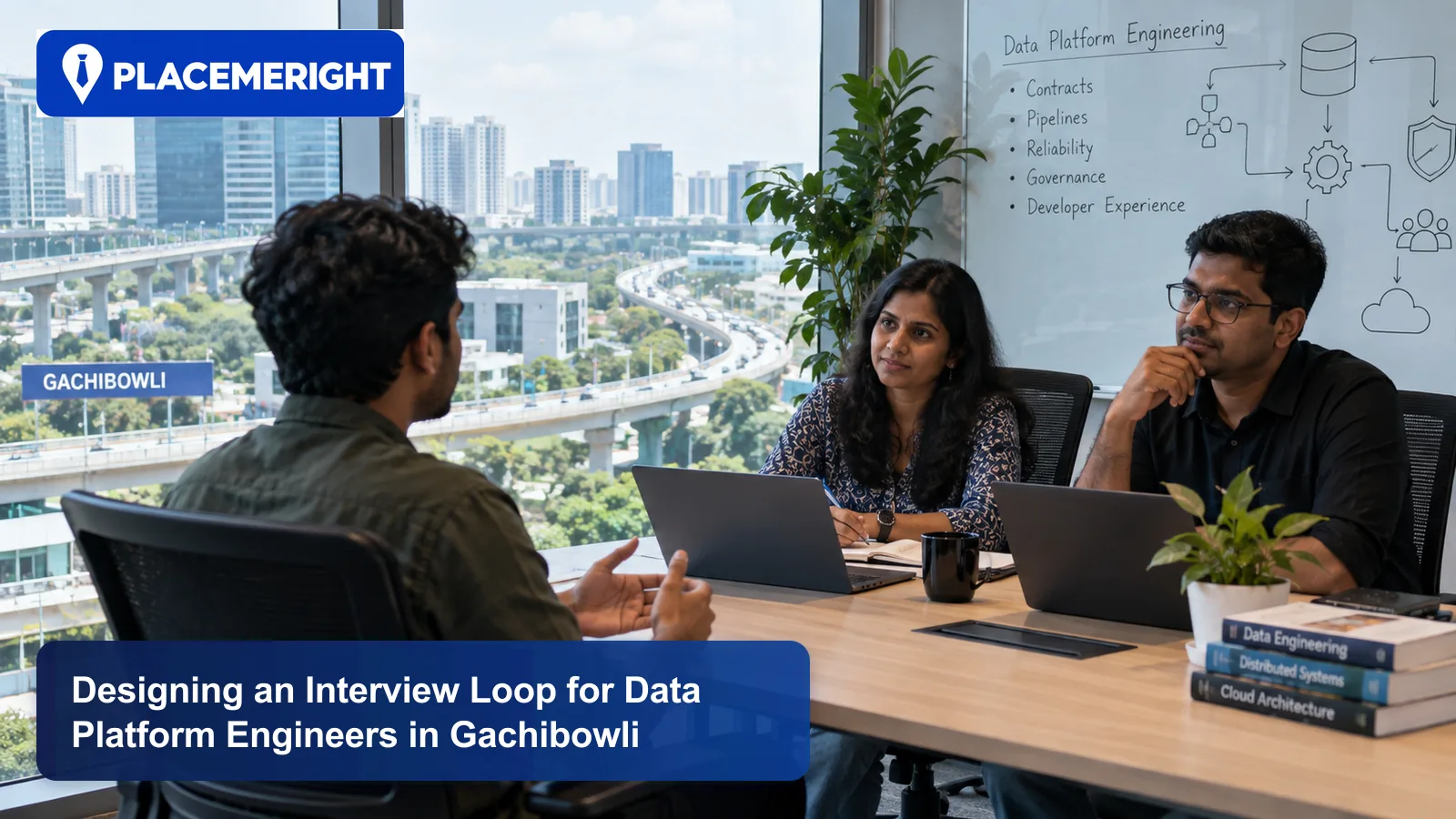
Data platform interviews often become a tour of technologies.
One interviewer asks about Spark. Another asks SQL. A third asks cloud architecture. A fourth asks coding. The panel then tries to convert four disconnected impressions into a hiring decision.
A stronger loop begins with the platform outcome: dependable, governed data that producers can publish and consumers can use without every team rebuilding the same controls.
Establish the current Hyderabad signal carefully
On 28 July 2026, PlaceMeRight reviewed the newest 120 records returned by its Hyderabad live-jobs endpoint. The records were published from 20 to 23 July, and the endpoint reported 1,565 Hyderabad records at collection time.
Use PlaceMeRight's Hyderabad technology recruitment context when turning this observation into a role-specific search.
A conservative title-only filter found 38 records containing data, platform, pipeline, ETL, Spark, cloud, database, analytics, machine learning, DevOps, or reliability terms. The sample included Data Engineer, Data Platform Engineer, Software Engineer - Data Infrastructure, Scala Spark Engineer, Senior Data Engineer, Azure Data Engineer, database administration, cloud, and DevOps titles.
These groups overlap. They are not shares of total demand.
The endpoint reported only Hyderabad, not Gachibowli, Financial District, Nanakramguda, Kondapur, Madhapur, or HITEC City. Compensation and workplace type were unpopulated, while only two records contained experience data.
The sample supports a narrow observation: several platform-adjacent labels appear in recent listings. It cannot show qualified candidate supply, neighbourhood demand, compensation, or role difficulty.
Define data platform engineering before interviewing
A data platform engineer builds capabilities used by other technical or analytical teams.
The role may own:
- ingestion frameworks;
- batch and streaming execution;
- storage and table formats;
- orchestration;
- data contracts and schema evolution;
- metadata and discovery;
- quality and observability;
- access and governance;
- developer tooling;
- cost and capacity;
- incident response;
- platform migration.
That is different from a data analyst producing a business answer, a data scientist developing a model, or an application engineer building a customer feature. The boundaries can overlap, but the primary consumer and outcome should be explicit.
Write one sentence:
> This engineer enables [producer or consumer] to [publish, process, discover, trust, or use data] under [scale, timeliness, governance, and reliability constraints].
If the team cannot complete that sentence, it is not ready to construct the interview.
Use current roles to calibrate the mandate
Current Hyderabad job descriptions show materially different platform problems.
Apple's Data Platform Engineer role, posted on 24 June 2026, seeks experience building large-scale data systems.
Salesforce's Unified Intelligence Platform role describes large-volume data processing and storage with Spark, Trino, Airflow, dbt, notebooks, Iceberg, and metadata tooling. The role can operate as platform, data, backend, DevOps, or support engineering depending on the need.
Cognizant's Hyderabad Data Platform Engineering Lead role connects batch and streaming pipelines, lakehouse architecture, governed data, AI-ready datasets, feature pipelines, and APIs.
McDonald's Data Engineer II role centres a real-time customer data platform, batch and streaming pipelines, audience or segmentation capability, privacy, performance, and global scale.
DAZN advertises an onsite Data Platform Engineer in Hyderabad, while Kantar's Hyderabad Senior Data Engineer listing connects data work to a large analytics business.
These examples do not form one universal Hyderabad stack. They reveal distinct platform consumers and consequences. The employer's loop should test its own combination.
Carry one scenario through five stages
Use an evolving scenario rather than five unrelated tests:
> Several product teams publish customer and operational events. Analytics, machine-learning, and operational users consume them. Producers change schemas independently, one source can replay events, some consumers need near-real-time data, and sensitive fields require restricted use. The current platform has inconsistent freshness, weak ownership, and expensive incident investigation.
Each stage adds information and tests another decision boundary.
Stage 1: contract and data-model discussion
Time: 45 minutes Owner: senior data engineer or platform architect
Give the candidate three example events with inconsistent identifiers and timestamps. Ask how producers and consumers should agree on meaning.
Probe:
- event identity and idempotency;
- event time versus processing time;
- schema ownership and compatibility;
- required and optional fields;
- deletion or correction;
- late and out-of-order events;
- privacy classification;
- documentation and discovery.
Strong evidence includes explicit contracts, versioning choices, consumer communication, and a way to handle invalid data without silently losing it.
Weak evidence includes selecting a storage technology before clarifying semantics.
Do not expect one preferred format. Evaluate whether the candidate makes the contract operable.
Stage 2: batch and streaming system design
Time: 60 minutes Owner: platform engineering lead
Add:
> One consumer needs updates within minutes. Finance-adjacent reporting can wait until the next controlled batch but must reconcile. Producers occasionally replay a day of events.
Ask the candidate to design ingestion, processing, storage, and serving paths.
Evaluate:
| Area | Evidence to seek | | --- | --- | | workload separation | distinguishes latency and correctness needs | | processing semantics | handles duplicates, replay, and late data | | storage | explains partitioning, evolution, and access patterns | | orchestration | identifies dependencies, retries, and backfills | | consumer interface | provides discoverable, stable data products | | trade-offs | states cost, complexity, and operational burden |
The diagram is not the result. The result is a set of reasoned decisions connected to the consumers.
Change one constraint: the volume is lower than expected, but producer quality is worse. See whether the candidate simplifies infrastructure and invests in contracts or validation.
Stage 3: reliability and incident exercise
Time: 45 minutes Owner: data platform or site-reliability interviewer
Provide:
> A dashboard is stale, a model feature is partially updated, and the ingestion service reports success. The incident begins shortly after a producer schema change.
Ask for the first 30 minutes, next two hours, and post-incident actions.
Look for:
- impact and consumer identification;
- freshness, completeness, volume, and distribution signals;
- lineage from consumer back to producer;
- safe containment;
- communication ownership;
- replay or repair criteria;
- validation after recovery;
- change to controls, tests, or observability.
An experienced candidate should separate pipeline health from data health. A successful job can still produce unusable data.
Do not reward a tool-name list. Ask what signal answers each diagnostic question.
Stage 4: governance and platform-product review
Time: 45 minutes Owner: data governance, security, or senior platform partner
Add:
> A new team wants access to sensitive fields for an experiment. The requested dataset combines customer attributes and operational events. The platform has coarse permissions and incomplete usage records.
Ask the candidate to propose an access and enablement path.
Evaluate:
- data classification and purpose;
- least privilege;
- approval and accountable ownership;
- masking, tokenisation, or derived alternatives;
- environment separation;
- audit and access review;
- retention and deletion;
- usability for legitimate consumers;
- escalation when policy is unclear.
This is not a legal examination. The candidate should know when specialist interpretation is required and how platform design can enforce confirmed policy.
Then test product thinking:
- How will producers onboard?
- How will consumers discover trusted datasets?
- What documentation belongs in the workflow?
- Which platform friction is intentional?
- How will adoption and support burden be measured?
A platform with excellent infrastructure but poor developer experience will be bypassed.
Stage 5: focused implementation and review
Time: 60 minutes live or a bounded paid take-home Owner: experienced data engineer
Choose one small task:
- implement a transformation that deduplicates and handles late events;
- review a flawed pipeline pull request;
- design tests for a schema change;
- write a simple contract validator;
- diagnose a provided set of pipeline and data-quality signals.
Provide sample data and clear acceptance criteria.
Score:
- correctness;
- handling of edge cases;
- test quality;
- readability;
- resource awareness;
- assumptions;
- ability to explain a production path.
Do not ask the candidate to build an entire lakehouse. The exercise should confirm implementation judgment left unresolved by the design rounds.
Assign one competency owner
Every scorecard dimension needs one accountable interviewer.
| Competency | Primary stage | Secondary evidence | | --- | --- | --- | | data contracts | 1 | 2 and 5 | | system architecture | 2 | 3 | | batch and streaming reasoning | 2 | 5 | | reliability | 3 | 2 | | governance and security | 4 | 1 | | platform product thinking | 4 | 2 | | implementation quality | 5 | 1 | | communication | all | structured summary |
Interviewers may contribute observations, but the primary owner submits the rating.
This reduces the common outcome where everyone scores "technical depth" while no one owns data contracts or platform adoption.
Define behavioural anchors
Use a four-point scale without a neutral middle.
For data contracts:
- 4: defines ownership, compatibility, validation, documentation, rollout, and failure handling with clear trade-offs;
- 3: covers semantics and evolution with minor gaps;
- 2: identifies schema concerns but leaves ownership or operational handling vague;
- 1: treats the format or table definition as the complete contract.
For reliability:
- 4: connects consumer impact, data-health signals, lineage, containment, repair, validation, and prevention;
- 3: gives a workable diagnosis and recovery path with limited depth in one area;
- 2: focuses mainly on job or infrastructure status;
- 1: restarts components without identifying data impact.
Create anchors for every assessed dimension before opening interviews.
Control interview leakage and inconsistency
Candidates should receive the same base scenario, time, data, and prompt.
Interviewers should use an approved probe list and record which probe was used. Do not make the scenario progressively easier for familiar candidates or harder for candidates whose communication style differs.
Rotate scenario details periodically, but preserve the competencies and difficulty.
Do not score:
- accent;
- familiarity with one employer's internal terminology;
- ability to guess an interviewer-preferred tool;
- unnecessary speed;
- memorised architecture diagrams.
Score observable decisions and explanations.
Include a candidate-facing architecture preview
An interview is also an information exchange.
After the scored portion, explain:
- platform consumers;
- current maturity;
- major constraints;
- ownership boundary;
- team structure;
- on-call expectations;
- planned migrations;
- how governance partners work with engineering;
- which decisions the new hire can influence.
Do not disclose sensitive architecture. Give enough truth for the candidate to evaluate the work.
A role advertised as platform engineering should not later turn out to be ticket-based pipeline support.
Make Gachibowli location claims precise
Official Telangana investment material says IT activity is concentrated in Gachibowli, Madhapur, and Nanakramguda, while the Ranga Reddy district site lists both Financial District, Nanakramguda and an IT park in Gachibowli.
HYSEA's 2025-26 report describes an ecosystem shaped by AI adoption, talent transformation, and collaboration among companies, government, academia, and startups.
That context supports the area's technology relevance. It does not place every Hyderabad role inside Gachibowli.
The employer should state:
- exact office;
- onsite, hybrid, or remote arrangement;
- office days and core hours;
- on-call model;
- where platform consumers and managers sit;
- whether interview rounds are remote or onsite.
Gachibowli, Financial District, Nanakramguda, Kondapur, and HITEC City should not be used interchangeably.
Decide with evidence, not panel enthusiasm
Before debrief, every interviewer submits:
- rating by owned competency;
- behavioural anchor selected;
- observed evidence;
- unresolved concern;
- confidence level;
- whether another round is genuinely necessary.
Begin the debrief with evidence, not a vote.
Resolve contradictions by returning to the scenario. One interviewer may have seen strong architecture while another found weak data contracts. Both can be true, and the role's weighting should determine the decision.
Do not add rounds because the panel failed to define the signal in advance.
Quick checklist
- Define the platform consumer and outcome.
- Use one evolving scenario across five stages.
- Test contracts before architecture.
- Separate data health from pipeline health.
- Include governance and developer experience.
- Keep coding bounded and job-relevant.
- Assign one owner per competency.
- Write behavioural anchors before interviewing.
- Give candidates the same base prompt and probes.
- State the exact Hyderabad workplace and on-call model.
- Debrief from recorded evidence.
Frequently asked questions
How many interview rounds should a data platform engineer complete?
Five stages do not require five separate days or panels. Some can be combined. Preserve the evidence areas while keeping the candidate journey proportionate to role seniority.
Should every candidate know Spark?
Only if Spark is a real day-one requirement. Test transferable distributed-data reasoning separately from tool familiarity and state which knowledge can be learned.
Is SQL enough for the implementation round?
It may be, depending on the role. A focused transformation, contract, test, or diagnostic exercise can be more relevant than a general algorithm problem.
How should we assess cloud experience?
Test decisions about managed services, identity, networking, reliability, cost, and operations in the employer's context. Cloud certification or vocabulary alone is insufficient.
Should governance be evaluated by a compliance specialist?
A qualified governance or security partner can improve the round. Keep the task focused on engineering collaboration and enforcement of confirmed controls, not legal interpretation.
Does a Gachibowli role require candidates already living nearby?
No. State the exact workplace and schedule, then assess commute or relocation feasibility individually. Do not infer willingness from a current address.
Related reading
- Hire data engineers
- Hire data and engineering professionals
- Explore PlaceMeRight technical recruitment
- Discuss a Hyderabad data hiring requirement
Conclusion
A data platform interview should behave like the platform itself: connected, observable, and built around consumers.
One scenario carried through contracts, architecture, reliability, governance, product adoption, and implementation produces a more coherent decision than a stack of unrelated technical rounds.
For Gachibowli employers, the additional discipline is local truth: use Hyderabad's technology-corridor context, but describe the actual workplace and role without assigning unsupported neighbourhood labels.
CTA
PlaceMeRight helps Hyderabad employers calibrate data-platform roles, source relevant profiles, design evidence-based scorecards, and coordinate structured technical interviews.
Share your data platform engineer hiring brief
References
- Invest Telangana: IT and ITeS sector
- Ranga Reddy District: industry areas including Financial District and Gachibowli IT Park
- HYSEA Annual Report 2025-26
- Apple Careers: Data Platform Engineer, Hyderabad
- Salesforce Careers: Big Data and Distributed Systems, Hyderabad
- Cognizant Careers: Data Platform Engineering Lead, Hyderabad
- McDonald's Careers: Data Engineer II, Hyderabad
- DAZN Careers: Data Platform Engineer, Hyderabad
- Kantar Careers: Senior Data Engineer, Hyderabad
Related PlaceMeRight resources
Our Tech Recruitment Services by City
Looking to hire vetted software engineers or scale your engineering teams in India's leading tech hubs? Explore our localized recruitment services: