
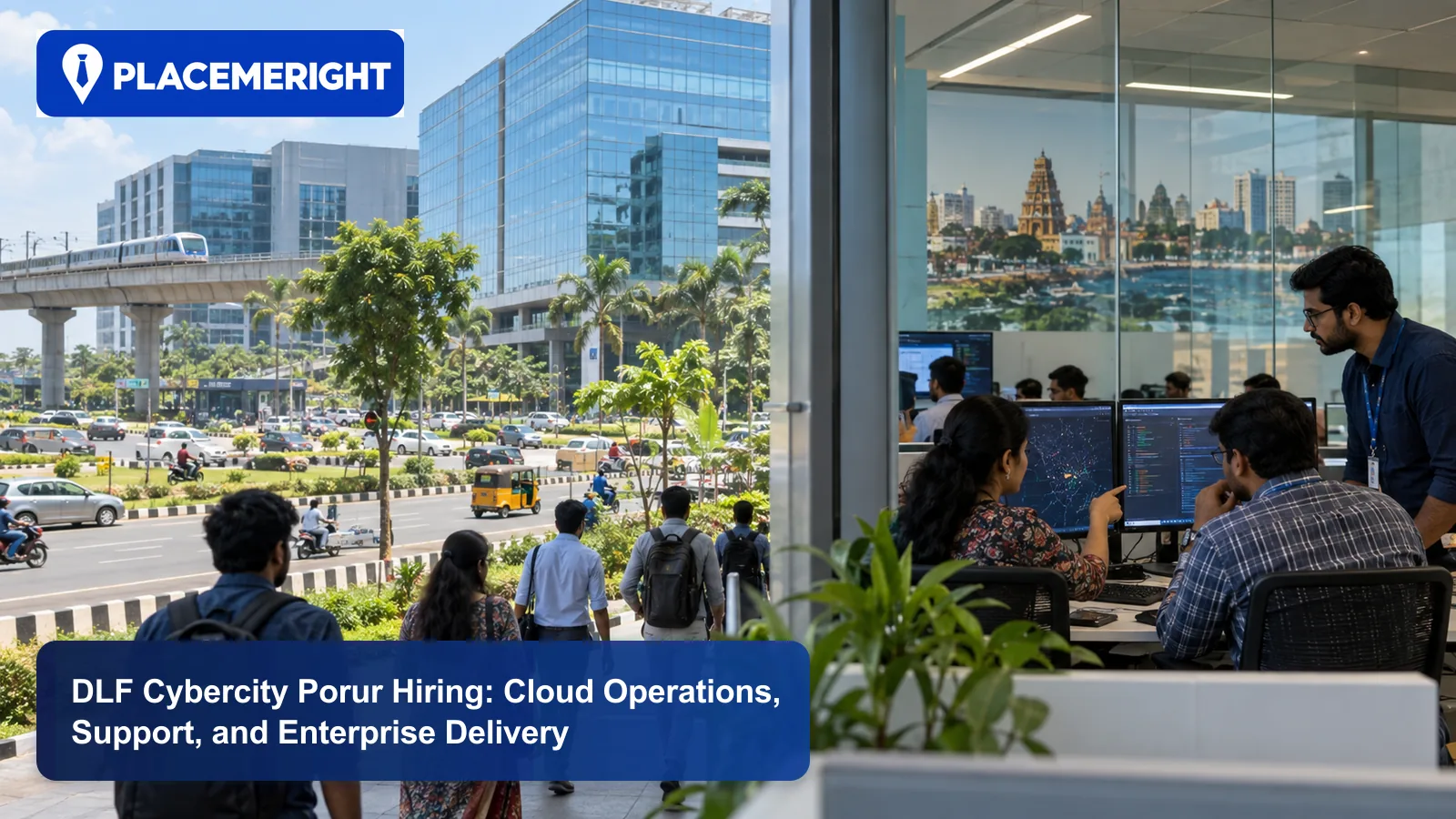
Enterprise technology is not complete when a cloud environment is provisioned or an application is released.
It must be operated.
Users need support, incidents need control, changes need evidence, clients need accurate communication, and recurring failure needs a route into engineering improvement. Around DLF Cybercity Porur, employers often hire these responsibilities under overlapping labels such as cloud engineer, application support analyst, operations lead, DevOps engineer, or service-delivery manager.
The title matters less than the operating loop the person will own.
Verify the Porur-Manapakkam context
DLF's official property page places DLF Cyber City Chennai in Manapakkam off Mount Poonamallee Road. It describes a large integrated office campus serving enterprise occupiers and states that a metro shuttle is available from Alandur.
Chennai Metro's official feeder-service page lists an Alandur-to-DLF Cybercity, Ramapuram connection, while its earlier press release describes the last-mile collaboration for staff and clients working at the Porur IT park.
These sources establish the workplace and transport service. They do not prove a candidate's personal commute, the number of open roles, or the current hiring plan of every campus occupier.
Current Chennai roles provide city-wide technical evidence. HCLTech describes cloud operations with infrastructure as code, automation, monitoring, troubleshooting, incident response, service-level commitments, and continuous improvement. Capgemini's current Chennai engineering role includes large-scale network operations, telemetry, automation, Linux, cloud-native monitoring, security, and performance.
Use PlaceMeRight's Chennai technology recruitment context for the broader search. State whether the office is DLF Cybercity in Manapakkam, Porur, Ramapuram, Guindy, Alandur, another Chennai technology corridor, or remote.
Model the work as six operating loops
Each loop produces a different outcome.
Loop 1: restore
The restore loop returns an affected service to an acceptable state.
Work can include:
- impact confirmation;
- alert and case intake;
- fault isolation;
- safe intervention;
- failover or rollback;
- user communication;
- recovery validation;
- incident timeline.
The person needs clear authority. A role that is accountable for recovery but cannot access evidence or invoke an approved action is structurally weak.
Loop 2: operate
The operate loop keeps the service healthy during normal conditions.
Work may include:
- monitoring;
- capacity;
- patching;
- certificate and secret lifecycle;
- job and integration checks;
- access;
- backup;
- routine automation;
- service requests;
- operational documentation.
Measure the role by stable, visible service health, not the volume of manual tasks completed.
Loop 3: change
The change loop introduces new or corrected behaviour.
Work may include:
- requirement clarification;
- design;
- infrastructure as code;
- application or configuration change;
- testing;
- migration;
- deployment;
- rollback;
- production verification.
Cloud operations and application teams need a shared change contract. Neither should discover a critical dependency during release.
Loop 4: assure
The assure loop creates evidence that the service meets defined expectations.
Work may include:
- automated testing;
- security control validation;
- performance;
- recovery exercise;
- audit evidence;
- configuration compliance;
- data reconciliation;
- service-level measurement.
Assurance is not paperwork after the work. It is the mechanism that makes risk visible before and after change.
Loop 5: govern
The govern loop aligns technology operation with business and client commitments.
Work can include:
- priority;
- service review;
- risk acceptance;
- client communication;
- supplier coordination;
- change calendar;
- continuity;
- escalation;
- decision records.
Governance should produce decisions and ownership. A weekly deck without changed action is reporting, not control.
Loop 6: improve
The improve loop removes recurring cost, delay, failure, or user friction.
Work may include:
- problem analysis;
- automation;
- platform standardisation;
- self-service;
- architectural correction;
- observability;
- runbook elimination;
- product feedback;
- operating-model redesign.
This loop turns operations into engineering evidence.
Place each role in a primary loop
Cloud operations engineer
Primary loop: operate.
Common adjacent loops: restore, change, assure, and improve.
Define:
- cloud and platform scope;
- infrastructure as code;
- monitoring;
- automation;
- on-call;
- security controls;
- capacity;
- recovery;
- application-team interface.
"AWS experience" does not explain whether the person designed a platform, administered workloads, handled incidents, or only consumed services.
Application support engineer
Primary loop: restore.
Common adjacent loops: operate, change, and improve.
Define:
- application and business process;
- support tier;
- data and integration access;
- configuration authority;
- code expectation;
- shift;
- stakeholder group;
- problem ownership.
Ask what the candidate changed after the incident, not only how quickly they closed the case.
DevOps or release engineer
Primary loop: change.
Common adjacent loops: operate, assure, and improve.
Define:
- users of the delivery platform;
- pipelines;
- environment and configuration;
- deployment method;
- approval;
- test evidence;
- rollback;
- release telemetry.
Avoid using DevOps as a catch-all for every task between code and cloud.
Quality or assurance engineer
Primary loop: assure.
Common adjacent loops: change, restore, and improve.
Define:
- risk model;
- automation;
- integration and performance depth;
- environment;
- test data;
- release authority;
- production feedback;
- security or compliance interfaces.
Service-delivery lead
Primary loop: govern.
Common adjacent loops: restore and improve.
Define:
- service and client boundary;
- technical decision rights;
- teams and suppliers;
- commitments;
- incident role;
- risk;
- change;
- improvement backlog.
The candidate should be able to translate between business consequence and technical choice.
Reliability or platform lead
Primary loop: improve.
Common adjacent loops: operate, restore, change, and assure.
Define:
- reliability objective;
- current failure pattern;
- platform users;
- automation authority;
- incident data;
- architecture influence;
- adoption responsibility;
- measurable operating change.
Create one operating charter for every opening
Use seven fields.
1. Service: the business or customer capability. 2. Primary loop: restore, operate, change, assure, govern, or improve. 3. Protected outcome: availability, correctness, security, recoverability, or user completion. 4. Decision rights: actions the person may take. 5. Interfaces: application, cloud, security, QA, business, client, and vendor teams. 6. Operating schedule: office hours, shifts, on-call, releases, and critical periods. 7. Evidence: how good work is demonstrated.
Example:
> Own operation and recovery of a customer identity service on Azure. Automate environment changes, maintain service telemetry, join the on-call rotation, and partner with application and security engineers on release and problem removal. Prove recovery through user-path tests and event reconciliation.
The charter limits keyword inflation.
Use one failed cloud migration in the interview
Give all candidates the same scenario:
> An enterprise document service was moved from virtual machines to a managed container platform. Two days later, some users can upload files but cannot retrieve them. Health checks are green. A storage access policy changed during migration, one background worker still uses an older credential, and support has advised users to retry. The client has a regulatory submission later that day.
Restore loop questions
- Which users and documents may be affected?
- What does successful upload actually prove?
- Which immediate workaround is safe?
- What evidence must be preserved?
- How will recovery be confirmed?
Operate loop questions
- Which service-level and dependency signals were missing?
- How should credential and policy lifecycle be monitored?
- What routine control could have exposed the mismatch?
- Which runbook action is appropriate?
- What remains unsafe after a partial recovery?
Change loop questions
- Which migration assumptions need review?
- How should identity and storage access be tested before cutover?
- Is rollback possible without losing new documents?
- How will configuration drift be controlled?
- What release evidence should become mandatory?
Assure loop questions
- Which user journeys and failure modes were absent from testing?
- How should old and new credentials be represented?
- Which security and recovery tests matter?
- How will affected documents be reconciled?
- What proof supports client sign-off?
Govern loop questions
- Who owns the incident decision?
- What should the client be told now?
- Which submission risk needs business input?
- Who may accept a temporary exception?
- When should the next update occur?
Improve loop questions
- Which repeated manual step should disappear?
- What platform guardrail would prevent incompatible access?
- How should observability follow the user transaction?
- Which ownership gap allowed the old credential to persist?
- How will teams adopt the change?
The candidate's primary loop should be deep, but they should recognise the others.
Add a correction challenge
Reveal that failed retrievals affect files above a particular size because those uploads take a different asynchronous path.
Ask the candidate to revise:
- impact scope;
- technical hypothesis;
- evidence request;
- containment;
- test plan;
- client message;
- reconciliation.
Good enterprise operators update their model when evidence changes.
Inspect proof from past work
Ask the candidate for one service change or incident and trace:
1. user or client consequence; 2. system boundary; 3. evidence gathered; 4. decision personally owned; 5. action; 6. proof of recovery or delivery; 7. lasting operating change.
Then ask:
- Which team disagreed?
- Which risk remained?
- What was automated later?
- What would you do differently?
The response should expose judgement, not only process compliance.
Score operating maturity
Service consequence
- 4: connects technical state to user, business, control, and client outcomes;
- 3: defines the primary service impact;
- 2: discusses component health without the service;
- 1: treats the ticket as the outcome.
Evidence and diagnosis
- 4: traces identity, events, state, dependencies, changes, and user proof;
- 3: reaches a sound diagnosis with a minor gap;
- 2: gathers broad telemetry without a clear hypothesis;
- 1: relies on restart, retry, or assumption.
Controlled action
- 4: balances containment, authority, evidence, rollback, recovery, and communication;
- 3: chooses a defensible action with one limited control gap;
- 2: proposes change before defining consequence;
- 1: acts outside authority or avoids ownership.
Improvement
- 4: removes a recurring failure through automation, design, observability, or ownership change;
- 3: proposes one practical preventive improvement;
- 2: updates documentation only;
- 1: normalises recurring manual recovery.
Record evidence before panel discussion.
Build separate sourcing lanes
Use distinct searches for:
- cloud operations and platform administration;
- application and product support;
- DevOps, release, and infrastructure automation;
- QA, reliability, and assurance;
- service delivery and technical operations leadership;
- platform or reliability improvement.
For every profile, tag:
- primary loop;
- adjacent loops;
- technology environment;
- business or client context;
- operating schedule;
- decision authority;
- production evidence.
This prevents a large application-support pool from being mistaken for a cloud-platform shortlist.
State the workplace operating reality
DLF Cybercity Chennai is in Manapakkam and is commonly associated with Porur and Ramapuram. Those labels should not replace the full office address.
Tell candidates:
- building or campus entry;
- office days;
- shift and client hours;
- on-call;
- release windows;
- transport or shuttle arrangements;
- travel to Guindy, Taramani, OMR, or another site;
- production-access restrictions;
- whether the schedule is approved and stable.
The official feeder connection is useful information. It is not a promise that every route or shift will be convenient.
Use onboarding to create one operating review
During the first 45 days, give the hire one service and ask for:
1. a six-loop ownership map; 2. three current operating risks; 3. one evidence gap; 4. one bounded improvement; 5. a recovery or release proof; 6. an operating review with decisions, owners, and dates.
The manager should provide incident history, service commitments, architecture, access, current runbooks, and named application, cloud, security, QA, and business partners.
Review whether the new hire reduces ambiguity and manual dependence.
Quick checklist
- Verify the DLF Cybercity Manapakkam worksite.
- Assign the role to one primary operating loop.
- Define the service and protected outcome.
- State decision rights and adjacent team interfaces.
- Separate cloud operations, support, release, assurance, governance, and improvement.
- Use one failed cloud migration across the panel.
- Change a material fact and require a revised plan.
- Score consequence, evidence, controlled action, and improvement.
- Disclose shifts, on-call, office days, release windows, and site restrictions.
- Build one decision-led operating review during onboarding.
Frequently asked questions
Is cloud operations the same as DevOps?
No. Cloud operations may focus on runtime health, access, capacity, patching, incidents, and recovery. DevOps may describe delivery practices and automation. Define services and authority.
Should application support engineers be able to code?
Only when the role requires software or automation changes. Every support engineer should still reason from application and data evidence, preserve state, and create useful escalation.
Is Porur the official address of DLF Cybercity Chennai?
DLF identifies the campus as Manapakkam off Mount Poonamallee Road. Recruitment communication should use the full worksite while acknowledging commonly used locality references.
Do Chennai-wide roles prove hiring inside DLF Cybercity?
No. They show current city-level work patterns. Attribute a role to the campus only when the employer verifies its location.
How can a service-delivery interview remain technical?
Use a real service incident. Ask the candidate to define impact, technical evidence, decisions, risk, client communication, recovery proof, and systemic improvement.
Should every operations role include night shifts?
No. Coverage depends on the service and client model. State exact hours, rotation, transport, on-call, and escalation support before outreach.
Related reading
- Hire cloud, support, reliability, and delivery professionals
- Explore PlaceMeRight technical recruitment
- Discuss a DLF Cybercity Porur hiring brief
Conclusion
DLF Cybercity Porur hiring becomes more useful when employers define the operating loop rather than expanding the title.
Clarify who restores, who operates, who changes, who assures, who governs, and who improves the enterprise service.
Then test each candidate on the evidence and authority required by that loop.
CTA
PlaceMeRight helps Chennai employers calibrate cloud operations, application support, DevOps, QA, reliability, and enterprise-delivery roles around real service outcomes.
Share your DLF Cybercity Porur technology requirement
References
- DLF Offices: DLF Cyber City Chennai in Manapakkam
- DLF Offices: Chennai office portfolio context
- Chennai Metro: current feeder services to DLF Cybercity
- Chennai Metro: Alandur-to-DLF Cybercity last-mile service
- HCLTech Careers: current Chennai AWS cloud-operations leadership role
- HCLTech Careers: Chennai cloud automation and support operations
- Capgemini Careers: current Chennai network operations and cloud-native monitoring role
Related PlaceMeRight resources
Our Tech Recruitment Services by City
Looking to hire vetted software engineers or scale your engineering teams in India's leading tech hubs? Explore our localized recruitment services: