
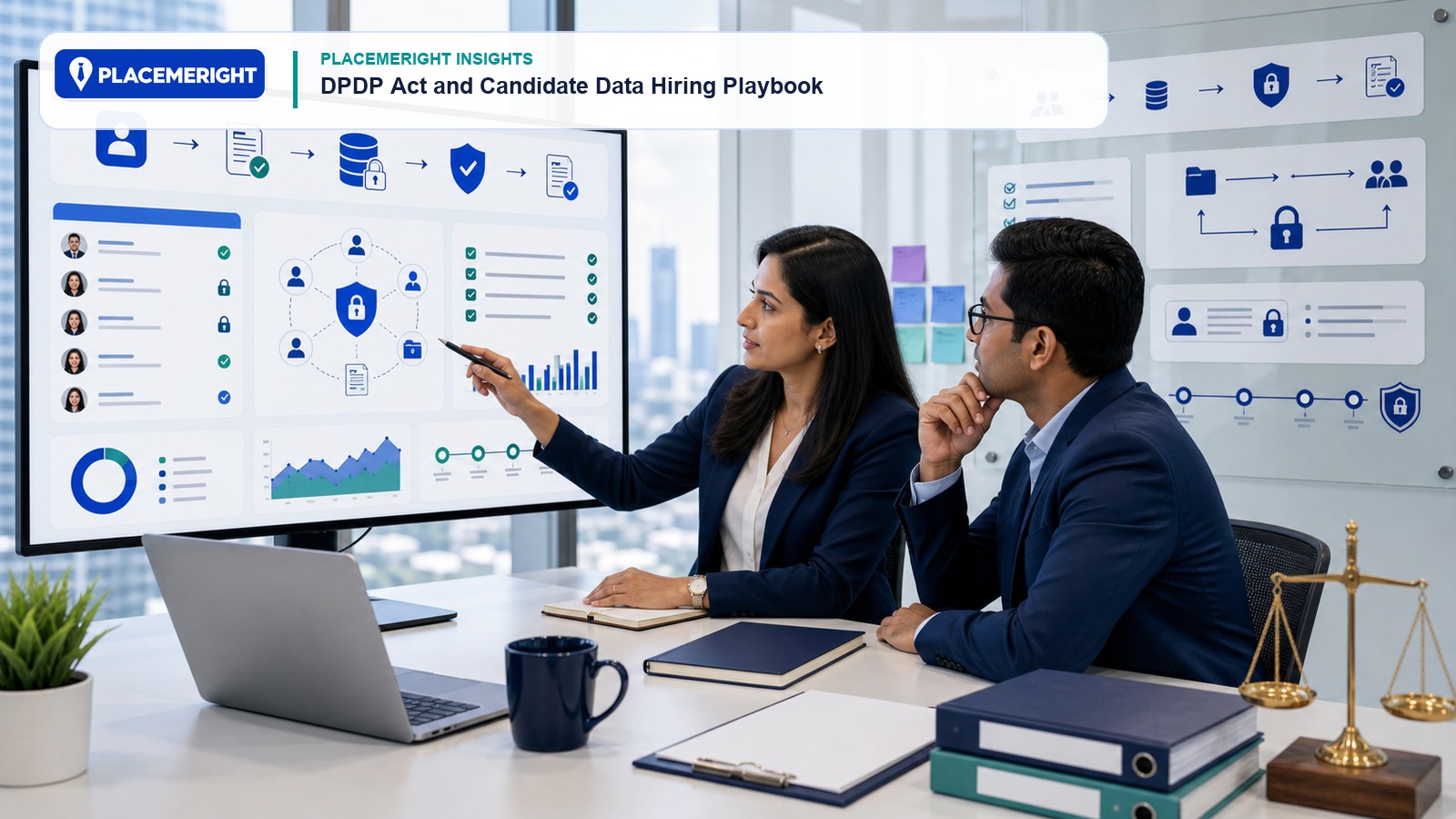
Why candidate data is a real operational risk in 2026
Recruitment is one of the most data-heavy business processes:
- resumes, phone numbers, emails, location
- interview notes and assessments
- compensation expectations and offers
- reference checks and background verification data
- vendor handoffs across ATS, spreadsheets, emails, messaging apps
That footprint creates privacy and security risk if you don’t have clear process controls. Multiple industry discussions have highlighted that organizations often focus on surface-level compliance artifacts but underestimate the operational changes needed for DPDP-style obligations.
This playbook is written for founders, HR leaders, and TA managers in India—and for any technical recruitment agency in India working as a hiring partner.
A simple way to think about DPDP in recruitment
You don’t need to be a lawyer to improve your posture. In hiring, focus on these practical principles:
1. Purpose clarity: collect only what you need for hiring decisions. 2. Transparency: candidates should understand what you collect and why. 3. Access control: reduce “everyone can see everything” data sharing. 4. Retention discipline: don’t store candidate data forever “just in case.” 5. Vendor accountability: your partners handle data on your behalf.
The hiring data lifecycle (map it before you fix it)
Most hiring teams don’t know where candidate data lives. Start with a mapping exercise:
- inbound: careers page, LinkedIn, referrals, agency submissions
- storage: ATS, drive folders, spreadsheets, inboxes
- evaluation: interview notes, scoring sheets, coding platforms
- offers: compensation docs, ID proofs (if collected), joining paperwork
- post-close: retention and deletion processes
If you use a premium IT recruitment agency in India, align on what gets shared, how it’s shared, and how long it’s retained.
Practical controls (high impact, low friction)
1) Standardize candidate notice + consent language (where needed)
Ensure candidates see a short, readable notice covering:
- what you collect
- why you collect it
- who you share it with (processors/vendors)
- how long you retain it
- how to request deletion or correction (operationally, via HR/TA)
2) Reduce “resume forwarding” across inboxes
Move agency submissions and referrals into one controlled system:

- ATS or a controlled intake form
- avoid spreadsheet sprawl
- avoid uncontrolled email chains
3) Lock down interview notes
Interview notes often contain sensitive personal data. Use:
- role-based access
- standardized scorecards
- minimal free-text fields
4) Define retention windows
Create practical retention tiers:
- rejected candidates: retain for a defined period, then delete/anonymize
- active pipeline candidates: retain until role closes + defined window
- hired candidates: move required data to HR systems; delete duplicates
5) Vendor and agency contracts matter
Even if primary obligations sit with the hiring company, processors and vendors face contractual and commercial accountability. Treat your recruitment partners as part of your privacy perimeter.
Operationally, agree on:
- what data the agency can store
- secure transmission methods
- deletion timelines
- incident notification expectations
Quick checklist (copy/paste)
Use this as a lightweight standard for your TA/RPO team before you start interviews:
- Confirm the role charter (outcomes, scope, stakeholders).
- Define 5–7 signals to test (must-haves vs trainable).
- Run a structured loop (same questions, same scoring).
- Use a scorecard with clear pass/fail thresholds.
- Communicate timelines and feedback windows at every stage.
- Track funnel metrics (time-to-interview, pass-through, offer acceptance).
- Close with a crisp offer narrative and joining plan.
FAQs
Does DPDP compliance affect hiring partners and recruitment agencies?
Yes—practically. Even where legal liability concentrates on the primary entity, hiring partners operate under contracts, audits, and commercial consequences. Strong data handling becomes a differentiator.
What’s the fastest way to reduce risk?
Map your data flow, standardize intake, control access to interview notes, and set retention windows. Most risk comes from uncontrolled sharing and indefinite storage.
Conclusion
The best hiring outcomes come from operational clarity: define what good looks like, use a structured interview loop, and evaluate candidates with scorecards instead of gut feel. When you communicate timelines clearly and track a few funnel metrics (speed, pass-through rates, and offer acceptance), you reduce drop-offs and hire faster without lowering the bar.
If you want help calibrating the role, tightening the screening, and improving shortlist quality for tech hiring in India, a specialist hiring partner can run this process end-to-end.
CTA (PlaceMeRight)
PlaceMeRight supports tech hiring in India with structured processes—not just sourcing. If you want a hiring partner that respects candidate trust and operational discipline, we can help.
- Talk to us: `/contact/`
- Trust markers: `/credentials/`
- Hiring support: `/it-recruitment-agency-india/` and `/tech-recruitment/`
References
- Economic Times: DPDP Act rollout exposing compliance gaps (Feb 2026): https://m.economictimes.com/tech/technology/dpdp-act-phased-rollout-exposing-compliance-gaps-privacy-experts/amp_articleshow/128387324.cms
- Times of India: Data processors accountability under DPDPA (Mar 2026): https://timesofindia.indiatimes.com/technology/tech-news/the-hidden-accountability-why-data-processors-must-take-dpdpa-seriously/articleshow/129501707.cms
- Economic Times: IT companies aligning compliance architecture with DPDP (Jun 2026): https://m.economictimes.com/tech/technology/it-companies-fast-aligning-compliance-architecture-with-dpdp-enroute/articleshow/130806263.cms
Related PlaceMeRight resources
Our Tech Recruitment Services by City
Looking to hire vetted software engineers or scale your engineering teams in India's leading tech hubs? Explore our localized recruitment services:
Tags: