
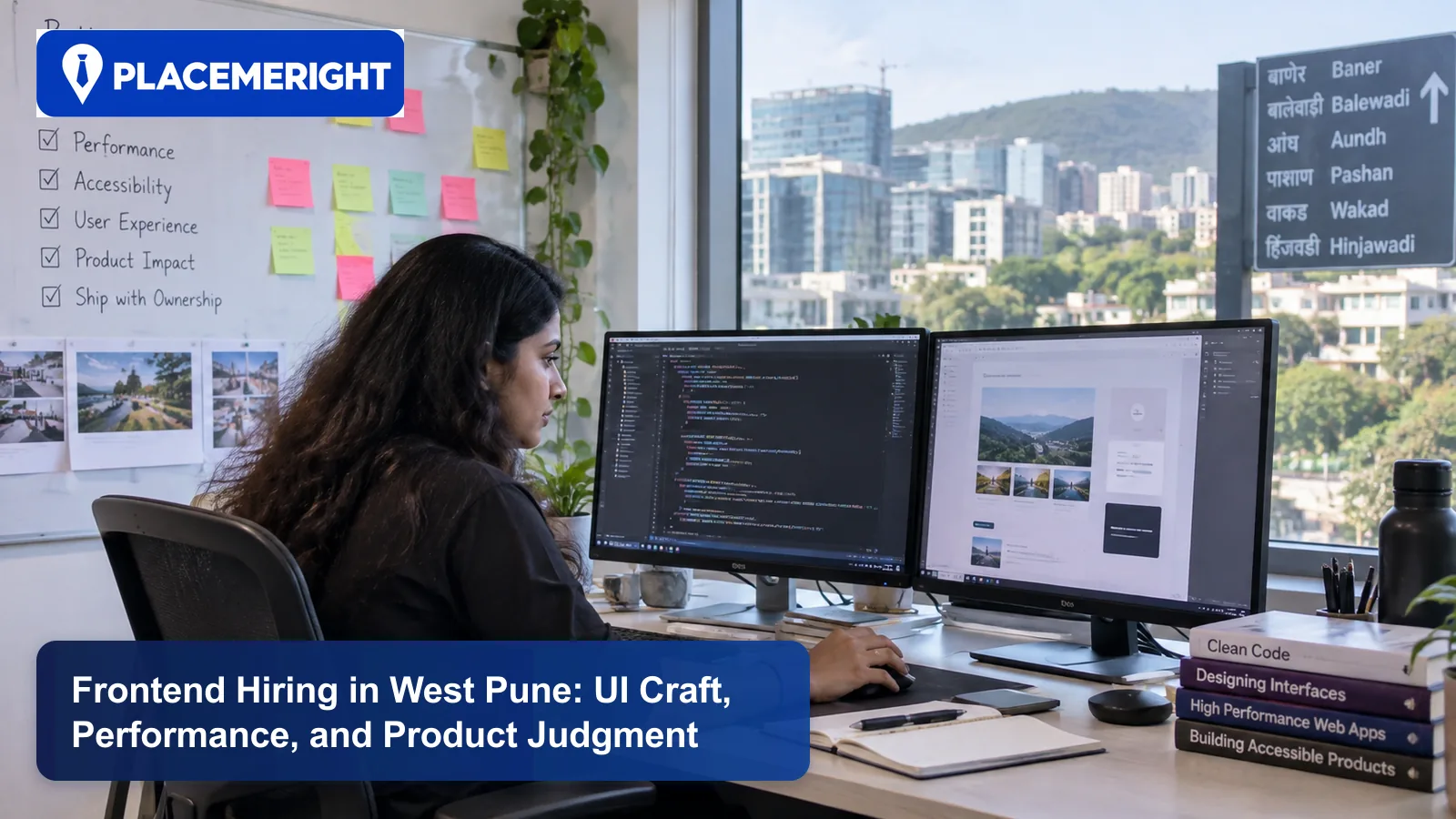
Frontend hiring becomes unreliable when employers compress three different capabilities into one framework keyword.
The first is interface craft: translating design intent into responsive, accessible, maintainable interaction. The second is browser engineering: controlling loading, rendering, state, network behaviour, and runtime performance. The third is product judgement: deciding what should happen when requirements, data, devices, and user behaviour do not match the happy path.
A React developer may be strong in one, two, or all three. A polished portfolio does not prove production performance. A difficult coding exercise does not prove interface judgement. A candidate who knows every optimisation term may not be able to decide which user problem deserves attention.
That matters for employers across Baner, Balewadi, Aundh, Pashan, Wakad, Hinjawadi, and the wider west Pune corridor. Product companies, SaaS teams, services businesses, financial-technology groups, analytics products, and enterprise operations can all use similar frontend stacks while expecting different ownership.
Cushman & Wakefield reported 3.22 million square feet of Pune office leasing in Q2 2026 and identified PBD West among the city's leading office-activity zones. PMRDA describes Metro Line 3 as a 23.203-kilometre, 23-station connection from the Hinjawadi technology area toward Shivajinagar. These facts help explain the corridor's business and mobility context; they do not measure the supply of frontend engineers.
For the wider hiring market, use PlaceMeRight's Pune technology recruitment guide. This article focuses on how to assess frontend ownership.
A current Pune sample shows varied frontend role labels
PlaceMeRight reviewed the first 120 records returned by its Pune live-job feed on 27 July 2026. The records were dated 20 to 23 July. A title-and-tag scan identified 21 records using frontend, front-end, React, Angular, Vue, or UI-developer language. Seven used mobile terms, and 101 used broader software-engineer, developer, or product-engineering language.
These groups overlap. A full-stack role can be counted as frontend and broader engineering, and the data is Pune-wide rather than West Pune-specific. Titles cannot show whether a role prioritises craft, performance, or product judgement. The figures are directional, not vacancy shares.
Representative titles included Lead Frontend Developer, Senior Frontend Developer, Web Developer, React and Node.js Full Stack Engineer, and React Native Engineer. That variety is the reason to define the work before choosing a title.
Use the product surface to define the role
Different interfaces create different frontend risks.
| Product surface | Primary risk | Evidence to seek | | --- | --- | --- | | SaaS administration | complex state and permissions become confusing | information architecture, forms, tables, access states, maintainability | | Consumer web product | slow or unstable experience loses users | loading, rendering, mobile networks, telemetry, experiments | | Data or analytics interface | users misread dense or delayed information | visual hierarchy, data states, filtering, accessibility, performance | | Commerce workflow | friction or failure interrupts conversion | forms, validation, recovery, payments, analytics | | Enterprise application | variation and long-lived workflows create complexity | component systems, role-based UI, backward compatibility, testing | | Marketing and content platform | authoring and discoverability degrade | rendering strategy, content model, performance, SEO fundamentals |
The job description should name the dominant surface and its failure. "Build responsive web applications" is too vague to guide sourcing or interviews.
UI craft is engineering work
Craft is not the ability to reproduce a screenshot at one viewport. It includes:
- responsive layout under realistic content;
- typography and spacing consistency;
- keyboard and focus behaviour;
- accessible names, states, and contrast;
- loading, empty, error, and permission states;
- motion that clarifies rather than distracts;
- reusable components without premature abstraction;
- collaboration with design when the specification is incomplete.
Give the candidate a small interface with awkward conditions: a long company name, a translated label, a slow response, a validation error, a keyboard-only user, and a narrow screen. Ask what changes.
The useful signal is not visual perfection during an interview. It is the candidate's ability to find design assumptions, preserve hierarchy, and explain implementation trade-offs.
Performance should connect to user experience
The Web Vitals initiative defines user-centred measures for loading, responsiveness, and visual stability. Employers do not need candidates to recite metric thresholds from memory. They need engineers who can connect a poor user experience to measurable browser behaviour.
Assess:
- JavaScript loading and execution;
- image and font strategy;
- rendering and hydration choices;
- caching and network waterfalls;
- state updates and unnecessary rendering;
- long tasks and interaction delay;
- layout shifts;
- third-party scripts;
- list and data-grid behaviour;
- performance measurement in production.
Use a scenario in which a dashboard looks fast on a developer laptop but becomes slow for users on mid-range devices and office VPNs. Ask how the candidate would collect evidence, form hypotheses, test changes, and protect against regression.
A candidate who immediately proposes a complete framework rewrite may be missing the diagnostic step.
Accessibility belongs in the delivery definition
Accessibility is not a final audit performed after the interface is complete. It affects semantics, interaction, focus, forms, error communication, colour, media, and testing.
The W3C Web Content Accessibility Guidelines provide a shared standard, but hiring should examine application rather than certification vocabulary.
Ask the candidate to review:
- a custom dropdown;
- a modal;
- a validation summary;
- a data visualisation;
- a live status update.
For each, ask how a keyboard user and assistive technology would understand and operate it. Then ask what should be covered by static checks, automated tests, component tests, and manual review.
Do not assign accessibility only to design or QA. A frontend engineer owns much of the implemented behaviour.
Product judgement appears in edge decisions
Product judgement does not mean the engineer replaces the product manager. It means the engineer understands user intent and can identify consequences before coding.
Look for candidates who ask:
- Who is the user and what decision are they making?
- Which state is irreversible?
- What happens with partial or stale data?
- Which permission or privacy boundary applies?
- How should the interface recover?
- What should be measured after release?
- Is the requested interaction consistent with the rest of the product?
Use an ambiguous prompt rather than a finished specification. Score the questions, assumptions, and decisions. A senior engineer should improve the problem definition, not merely produce more code.
Translate West Pune locations into workplace facts
Baner and Balewadi
Baner and Balewadi include offices, coworking, product businesses, and links toward Hinjawadi. An employer should state whether the vacancy belongs to a product, design-system, frontend-platform, or full-stack setting rather than infer skill from the locality.
State the exact office point, usual hours, and office days in the first conversation. Neither a nearby address nor a route on a map proves that the arrangement works for a particular candidate.
Metro and road projects can change accessibility over time. Use current official transport information when publishing or updating a vacancy, and ask candidates about their actual route.
Aundh and Pashan
Aundh and Pashan add university, research, residential, and central-city context to the West Pune map. Those facts can help explain the worksite but do not establish who is available, interested, or technically suitable.
Do not infer a candidate's technical profile from residence. Use locality only for realistic working-pattern discussion. Sourcing should remain driven by product and engineering evidence.
Wakad and Hinjawadi
Wakad and Hinjawadi include large technology workplaces, delivery centres, and product teams. A vacancy in that context may involve mature design systems, global applications, formal releases, or specialised modules; the employer must specify which.
Ask:
- Which user workflow did you own?
- Which frontend architecture decision was yours?
- Which production metric did you observe?
- How did you work with design and backend teams?
- What did you change after user or support feedback?
Large-environment experience can provide scale and discipline. The interview should establish the candidate's actual decision boundary.
Do not confuse five frontend profiles
UI implementer
Strong at translating defined designs into responsive interfaces. May need support on architecture, product ambiguity, or performance diagnosis.
Frontend application engineer
Owns state, data flow, application structure, tests, and production behaviour across a substantial product surface.
Design-system engineer
Builds reusable components, tokens, accessibility patterns, documentation, and governance for multiple teams.
Frontend platform engineer
Works on build systems, rendering architecture, performance tooling, observability, deployment, and developer experience.
Product-minded frontend engineer
Connects technical and interaction decisions to user outcome, measurement, and iteration. This can overlap with any of the other profiles.
Choose the primary profile and list adjacent expectations. Do not ask one vacancy to be all five without senior scope and organisational support.
Read portfolios as evidence, not decoration
For each portfolio project, ask:
1. What was the user's difficult task? 2. Which part did the candidate own? 3. What constraint changed the design? 4. Which state or edge case was hardest? 5. How was performance measured? 6. What accessibility decision was made? 7. What changed after release?
A visually simple enterprise workflow may contain more difficult reasoning than a highly animated marketing page. A public project may not be available for candidates working on confidential products. Accept anonymised walkthroughs and code reasoning.
Assess design collaboration as a working skill
Frontend engineers regularly receive designs that are incomplete, inconsistent with an existing component, or silent about difficult states. The interview should show how the candidate collaborates without either implementing blindly or turning every detail into a prolonged debate.
Provide a design with a missing loading state, an interaction that conflicts with keyboard use, and a mobile layout that cannot contain realistic data. Ask the candidate how they would raise each issue, what they could decide independently, and when a product or design decision is required.
Score the quality of the question, the respect for design intent, the user consequence, and the practicality of the proposed resolution. This is especially useful for West Pune teams whose designer, product manager, and engineering lead may work across different offices or time zones.
A 90-minute four-surface work sample
Provide a compact product brief for a subscription-management screen.
The interface must:
- show current plan and usage;
- allow an authorised administrator to change plan;
- warn about a billing consequence;
- work on mobile;
- load usage data slowly;
- handle an expired session;
- support keyboard navigation.
Ask the candidate to:
1. identify open product questions; 2. sketch component and state boundaries; 3. implement or pseudocode the most important interaction; 4. explain performance and accessibility risks; 5. define tests and production measurements.
Score craft, systems reasoning, product judgement, communication, and prioritisation separately. Do not expect a finished production application in 90 minutes.
Calibrate framework requirements
React, Angular, Vue, and related frameworks organise work differently, but browser fundamentals transfer.
Require an exact framework when:
- the role must contribute immediately to a complex existing codebase;
- framework-specific architecture is central;
- the team cannot support a transition period.
Allow adjacent experience when:
- JavaScript or TypeScript depth is strong;
- the candidate understands components, state, rendering, routing, data, and testing;
- the role has onboarding capacity;
- the product problem matters more than framework trivia.
Interview for concepts first and local syntax second.
Quick checklist for a West Pune frontend brief
- Name the product surface and user.
- Define the primary failure the role must prevent.
- Separate UI craft, performance, accessibility, and product judgement.
- State component-system or frontend-platform ownership.
- Identify browser, device, and network conditions.
- Define analytics and production-observability expectations.
- Give the exact Baner, Balewadi, Hinjawadi, or other office point.
- State office days and hours before screening.
- Use a bounded product work sample.
- Score framework knowledge separately from transferable browser engineering.
Frequently asked questions
Should West Pune employers require React experience?
Require it when immediate depth in an existing React architecture is essential. Otherwise, assess JavaScript or TypeScript, browser behaviour, component thinking, state, testing, accessibility, and learning ability.
What is the difference between a UI developer and a frontend engineer?
Titles vary. A UI developer may focus on implementation and visual behaviour, while a frontend engineer may own broader application architecture, data flow, testing, performance, and production operation. Describe the output rather than relying on the label.
How do we test product judgement in a frontend interview?
Provide an incomplete product scenario with edge cases. Evaluate the candidate's questions, user reasoning, trade-offs, recovery design, measurement plan, and communication.
Is a portfolio mandatory?
No. Candidates from confidential enterprise or financial products may not have public work. Accept anonymised case studies, live walkthroughs, design-system examples, or a consistent work sample.
Should accessibility be a specialist role?
Specialists can deepen practice, but frontend engineers still need role-appropriate accessibility competence. The brief should define the expected standard and available support.
Which West Pune areas should the search cover?
The research geography may include Baner, Balewadi, Aundh, Pashan, Wakad, Hinjawadi, Bavdhan, and other Pune locations. Set it from the actual office requirement, then confirm feasibility directly rather than treating an address as evidence of who is available.
Related reading
- Hire React developers
- Hire software developers across India
- PlaceMeRight technical recruitment services
- Startup hiring support
- Share a frontend hiring requirement
Conclusion
West Pune's documented product, services, enterprise, analytics, financial-technology, and startup workplace contexts make the frontend question locally relevant. They do not show who is available. What matters is whether each person's evidence matches the interface the employer needs to build.
Define the product surface. Separate craft, performance, accessibility, and judgement. Clarify the working location. Then use a bounded product scenario and structured scorecard.
That process reveals frontend ownership more reliably than framework years or a polished screenshot.
CTA
PlaceMeRight helps Pune employers calibrate frontend, full-stack, design-system, web-performance, and product-engineering roles. Share your West Pune hiring requirement to build the role brief, local search map, technical scorecard, and interview exercise.
References
- Cushman & Wakefield: Pune MarketBeat, Q2 2026
- PMRDA: Pune Metro Line 3
- PMRDA: Maan-Hinjawadi-Shivajinagar project status
- W3C: Web Content Accessibility Guidelines
- web.dev: Web Vitals
- MDN Web Docs: web performance
- React documentation: Thinking in React
Related PlaceMeRight resources
Our Tech Recruitment Services by City
Looking to hire vetted software engineers or scale your engineering teams in India's leading tech hubs? Explore our localized recruitment services: