
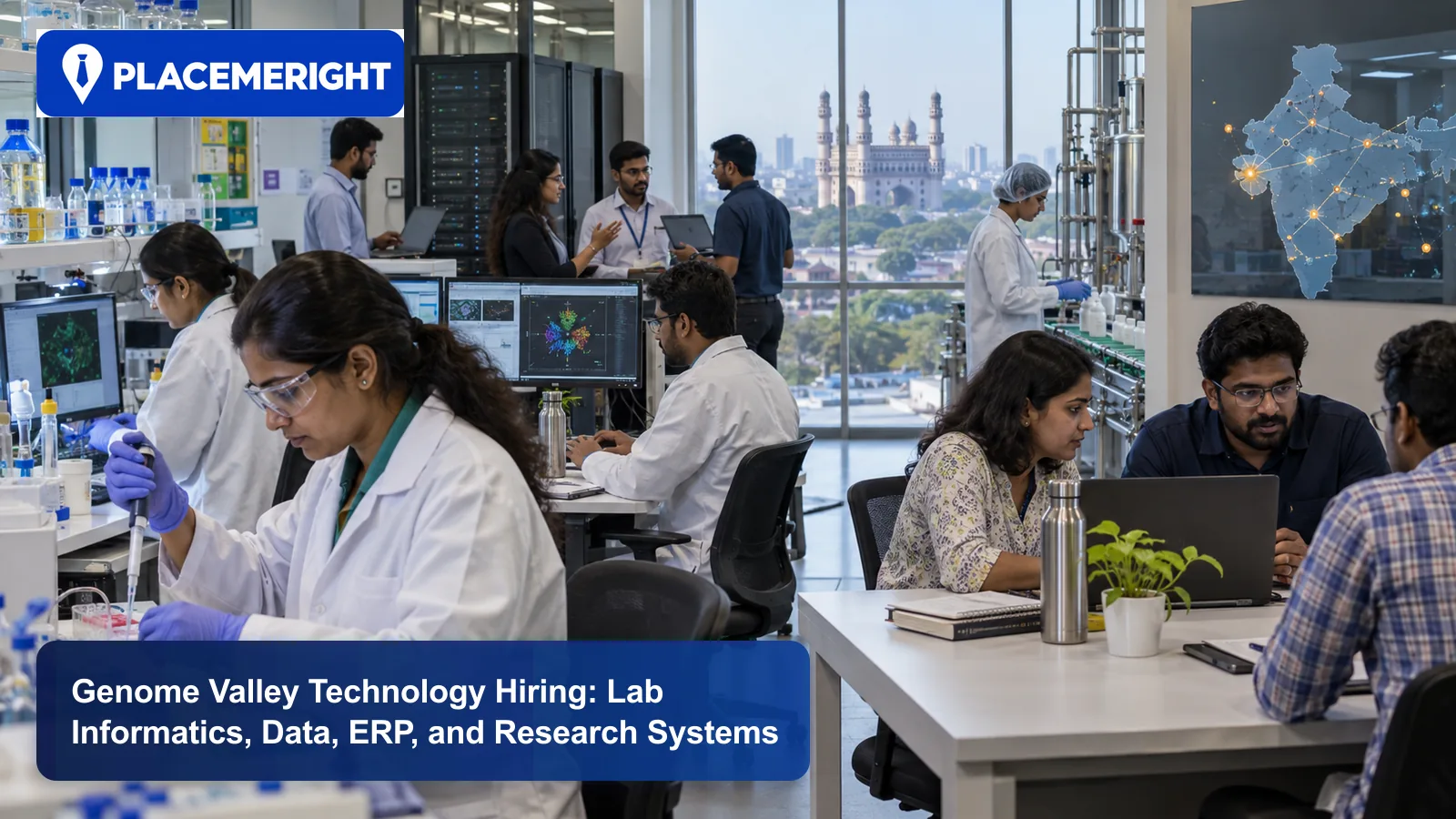
A research sample can cross more software boundaries than a customer order.
Its identity may begin in a study or laboratory workflow, move through an instrument, enter a laboratory information management system, acquire scientific context, trigger a quality review, connect to material or asset records in enterprise software, and appear in a report used for a research or manufacturing decision.
That is why "life-sciences IT professional" is not a useful hiring brief for a Genome Valley employer.
The phrase can describe a LIMS analyst, laboratory integration engineer, validated systems specialist, scientific data engineer, SAP consultant, research application owner, cybersecurity professional, or product manager. Each protects a different part of the evidence chain.
The employer must identify the decision the role supports, the controlled record it owns, and the failure it is expected to prevent.
Start with Genome Valley's operating context
The Government of Telangana presents Genome Valley as a life-sciences research and development cluster. Its pharmaceutical sector material also describes a wider state ecosystem spanning research, contract services, vaccines, manufacturing, and supporting infrastructure.
That context explains why a local technology search can involve laboratory and enterprise systems together. It does not establish the number of available candidates, their compensation, or their willingness to commute to a particular campus.
Current Hyderabad role material from Dr. Reddy's Laboratories offers more specific system evidence. Its roles discuss LIMS, manufacturing execution systems, SAP, warehouse systems, laboratory instruments, supply-chain data, track-and-trace, integrations, validation, observability, and enterprise application ownership.
Use PlaceMeRight's Hyderabad technology recruitment context for the broader employer search. Record the precise worksite separately. Genome Valley, Shamirpet, Turkapally, Medchal, central Hyderabad, and another pharmaceutical facility are not interchangeable location labels.
Follow the sample-to-decision digital thread
Map one sample through eight connected stages before choosing a job title.
1. Study, batch, and sample identity
The first control is identity.
A sample may need links to:
- a research study or method;
- a product, material, or batch;
- a collection point and time;
- a laboratory request;
- a chain of custody;
- an instrument run;
- a specification or acceptance rule.
Ask which system creates the authoritative identifier and how downstream systems preserve it. A candidate who starts with dashboards before establishing identity may hide a basic traceability problem.
2. Instrument acquisition
Analytical instruments generate results, files, metadata, run logs, and error states.
Relevant engineering work can include:
- instrument connectivity;
- interface configuration;
- acquisition software;
- file transfer;
- time synchronisation;
- result parsing;
- equipment status;
- access control;
- backup and recovery.
The role boundary matters. An instrumentation engineer may maintain the device and acquisition environment, while an informatics engineer owns how results enter a controlled application.
3. LIMS and electronic laboratory workflows
LIMS can coordinate sample registration, assignment, result entry, review, status, specifications, and release.
An employer should clarify whether the role owns configuration, development, administration, validation, support, integration, or process design. These are different searches.
Ask candidates to explain:
- sample lifecycle states;
- method and specification versioning;
- calculations;
- review and approval;
- exception handling;
- audit trails;
- electronic records;
- interface retries.
Tool familiarity matters less than evidence that the person can preserve laboratory meaning through a change.
4. Scientific data and context
Instrument files alone are not a reusable research dataset.
Scientific data work may involve:
- experiment metadata;
- data standards;
- storage and retention;
- lineage;
- searchable context;
- notebooks or research applications;
- controlled transformations;
- analysis environments;
- reproducible reporting.
Ask how a researcher can find the right result, understand its provenance, reproduce an analysis, and know whether the underlying record changed.
5. Quality, validation, and audit evidence
Regulated technology work requires more than a technically successful deployment.
The team may need:
- intended-use statements;
- risk assessment;
- requirements and traceability;
- test evidence;
- access reviews;
- change control;
- incident records;
- backup verification;
- periodic review;
- controlled retirement.
Do not write "validation experience required" without defining the candidate's responsibility. A system owner, quality partner, test analyst, and infrastructure engineer contribute different evidence.
6. ERP, materials, assets, and maintenance
Laboratory work often touches enterprise records.
SAP or another ERP may hold:
- material identity;
- batch status;
- procurement;
- inventory;
- quality lots;
- equipment and maintenance;
- cost or order context;
- warehouse movement;
- release-dependent transactions.
The hire may not configure ERP, but should understand what laboratory event changes an enterprise state and how failed messages are reconciled.
7. Research analytics and reporting
Reports can support scientists, quality teams, operations, programme leaders, and regulatory functions.
Assess:
- metric definitions;
- source lineage;
- late or corrected results;
- study and batch filters;
- approval state;
- access restrictions;
- report versioning;
- decision thresholds.
A polished visual is not proof that the underlying sample population is complete and controlled.
8. Security and service reliability
Availability, integrity, and confidentiality apply across the thread.
The role may need experience with:
- identity and privileged access;
- segmented laboratory networks;
- endpoint constraints;
- vendor access;
- vulnerability handling;
- backup and restore;
- monitoring;
- incident response;
- recovery priorities.
Ask how the candidate would contain a problem without destroying evidence or stopping unrelated laboratory work.
Divide the hiring requirement by ownership
Lab informatics analyst or product owner
This person translates laboratory workflow into controlled system behaviour.
Look for sample lifecycle knowledge, configuration judgement, user communication, requirement quality, testing, change control, and support ownership. Specify whether the work is LIMS, ELN, chromatography data, scientific content, or a broader laboratory platform.
Laboratory integration engineer
The integration role connects instruments, middleware, LIMS, scientific repositories, ERP, and reporting.
Test message identity, idempotency, sequencing, acknowledgements, error queues, reconciliation, observability, and safe replay. Generic API experience is not enough when a duplicate or late result can change laboratory state.
Scientific data engineer
This role protects context, lineage, quality, access, and analytical usability.
Ask for examples involving scientific metadata, unstructured files, schema evolution, controlled transformations, reproducibility, and data products. Separate research analysis enablement from ordinary business intelligence.
Validated applications specialist
The role may coordinate intended use, risk, requirements, testing, release evidence, access control, periodic review, and audit response.
Determine whether the employer needs a validation practitioner, application owner, quality-system partner, or engineer who can build within a validated lifecycle.
ERP and manufacturing systems consultant
This person may own SAP quality, materials, plant maintenance, warehouse, finance, or manufacturing integrations.
Define the exact module, process, plant or laboratory interface, S/4HANA context, and implementation-versus-support requirement. "Pharma ERP" is still too broad.
Research systems or digital product manager
The product role connects scientific users, quality, engineering, data, security, vendors, and programme priorities.
Assess decision quality, adoption evidence, lifecycle ownership, backlog discipline, and the ability to distinguish a scientific need from a software feature request.
Build the charter around a controlled decision
Use seven fields:
1. Decision supported: research interpretation, sample disposition, method execution, material release, asset readiness, or operational planning. 2. Authoritative record: the system and object that hold the controlled state. 3. Owned boundary: laboratory application, integration, data, ERP, validation, security, or service. 4. Users: scientists, analysts, quality reviewers, plant teams, IT, vendors, or leaders. 5. Failure consequence: delay, wrong status, lost traceability, unauthorised access, or unreliable reporting. 6. Decision authority: what the hire may change, stop, approve, or escalate. 7. Recovery evidence: the records and checks that prove normal operation.
A concise charter could read:
> Own sample-status integration between laboratory workflows and enterprise material records. Preserve identity, sequencing, audit evidence, controlled correction, and operational visibility across LIMS, middleware, and ERP.
That statement gives sourcing and interviewing a real centre.
Use one sample-status incident in every interview
Present this case:
> An instrument result is available and the LIMS marks the sample as reviewed. The ERP material or batch state remains unchanged. A downstream report includes the result but shows the old enterprise status. The laboratory wants the record released before a time-sensitive review.
Ask for the evidence order
Strong candidates first request:
- sample, test, material, and batch identifiers;
- source and target states;
- instrument, LIMS, integration, ERP, and report timestamps;
- message identifiers and acknowledgements;
- audit-trail entries;
- user or service-account actions;
- interface retries and error queues;
- the rule governing release;
- affected records and decisions.
They should not begin by manually changing ERP.
Reveal a delayed message
Tell the candidate that the integration platform contains an earlier failed message and a later successful retry, but the two systems use different event timestamps.
Look for reasoning about event time, processing time, duplicate protection, ordering, status transitions, reconciliation, and whether the report reads a replicated state.
Require a controlled correction
The candidate should define:
- the accountable business and quality decision;
- whether release must pause;
- how to preserve original evidence;
- how to correct or replay safely;
- which records require review;
- how affected reports are identified;
- what proves the systems agree again.
An answer that fixes a screen but ignores the audit trail is incomplete.
Score evidence, not life-sciences vocabulary
Traceability reasoning
- 4: follows identity, state, timestamps, lineage, and audit evidence end to end;
- 3: finds the mismatch with one limited control gap;
- 2: checks applications independently without a common record;
- 1: recommends manual updates before establishing the source of truth.
Laboratory and enterprise depth
- 4: explains both the owned system and the business consequence of adjacent states;
- 3: has strong primary-domain depth and identifies dependencies;
- 2: repeats product terminology without workflow detail;
- 1: treats LIMS, data, and ERP as interchangeable databases.
Validation and change judgement
- 4: preserves evidence, uses controlled correction, assesses impact, and defines release proof;
- 3: reaches a sound recovery with a minor documentation omission;
- 2: proposes a technical fix without lifecycle evidence;
- 1: bypasses controls to meet the deadline.
Stakeholder communication
- 4: gives laboratory, quality, IT, data, and business owners clear decisions and status;
- 3: communicates well but misses one consequence;
- 2: reports technical activity without decision impact;
- 1: hides uncertainty or assigns blame.
Record scores independently before the panel compares candidates.
Keep Hyderabad geography honest
Genome Valley is a specific cluster north of central Hyderabad. Shamirpet and Turkapally may be useful location references, while Medchal can matter for the wider industrial and life-sciences search. They should not be used as decorative synonyms.
Before sourcing, state:
- exact campus and reporting location;
- laboratory or plant access requirements;
- office, shift, and support schedule;
- transport arrangements;
- clean-area or safety constraints;
- production-system access;
- vendor and global-team overlap;
- remote-work limits;
- travel between sites.
A current Hyderabad role proves that an employer is defining that work in the city. It does not prove the role is based in Genome Valley or that every relevant candidate accepts that commute.
Onboard through one controlled record
Give the new hire:
- the sample and system lifecycle;
- authoritative-data definitions;
- interface inventory;
- validation and change procedures;
- access model;
- recent deviations and incidents;
- recovery priorities;
- user and vendor map.
Assign one bounded task, such as reconciling a sample-state interface, improving a failed-message alert, documenting a controlled correction, or tracing one report field to its authoritative record.
At the first-month review, ask the hire to show the original risk, evidence gathered, decision path, controlled change, recovery proof, and remaining limitation.
Quick checklist
- Name the scientific or operational decision before the technology.
- Map one sample across instruments, LIMS, data, quality, ERP, and reporting.
- Identify the authoritative record and lifecycle state.
- Separate informatics, integration, data, validation, ERP, product, and security roles.
- Define implementation, support, migration, or ownership expectations.
- Use a mismatched sample-status incident in interviews.
- Score traceability, controlled correction, and communication.
- State the exact Genome Valley or Hyderabad worksite.
- Avoid candidate-supply and hiring-speed assumptions.
- Recheck time-sensitive sources before publication.
Frequently asked questions
Is a LIMS administrator the same as a lab informatics product owner?
No. Administration may focus on configuration, users, jobs, and support. Product ownership includes workflow decisions, priorities, stakeholders, lifecycle outcomes, and adoption. Some employers combine them, but the brief should state the actual authority.
Should a scientific data engineer know ERP?
Only to the depth required by the data product and interfaces. The person should understand material, batch, asset, or quality context when it affects lineage, but may not need module configuration skills.
How should employers test validation experience?
Give candidates a real change or incident and ask for intended use, risk, traceability, test evidence, approvals, release controls, and post-change verification. Avoid relying on acronyms alone.
Can a general integration engineer work on laboratory systems?
Possibly. Test identity, ordering, duplicate handling, controlled records, vendor interfaces, audit evidence, and correction procedures. Domain learning should be explicit in the onboarding plan.
Do Hyderabad pharmaceutical roles prove Genome Valley candidate availability?
No. They provide current evidence of system responsibilities in the wider city market. Availability, compensation fit, worksite acceptance, and notice periods require the employer's own funnel data.
Which location details matter most?
The exact campus, shift or support pattern, transport, laboratory access, production responsibilities, remote-access restrictions, and travel between sites should be stated before outreach.
Related reading
- Hire data engineers
- Hire technical and enterprise systems specialists
- Explore employer-side technology recruitment
- Discuss a life-sciences systems brief
Conclusion
Genome Valley technology hiring becomes more precise when the employer follows a controlled sample instead of listing software names.
Map identity, acquisition, laboratory workflow, scientific context, quality evidence, enterprise state, reporting, and reliability. Then assign one part of that thread to the role and test it with a traceable incident.
The result is a clearer search, a fairer interview, and an onboarding plan connected to research and operational decisions.
CTA
PlaceMeRight helps Hyderabad life-sciences employers define laboratory and enterprise technology roles, calibrate evidence, and assess candidates through realistic system boundaries.
Share your Genome Valley technology hiring requirement
References
- Invest Telangana: pharmaceutical and life-sciences sector
- Invest Telangana: Telangana industry overview
- Dr. Reddy's Laboratories: supply-chain data and intelligence role
- Dr. Reddy's Laboratories: manufacturing digital transformation role
- Dr. Reddy's Laboratories: enterprise applications role
- Dr. Reddy's Laboratories: instrumentation engineering role
- Dr. Reddy's Laboratories: track-and-trace digital specialist role
- Dr. Reddy's Laboratories: production documentation role
Related PlaceMeRight resources
Our Tech Recruitment Services by City
Looking to hire vetted software engineers or scale your engineering teams in India's leading tech hubs? Explore our localized recruitment services: