
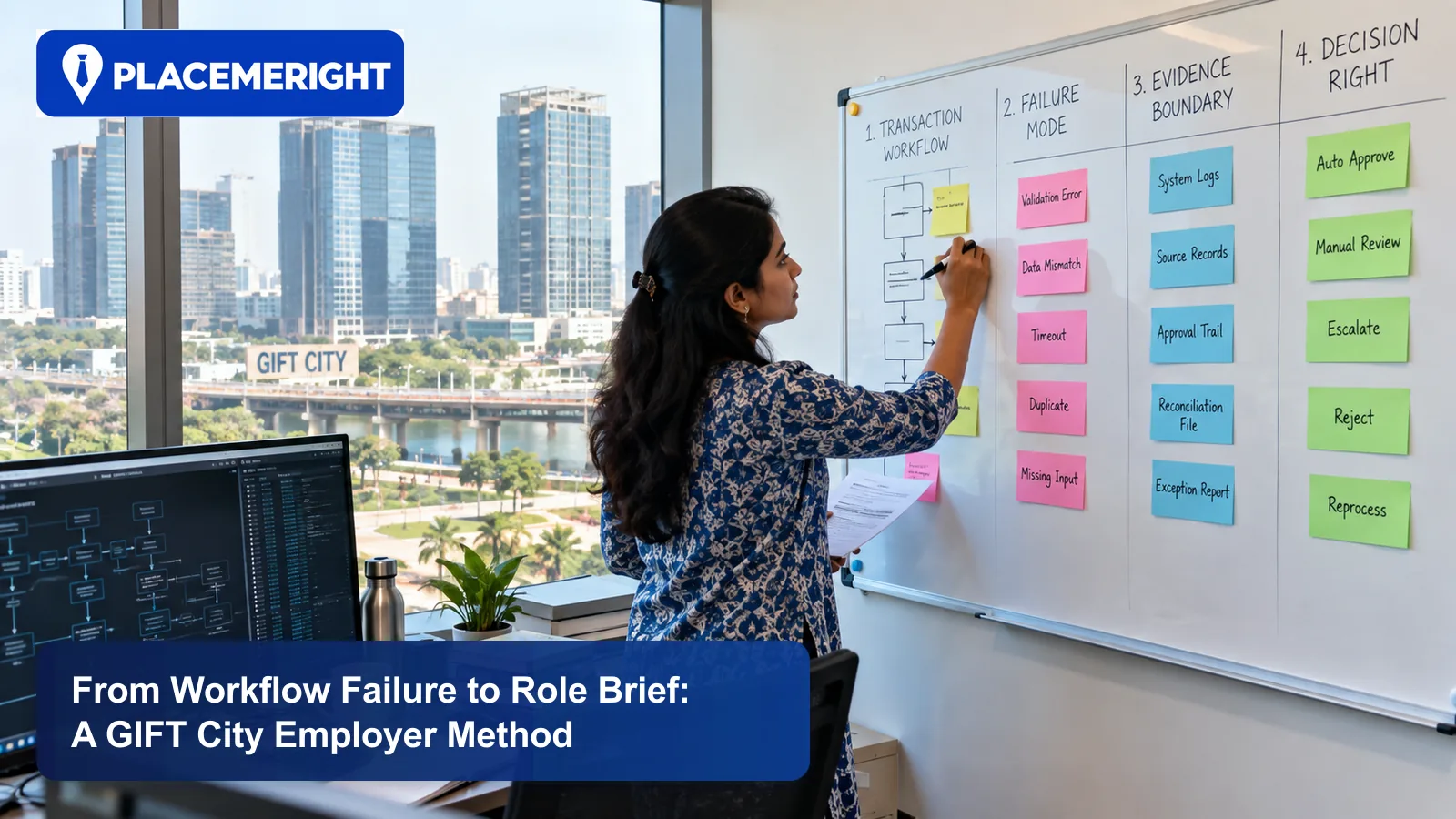
GIFT City technology hiring is not ordinary fintech recruitment with a different office address.
A financial platform may process transactions, maintain records, connect regulated institutions, or support cross-border workflows. Each use case combines engineering, data, security, operations, and domain ownership differently. A vacancy asking for banking, cloud, cybersecurity, AI, data, compliance, and product delivery loses that distinction.
The better starting point is the control the new hire must own.
Will this person protect transaction integrity? Build a governed data pipeline? Secure an application? Operate a production service? Translate a regulated workflow into product rules? The answer determines the role, evidence, interview panel, and research market.
This distinction matters across GIFT City, Gandhinagar, Infocity, SG Highway, Thaltej, and wider Ahmedabad. These places are connected, but they are neither interchangeable commute points nor identical employer clusters.
Translate the IFSC context into a control boundary
The International Financial Services Centres Authority regulates and develops financial services in India's IFSCs. Its current fintech material includes a 2026 sandbox framework, while its public circular register also lists guidelines on cyber security and cyber resilience for regulated entities. GIFT City's official fintech ecosystem material refers to digital payments, artificial intelligence, blockchain, data security, and regulatory frameworks.
Those are ecosystem facts. They do not prove that every employer in GIFT City needs the same stack or that a candidate must have previous IFSC experience.
They do show why financial-platform hiring should begin with:
- the regulated or commercial workflow;
- the information and transaction boundary;
- the required control evidence;
- the service's availability and recovery expectations;
- the candidate's decision authority;
- the teams that remain accountable after release.
HCLTech's July 2026 announcement of a GIFT City technology centre for AI-led financial-services solutions is one current employer example. It also announced collaboration with IIT Gandhinagar and Gujarat Technological University. This is not a corridor-wide trend or a reason to add AI to every role.
Employers planning a broader Ahmedabad search can use PlaceMeRight's Ahmedabad technology recruitment context after defining the role's GIFT City-specific control boundary.
Start with a financial workflow, not a fintech label
"Fintech engineer" can describe very different work:
| Workflow | Primary engineering concern | Evidence to request | | --- | --- | --- | | Payments or transaction processing | idempotency, reconciliation, fraud signals, auditability | failure handling, duplicate prevention, ledger reasoning | | Capital-market or trading platform | event ordering, market data, latency, controls | production incidents, data lineage, test strategy | | Fund, banking, or insurance operations | workflow accuracy, permissions, reporting | business-rule modelling, maker-checker controls, exception handling | | Regulatory or compliance technology | traceability, policy logic, case management | explainable rules, evidence retention, change governance | | Financial data and analytics | lineage, quality, access, model risk | source-to-report mapping, quality controls, reproducibility | | AI-assisted financial service | evaluation, privacy, human oversight, drift | test datasets, guardrails, monitoring, escalation |
Two employers may both use Java, Python, cloud infrastructure, and APIs. One needs an engineer who understands transaction finality and reconciliation. The other needs a data engineer who can prove lineage from source to regulatory report. Technology overlap does not remove workflow differences.
Write the first paragraph of the job description around the workflow and failure cost. Mention the module or product only after that.
Separate four kinds of technical ownership
Financial-platform engineering
This lane covers backend services, transaction processing, integrations, workflow engines, APIs, and platform components. Suitable candidates should be able to reason about state changes, retries, duplicate messages, consistency, permissions, and operational failure.
Do not reduce the interview to framework syntax. Give the candidate a payment, trade, policy, or fund-workflow scenario. Introduce a timeout after an external service receives a request but before the platform records confirmation. Ask what can now be true, what must be logged, which action is safe to retry, and how an operator will reconcile the exception.
The candidate does not need to recite regulation. They should expose ambiguity and protect money, records, or customer outcome.
Financial data engineering
Data roles in regulated environments require more than moving records into a warehouse. Employers may need source ownership, quality rules, lineage, access segregation, retention, reconciliation, and reliable reporting.
Ask a candidate to map:
1. where the record originates; 2. which transformation changes its business meaning; 3. how late or corrected data is handled; 4. how access is granted and reviewed; 5. which totals must reconcile; 6. how an auditor or business owner can reproduce the result.
An effective response connects pipelines to decisions. It also distinguishes a technical freshness metric from a business-completeness check.
Product and application security
Product security sits close to design and engineering. Its scope can include threat modelling, secure development, code and dependency risk, API security, identity design, vulnerability triage, and release assurance.
The IFSCA sandbox FAQ asks applicants for items including security assessment or VAPT material and information about advanced technologies. That does not make every security role a VAPT role. An employer building a financial product may need someone who can change design decisions before code exists, not only report vulnerabilities after development.
Use an architecture review in the interview. Ask the candidate to identify assets, trust boundaries, abuse paths, preventive controls, detection, and residual risk. Score prioritisation and developer collaboration as well as technical coverage.
Cyber operations, governance, and resilience
Security operations, identity, governance, incident response, and cyber resilience form a separate lane. These roles protect the enterprise and production environment through monitoring, access control, response, recovery, evidence, and policy execution.
A security operations analyst is not automatically an application security engineer. A governance specialist is not automatically a cloud-security architect. A broad CISO-office title can conceal very different daily work.
Specify whether the role owns alerts, identity lifecycle, third-party risk, control testing, incident command, resilience exercises, policy, or technical remediation. If several are included, define which are primary and which are interfaces.
Read the Ahmedabad job sample carefully
PlaceMeRight reviewed a city-wide sample of 120 Ahmedabad technology listings visible in its job feed from June 14 to July 23, 2026. A strict title-and-tag scan found 11 data or analytics roles and 10 platform, cloud, integration, or software-engineering roles. It found no titles that explicitly named finance or cybersecurity.
This is not evidence that finance or security demand is absent. Job titles often hide industry context, and the sample is Ahmedabad-wide rather than a GIFT City census. It is also a snapshot, not a forecast.
The practical lesson is narrower: keyword counts cannot replace role research. Employers should inspect company context, responsibilities, systems, and controls before labelling the role or choosing search terms.
Keep geography subordinate to control design
GIFT City and Gandhinagar
Treat GIFT City and Gandhinagar as the primary worksite context when a role interfaces with an IFSC entity or regulated financial workflow. Record the employer setting rather than assigning capability to the postcode.
State the exact GIFT City zone, work pattern, transport expectations, and any shift or market-hour requirement at first contact.
Infocity and the Gandhinagar technology belt
Use Infocity and nearby Gandhinagar as adjacent research context. When an applicant has worked there, test whether the evidence transfers to the vacancy's financial control rather than requiring a fintech title.
Screen for transferable evidence: access controls, audit trails, sensitive data, high-availability systems, reconciliation, incident handling, or complex stakeholder workflows.
Ahmedabad business and technology corridors
SG Highway, Thaltej, Bodakdev, Prahlad Nagar, and Navrangpura contain varied technology workplaces. Include them in research only with an explicit GIFT City travel and attendance requirement.
Do not advertise "Ahmedabad hybrid" when the practical requirement is several fixed days in GIFT City. A precise office rhythm lets each person assess feasibility before technical interviews begin.
A control-to-role hiring brief
Use six fields before opening sourcing:
Business event
Name the event the system handles: payment, order, policy, trade, settlement, onboarding, risk review, customer case, or report.
Control outcome
Define what must remain true: authorised access, correct calculation, complete record, timely processing, recoverable service, or explainable decision.
Failure mode
Describe the costly failure: duplicate transaction, missed alert, incorrect report, leaked data, unresolved exception, unavailable service, or uncontrolled model output.
Technical surface
List the systems the person will change or operate: APIs, services, databases, streams, identity, cloud controls, data platform, observability, or case-management tools.
Evidence boundary
State what proves good operation: reconciled totals, traceable lineage, test results, security findings closed, service objectives, access reviews, or incident learning.
Ownership boundary
Clarify what the person decides, what requires risk or compliance approval, and which team carries production accountability.
This brief produces more relevant searches than a long list of tools.
Interview financial-platform engineers with a failure journey
Give the candidate one end-to-end scenario:
A customer submits an instruction. The platform validates it, calls an external service, writes an internal record, triggers a notification, and updates reporting. During a partial outage, the external service may complete while the internal response times out.
Ask the candidate to:
- define possible states;
- decide which identifiers are required;
- prevent an unsafe repeat;
- design reconciliation;
- identify access and data risks;
- choose logs, metrics, traces, and alerts;
- explain customer and operator communication;
- propose tests for recovery.
Score business-state reasoning, data integrity, security, operability, and communication separately. A candidate who asks precise questions may provide better evidence than one who draws the most elaborate architecture.
Screen data candidates through lineage and exception handling
Provide three sources with different update times, one corrected historical record, and a report deadline. Ask how the candidate would preserve raw data, model business keys, detect late arrival, reconcile totals, control access, and re-run affected outputs.
Look for:
- explicit data contracts or source expectations;
- quality checks tied to business meaning;
- traceable transformations;
- safe backfills;
- separation of sensitive fields;
- reproducible reports;
- named ownership for failed records.
Tool knowledge matters, but the evidence chain matters more.
Separate AI capability from AI decoration
An AI role for financial services should name the decision or task being assisted. Examples include document extraction, anomaly triage, service-agent support, search, forecasting, or case prioritisation.
The brief should define:
- data permitted for training or inference;
- evaluation against the real task;
- unacceptable errors;
- human review;
- explanation and logging;
- drift or performance monitoring;
- fallback when the model is unavailable;
- responsibility for model and workflow changes.
Do not combine a data scientist, machine-learning engineer, platform engineer, security reviewer, and financial-domain lead into one mid-level vacancy. Build a small ownership map around the use case.
Score the control evidence
Use a 100-point scorecard:
- 25 points: financial or business-workflow reasoning;
- 20 points: technical depth on the assigned system;
- 15 points: data integrity, security, or control thinking;
- 15 points: production failure and recovery;
- 10 points: evidence and documentation;
- 10 points: stakeholder communication;
- 5 points: GIFT City work-pattern feasibility.
Adjust the weights by role. For a security position, move more weight to threat and control depth. For a data role, increase lineage and quality. Keep work-location feasibility separate from technical merit so the decision remains visible.
Quick checklist
- Name the regulated or commercial financial workflow.
- State the event, record, or customer outcome being protected.
- Separate platform, data, product-security, and cyber-operations needs.
- Define the primary failure mode.
- List the required control evidence.
- Clarify production, incident, and on-call ownership.
- Identify the exact GIFT City or Gandhinagar office point.
- State workdays, hours, and market or support shifts.
- Accept transferable controlled-system evidence where IFSC experience is not mandatory.
- Use one workflow exercise and one structured scorecard.
Frequently asked questions
Must candidates have previous GIFT City experience?
Only when the role genuinely depends on direct IFSC, product, or regulatory context from day one. For many engineering roles, strong evidence from banking, payments, insurance, capital markets, enterprise security, controlled data, or high-reliability platforms can transfer.
Is fintech experience enough for a financial-platform role?
No. Fintech is a sector label. Establish the candidate's ownership of transactions, records, integrations, controls, data, security, or production operation.
Should cybersecurity and application security use one interview?
Usually not. Application security focuses on product design and software delivery, while security operations, identity, governance, and resilience require different evidence. Use a shared foundation but separate role-specific panels.
Which locations should a GIFT City brief distinguish?
Distinguish GIFT City, Gandhinagar, Infocity, SG Highway, Thaltej, Bodakdev, Prahlad Nagar, and broader Ahmedabad when those places are relevant to the worksite or research plan. Discuss the real journey and office rhythm before interview scheduling.
What should employers test in a financial data interview?
Test source meaning, lineage, quality, reconciliation, late data, corrections, access, reproducibility, and exception ownership. Avoid an exercise that only measures SQL speed.
Can PlaceMeRight support a multi-role GIFT City build?
Yes. The search should still be split into calibrated workstreams so platform, data, security, operations, and product candidates are not assessed through one generic fintech brief.
Related reading
- Build a cloud-security team for GIFT City financial services
- Design a two-corridor GIFT City and Ahmedabad strategy
- Hire data-governance talent for regulated financial operations
- Recruit AML, KYC, and compliance technology talent for GIFT City
Conclusion
GIFT City gives Ahmedabad-region employers a distinctive financial-services technology context. That context becomes useful when hiring teams resist turning it into one oversized fintech vacancy.
Begin with the workflow. Identify the control and failure mode. Decide whether the role belongs to platform engineering, data, product security, cyber operations, or a clearly bounded combination. Then search across GIFT City, Gandhinagar, Infocity, and Ahmedabad with an honest work-location plan.
That approach produces interviews about financial-platform ownership, not keyword proximity.
CTA
PlaceMeRight helps employers calibrate financial-platform, fintech, data, cybersecurity, cloud, and enterprise-technology searches across the Ahmedabad-Gandhinagar market. Share your GIFT City hiring requirement to define the role map, sourcing radius, evidence screen, and interview scorecard.
References
- IFSCA: FinTech Sandbox Framework and ecosystem material
- IFSCA: circulars, guidelines, and current notices
- IFSCA: FinTech Sandbox Framework 2026 FAQ
- GIFT City: FinTech ecosystem
- GIFT City: official overview
- HCLTech: Global Technology Center in GIFT City, July 2026
- Gujarat Department of Science and Technology: IT and ITeS policy
- Reserve Bank of India: Digital Payment Security Controls
Related PlaceMeRight resources
Our Tech Recruitment Services by City
Looking to hire vetted software engineers or scale your engineering teams in India's leading tech hubs? Explore our localized recruitment services: