
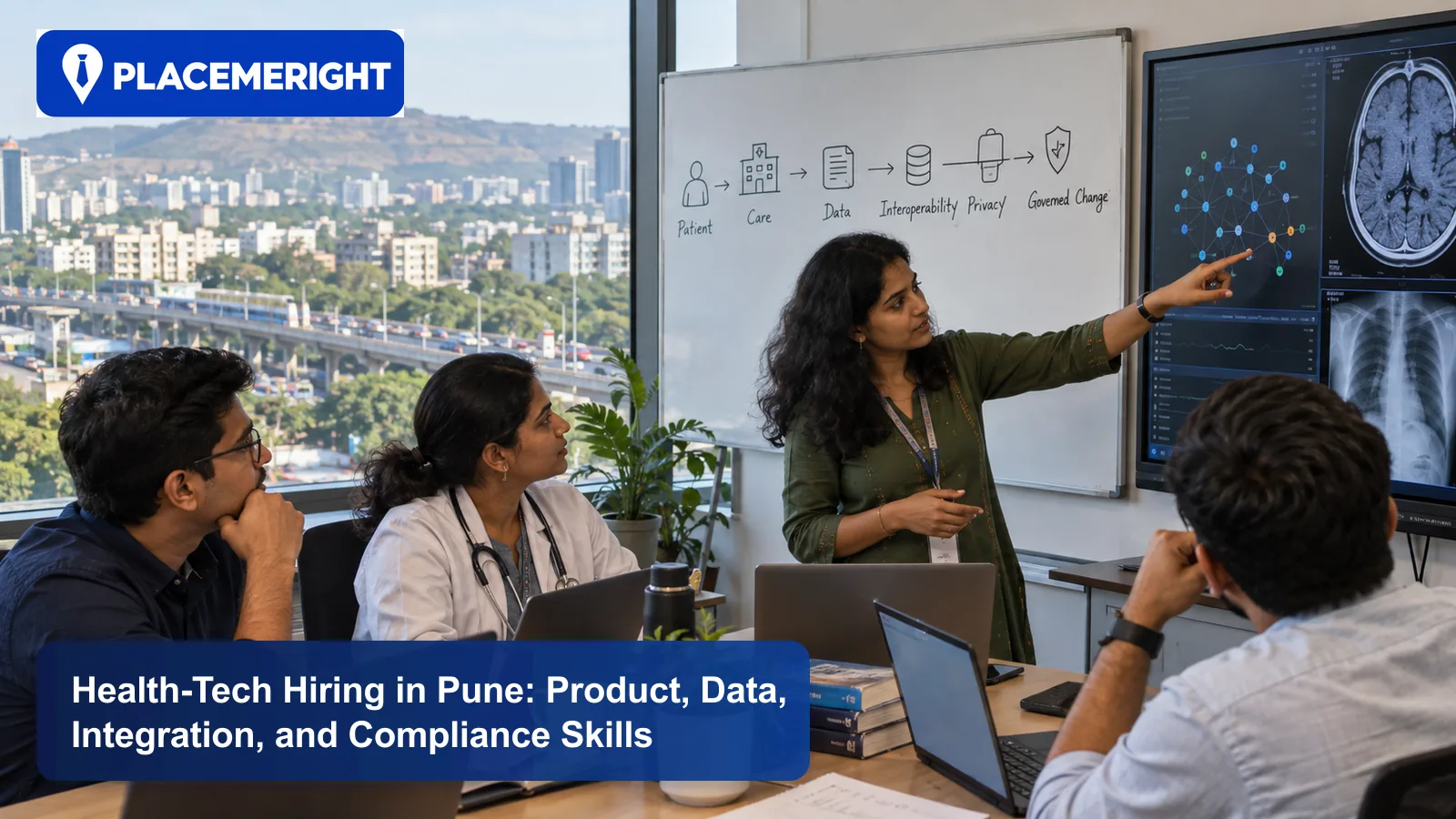
A Pune health-tech company changes the follow-up flow for a diagnostic service. Product removes one confirmation step to reduce abandonment. The mobile application submits the request correctly, but the integration service interprets a missing field as a cancellation. The laboratory system retains the result under the original episode. A support agent can see the failed status but not the clinical result. The patient tries again, creating a second request.
No single technology failed completely. The care episode fractured across product behaviour, clinical meaning, identity, integration, consent, data state, and support.
Hiring a product manager, data engineer, integration developer, and compliance specialist from separate keyword lists will not automatically solve that problem. The employer needs a care-episode change dossier: one governed record showing how a healthcare interaction should move, what each system means, which decisions require qualified clinical or legal authority, and what evidence is needed before and after change.
For Pune employers across Aundh, Baner, Hinjawadi, Kharadi, Magarpatta, Pimpri-Chinchwad, and connected healthcare or technology workplaces, the dossier creates a role-specific hiring foundation without claiming that one locality contains a ready-made talent pool.
Choose one care episode
Select a real workflow and remove confidential or identifying details. This article uses diagnostic follow-up, but the method can apply to appointment booking, teleconsultation, pharmacy fulfilment, remote monitoring, claims, discharge, referral, or chronic-care coordination.
Write the episode as observable states:
1. person or authorised representative initiates a request; 2. identity and context are resolved; 3. appointment or service is confirmed; 4. clinician or provider performs the relevant activity; 5. observation or result is created; 6. authorised information is made available; 7. person and provider receive the next action; 8. exception or correction is handled; 9. episode is closed with retained evidence.
Do not ask recruitment to define clinical practice. Qualified clinical, product, privacy, security, legal, compliance, and operational owners must approve the real states.
PlaceMeRight's Pune technology recruitment guide provides wider employer context. This article stays with the cross-functional evidence required for health-tech product, data, integration, and compliance hiring.
Build the care-episode change dossier
The dossier should contain eight connected pages.
| Page | Employer question | | --- | --- | | care purpose | What person or provider outcome is supported? | | workflow states | What can happen, and in what order? | | clinical meaning | Which terms, results, and decisions need qualified ownership? | | identity and consent | Who is acting, for what purpose, under which authority? | | data and integration | Which sources, standards, mappings, and failure paths apply? | | privacy and security | What collection, access, sharing, retention, and protection are approved? | | operation | Who sees, supports, reconciles, and corrects exceptions? | | change evidence | What must be tested, approved, monitored, and reviewed? |
The document is not a substitute for applicable policy, contract, regulation, clinical governance, or legal advice. It is the common object around which the employer can define roles and compare candidate evidence.
Calibrate the product role
Health-tech product work should begin with the care decision, not the screen.
For diagnostic follow-up, the product person may need to understand the person seeking care, clinician, diagnostic provider, support team, and operations staff. They must distinguish convenience from a clinically or operationally meaningful confirmation.
A useful brief names:
- the user and care context;
- decisions the product person can make;
- decisions requiring clinical, privacy, legal, or operational approval;
- accessibility and language needs;
- failure and recovery experience;
- adoption and support responsibilities;
- evidence reviewed after launch.
Interview with a confirmation-removal replay. Give the candidate the original flow and evidence that users abandon one step. Ask for a change. Then reveal that the step also establishes an operational handoff and helps prevent duplicate requests.
Strong candidates revisit the problem. They seek qualitative and quantitative evidence, separate user friction from control purpose, propose safer experiments, protect exception paths, and state who must approve the change.
Do not award extra points for prior healthcare employment unless the role truly requires immediate independent domain judgement.
Calibrate the clinical-data role
Clinical data is not merely sensitive customer data. Meaning, provenance, time, coding, units, status, correction, and context can affect interpretation.
The data role may own:
- source and canonical models;
- terminology and code mappings under qualified governance;
- observation and result status;
- timestamps and effective periods;
- provenance and transformation evidence;
- quality checks and reconciliation;
- analytics-ready representations;
- correction without loss of history;
- access and use boundaries.
Use a result-status case. A diagnostic result appears as final in one system, amended in another, and duplicated in an analytics feed. Ask the candidate to identify authoritative sources, temporal meaning, consumer impact, reconciliation, correction, and monitoring.
A strong candidate does not decide whether a clinical interpretation is valid. They show how the system preserves the authorised meaning and makes uncertainty visible.
ABDM's official material identifies common health-data standards and consent-based, federated interoperability principles. The National Resource Centre for EHR Standards at C-DAC Pune provides an additional standards context. Employers must determine which standards and obligations apply to their product.
Calibrate the integration role
Health-tech integration can cross hospital systems, laboratory systems, provider applications, patient applications, registries, claims services, devices, and external partners.
The role should cover the contract, not only the API.
Define:
- identity and participant resolution;
- authorised purpose and consent evidence;
- resource or message semantics;
- version and compatibility;
- authentication and authorisation;
- retries, duplication, ordering, and timeout;
- acknowledgement and business completion;
- error ownership and reconciliation;
- observability without exposing unnecessary health data.
Interview with an unknown-state exchange. The receiving system times out after processing a request. The sending application does not know whether the care action was created. Ask how the candidate prevents duplicate effect, obtains authoritative status, communicates uncertainty, and restores a consistent episode.
Look for idempotency, correlation, state reconciliation, version management, privacy-aware telemetry, and respect for business authority.
Calibrate privacy, security, and compliance work
Do not combine every governed responsibility into a lone "compliance person."
The employer should identify separate authorities for:
- product purpose and minimum necessary data;
- consent and participant rights;
- privacy notice and data processing;
- identity and access;
- security architecture and testing;
- retention and deletion;
- clinical governance;
- incident and breach response;
- contracts and third-party obligations;
- regulatory interpretation.
The final role shape depends on the organisation and applicable framework.
MeitY's official page records the Digital Personal Data Protection Rules, 2025 and related enforcement material. ABDM publishes a Health Data Management Policy and current privacy, interoperability, and consent guidance. Qualified employer legal and privacy functions should assess applicability and current effect; a recruiter or candidate should not be asked to provide a definitive legal interpretation.
Use a purpose-change exercise. A dataset collected to support diagnostic follow-up is proposed for model training and product analytics. Ask the candidate what must be clarified before use. Strong evidence includes purpose, authority, data minimisation, provenance, access, retention, third parties, security, rights, testing, and documented approval.
Add operations and support before sourcing
Health-tech products operate after release. The team needs an owner for:
- failed care episodes;
- identity and access problems;
- late or conflicting results;
- duplicate requests;
- partner unavailability;
- user communication;
- clinical escalation;
- reconciliation and correction;
- audit evidence;
- product learning.
Do not allow a support agent to infer clinical advice or disclose information outside their authorised view. The product should route each exception to the right qualified owner.
In the interview case, ask every role how the support team learns what happened without gaining unnecessary access. Product candidates should design the recovery experience. Data candidates should preserve status and provenance. Integration candidates should expose reliable technical state. Privacy and security candidates should control access and evidence.
Use the Pune context precisely
Pune has current, official digital-health context that can inform research without becoming a market statistic.
The National Health Authority held an ABDM and AB PM-JAY Chintan Shivir in Pune in April 2026, including discussion of digital-health integration and health-information systems. C-DAC Pune hosted the NRCeS Users' Meet and Expo 2026 around EHR standards. NHM Maharashtra identifies its State Health Systems Resource Centre at the Aundh District Hospital campus and describes work including HMIS strengthening.
These sources show institutional activity in Pune. They do not establish the number of available health-tech candidates, the dominance of any product category, or the workplace of a private employer.
State the employer's exact office, healthcare site, lab, customer location, work mode, travel, and controlled-access expectations separately.
Decide which domain experience is essential
Use a three-level domain gate.
Immediate independent interpretation
Require direct experience when the person must independently make qualified clinical, privacy, regulatory, quality, or safety decisions from the start. Confirm that the requested authority is lawful and organisationally appropriate.
Applied domain collaboration
Require evidence of working with qualified domain owners when the role must translate clinical workflow, terminology, consent, interoperability, or operational constraints into technology.
Transferable technology with structured learning
Accept adjacent experience when the core burden is product, data, integration, reliability, security, or support and the employer can provide qualified domain guidance.
Write the gate against individual responsibilities. "Healthcare experience mandatory" is too broad and may remove strong candidates without improving safety.
Run one cross-functional episode panel
Avoid four unrelated interviews.
Give every candidate the same care episode and change event. Product, clinical or domain, data, engineering, privacy, security, and operations interviewers should score only assigned evidence.
| Dimension | Evidence | | --- | --- | | care-context respect | identifies qualified owners and harm boundaries | | state reasoning | traces normal, exception, correction, and close | | data meaning | protects provenance, time, status, and uncertainty | | integration judgement | handles identity, consent, failure, and reconciliation | | privacy and security | applies minimum access and evidence discipline | | product learning | measures outcome without weakening governance | | handoff quality | leaves an operable owner and record |
Candidates should be allowed to ask clarifying questions. In health technology, pretending to know an unspecified clinical or legal answer is not a strength.
Validate a change before production
Use the dossier as a release gate.
Ask:
1. Has the care purpose changed? 2. Are workflow and exception states updated? 3. Did clinical owners approve meaning? 4. Are identity, consent, access, and purpose correct? 5. Do data and integration contracts remain compatible? 6. Are privacy and security reviews complete? 7. Can operations detect and correct failure? 8. Is the rollback or containment path tested? 9. What evidence will be reviewed after launch?
The new hire's first assignment can be to reconstruct a low-risk historical change through this gate. That shows how the organisation works before granting consequential production authority.
Avoid common health-tech hiring errors
Do not use "FHIR," "ABDM," "AI," or "HIPAA" as generic quality labels. Require only applicable standards and context.
Do not ask one candidate to own product strategy, clinical interpretation, data engineering, integrations, privacy, security, compliance, and support without authority and a supporting team.
Do not infer clinical competence from a healthcare employer name.
Do not infer product judgement from a polished patient application.
Do not treat consent as one checkbox or interoperability as one successful API response.
Do not publish health-data examples that expose real people or confidential business information.
Quick checklist
- Select one sanitised care episode.
- Map normal, failure, correction, and closure states.
- Build a care-episode change dossier.
- Name qualified clinical, privacy, legal, and security owners.
- Separate product, data, integration, and control burdens.
- Define essential and learnable domain experience.
- Test one change event across all role families.
- Score provenance, consent, state, recovery, and handoff.
- Add support and reconciliation before release.
- State the exact Pune workplace and site duties.
- Date standards, policy, and employer sources.
- Revalidate the dossier after every material change.
Frequently asked questions
Must every health-tech engineer understand clinical terminology?
They need enough context for their responsibility. Independent clinical interpretation belongs with qualified owners; engineers should preserve authorised meaning and know when to seek clarification.
Is ABDM experience mandatory for a Pune health-tech role?
Only when the product integrates with or must conform to relevant ABDM components or standards. Test the actual integration and governance burden rather than using the acronym as a blanket filter.
Can a fintech data engineer move into health technology?
Potentially. Data provenance, controls, security, and reconciliation can transfer, while clinical meaning, consent, care workflow, and applicable standards may require structured learning and qualified support.
Who should assess health-data compliance?
The employer's qualified legal, privacy, security, compliance, and domain functions should determine applicable requirements. Recruitment can test evidence of governed implementation and collaboration.
Does the Pune digital-health ecosystem prove local candidate supply?
No. Official events and institutions establish relevant activity, not the size or availability of a candidate pool.
Related reading
- Hire data engineers
- Structure a specialised technology search
- Hire product and engineering teams across India
- Review PlaceMeRight's employer credentials
Conclusion
Health-tech hiring in Pune becomes clearer when the employer follows one care episode rather than collecting disconnected technology keywords.
The care-episode change dossier connects product decisions, clinical meaning, data provenance, interoperability, consent, privacy, security, operations, and governed change. It also shows which responsibilities require direct domain experience and which can be learned with qualified support.
That gives candidates a real system to reason about and gives the employer evidence that can survive beyond the interview.
CTA
Building a Pune health-tech product, data, integration, or platform team? Discuss the hiring brief with PlaceMeRight for employer-side role calibration, specialised sourcing, and evidence-led assessment support.
References
- Press Information Bureau: NHA digital-health Chintan Shivir in Pune, April 2026
- C-DAC Pune: NRCeS Users' Meet and Expo 2026
- NHM Maharashtra: State Health Systems Resource Centre in Aundh, Pune
- Ayushman Bharat Digital Mission: Frequently asked questions and health-data standards
- Ayushman Bharat Digital Mission: Guiding and technology principles
- Ayushman Bharat Digital Mission: Health Data Management Policy
- MeitY: Digital Personal Data Protection Rules, 2025
- NRCeS at C-DAC Pune: EHR Standards for India
Related PlaceMeRight resources
Our Tech Recruitment Services by City
Looking to hire vetted software engineers or scale your engineering teams in India's leading tech hubs? Explore our localized recruitment services: