
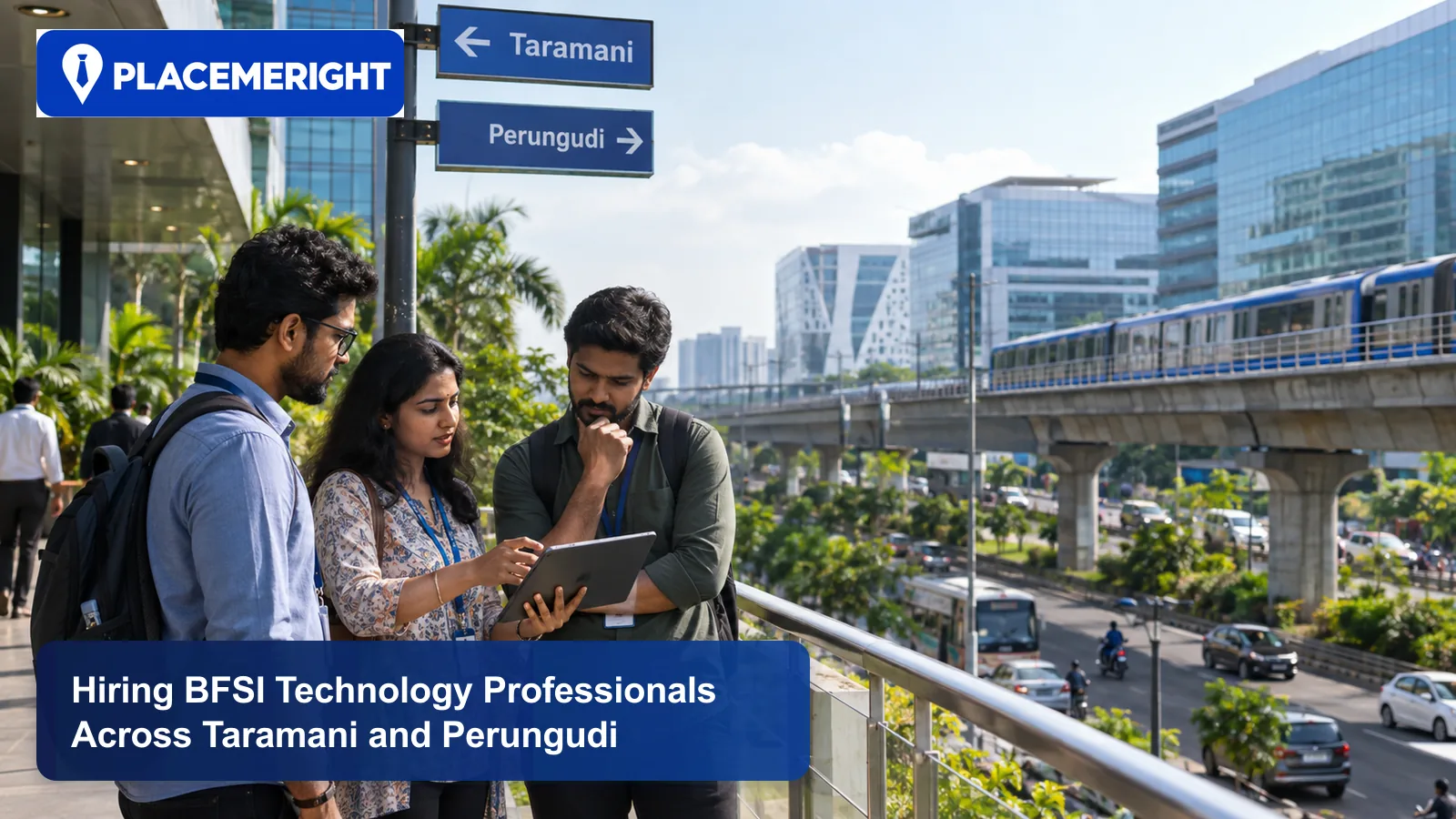
BFSI technology hiring becomes weak when the brief starts with Java, cloud, or data and ends there.
The same technical stack can support a payment, credit decision, trading control, insurance claim, wealth workflow, regulatory report, customer onboarding journey, or internal finance process.
Each workflow has a different consequence when it fails.
For employers hiring around Taramani and Perungudi, the first task is to connect the financial workflow, system boundary, control obligation, and engineering mandate.
Ground the corridor in official context
Software Technology Parks of India locates its Chennai centre on Rajiv Gandhi Salai in Taramani.
STPI's FinBlue Centre of Entrepreneurship is also located there. It identifies focus areas including banking, insurance, lending, payments, trading, remittance, wealth advisory, risk, and compliance. Its service context includes APIs, payment gateways, bank and NPCI sandboxes, identity-linked services, core banking software, and cloud resources.
Tamil Nadu's FinTech Policy describes Chennai as a financial-technology hub and names banking, financial services, insurance, digital technology, automation, AI, data analytics, and industry sandboxes among the intended ecosystem.
This official material supports the relevance of financial technology to Chennai and Taramani.
It does not prove that every office in Taramani or neighbouring Perungudi performs BFSI work. Employers must verify the exact workplace, business unit, product, customer, and operating model.
Use the vacancy snapshot carefully
On 28 July 2026, PlaceMeRight reviewed the newest 120 published records returned by its Chennai live-jobs endpoint.
The records were posted from 16 to 23 July. They represented 98 named employers and 101 distinct normalized titles. The endpoint reported 1,234 published Chennai records in total at collection time.
Use PlaceMeRight's Chennai technology recruitment context when converting this city-level view into a specific BFSI hiring brief.
A conservative title-only rule found 84 application or software titles, 34 data and analytics titles, 15 cloud or platform titles, and 12 QA or testing titles.
The groups overlap.
The title classifier found no explicit finance-family term in the newest 120. That does not mean there was no BFSI technology work. A "Java Developer", "Data Engineer", "Application Support Analyst", or "QA Engineer" can support a financial workflow without naming the industry in the title.
Compensation and workplace type were absent across all records, while experience was populated for one. Location was reported only as Chennai.
The sample cannot measure BFSI demand, candidate supply, local office distribution, salary, or work mode. Its limitation reinforces the article's method: classify the workflow from verified role content rather than infer industry from a generic title.
Choose the employer operating model
Start with the organisation's relationship to financial services.
| Operating model | Typical technology consequence | | --- | --- | | bank or regulated financial institution | controls, resilience, customer protection, data, audit, regulatory change | | insurer | policy, underwriting, claims, actuarial data, distribution, document and customer workflows | | fintech product company | product adoption, transaction integrity, partner integrations, fraud, scale, trust | | technology services provider | client delivery, domain translation, handoff, documentation, SLA, multi-system change | | operations or shared-services team | workflow accuracy, case management, controls, reporting, escalation | | enterprise vendor | configurable product, implementation, integration, support, release governance |
One employer may contain several models. State which one the role serves.
Map the financial workflow before the technology
Payments and transaction processing
Clarify authorisation, routing, settlement, reconciliation, refunds, disputes, fraud checks, ledger impact, and partner failure.
A software role may need idempotency, event processing, API design, observability, and recovery. A product role may need merchant or customer workflow understanding. A support role may need traceable incident handling.
Lending and credit
Clarify customer acquisition, identity, eligibility, underwriting, decisioning, documentation, disbursal, servicing, collections, and reporting.
Data and model roles need governance, monitoring, explainability appropriate to the use, and controlled change. Software roles need clear state transitions and evidence.
Markets and treasury
Clarify instrument, order or trade lifecycle, pricing, margin, risk, confirmation, settlement, reference data, and controls.
Latency, data quality, calculation correctness, resilience, and auditability may have different importance depending on the system.
Wealth and investment
Clarify onboarding, suitability, portfolio, advice boundary, orders, reporting, reconciliation, and client communication.
User experience must coexist with disclosures, data confidence, permissions, and operational review.
Insurance
Clarify quote, policy issuance, endorsement, premium, underwriting, claim, document, survey, fraud, and settlement workflows.
Integration with partners and legacy systems can be as important as front-end product work.
Financial crime, identity, and compliance
Clarify KYC, screening, transaction monitoring, investigation, case management, evidence, escalation, and regulatory reporting.
The role may require privacy, false-positive analysis, explainable decisioning, access control, and careful operating handoff.
Build a workflow-control-role map
Create one map before releasing the job description.
| Layer | Questions | | --- | --- | | business event | What starts the workflow? | | actors | Which customer, operator, partner, or control owner acts? | | system | Which application, data product, model, or platform is in scope? | | financial consequence | What amount, account, position, policy, or entitlement can change? | | control | What must be prevented, detected, approved, reconciled, or evidenced? | | operating duty | Who monitors, supports, investigates, and recovers? | | role decision | What can the hire decide or change? | | proof | What interview evidence would demonstrate that capability? |
This map prevents a technology list from replacing the actual mandate.
Read current employer activity as workflow evidence
Citi's current Chennai careers pages provide a useful employer-authored example of role diversity.
Its Chennai technology search currently includes application development, application support, data, digital software engineering, infrastructure, systems engineering, technology product management, technology project management, and quality categories.
Current listed roles include work related to Loan IQ, credit-risk technology, data engineering, Java, Python, AI, application support, distributed storage, digital product management, KYC operations, wealth technology, and risk analytics.
A current FI Risk Senior Java Developer posting describes application-development work in risk technology. Citi's current Chennai operations and technology search connects roles across investment operations, wealth data, KYC, support, and credit-risk technology.
This is one employer's public activity, not a census of Chennai BFSI hiring.
It demonstrates that BFSI technology work spans software, data, product, operations, risk, support, and control rather than one "banking developer" profile.
Design role briefs by responsibility
Software engineer
State:
- financial workflow;
- service or application boundary;
- data and integration pattern;
- resilience and recovery expectation;
- security and control obligations;
- test and release process;
- production support duty.
Data engineer or analyst
State:
- data consumer;
- source and contract;
- timeliness and quality expectation;
- reconciliation;
- lineage and access;
- model or reporting consequence;
- incident and correction process.
QA or quality engineer
State:
- critical journeys;
- test data controls;
- API, batch, event, and UI boundaries;
- reconciliation and negative cases;
- release gate authority;
- evidence retained;
- production-defect learning.
Product manager or business analyst
State:
- customer and operator;
- regulated or control constraint;
- problem and outcome;
- discovery access;
- decision authority;
- adoption measure;
- change and release boundary.
Support or reliability engineer
State:
- service hours;
- severity model;
- financial and customer impact;
- monitoring;
- investigation access;
- communication responsibility;
- recovery and post-incident evidence.
Test domain depth without trivia
Do not ask candidates to recite abbreviations.
Use a workflow case.
Example: duplicate payment concern
Give the candidate:
- a customer reporting two debits;
- an upstream timeout;
- an idempotency key;
- a partner callback delay;
- a ledger entry;
- a reconciliation batch;
- incomplete observability.
Ask:
1. What facts are needed first? 2. Which systems and owners are involved? 3. What customer harm must be contained? 4. How should the technical failure be diagnosed? 5. What should be communicated and recorded? 6. What permanent control or product change might follow?
Score the candidate's reasoning for the target role.
An engineer should go deeper into system behaviour. A product manager should connect customer, process, partner, and decision. A support lead should expose triage, escalation, and communication. A QA lead should identify missing test and release evidence.
Test control judgment
BFSI experience is not useful when the candidate treats controls as paperwork detached from the system.
Ask for a real example where a control:
- prevented an unsafe change;
- detected a data or transaction problem;
- created excessive noise;
- failed because ownership was unclear;
- needed redesign after an incident.
Look for:
- the risk addressed;
- evidence produced;
- operator and reviewer;
- exception handling;
- impact on users and delivery;
- learning after failure.
The goal is not maximum process. It is appropriate, working control.
Keep Taramani and Perungudi geography precise
Do not advertise "OMR" when the candidate needs an exact destination.
Record:
- Taramani, TIDEL Park, Rajiv Gandhi Salai, Perungudi, or another actual location;
- building and entrance;
- MRTS, bus, parking, shuttle, and last-mile facts;
- office days and hours;
- late support or incident expectations;
- whether the business unit works from the same office as the technology team.
Taramani and Perungudi are adjacent parts of a larger corridor, but candidate journeys differ by origin and last mile.
Do not publish an unverified commute time.
Calibrate the interview panel to the workflow
Use:
1. Hiring manager: role outcome and level. 2. Technology owner: engineering, data, platform, or quality evidence. 3. Domain or operations owner: workflow and operating consequence. 4. Risk or control owner: only when materially part of the job. 5. Product or customer owner: for roles affecting journeys and adoption.
One interviewer can own multiple lenses in a smaller organisation.
Publish the scorecard before interviewing and let panelists score independently.
Verify closure reality
Before an offer, confirm:
- exact office and work model;
- support hours and on-call rotation;
- access to regulated or sensitive systems;
- background or compliance steps that are lawful and role-relevant;
- compensation components;
- notice period;
- title and reporting line;
- travel to client or alternate sites;
- decision authority promised in the interview.
BFSI candidates often evaluate the operating burden as carefully as the technology.
Plan domain onboarding before choosing an adjacent candidate
An employer can widen a search responsibly when the learning path is explicit.
Create a 30-day domain plan with:
- one workflow owner who can explain the process;
- a sanitized end-to-end transaction or case;
- system and data maps;
- relevant policies and control narratives;
- observed operations or support sessions;
- common exceptions and failure examples;
- a glossary tied to real decisions;
- one review where the new hire teaches the workflow back.
Separate facts the person must know before changing production from context that can be learned while working.
For an engineer entering payments, the early bar may include transaction states, idempotency, reconciliation, and incident escalation. For a data hire entering credit, it may include source meaning, decision use, quality, access, monitoring, and change approval. For a product hire entering insurance, it may include policy, claim, operator, customer, and regulatory boundaries.
This approach is more reliable than demanding a fixed number of BFSI years without testing what those years actually taught.
Quick checklist
- [ ] Employer operating model is named.
- [ ] Financial workflow is mapped end to end.
- [ ] Failure consequence and customer harm are clear.
- [ ] Controls are connected to system behaviour.
- [ ] Role decision rights are written.
- [ ] Generic titles are not used as industry proof.
- [ ] Work sample matches the actual workflow.
- [ ] Domain questions test judgment, not trivia.
- [ ] Taramani or Perungudi office is exact.
- [ ] Support, incident, and time-zone expectations are visible.
- [ ] Scorecard ownership is divided across the panel.
- [ ] No salary, supply, or demand claim is inferred from the snapshot.
Frequently asked questions
Do BFSI software engineers need prior banking experience?
Not always. Define the consequence and learning curve. Some roles require deep workflow and control experience; others can use strong engineering evidence plus structured domain onboarding.
How should employers test fintech versus bank experience?
Do not treat the labels as levels. Test the relevant workflow, system consequence, control judgment, customer context, and operating ownership.
Is Taramani the same hiring market as Perungudi?
They are connected parts of Chennai's technology corridor, but the exact office, access, last mile, and team practice still matter. Verify each candidate's feasibility.
Which BFSI roles need the most specific control testing?
Roles influencing money movement, credit, identity, financial crime, customer records, market risk, regulatory reporting, security, and production change often need explicit control evidence. The depth depends on the actual system.
Does the PlaceMeRight sample show no BFSI activity because no financial title matched?
No. Title-only matching misses industry work hidden behind generic titles. The sample cannot establish the presence or absence of BFSI demand without verified descriptions and employer context.
What should a domain interview avoid?
Avoid obscure terminology contests, unsupported assumptions about one employer's process, and questions unrelated to the role's decision boundary.
Related reading
- PlaceMeRight technology recruitment services
- Hire developers and technical teams
- Share a Chennai BFSI technology requirement
Conclusion
Strong Chennai BFSI hiring starts with a financial workflow and its consequence, not a stack list.
Map the event, actors, system, control, operating duty, and role decision. Then test the candidate with a realistic case and disclose the exact Taramani or Perungudi workplace.
That creates a useful local hiring process without pretending that a generic engineering title proves financial-domain depth.
CTA
PlaceMeRight helps Chennai employers calibrate BFSI technology roles around workflow ownership, controls, engineering evidence, office context, interview design, and closure feasibility.
Discuss a Chennai BFSI technology search
References
- PlaceMeRight, Chennai live employer-demand snapshot, accessed 28 July 2026
- Software Technology Parks of India, About STPI Chennai
- Software Technology Parks of India, FinBlue Centre of Entrepreneurship
- Government of Tamil Nadu, Tamil Nadu FinTech Policy 2021
- Government of India, Tamil Nadu FinTech Policy information, reviewed July 2026
- Citi, Technology jobs in Chennai
- Citi, Operations and technology jobs in Chennai
- Citi, FI Risk Senior Java Developer, Chennai
- Tamil Nadu Information Technology Department, State IT policies
Related PlaceMeRight resources
Our Tech Recruitment Services by City
Looking to hire vetted software engineers or scale your engineering teams in India's leading tech hubs? Explore our localized recruitment services: