
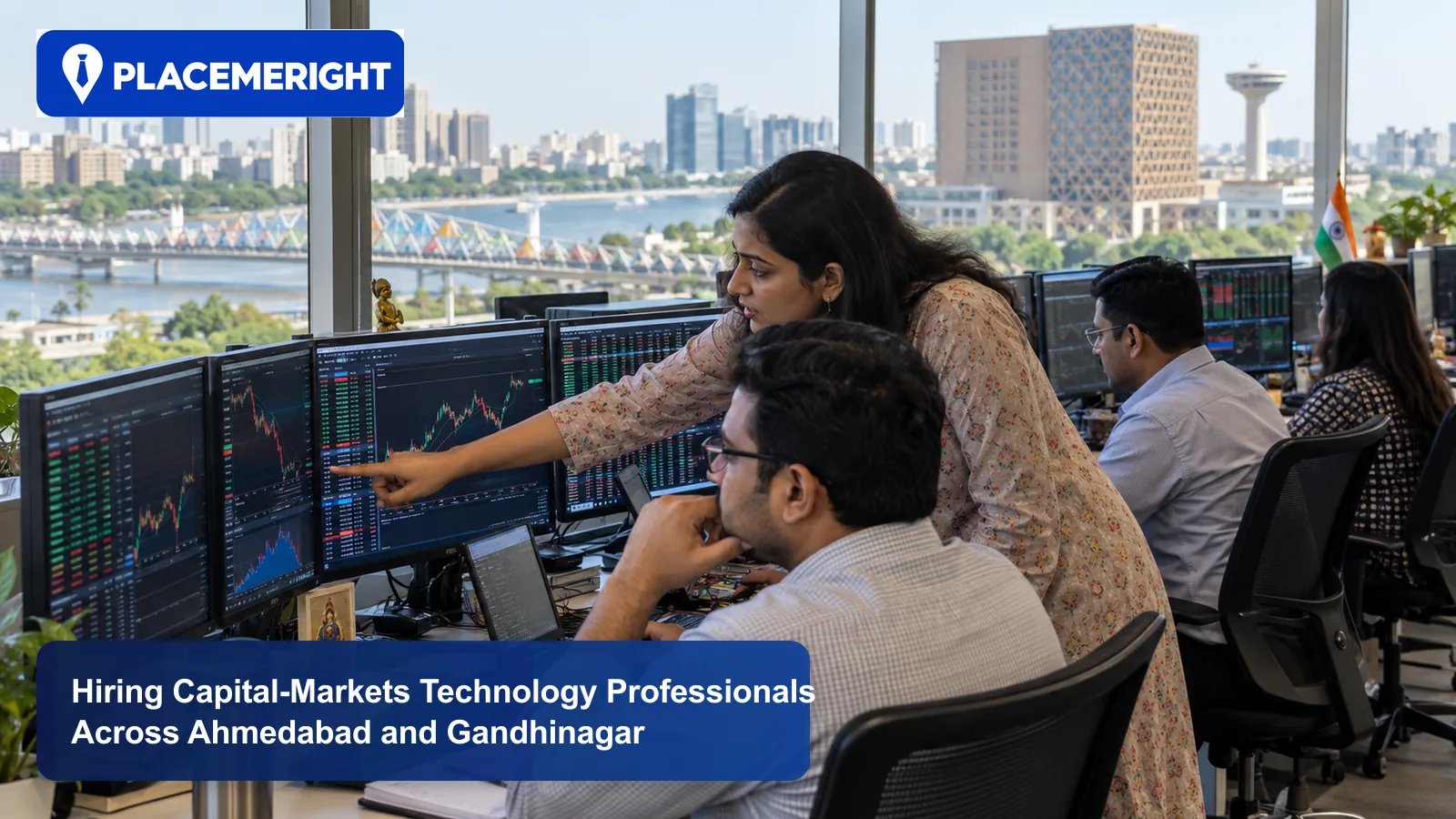
Capital-markets technology is not one software category.
It is a controlled chain in which timing, data quality, identity, risk, execution, clearing, settlement, surveillance, and reporting depend on one another.
That matters when an Ahmedabad employer asks for a "capital-markets developer," "fintech analyst," or "trading support engineer." The same title can describe market-data engineering, order-management development, post-trade operations technology, surveillance configuration, regulatory reporting, platform reliability, or business analysis.
The hiring brief should name the part of the market lifecycle the person will protect.
Read the Ahmedabad-Gandhinagar market accurately
GIFT City is in Gandhinagar, not Ahmedabad. Ahmedabad remains a relevant employer, residential, professional-services, and technology market, but the workplace should be stated precisely.
IFSCA is the unified regulator for financial products, financial services, and financial institutions in India's international financial services centre. Its current capital-market materials identify a regulated ecosystem that includes exchanges, clearing corporations, a depository, broker-dealers, clearing members, custodians, depository participants, investment bankers, and other intermediaries.
IFSCA's 2026 notices also show that cyber resilience, reporting, market infrastructure, and regulated operating controls remain active concerns. A current GIFT City software-engineering role published by Bank of America adds employer evidence around distributed data systems, APIs, cloud, and DevOps.
These sources establish role variety. They do not prove the number of candidates available, the time needed to hire, or a neighbourhood salary.
Use PlaceMeRight's Ahmedabad technology recruitment context for the wider city search. Record whether the worksite is GIFT City, Gandhinagar, SG Highway, Prahlad Nagar, another Ahmedabad location, or remote from India.
Map the market-infrastructure control chain
Start with eight connected stages.
1. Access and identity
This stage establishes who or what may use a service.
Work can include:
- user and system identity;
- entitlements;
- client onboarding;
- authentication;
- API credentials;
- session control;
- privileged access;
- audit evidence.
A developer working here needs more than login-page experience. The hiring panel should inspect how permissions are modelled, changed, reviewed, and traced.
2. Market and reference data
Trading and post-trade systems depend on timely, correctly identified data.
Work can cover:
- prices and quotes;
- instrument masters;
- corporate actions;
- calendars;
- currency and rate data;
- legal-entity references;
- data lineage;
- validation and exception handling.
Ask where the candidate has detected stale, incomplete, duplicated, or mis-keyed data before it became a downstream decision.
3. Pre-trade controls
An order may need credit, position, price, limit, eligibility, jurisdiction, or product checks before execution.
The role may involve:
- limit services;
- rules engines;
- reference-data dependencies;
- low-latency decisions;
- rejection reasons;
- control overrides;
- evidence retention.
The important question is how the system fails when a dependency is unavailable or uncertain.
4. Order and execution flow
This stage can involve order capture, routing, acknowledgement, modification, cancellation, execution, and client status.
Assess:
- state-machine design;
- idempotency;
- message ordering;
- protocol knowledge;
- concurrency;
- latency;
- replay;
- recovery after partial failure.
Do not infer this depth from "worked on a trading platform." Trace one order through every state the candidate owned.
5. Clearing and margin
Clearing technology may calculate obligations, positions, collateral, margin, or risk after execution.
Relevant evidence can include:
- event ingestion;
- netting logic;
- valuation inputs;
- margin processes;
- batch and real-time boundaries;
- exception queues;
- reconciliation;
- controlled reruns.
The candidate should explain how a correction propagates without losing the original record.
6. Settlement and custody
Settlement connects cash, securities, instructions, accounts, status, and failure management.
Work may include:
- settlement instructions;
- depository interfaces;
- cash and security movement;
- matching;
- custody records;
- fails;
- reconciliation;
- client reporting.
Ask how the person distinguishes a delayed message from an incorrect instruction.
7. Surveillance and regulatory reporting
Surveillance and reporting roles may combine domain logic, data engineering, analytics, case workflow, evidence, and regulatory interpretation.
Look for:
- event completeness;
- rule or model governance;
- alert lineage;
- false-positive analysis;
- investigation workflow;
- report validation;
- change control;
- submission and correction evidence.
A dashboard alone is not a control. The team must know whether the underlying event population is complete.
8. Resilience and production operations
Every stage depends on service health.
Work may span:
- monitoring and alerting;
- incident command;
- capacity;
- release controls;
- failover;
- disaster recovery;
- cybersecurity;
- vulnerability response;
- root-cause removal.
Capital-markets operations make restoration important, but an uncontrolled restart can hide evidence or duplicate processing. Assess judgement under consequence.
Choose the role family before choosing the title
Market-platform engineer
Primary ownership may include order, execution, market-data, or integration services.
Require evidence of:
- distributed-system behaviour;
- state and message handling;
- automated testing;
- performance;
- observability;
- controlled release.
Domain knowledge can be developed, but the brief should say how much is required on entry.
Data and controls engineer
This role may own pipelines, quality rules, lineage, reconciliation, reporting datasets, or analytics platforms.
Ask about:
- source contracts;
- late and corrected data;
- completeness;
- lineage;
- access;
- retained evidence;
- consumer impact.
SQL familiarity without control ownership is not enough.
Capital-markets business analyst
A strong analyst can connect product and process rules to system behaviour.
Test whether the person can:
- map actors and states;
- express control intent;
- resolve terminology;
- identify exceptions;
- define acceptance evidence;
- support testing;
- communicate with operations, risk, and technology.
The role should not become a messenger between teams that never share a model.
Production and reliability engineer
The brief should define whether the person restores a service, owns problem removal, changes application code, administers infrastructure, or coordinates several teams.
Inspect:
- incident diagnosis;
- observability;
- safe intervention;
- batch recovery;
- replay;
- stakeholder updates;
- problem management;
- automation.
State shifts and on-call expectations before sourcing.
Surveillance or reporting technologist
This person may configure rules, engineer data, validate reports, operate case systems, or build control automation.
The panel should distinguish regulatory interpretation from software implementation and data-control ownership. Few candidates will own all three equally.
Build a role charter around one controlled outcome
Use a six-line charter:
1. Market activity: the product, instrument, client, or operational process. 2. Lifecycle stage: the primary stage in the eight-part chain. 3. Controlled outcome: what must remain accurate, timely, available, or reviewable. 4. Decision authority: what the hire may change during normal work or an incident. 5. Interfaces: upstream, downstream, operations, risk, compliance, and vendors. 6. Evidence: the artefact proving the outcome.
For example:
> Own completeness and traceability of trade events entering a surveillance platform. Investigate ingestion gaps, coordinate source corrections, validate backfills, and preserve rule and alert lineage. Work with application engineering, market operations, surveillance users, and control teams.
That is more useful than "five years of Java, SQL, and capital markets."
Use one cross-chain incident in the interview
Give every candidate the same situation:
> A market-data feed begins arriving late for one product group. Some orders are rejected by a pre-trade price check, while other orders proceed using the last accepted value. Operations sees a mismatch between the order log and a downstream report. The opening session has started, and the cause is unknown.
Ask the candidate to establish facts
- Which timestamps matter?
- What is the authoritative data state?
- Which products, clients, and orders may be affected?
- Is the control failing closed, failing open, or behaving inconsistently?
- Which logs and event identifiers must be preserved?
- Who has decision authority?
A strong answer separates known impact from possible exposure.
Ask for a containment decision
Possible actions include:
- disabling affected instruments;
- rejecting uncertain orders;
- isolating a source;
- moving to an approved alternate feed;
- pausing downstream publication;
- increasing review;
- preserving events for replay.
Do not score one universal action. Score how the candidate connects the intervention to market, client, control, and recovery consequences.
Introduce a second fact
Reveal that the alternate feed uses a different instrument identifier for part of the product set.
The candidate should revisit the plan, not force the original answer. Look for reference-data reasoning, mapping validation, controlled scope, and explicit approval.
Ask for recovery and correction
The candidate should address:
- corrected input;
- deterministic replay;
- duplicate prevention;
- downstream reconciliation;
- rejected-order review;
- report correction;
- stakeholder communication;
- post-incident control change.
The quality of the recovery plan reveals whether the person understands the whole chain.
Score evidence across four dimensions
Lifecycle reasoning
- 4: traces the event across relevant stages and names control consequences;
- 3: covers the primary stage and important interfaces;
- 2: reasons within one component but misses downstream effects;
- 1: lists tools without explaining the market event.
Data integrity
- 4: addresses identity, time, lineage, completeness, correction, and replay;
- 3: covers source validation and reconciliation;
- 2: checks values but not provenance or propagation;
- 1: assumes data is trustworthy because a pipeline succeeded.
Operational judgement
- 4: contains impact, preserves evidence, establishes authority, restores safely, and learns;
- 3: reaches a sound recovery with a minor governance gap;
- 2: jumps to a restart or code fix without defining consequence;
- 1: treats the incident as another team's problem.
Communication and control
- 4: adapts technical detail for operations, risk, leadership, and affected users;
- 3: provides clear status and decision points;
- 2: reports activity rather than impact and choices;
- 1: withholds uncertainty or overstates confidence.
Require written evidence from each interviewer before the panel discusses the candidate.
Keep local sourcing geography honest
An office in GIFT City creates a specific workplace requirement. It does not make every relevant professional a GIFT City resident.
The search may include:
- GIFT City and Gandhinagar professionals;
- Ahmedabad-based technology and financial-services talent;
- candidates elsewhere in Gujarat;
- capital-markets specialists in Mumbai, Pune, Bengaluru, Hyderabad, Chennai, or Gurugram;
- remote or relocation-ready candidates where the operating model permits.
State:
- exact building and city;
- office days;
- shift or market-hour coverage;
- transport support;
- relocation expectation;
- travel to another office;
- remote incident responsibility;
- regulatory or data-access constraints.
Measure response and conversion by geography. Do not publish assumptions about local supply.
Confirm the accepted work arrangement again before issuing an offer.
Design onboarding around the transaction lifecycle
The first month should connect the new hire to a real controlled flow.
Provide:
- a system and process map;
- glossary of products, actors, and event states;
- control inventory;
- sample messages and identifiers;
- monitoring and incident history;
- release and access procedures;
- named operations, risk, and technology partners.
Assign one bounded task such as tracing a reconciliation break, improving an alert, documenting a replay procedure, or validating a control after a change.
Review whether the person can explain:
1. the original event; 2. the expected state transition; 3. the evidence of deviation; 4. the business and control consequence; 5. the intervention; 6. the proof of recovery.
This continues the same evidence model used in hiring.
Quick checklist
- State whether the workplace is GIFT City, Gandhinagar, or Ahmedabad.
- Name the market activity and lifecycle stage.
- Define the controlled outcome before listing tools.
- Separate platform, data, analysis, support, surveillance, and reporting roles.
- Map upstream and downstream interfaces.
- Use one delayed-data incident across the interview panel.
- Test correction, replay, reconciliation, and evidence retention.
- Score lifecycle reasoning, data integrity, operational judgement, and communication.
- State shifts, office days, access constraints, and incident duties.
- Measure the employer's own funnel instead of asserting local supply.
Frequently asked questions
Is a fintech developer automatically suitable for capital-markets technology?
No. Fintech is broad. Trace the candidate's product, transaction lifecycle, control environment, data consequences, and production ownership.
Must every engineer already understand clearing and settlement?
Not necessarily. Define the entry-level domain depth and a learning plan. Roles with immediate control authority or complex post-trade ownership may require stronger prior evidence.
Should operations and technology candidates use different incidents?
They can use the same event with different expected depth. A shared scenario helps the panel inspect handoffs and whether each person understands adjacent consequences.
Can Ahmedabad-based candidates support a GIFT City role?
That depends on the stated office schedule, travel feasibility, shifts, and candidate preference. Ask directly and record the arrangement; do not infer it from a city label.
Are current job postings proof of a local talent pool?
No. They are evidence of role design and employer demand at a point in time. They do not prove candidate availability or hiring speed.
How should an employer assess regulatory-reporting experience?
Ask the candidate to trace source events through transformation, validation, submission, correction, approval, and retained evidence. Tool familiarity alone is insufficient.
Related reading
- Hire technology professionals for regulated systems
- Explore employer-side technical recruitment
- Discuss an Ahmedabad or GIFT City hiring brief
Conclusion
Capital-markets technology hiring becomes clearer when the employer follows the event.
Identify who enters it, which data describes it, what controls it must pass, how it executes, where obligations are calculated, how it settles, what must be monitored, and which evidence survives.
Then hire for the stage the person will own and the interfaces they must protect.
Translate that event chain into a role scorecard before sourcing: name the required market process, control boundary, technology depth, stakeholder group, and evidence the candidate must explain. This preserves domain precision without turning one project example into a universal qualification.
CTA
PlaceMeRight helps Ahmedabad and GIFT City employers calibrate capital-markets technology roles, separate domain and engineering evidence, and build interviews around real transaction and control consequences.
Share your capital-markets technology requirement
References
- IFSCA: capital-market intermediaries
- IFSCA: current circulars, notices, and market updates
- IFSCA: unified regulatory role and IFSC activities
- IFSCA annual report 2024-25
- IFSCA: Global Securities Markets Conclave 2.0
- GIFT City: official financial-services and technology ecosystem
- Bank of America: GIFT City software-engineering role
Related PlaceMeRight resources
Our Tech Recruitment Services by City
Looking to hire vetted software engineers or scale your engineering teams in India's leading tech hubs? Explore our localized recruitment services: