
Why cloud architect hiring fails (and why migrations go over budget)
Cloud architecture interviews often test:
- service memorization (“what is X service?”)
- high-level diagrams without constraints
- generic best practices
But the job is tradeoffs:
- security boundaries vs developer speed
- reliability vs cost
- operational simplicity vs architectural “purity”
Hiring fails when a candidate can draw a diagram but can’t answer:
- “What breaks at 10x load?”
- “How do we reduce blast radius?”
- “What’s the cost driver and how do we control it?”
What strong cloud architects do differently
In practice, strong cloud architects:
- ask for constraints (SLA, data sensitivity, budget, team maturity)
- design for failure (multi-AZ, fallbacks, retries)
- reduce complexity (few patterns reused well)
- define guardrails (network boundaries, IAM discipline)
- think about day-2 operations (monitoring, incident readiness)
The signals that matter most in cloud architecture interviews
1) Tradeoff clarity (can they pick a path and justify it?)
Strong candidates:
- explain why a simpler design wins
- show where complexity is necessary (and where it isn’t)
- reason about latency, availability, and cost drivers
2) Security boundaries (least privilege and blast radius)
Look for:
- IAM discipline and access segmentation
- network boundary clarity (VPC/VNet, private endpoints)
- logging and auditability
3) Operational readiness (day-2 thinking)
Strong architects:
- define monitoring/alerting expectations
- plan rollback and safe deployments
- design for incident response
A practical interview loop for hiring cloud architects in India
Round 1: 20-minute screen (signals: constraints-first thinking)
Ask:
- “Describe a cloud architecture decision you made. What tradeoff did you accept?”
- “How do you reduce blast radius in production?”
- “What are your top 3 cost controls for cloud?”
Pass criteria:
- specific decisions with measurable outcomes
Round 2: 60-minute constrained design review (signals: real architecture)
Give a realistic prompt:
- “A B2B SaaS app expects 10x spikes during campaigns. Data includes PII. The team deploys weekly. Target availability: 99.9%. Budget is watched closely.”
Ask the candidate to design:
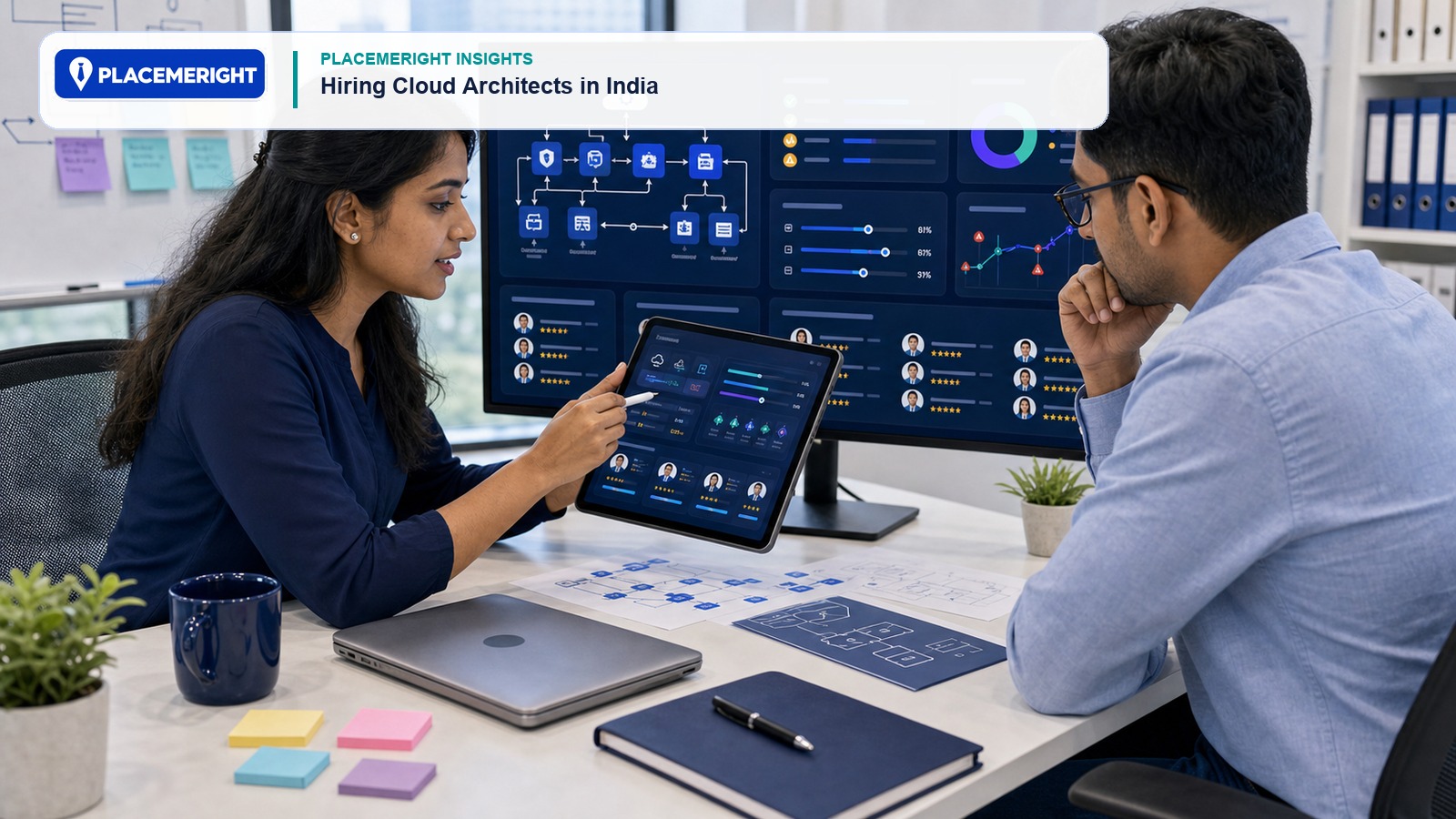
- network boundaries (public vs private)
- identity and access model basics
- data storage approach + encryption
- scaling strategy (what scales automatically, what doesn’t)
- cost drivers + how to reduce them
- operational plan (monitoring, runbooks, incident readiness)
Grade for clear reasoning and prioritization, not for naming every service.
Round 3: Threat-and-failure “what-if” drill (20 minutes)
Ask:
- “What if a dependency goes down?”
- “What if a key is leaked?”
- “What if a region outage happens?”
Strong candidates choose a pragmatic mitigation aligned to your SLA and budget.
Scorecard (simple, consistent)
Rate each bucket: Strong / Acceptable / Risk.
1) Tradeoff clarity
2) Security boundary thinking
3) Reliability planning
4) Cost awareness
5) Operational readiness (day-2)
6) Simplicity and standardization mindset
If “simplicity” is a Risk, your team may inherit an architecture that is hard to operate.
What to avoid (common cloud architect hiring mistakes)
- Service memorization quizzes
- Diagrams without constraints (real work always has constraints)
- Ignoring cost in interviews (cost is architecture)
- Not testing operational thinking (day-2 is where reality happens)
Quick checklist (copy/paste)
Use this as a lightweight standard for your TA/RPO team before you start interviews:
- Confirm the role charter (outcomes, scope, stakeholders).
- Define 5–7 signals to test (must-haves vs trainable).
- Run a structured loop (same questions, same scoring).
- Use a scorecard with clear pass/fail thresholds.
- Communicate timelines and feedback windows at every stage.
- Track funnel metrics (time-to-interview, pass-through, offer acceptance).
- Close with a crisp offer narrative and joining plan.
FAQs
Should we hire cloud architects who can code?
Coding is a strong advantage, especially in smaller teams. But the essential signal is decision-making under constraints and alignment with engineering execution.
How do we prevent “over-architecture”?
Use constrained design reviews and score for simplicity. Ask: “What would you remove if we had to ship in 2 weeks?”
How can we improve cloud architect shortlist quality quickly?
Replace tool trivia with a single constrained design review plus a cost/tradeoff discussion. It filters candidates who can talk cloud but can’t make decisions.
Conclusion
The best hiring outcomes come from operational clarity: define what good looks like, use a structured interview loop, and evaluate candidates with scorecards instead of gut feel. When you communicate timelines clearly and track a few funnel metrics (speed, pass-through rates, and offer acceptance), you reduce drop-offs and hire faster without lowering the bar.
If you want help calibrating the role, tightening the screening, and improving shortlist quality for tech hiring in India, a specialist hiring partner can run this process end-to-end.
CTA (PlaceMeRight)
If your cloud migration is stalling, costs are rising, and architecture decisions keep changing, PlaceMeRight can help you hire cloud architects in India who make clear tradeoffs across security, reliability, and cost—so teams ship and operate with confidence.
- Talk to us: `/contact/`
- Explore tech recruitment: `/tech-recruitment/` and `/it-recruitment-agency-india/`
- For embedded pods: `/rpo-services/` and `/recruitment-process-outsourcing-india/`
- Review trust markers: `/credentials/`
References
- AWS Well-Architected Framework: https://docs.aws.amazon.com/wellarchitected/latest/framework/welcome.html
- Azure Well-Architected Framework: https://learn.microsoft.com/azure/well-architected/
- Google Cloud Architecture Framework: https://cloud.google.com/architecture/framework
Related PlaceMeRight resources
Our Tech Recruitment Services by City
Looking to hire vetted software engineers or scale your engineering teams in India's leading tech hubs? Explore our localized recruitment services:
Tags: