
Why warehouse data engineering hiring fails (and why your dashboards can’t be trusted)
Warehouse-oriented data engineering is often treated like “moving data from A to B.” In practice, the job is:
- build trustworthy tables that represent the business correctly
- define metric logic clearly (and prevent silent drift)
- implement data quality checks and backfills
- keep pipelines reliable and costs predictable
Hiring fails when interviews focus on:
- tool trivia (vendor X vs vendor Y)
- streaming-only questions when the org mostly runs batch
- “years of experience” without ownership proof
The result is pipelines that run… until they silently break, and leadership loses trust in data.
The three signals that predict strong warehouse data engineers
1) Modeling judgment (grain, joins, and business logic)
Strong candidates:
- ask about table grain (“one row per what?”)
- design dimensions/facts with clear definitions
- prevent double-counting and metric ambiguity
2) Data quality discipline (checks, contracts, and backfills)
Look for:
- basic checks (nulls, duplicates, referential integrity)
- freshness monitoring and SLAs
- backfill strategy that doesn’t corrupt data
3) Cost and performance awareness (warehouse bills are real)
Strong engineers:
- understand partitioning/clustering basics
- choose incremental loads where appropriate
- watch query patterns and cost drivers
A practical interview loop for hiring data engineers (warehouse-focused) in India
Round 1: 20-minute screen (signals: ownership + clarity)
Ask:
- “What was your last data incident? How did you detect it and fix it?”
- “How do you prevent metric definition drift?”
- “How do you design for backfills?”
Pass criteria:
- concrete examples with tradeoffs and outcomes
Round 2: 45-minute SQL + modeling exercise (signals: grain + correctness)
Provide:
- a simplified schema (users, orders, events, refunds)
Ask the candidate to:
- define a metric (e.g., net revenue) clearly
- write a SQL query that avoids double-counting
- propose 2 data-quality checks for that table
Grade:
- correctness and reasoning
- clarity of metric logic
Round 3: 45-minute pipeline design review (signals: reliability + cost discipline)
Prompt:
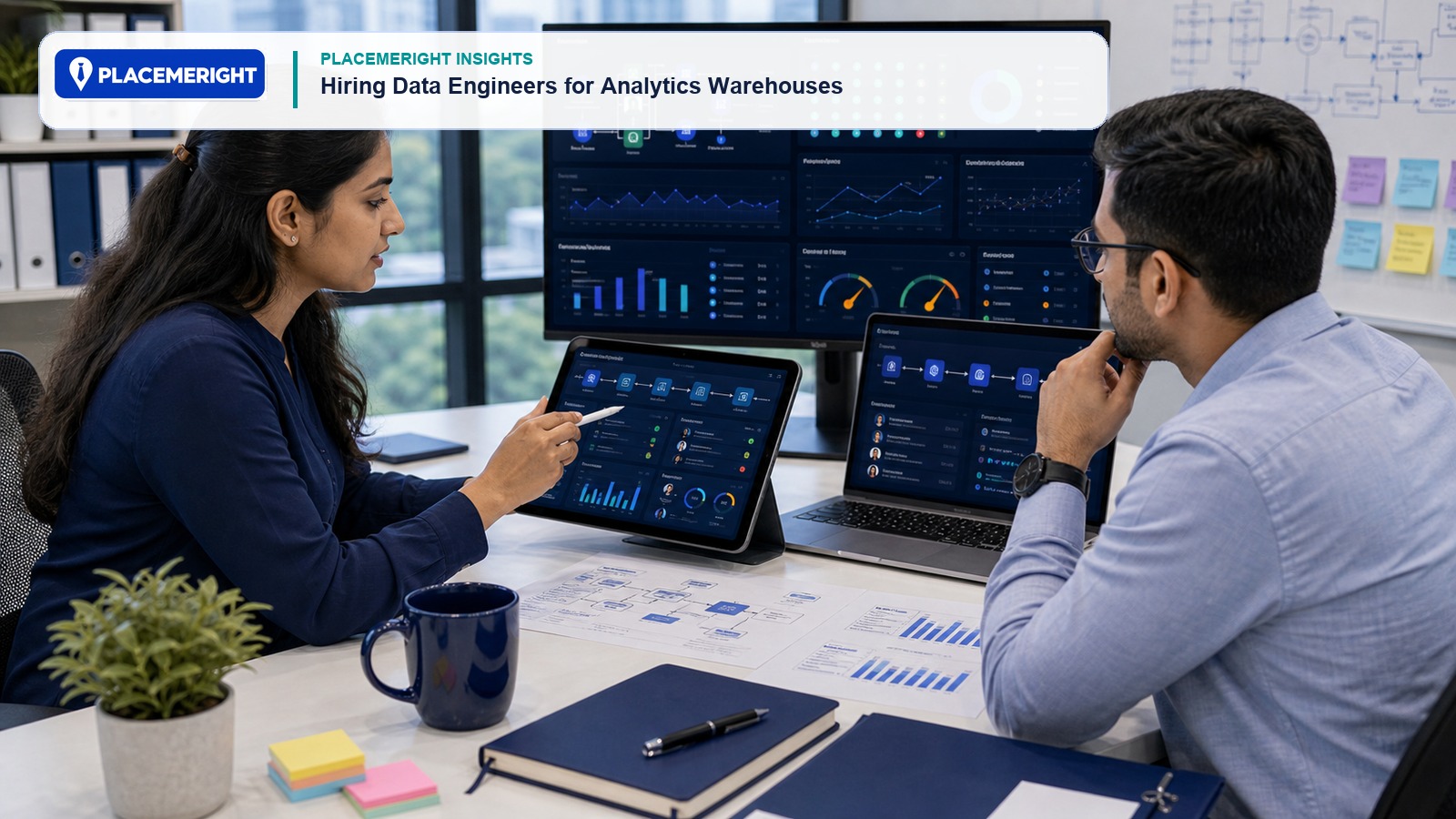
- “Design a daily batch pipeline for the warehouse. Data arrives late. Backfills happen weekly. Stakeholders need freshness guarantees.”
Look for:
- orchestration approach (dependencies, retries, idempotency)
- late-arriving data strategy
- monitoring (freshness + volume anomalies)
- cost controls (incremental loads, avoiding full scans)
Round 4: Stakeholder scenario (20 minutes)
Scenario:
- “The CFO says the dashboard is wrong. The PM says numbers don’t match. You find that two definitions of ‘active customer’ exist.”
Test:
- can the candidate drive alignment?
- can they document metric definitions and prevent recurrence?
Scorecard (simple, consistent)
Rate each bucket: Strong / Acceptable / Risk.
1) Modeling judgment (grain + joins)
2) SQL correctness + reasoning
3) Data quality discipline
4) Pipeline reliability thinking
5) Cost/performance awareness
6) Stakeholder alignment on metrics
If “stakeholder alignment” is a Risk, your data org will stay stuck in debates instead of decisions.
What to avoid (common warehouse data engineering hiring mistakes)
- Treating “tool experience” as the primary signal (tools change; modeling judgment matters)
- Ignoring data quality and freshness (trust is the product)
- Take-homes that require many hours (low conversion, low fairness)
- Over-indexing on streaming questions for batch-heavy orgs
Quick checklist (copy/paste)
Use this as a lightweight standard for your TA/RPO team before you start interviews:
- Confirm the role charter (outcomes, scope, stakeholders).
- Define 5–7 signals to test (must-haves vs trainable).
- Run a structured loop (same questions, same scoring).
- Use a scorecard with clear pass/fail thresholds.
- Communicate timelines and feedback windows at every stage.
- Track funnel metrics (time-to-interview, pass-through, offer acceptance).
- Close with a crisp offer narrative and joining plan.
FAQs
Is this the same as hiring analytics engineers?
Analytics engineers often focus more on semantic modeling and enabling self-serve analytics (sometimes using tools like dbt). Warehouse data engineers are more focused on pipeline reliability, backfills, and platform-level quality. Many teams need both; define scope clearly.
How can we quickly improve data engineer shortlist quality?
Add a modeling + SQL exercise that tests grain and double-counting. Many false positives fail on basics under realistic schemas.
Should data engineers be judged on knowing a specific warehouse vendor?
Only if your role is vendor-specialist. For most teams, fundamentals—modeling, quality, reliability, cost—transfer across vendors.
Conclusion
The best hiring outcomes come from operational clarity: define what good looks like, use a structured interview loop, and evaluate candidates with scorecards instead of gut feel. When you communicate timelines clearly and track a few funnel metrics (speed, pass-through rates, and offer acceptance), you reduce drop-offs and hire faster without lowering the bar.
If you want help calibrating the role, tightening the screening, and improving shortlist quality for tech hiring in India, a specialist hiring partner can run this process end-to-end.
CTA (PlaceMeRight)
If your analytics dashboards are inconsistent and your warehouse pipelines break silently, PlaceMeRight can help you hire data engineers in India who build reliable tables, enforce data quality, and keep costs under control—so teams trust data again.
- Talk to us: `/contact/`
- Explore tech recruitment: `/tech-recruitment/` and `/it-recruitment-agency-india/`
- For embedded pods: `/rpo-services/` and `/recruitment-process-outsourcing-india/`
- Review trust markers: `/credentials/`
References
- Dimensional modeling basics (Kimball Group): https://www.kimballgroup.com/data-warehouse-business-intelligence-resources/
- Data quality dimensions (AWS glossary): https://docs.aws.amazon.com/prescriptive-guidance/latest/aws-glossary/data-quality.html
- Partitioning / clustering concepts (BigQuery docs): https://cloud.google.com/bigquery/docs/partitioned-tables
Related PlaceMeRight resources
Our Tech Recruitment Services by City
Looking to hire vetted software engineers or scale your engineering teams in India's leading tech hubs? Explore our localized recruitment services:
Tags: