
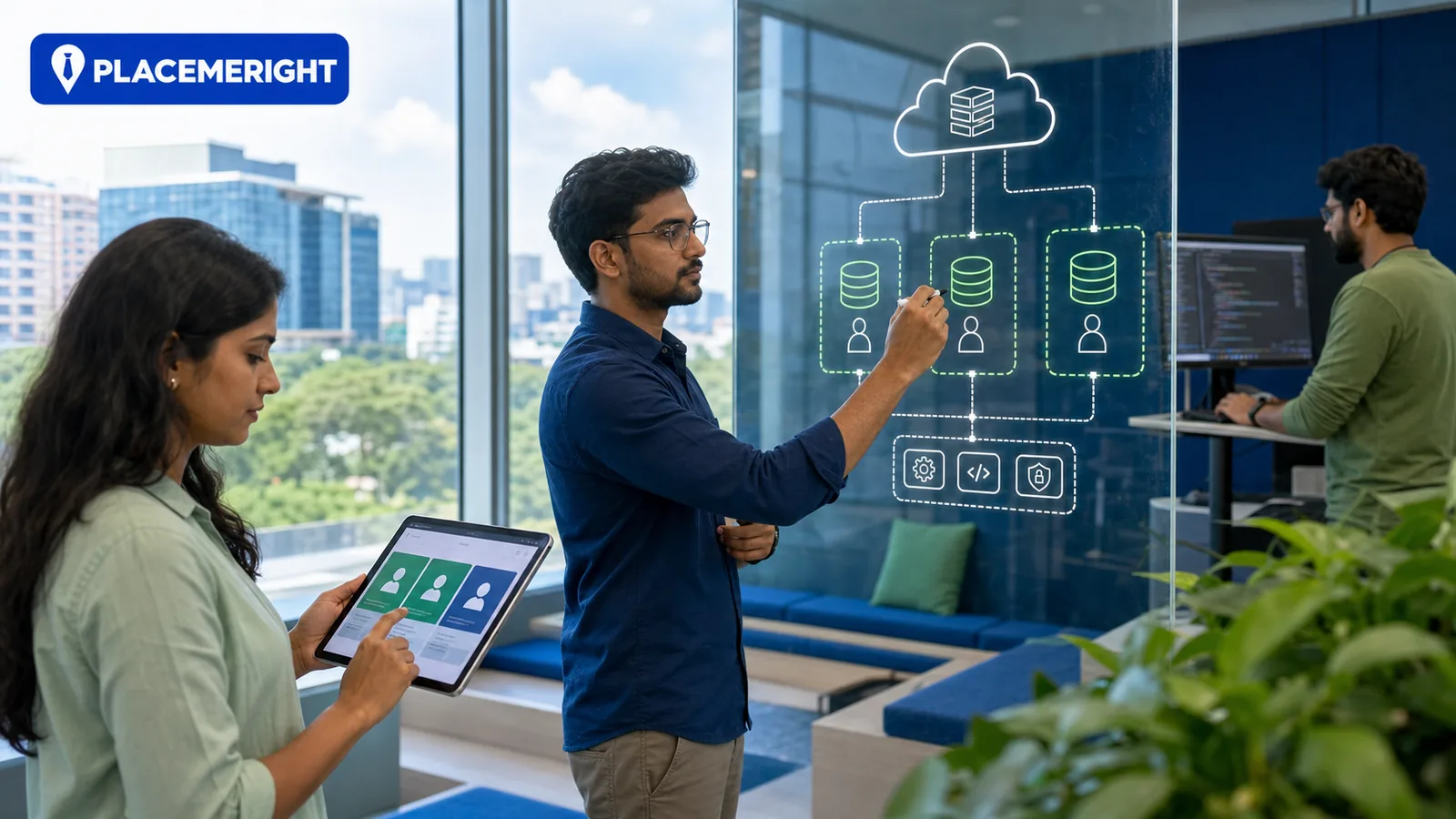
A candidate can design a scalable web service and still miss the hardest part of a multi-tenant software product: one customer's identity, configuration, data, workload, support action, and lifecycle must not become another customer's problem.
Logging in is not tenant isolation. Adding a tenant identifier to a table is not a complete isolation strategy.
For a Bangalore SaaS engineering search, build a tenant-isolation evidence matrix. Across every component, record how tenant context is established, enforced, propagated, observed, tested, recovered, and removed.
The matrix turns a broad "SaaS experience" requirement into architecture and operating evidence that engineers, platform specialists, security professionals, and technical leaders can demonstrate.
Define the product tenancy model
Before writing the job description, document:
- who the tenant is: customer, subsidiary, workspace, project, geography, partner, or another boundary;
- whether one user can belong to several tenants;
- whether customers can create sub-organisations or delegated administrators;
- which components are shared;
- which resources are partitioned, pooled, or dedicated;
- which tiers or regulatory needs change the model;
- whether isolation requirements apply to performance as well as data;
- how tenant context enters the system;
- where regional, legal, or contractual boundaries apply;
- how tenants are provisioned, changed, suspended, exported, and deleted;
- which support or operations personnel can cross tenant boundaries;
- what evidence the company must retain.
PlaceMeRight's Bangalore technology recruitment guide describes the wider employer market. This guide focuses on evaluating engineers for multi-tenant SaaS products.
Build the tenant-isolation evidence matrix
Use one row per surface:
| Surface | Evidence to capture | | --- | --- | | identity | user, service, device, and organisation identities | | tenant resolution | how a request is bound to a tenant | | authorisation | action and resource policy within that context | | routing | how requests reach the correct service or partition | | data | schema, database, partition, row, key, and transaction boundary | | cache | tenant-aware keys, invalidation, and eviction | | messaging | topic, queue, message, consumer, replay, and dead-letter context | | files and objects | paths, buckets, keys, links, scanning, and retention | | search | indexing, filters, aliases, and query enforcement | | logs and metrics | visibility, labels, redaction, and cardinality | | analytics | aggregation, export, and cross-tenant governance | | support | impersonation, break-glass, approval, and audit | | control plane | provisioning, configuration, entitlement, and administration | | deployment | release rings, migrations, flags, and rollback | | backup and restore | tenant scope, shared dependencies, and verification | | deletion | discovery, propagation, evidence, and residual copies | | performance | quotas, fairness, hotspots, and noisy-neighbour controls | | billing | metering identity, reconciliation, correction, and disputes |
For each row, add owner, enforcement location, failure mode, test, signal, response, and retained evidence.
Separate five concepts
Authentication
Authentication establishes an identity. It does not by itself decide which tenant or resource that identity may access.
Tenant context
Tenant context binds an operation to the relevant customer or organisational boundary. It must come from a trusted source and remain intact through internal calls, background jobs, messages, and storage.
Authorisation
Authorisation decides whether the identity may perform an action on a resource within the tenant context.
Tenant isolation
Isolation prevents one tenant's activity from affecting or exposing another tenant beyond the product's approved design. It can include data, configuration, performance, encryption, network, deployment, and operational boundaries.
Entitlement
Entitlement determines which product features, limits, regions, or service levels a tenant has purchased or been assigned.
Candidates should explain how these concepts interact without collapsing them into one middleware check.
Use Bangalore only as truthful operating context
Bangalore's product and technology employers operate across Outer Ring Road, Whitefield, Electronic City, Manyata, Koramangala, HSR Layout, and other locations. Karnataka Digital Economy Mission describes current work around innovation, startups, and digital economic development.
This context can help an employer define office location, team interfaces, customer hours, and ecosystem relationships. It does not establish the number, quality, availability, or compensation of multi-tenant SaaS engineers.
State:
- exact employing office;
- approved office days;
- location of product, platform, security, SRE, support, sales, and customer-success teams;
- customer time-zone obligations;
- production access model;
- on-call responsibility;
- remote-work and relocation terms;
- travel to customer or other company sites;
- whether a global parent or customer controls architecture or compliance decisions.
Let each candidate assess feasibility.
Test tenant context propagation
Give a candidate a request path:
1. browser or client calls an edge service; 2. identity is authenticated; 3. tenant is resolved; 4. API calls an internal service; 5. a background job is queued; 6. a worker reads and writes data; 7. an event updates search; 8. analytics records usage; 9. a support tool displays the result.
Ask:
- where tenant context originates;
- which components may trust it;
- how it is signed, derived, or revalidated;
- whether a client can substitute it;
- how services prevent confused-deputy behaviour;
- what happens in retries and scheduled jobs;
- how logs retain useful context without exposing data;
- where a missing or conflicting tenant identifier fails closed;
- how the complete path is tested.
The answer should address both architecture and implementation.
Assess data-isolation choices
AWS and Microsoft publish current guidance on SaaS tenant isolation and multitenant architecture approaches. Both make an important point: tenancy choices involve trade-offs and must be evaluated across the complete solution.
Ask candidates to compare:
- database per tenant;
- schema per tenant;
- shared schema with tenant-aware rows;
- partition or shard by tenant;
- dedicated deployment for selected tenants;
- hybrid models;
- regional or regulated variants.
Evaluate:
- policy enforcement;
- connection and credential management;
- migration;
- backup and restore;
- operational cost;
- capacity;
- noisy neighbours;
- observability;
- testing;
- tenant movement between models;
- deletion;
- failure blast radius.
A senior answer should avoid declaring one model universally best.
Look beyond the primary database
Cross-tenant exposure often occurs outside the obvious data store.
Cache
Keys, namespaces, invalidation events, and fallback behaviour must preserve tenant context. Ask what happens when a key omits the tenant, a shared object contains tenant-specific fields, or a cache is warmed from the wrong context.
Messaging
Messages need trusted tenant identity, authorisation at production and consumption boundaries, replay controls, dead-letter handling, and idempotent processing. A worker must not accept arbitrary tenant context from an untrusted payload.
Search
Indexes, aliases, filters, autocomplete, snippets, and administrative queries require consistent isolation. Filtering only in the user interface is insufficient.
Files
Object keys, signed links, previews, derived files, antivirus or content-processing services, exports, and retention workflows can all cross boundaries.
Logs and support tools
Logs may contain identifiers or content. Support tools may intentionally cross tenants. Both need bounded access, purpose, audit, and redaction.
Evaluate the control plane
AWS separates control-plane concerns from application-plane operation, while Microsoft guidance also treats control planes as a distinct multitenant design area.
A SaaS control plane may manage:
- tenant creation;
- domains and identity providers;
- region and deployment placement;
- configuration;
- plans and entitlements;
- keys or secrets;
- feature flags;
- quotas;
- migrations;
- suspension;
- export;
- deletion;
- administrative support.
Ask candidates what happens if the control plane is unavailable, delayed, compromised, or inconsistent with the application plane.
Test:
- privileged access;
- approval;
- idempotency;
- audit;
- reconciliation;
- safe retry;
- rollback;
- eventual consistency;
- tenant-specific failure;
- large-scale failure;
- recovery without duplicate provisioning.
Test tenant lifecycle engineering
Provisioning is only the beginning.
Use this case:
> A customer with several workspaces is moving to a new region. It also needs a new identity provider, a plan change, historical exports, and eventual deletion of the old environment. Service must remain available within agreed constraints.
Ask the candidate to:
1. identify control-plane and application-plane changes; 2. inventory tenant data and dependencies; 3. establish source and destination state; 4. design identity transition; 5. handle configuration and entitlements; 6. move or recreate data safely; 7. manage messages and scheduled work; 8. verify isolation; 9. reconcile metering; 10. design rollback; 11. communicate customer-visible effects; 12. delete residual data under approved policy; 13. retain appropriate evidence.
This distinguishes feature development from full lifecycle ownership.
Assess noisy-neighbour reasoning
Isolation includes availability and performance.
Ask what happens when one tenant:
- submits a large import;
- runs expensive searches;
- creates many scheduled jobs;
- receives an event burst;
- exports years of data;
- consumes excessive cache;
- triggers repeated failures;
- creates high-cardinality metrics;
- occupies a shared database partition;
- causes downstream rate limits.
Look for quotas, admission control, fair scheduling, workload classes, partitioning, backpressure, rate limits, circuit breakers, bounded retries, observability, and tenant-aware capacity decisions.
The candidate should explain customer impact and trade-offs, not merely list patterns.
Examine support and break-glass access
Support teams sometimes need to see or act within a tenant context.
Define:
- who can request access;
- who approves;
- the stated purpose;
- least privilege;
- duration;
- impersonation versus direct access;
- customer visibility or consent where required;
- recording and audit;
- sensitive-field restrictions;
- emergency access;
- review and revocation.
Ask how the engineer prevents a support convenience from becoming an invisible universal administrator.
OWASP's current Multi-Tenant Security Cheat Sheet is a practical reference for tenant context, isolation, access control, data protection, and testing. It should inform judgement, not replace system-specific threat modelling.
Design tests that can fail
Tenant-isolation tests should attempt the wrong outcome.
Include:
- changing tenant identifiers in requests;
- using a valid resource ID from another tenant;
- background jobs with missing context;
- cache keys without tenant namespace;
- replaying a message under a different tenant;
- search filters removed or altered;
- signed links after permission or tenant change;
- cross-tenant report exports;
- support access after expiry;
- backup restoration into an incorrect context;
- deletion with shared references;
- concurrent provisioning;
- migration rollback;
- noisy-neighbour load.
Use synthetic or controlled test data. Do not expose customer information during interviews.
Calibrate roles by ownership
Product engineer
Owns tenant-aware features, APIs, data access, tests, and operational behaviour within a product area.
Platform engineer
Provides reusable identity, provisioning, deployment, observability, policy, quota, and lifecycle capabilities.
Site reliability engineer
Designs signals, capacity, incident response, recovery, and fairness across shared services.
Security engineer
Threat-models tenant boundaries, reviews enforcement, tests abuse paths, and improves privileged-access controls.
Data engineer
Protects tenant context in pipelines, analytics, exports, retention, and deletion.
SaaS architect or technical lead
Owns cross-system trade-offs, tenancy models, migration strategy, control-plane design, and decision records.
Do not use the title alone. State the surfaces and decisions the person owns.
Avoid weak interview signals
- A cloud certification does not prove tenant isolation.
- A successful login demo does not prove authorisation.
- One tenant ID column does not cover caches, queues, search, files, or logs.
- Kubernetes namespaces do not automatically create an end-to-end boundary.
- Encryption does not correct a wrong authorisation decision.
- Microservices do not guarantee smaller tenant blast radius.
- A dedicated database does not resolve control-plane or support access.
- A system-design diagram without failure tests is incomplete.
- Bangalore employment history does not prove SaaS architecture depth.
- Previous scale numbers require context and should not be treated as portable guarantees.
Quick checklist
- [ ] Define the tenant and tenancy model.
- [ ] Build the tenant-isolation evidence matrix.
- [ ] Separate authentication, context, authorisation, isolation, and entitlement.
- [ ] State the actual Bangalore operating model.
- [ ] Trace tenant context through a complete request.
- [ ] Compare data-isolation models with trade-offs.
- [ ] Test cache, messaging, search, files, logs, and support surfaces.
- [ ] Evaluate the control plane.
- [ ] Assess the complete tenant lifecycle.
- [ ] Test noisy-neighbour controls.
- [ ] Define support and break-glass access.
- [ ] Use negative isolation tests.
- [ ] Calibrate the role by owned surfaces.
- [ ] Protect customer information during assessment.
- [ ] Recheck architecture guidance before publication.
Frequently asked questions
Is authentication enough for a multi-tenant SaaS product?
No. Authentication establishes identity. Tenant context, authorisation, isolation, entitlement, and operational controls require additional design and enforcement.
Should every tenant have a separate database?
There is no universal model. Security, regulation, cost, scale, operations, recovery, migration, and customer requirements affect the decision.
How can an employer test tenant-isolation depth?
Use one architecture path and several failure cases across data, cache, messages, files, search, support, lifecycle, and performance. Ask for enforcement and evidence at every boundary.
Is SaaS product experience mandatory?
Relevant experience helps, but candidates may demonstrate transferable depth in identity, distributed systems, security, platform engineering, data boundaries, or control planes. Assess the actual evidence.
Should the role sit in product, platform, security, or SRE?
Place it according to owned decisions and surfaces. Cross-functional reviews remain necessary because tenant isolation spans all four.
Can PlaceMeRight recruit a complete SaaS engineering pod?
PlaceMeRight can support employer-side calibration and sourcing for product, platform, cloud, SRE, security, data, QA, and architecture roles once tenancy and ownership are explicit.
Related reading
- Use the Bangalore resource linked earlier for broader city, corridor, and employer context.
- Review architecture decisions, tenancy models, threat models, incidents, support-access logs, migration plans, performance reports, data inventories, and deletion procedures.
- Recheck AWS, Microsoft, OWASP, Karnataka ecosystem, and company-specific compliance guidance before publication.
Conclusion
Multi-tenant SaaS engineering is an end-to-end isolation problem, not a checkbox attached to the database.
The tenant-isolation evidence matrix lets a Bangalore employer examine how context and controls survive identity, routing, data, caches, messages, files, search, support, analytics, the control plane, migration, recovery, deletion, and performance pressure.
The matrix cannot guarantee security, scale, or a successful hire. It can make the architecture responsibilities and interview evidence much harder to fake.
CTA
PlaceMeRight helps Bangalore employers calibrate and recruit product engineers, platform engineers, SREs, cloud and security specialists, SaaS data engineers, QA professionals, and technical leaders. Share the tenancy model, architecture surfaces, lifecycle responsibilities, work arrangement, compensation band, and interview process to begin an employer-side search.
References
1. Karnataka Digital Economy Mission 2. Karnataka Digital Economy Mission: Innovation and startup initiatives 3. AWS: SaaS Tenant Isolation Strategies 4. AWS: SaaS Architecture Fundamentals - Control plane versus application plane 5. AWS: SaaS Architecture Fundamentals - Tenant isolation 6. AWS Well-Architected SaaS Lens: Tenant isolation 7. Microsoft Azure Architecture Center: Multitenant solution overview 8. Microsoft Azure Architecture Center: Tenancy models 9. Microsoft Azure Architecture Center: Architectural approaches for multitenancy 10. Microsoft Azure Architecture Center: Control planes in multitenant solutions 11. OWASP: Multi-Tenant Security Cheat Sheet
Related PlaceMeRight resources
Our Tech Recruitment Services by City
Looking to hire vetted software engineers or scale your engineering teams in India's leading tech hubs? Explore our localized recruitment services: