
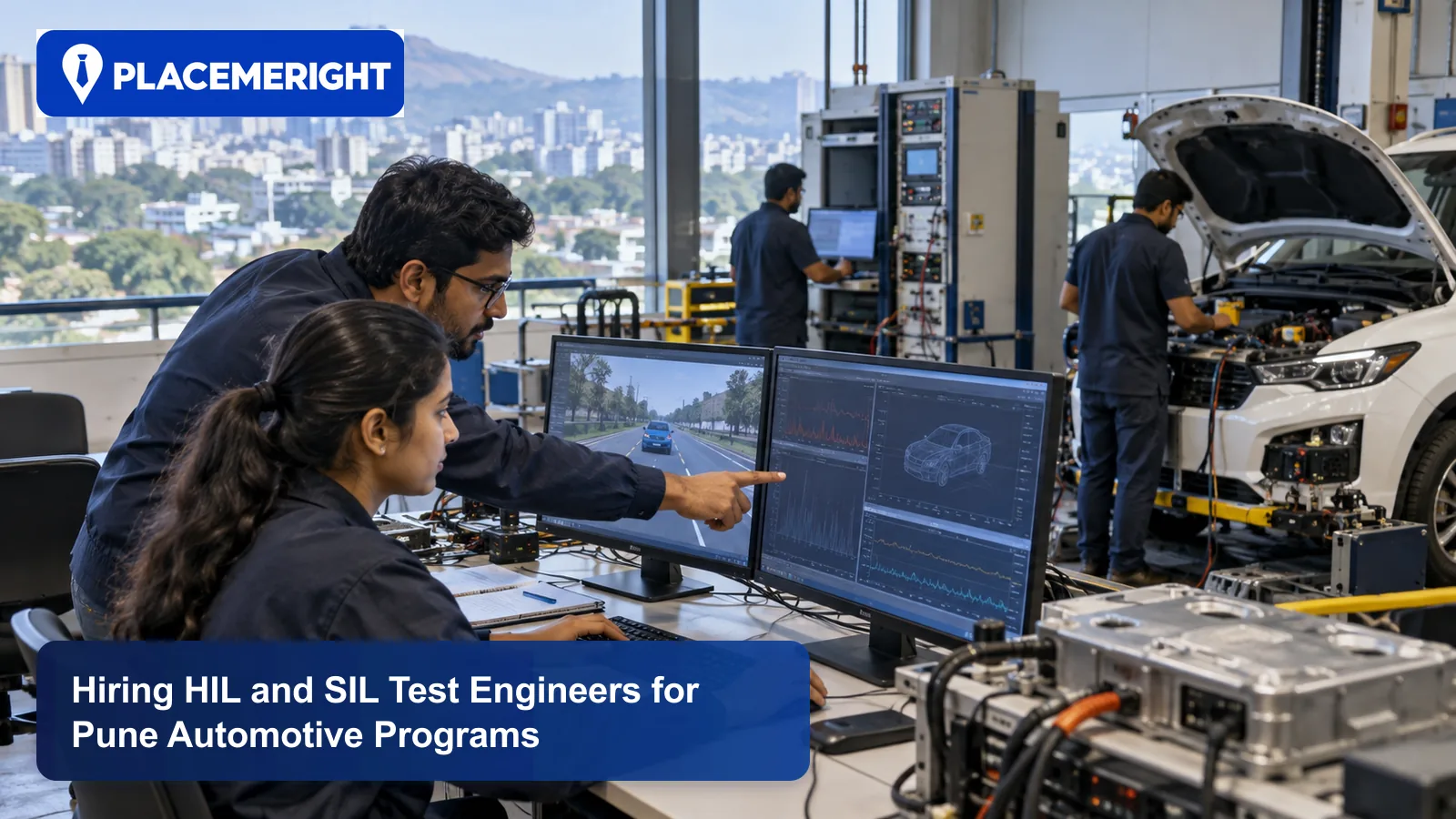
An electric powertrain test passes in software-in-the-loop and fails intermittently on a hardware-in-the-loop rig.
The failure appears only after a communication delay is combined with a voltage disturbance. The test report labels it "HIL unstable." The controls team suspects the plant model. The rig engineer suspects I/O timing. The software team cannot reproduce it on a desktop. A vehicle slot is approaching, and the release meeting needs an answer.
Opening one vacancy for a "HIL/SIL test engineer" will not resolve this situation unless the employer defines which part of the evidence chain that person owns.
Pune's automotive geography spans Pimpri-Chinchwad, Chakan, Talegaon, Hinjawadi, Kharadi, and other industrial and technology locations. Maharashtra Industrial Development Corporation identifies Pune as a major automobile hub and points to the Automotive Research Association of India and Auto Cluster Development and Research Institute within the local ecosystem. Current Mercedes-Benz career material describes Indian engineering work involving HIL benches, SIL environments, diagnostics, vehicle validation, automation, and software-defined vehicles. These sources establish the relevance of the work; they do not quantify available candidates.
The practical hiring question is: at which test-environment boundary does evidence become unreliable, and who can prove why?
Build a test-environment fidelity ladder
Define the program's environments before defining the title.
1. requirement and behavioural model; 2. model-in-the-loop, where applicable; 3. software-in-the-loop or virtual ECU; 4. processor-in-the-loop, if part of the workflow; 5. hardware-in-the-loop with real controller hardware; 6. component or mechatronic bench; 7. vehicle or system integration; 8. controlled field or fleet evidence.
PlaceMeRight's Pune technology recruitment page provides broader employer context for automotive, industrial, product, and enterprise hiring across the city.
The ladder is not a maturity ranking. Each environment answers different questions and has different blind spots.
Separate seven kinds of ownership
Test intent
This owner converts requirements, hazards, defects, interfaces, and operating scenarios into testable claims. The work includes expected behaviour, preconditions, tolerances, pass criteria, observability, and the reason each test exists.
A test engineer who only executes scripts may not own test intent. State the boundary honestly.
Plant and environment modelling
SIL and HIL depend on models of vehicle, battery, motor, road, traffic, sensor, actuator, network, or other environment behaviour. Model owners define fidelity, assumptions, parameter sources, validity ranges, numerical behaviour, and known exclusions.
The role may require controls, physics, simulation, or domain knowledge beyond test automation.
Virtual integration
SIL engineers integrate compiled software or virtual ECUs with simulated components and networks. They may own interfaces, configuration, scenario execution, regression, virtual buses, CI integration, result interpretation, and reproducibility.
The employer should state whether the role develops virtual components or only operates an existing platform.
Rig and real-time integration
HIL engineers connect real controller hardware to a real-time simulated environment. Their boundary can include I/O, signal conditioning, loads, bus communication, rest-bus simulation, wiring, breakouts, safety interlocks, timing, calibration, hardware variants, and rig health.
This is different from writing functional test cases.
Automation infrastructure
Automation owners manage test orchestration, environment provisioning, versioning, data capture, parallel execution, result storage, reporting, flaky-test control, and integration with build or release pipelines.
Python experience alone does not prove that someone can operate a dependable validation service.
Diagnosis
Diagnosis connects a failure to software, model, rig, configuration, timing, network, hardware, requirement, or test error. It requires synchronised evidence, controlled reproduction, hypothesis testing, and collaboration across teams.
Release evidence
Someone must decide whether the evidence supports integration, vehicle testing, or release. That authority may sit with validation leadership, systems engineering, safety, quality, or a program board. The engineer should know how unresolved defects, waivers, coverage gaps, and environment limitations reach that decision.
Do not imply release authority if the role only prepares evidence.
Use one defect across the ladder
Give candidates a sanitised torque-control case.
The available packet contains:
- a requirement for torque response under a voltage range;
- a control model and generated code version;
- a SIL run that passes;
- a HIL run with one intermittent limit violation;
- CAN and Ethernet timing traces;
- a plant-model parameter changed two weeks earlier;
- a rig I/O calibration record;
- a vehicle log that does not show the same failure;
- an approaching integration decision.
Ask the candidate to decide what the evidence proves, what it does not prove, and which experiment should run next.
Test reasoning at each environment
Requirement to executable claim
The requirement may specify a response window without defining measurement point, filtering, initial condition, or allowable transient. Strong candidates identify the ambiguity before blaming an environment.
Ask them to write one test oracle: the inputs, observed output, time base, tolerance, and failure condition.
SIL interpretation
Official MathWorks material describes SIL as compiled source code executing in a simulated environment, while virtual ECUs can support earlier integration and continuous testing. Ask what SIL proves in this case and what real-time or hardware effects it excludes.
A strong answer avoids both extremes: SIL is neither useless nor equivalent to the target system.
HIL interpretation
Official dSPACE and MathWorks material describes HIL as real controller hardware interacting with a real-time simulated plant. That introduces target hardware, I/O, communication, timing, and integration evidence, but fidelity still depends on the model, interfaces, configuration, and test design.
Ask whether the intermittent failure follows software build, ECU, rig channel, voltage profile, timing load, plant version, or test seed.
Bench and vehicle evidence
A vehicle non-reproduction does not automatically invalidate HIL. The vehicle run may not contain the same timing, disturbance, instrumentation, or repetition. Conversely, a HIL failure does not prove a vehicle defect if the rig injects an unrealistic condition.
The candidate should design a bridge experiment rather than vote for one environment.
Examine fault-injection discipline
Fault injection is valuable when the fault has a defined purpose and evidence boundary.
Ask the candidate to design tests for:
- delayed or missing communication;
- stuck, implausible, or noisy sensor input;
- voltage variation;
- actuator limitation;
- bus load and timing disturbance;
- reset or power-cycle behaviour;
- corrupted configuration;
- degraded component or fallback state.
For each, require:
1. the requirement, hazard, defect, or resilience question; 2. injection point and physical meaning; 3. magnitude, timing, and duration; 4. expected detection and response; 5. required logs and synchronisation; 6. environment limitations; 7. restoration and repeatability; 8. result disposition.
This separates controlled validation from dramatic scenario generation.
Assess rig ownership with a health contract
An unreliable HIL rig can create false defects and hide real ones. Ask candidates to define a rig health contract.
It should cover:
- hardware and software inventory;
- wiring and I/O configuration;
- calibration status;
- time synchronisation;
- model and parameter versions;
- ECU and flash versions;
- bus databases and network configuration;
- pre-run self-tests;
- reference or golden scenarios;
- environmental conditions;
- failure classification;
- maintenance and change history;
- access, reservation, and recovery.
Then introduce a failed self-test that was overridden to protect the schedule. Ask who can approve the override and how the resulting evidence should be labelled.
Strong candidates preserve decision context. They do not allow a green dashboard to erase a compromised environment.
Distinguish a failed test from a failed test system
Use four initial classifications:
| Classification | Question | | --- | --- | | product failure | did the controller or integrated system violate intended behaviour? | | model limitation | did the simulated environment represent the scenario incorrectly? | | rig or infrastructure failure | did hardware, I/O, timing, configuration, or orchestration invalidate the run? | | test-definition failure | were inputs, oracle, preconditions, or expected results wrong? |
The classification is a hypothesis until evidence supports it. Ask candidates to state the next observation that would change their view.
For the torque case, a useful investigation may replay the same seed across multiple ECUs, rig channels, voltage sources, loads, and model versions while retaining a common time base. The candidate should control variables rather than produce more screenshots.
Design a role-specific interview loop
SIL or virtual-validation engineer
Test virtual integration, interface contracts, scenario design, deterministic replay, CI execution, artefact versioning, result analysis, and the limits of simulation.
HIL integration engineer
Test real-time execution, I/O and signal conditioning, bus systems, rest-bus simulation, wiring, calibration, fault injection, rig diagnostics, and safe operation.
Test-automation engineer
Test framework architecture, orchestration, data handling, parallelism, flaky-test control, environment provisioning, reporting, and maintainability.
Validation or system engineer
Test requirements, coverage strategy, environment allocation, failure diagnosis, evidence synthesis, stakeholder coordination, and release judgement.
Validation lead
Add investment decisions, lab capacity, environment strategy, supplier interfaces, quality governance, escalation, team composition, and release authority.
Write the Pune brief around program reality
State the domain: powertrain, battery, body, chassis, ADAS, infotainment, connectivity, diagnostics, or another system. Name the controller and program stage. Explain which environments exist today and which the hire must build or improve.
Disclose:
- OEM, supplier, engineering-services, or internal product context;
- Pune worksite, such as Chakan, Pimpri-Chinchwad, Hinjawadi, Talegaon, or Kharadi;
- lab access and physical-presence needs;
- available rigs, tools, models, and interfaces;
- software and hardware variants;
- applicable lifecycle, quality, or safety processes;
- first defect class or coverage gap to own;
- global collaboration or shift overlap;
- travel to plant, proving ground, supplier, or customer site;
- decision rights and escalation path.
"Automotive HIL knowledge" is not an adequate brief.
Read current market evidence without inflating it
MIDC's official automotive sector page establishes Pune's industrial context and names local research and test institutions. Current Mercedes-Benz career pages reviewed on July 28, 2026 describe Indian roles involving HIL validation, test-module development, OTA automation across HIL and SIL, diagnostics, vehicle testing, and leadership of HIL teams. One role also states that Mercedes-Benz Research and Development India has major operations in Bengaluru and Pune.
This is a purposive evidence set, not a vacancy count. Listings may change, several roles are not exclusively assigned to Pune, and one employer cannot represent the full local market.
The responsible conclusion is limited: employers are publicly describing work that combines simulation, real hardware, automation, diagnostics, production interfaces, and system responsibility. A Pune brief should be equally specific.
Score evidence, not tool recitation
Use these dimensions:
- requirement and test-intent clarity;
- environment selection;
- plant-model judgement;
- real-time and interface reasoning;
- fault-injection discipline;
- automation architecture;
- reproducibility and artefact control;
- failure diagnosis;
- safety and release awareness;
- lab and workplace feasibility;
- communication across software, controls, hardware, test, and program teams.
Ask for a past failure that crossed environments. What did the candidate first believe? Which evidence disproved it? What changed in the product, model, rig, or test process?
Sequence the hire from the broken boundary
If tests are not traceable to requirements, prioritise validation design. If virtual tests cannot run consistently, strengthen SIL integration and automation. If target effects remain invisible, strengthen HIL capability. If rigs are unreliable, hire for lab integration and service ownership. If failures bounce between teams, strengthen system diagnosis. If evidence exists but cannot support a release decision, clarify validation leadership and authority.
Define first outputs such as:
- one environment-allocation matrix;
- one versioned test case carried from SIL to HIL;
- a rig health contract;
- a failure-classification and escalation rule;
- a synchronised evidence packet for one intermittent defect;
- a review of model validity and excluded conditions;
- an automated regression with controlled result storage;
- a documented release disposition.
These outputs describe work. They do not promise a hiring or program timeline.
Quick checklist
- Map the full test-environment ladder before opening a role.
- Separate test intent, modelling, virtual integration, rig integration, automation, diagnosis, and release evidence.
- State the exact automotive domain and controller.
- Use one intermittent defect across the interview.
- Ask what each environment proves and excludes.
- Test fault-injection purpose, not only tool familiarity.
- Require versioned software, model, rig, and test artefacts.
- Treat vehicle non-reproduction as evidence, not a verdict.
- Disclose Pune lab location, presence, travel, and shift needs.
- Use current roles as examples, not labour-market statistics.
Frequently asked questions
What is the difference between SIL and HIL hiring?
SIL roles focus on compiled software or virtual ECUs in simulated environments, often enabling earlier integration and automation. HIL roles add real controller hardware, real-time simulation, physical I/O, networks, rig configuration, and hardware-software integration. Some roles cover both, but the evidence should remain distinct.
Does a HIL engineer need automotive-domain knowledge?
The required depth depends on ownership. A rig-platform engineer may emphasise real-time systems and interfaces, while a validation engineer may need deeper powertrain, battery, ADAS, body, or diagnostics knowledge. State the system boundary.
Should every test move from SIL to HIL?
No. Allocate tests to the environment that can answer the question efficiently and credibly. Some logic can remain virtual; timing, I/O, hardware, and network effects may require HIL or later environments.
How should employers assess fault-injection experience?
Ask for the purpose, injection point, physical meaning, expected response, required evidence, repeatability, and environment limitations. Tool names alone reveal little.
Does Pune automotive experience prove HIL capability?
No. Pune location and automotive-employer history are context. Ask the candidate to demonstrate environment design, rig ownership, diagnosis, and evidence decisions directly.
Related reading
- Technical recruitment for automotive engineering teams
- Hire embedded and software developers
- PlaceMeRight employer credentials
Conclusion
HIL and SIL hiring becomes sharper when a Pune employer follows one defect through the validation ladder.
Define what should be proved in software, what requires real hardware and real-time behaviour, how rig and model health remain visible, and who converts test evidence into a release decision. Then hire for the broken boundary rather than a combined acronym.
The strongest engineer is not the person who produces the largest test report. It is the person who can explain which environment made a claim credible, which limitation remains, and what evidence should come next.
CTA
Need to turn a Pune automotive validation gap into distinct HIL, SIL, automation, and system briefs? Discuss the hiring plan with PlaceMeRight for employer-side recruitment support.
References
- Maharashtra Industrial Development Corporation: Automobiles
- Mercedes-Benz Careers: Technical Lead, Test Module Development
- Mercedes-Benz Careers: OTA Test and Automation Engineer
- Mercedes-Benz Careers: Body Electronics HIL Validation Leadership
- Mercedes-Benz Careers: Body Electronics Validation and India engineering operations
- dSPACE: SIL, HIL, or Test Bench
- dSPACE: HIL Test Phases and Test Systems
- MathWorks: Virtual ECU and SIL Simulation
- MathWorks: Hardware-in-the-Loop Testing
Related PlaceMeRight resources
Our Tech Recruitment Services by City
Looking to hire vetted software engineers or scale your engineering teams in India's leading tech hubs? Explore our localized recruitment services: