
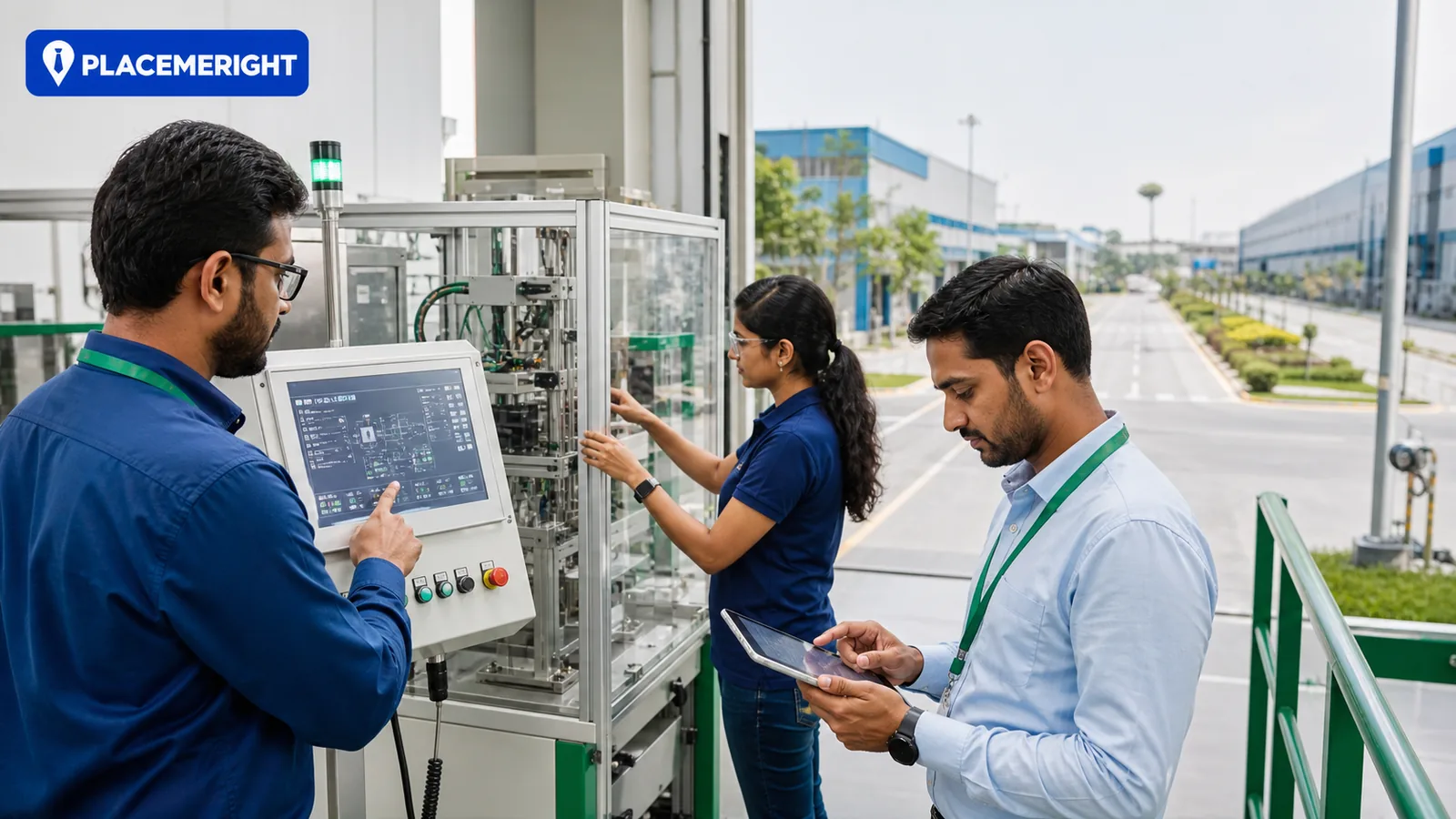
A production line near Bommasandra stops for twelve minutes. The programmable controller records a fault. An edge gateway sends two events because connectivity recovers. The manufacturing execution system associates one event with the active operation, while the enterprise system has already advanced the order. Quality places the affected lot on hold, but the reporting layer describes the stoppage as planned.
Every system is technically available. The plant still has four versions of what happened.
An employer may respond by opening separate vacancies for automation, industrial IoT, MES, ERP, and integration. That structure is useful only if the people share a plant semantic contract: an agreed definition of asset, order, lot, event, state, time, reason, and decision authority across the production flow.
For teams around Bommasandra, Jigani, Electronic City, Hosur Road, and connected south Bengaluru industrial locations, the contract provides a sharper hiring basis than a list of platforms. It tests whether candidates can preserve manufacturing meaning while data moves from equipment to enterprise decisions.
Begin with the plant event
Choose one sanitised event that crosses layers. This article uses an unplanned stop followed by a quality hold.
Record the physical sequence before discussing software:
1. equipment enters a fault condition; 2. the current operation pauses; 3. production personnel assess the line; 4. affected material is identified; 5. quality decides whether to hold it; 6. maintenance corrects the condition; 7. authorised personnel approve restart; 8. production state is reconciled; 9. planning and enterprise records are updated; 10. learning reaches maintenance, quality, and engineering.
The employer must define which steps vary by plant, line, product, and policy. Recruitment should not invent those rules.
PlaceMeRight's Bangalore technology recruitment guide covers the wider regional hiring context. This article focuses on industrial software roles around Bommasandra and the shared meanings that connect them.
Establish the Bommasandra operating context
Invest Karnataka's official Bengaluru Urban district material identifies industrial areas including Bommasandra phases and the Bommasandra-Jigani link-road area. It also describes the district's manufacturing and technology context. ELCITA provides current governance and infrastructure context for the nearby Electronic City industrial township.
These sources establish a mixed industrial-technology setting. They do not prove how many MES engineers live nearby, which platform is dominant, or how quickly a role can close.
Localise the search with employer facts:
- exact plant, office, lab, or engineering centre;
- production processes and equipment in scope;
- work that requires controlled-site access;
- shift, commissioning, shutdown, or support duties;
- movement between Bommasandra, Jigani, Electronic City, suppliers, and other sites;
- team and manager locations;
- approved remote or hybrid boundaries.
Candidates can then evaluate the actual industrial role rather than a broad "Bangalore" label.
Write the plant semantic contract
The contract should be readable by production, quality, maintenance, automation, software, data, ERP, and operations teams.
| Term | Questions the employer must settle | | --- | --- | | asset | Which physical or logical unit is being described? | | order | Which production instruction and version are active? | | lot | Which material genealogy and quantity are affected? | | event | What occurred, where was it observed, and was it duplicated? | | state | Is the equipment, operation, order, or material state meant? | | time | Which clock, timezone, sequence, and correction rule apply? | | reason | Is this observed, selected, inferred, or approved? | | authority | Who can hold, release, restart, correct, or close? |
Do not treat the table as a data dictionary alone. A term has operational consequences. "Line running" may describe equipment motion while the production order is not yet authorised. "Good quantity" may exist at one layer before quality release. "Downtime reason" may be an operator selection requiring later engineering review.
The contract records those distinctions.
Separate five role burdens
Each role family owns a different part of the shared meaning.
Automation and controls engineering
This role is close to equipment behaviour. Depending on the plant, it may include PLC, DCS, SCADA, HMI, instrumentation, alarms, interlocks, sequence logic, commissioning, and safe change.
The role should not be written as a software keyword list. Define which process, equipment, control boundary, and commissioning authority apply. Safety and production decisions remain with qualified employer owners.
Interview with a sequence trace. Provide selected inputs, equipment states, alarm history, and a duplicate sensor transition. Ask the candidate to distinguish physical condition, control state, operator action, and evidence needed before changing logic.
Edge and industrial IoT engineering
This role connects plant observations with reliable higher-level consumption. Work may include gateways, protocols, device identity, buffering, time synchronisation, connectivity, filtering, edge processing, security, and observability.
Ask how the candidate handles an offline gateway that later publishes buffered events. Look for timestamps, sequence, identity, duplicates, late arrival, data quality, backpressure, and a clear boundary between observing equipment and controlling it.
MES or manufacturing operations software
This role connects orders, operations, resources, material, quality, labour, genealogy, execution state, and production evidence. Product names differ; the employer should test manufacturing operations reasoning.
Give the candidate an order that advanced in ERP while the line operation paused in MES. Ask which state can be corrected, which requires business approval, how genealogy is protected, and how the event remains auditable.
ERP and planning systems
This role connects demand, orders, materials, inventory, costing, quality decisions, procurement, maintenance, and financial consequences. It should not silently own shop-floor truth.
Test an enterprise update created from an incorrect production state. Strong candidates identify master and transaction data, posting consequences, reversal or correction authority, interface dependencies, and reconciliation.
Plant integration and industrial data engineering
This role protects contracts between layers. It may cover APIs, messages, files, schemas, OPC UA, middleware, event platforms, transformation, lineage, retries, security, monitoring, and replay.
Ask the candidate to reconcile two stop events, one MES state, and one ERP movement. Look for correlation, source authority, idempotency, temporal reasoning, error queues, observability, and governed correction.
Use standards as vocabulary, not hiring theatre
The OPC Foundation's official overview states that OPC UA applies across sensors, controls, manufacturing execution, enterprise resource planning, and industrial IoT, and supports information exchange through structured models. Its ISA-95 common-object-model material describes personnel, equipment, physical assets, and material information used in manufacturing operations.
This material is useful for designing shared vocabulary and interfaces.
It does not mean every candidate must memorise a standard number. Decide which standards, protocols, and models are actually used by the employer. Test practical reasoning against the plant event. If the environment uses a proprietary interface, the candidate still needs to protect identity, meaning, state, time, and authority.
Qualified engineering and safety functions should determine applicable standards and validation obligations.
Run the semantic-drift interview
Give all role families the same event.
At 10:04:12, Line 3 stops during Operation 40 for Order A. The controller records Fault 17. The gateway loses connection and later publishes two stop events with different receipt times. MES shows Operation 40 paused, but ERP receives a completion message from a manual interface. Quality discovers that twelve units may have crossed the affected station and places the lot on hold. Maintenance clears the fault. Production wants to restart.
Ask every candidate:
1. What is known, inferred, or contradictory? 2. Which source is authoritative for each fact? 3. Which action must stop until an owner decides? 4. How will affected material be bounded? 5. How will duplicate or late events be handled? 6. What must be corrected without erasing history? 7. Who can approve restart and lot release? 8. What monitoring or design change would prevent recurrence?
Then assess role-specific depth. Controls candidates focus on physical and sequence evidence. IoT candidates focus on acquisition and timing. MES candidates focus on execution and genealogy. ERP candidates focus on enterprise transactions. Integration candidates focus on cross-system contract and reconciliation.
Strong candidates also identify what they are not authorised to decide.
Test the handshakes, not only the specialists
Industrial software failures often appear between roles.
Write five handshakes into the hiring plan:
- controls to edge: tag identity, state transition, quality, and time;
- edge to MES: event contract, buffering, duplication, and rejection;
- MES to ERP: order, operation, quantity, material, and posting state;
- quality to systems: hold, release, reason, authority, and evidence;
- operations to engineering: incident, workaround, restart, correction, and learning.
For each handshake, name a producing owner, accepting owner, test, monitor, error path, and change process.
During panel interviews, pair adjacent specialists for a short design discussion. Score whether they expose assumptions and negotiate a common meaning. Deep expertise that cannot form a reliable interface may increase plant risk.
Include the physical workplace in the brief
Industrial software work is not automatically office-only or plant-only.
The employer should distinguish:
- design and development that can occur in an approved office or remote environment;
- lab integration requiring devices or simulators;
- plant observation and process walkthroughs;
- commissioning and planned shutdown work;
- production support and incident response;
- supplier or customer-site travel;
- activities restricted by safety, security, or confidentiality.
Disclose frequency and current policy. "Must be flexible" is not enough.
Current Schneider Electric Bangalore role pages reviewed on July 28, 2026 describe manufacturing, automation, digital operations, production planning, and on-site work in particular roles. ABB's current India R&D material describes Bengaluru work in automation, smart manufacturing, process control, industrial software, and related technologies.
These sources illustrate active employer language. They do not establish Bommasandra skill supply or a universal workplace model.
Design the team around authority
A small industrial software team may include:
- one plant-systems or solution lead;
- controls and automation engineers;
- an edge or industrial IoT engineer;
- an MES specialist;
- ERP functional and technical support;
- an integration or industrial data engineer;
- quality, maintenance, production, security, and infrastructure partners.
The exact shape depends on the installed systems and programme. More important than titles is an authority map.
Name who can:
- change control logic;
- approve an interface schema;
- place or release material hold;
- correct production records;
- reverse enterprise transactions;
- restart equipment;
- accept a temporary workaround;
- close the incident;
- approve production release after change.
If the employer cannot name these owners, candidates cannot demonstrate fit against the real role.
Calibrate seniority with consequence
Years and certifications are weak substitutes for operating burden.
Assess seniority through:
1. physical consequence: can software affect equipment, material, safety, quality, or output? 2. semantic span: how many systems and functions depend on the person's definitions? 3. change difficulty: how hard is it to reverse an incorrect decision? 4. operating accountability: does ownership continue through commissioning and production? 5. authority complexity: how many qualified owners must agree?
A senior integration engineer may not write control logic, but may own a contract that determines how several plants interpret events. A senior MES specialist may not decide quality policy, but must ensure the system preserves and enforces authorised decisions.
Create joining evidence
The first month should not begin with unrestricted production change.
A staged plan can include:
- plant safety and access induction;
- process and equipment walkthrough;
- semantic-contract review;
- system and owner map;
- read-only event reconstruction;
- controlled test-environment change;
- observed incident or release review;
- supervised production responsibility;
- documented improvement proposal.
Set approval gates through the employer's qualified functions. The aim is to let the new hire learn the physical and organisational system before carrying consequential authority.
Review the semantic contract after change
Revisit the contract when a new line, product, sensor, gateway, MES module, ERP process, supplier interface, quality rule, or reporting need is introduced.
Ask:
- Did the meaning of an existing term change?
- Is an effective date required?
- Can old and new versions coexist?
- Which downstream consumers are affected?
- What test proves interoperability?
- How are late or replayed events treated?
- Who owns migration and rollback?
- What production evidence must be retained?
This review prevents new technology from creating silent semantic drift.
Quick checklist
- Start with one cross-layer plant event.
- Map the physical sequence before software.
- Define asset, order, lot, event, state, time, reason, and authority.
- Separate controls, IoT, MES, ERP, and integration burdens.
- Test one event across all role families.
- Score candidates on evidence and decision boundaries.
- Write cross-role handshakes into the brief.
- Use applicable standards as shared vocabulary.
- Disclose plant, lab, office, shift, and travel duties.
- Map consequential change and restart authority.
- Stage joining access and production responsibility.
- Review semantics whenever systems or processes change.
Frequently asked questions
Does an MES candidate need PLC programming experience?
Not always. The candidate should understand the controls-to-MES boundary and manufacturing state. Hands-on PLC depth is required only when the role genuinely owns control logic or commissioning.
Is industrial IoT the same as plant integration?
They overlap. Industrial IoT often focuses on acquisition, edge processing, device connectivity, and observability, while plant integration may span MES, ERP, APIs, middleware, reconciliation, and enterprise contracts.
Should every candidate know OPC UA?
Only require it when relevant to the environment. More broadly, test whether the candidate can preserve identity, structure, state, time, quality, security, and meaning across systems.
Must these roles work from the plant every day?
No universal rule applies. Presence should follow plant access, commissioning, lab, controlled operations, incident, and employer-policy requirements. State the actual pattern.
How can employers avoid hiring five disconnected specialists?
Use one plant event, a shared semantic contract, explicit handshakes, and paired assessment. Specialists should demonstrate both depth and reliable boundary work.
Related reading
- Calibrate industrial technology recruitment
- Hire engineering specialists across India
- Explore PlaceMeRight's employer credentials
Conclusion
Industrial software hiring around Bommasandra should not begin with five disconnected technology lists.
It should begin with the plant event and the meanings that must remain coherent from equipment through enterprise systems. A plant semantic contract exposes where controls, industrial IoT, MES, ERP, integration, quality, and operations need distinct authority and precise handshakes.
Candidates can then be assessed on whether they protect physical truth, data meaning, system state, and governed decisions under change.
CTA
Building an industrial software team around Bommasandra or south Bengaluru? Discuss the hiring brief with PlaceMeRight for employer-side role calibration, specialised sourcing, and cross-system interview design.
References
- Invest Karnataka: Bengaluru Urban district
- Invest Karnataka: KIADB industrial areas
- Electronics City Industrial Township Authority
- OPC Foundation: OPC UA overview and concepts
- OPC Foundation: OPC UA common object model for ISA-95
- ABB Careers: R&D careers in India, reviewed July 28, 2026
- Schneider Electric Careers: Senior Manufacturing Engineer, Bangalore, reviewed July 28, 2026
- Schneider Electric Careers: Industrialisation Process and Technology Leader, Bangalore, reviewed July 28, 2026
Related PlaceMeRight resources
Our Tech Recruitment Services by City
Looking to hire vetted software engineers or scale your engineering teams in India's leading tech hubs? Explore our localized recruitment services: