
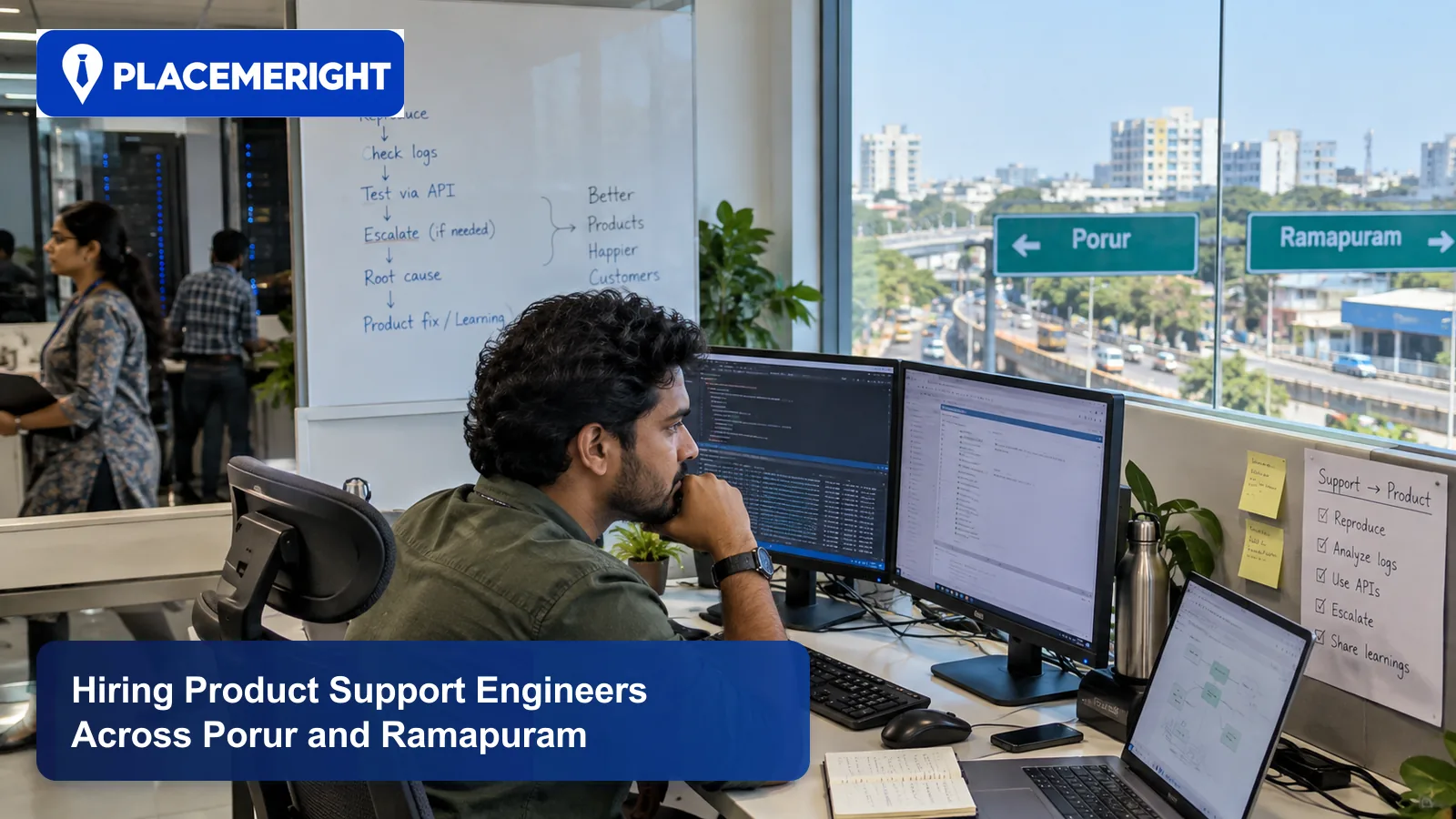
Effective product support engineers do not merely close tickets.
They turn an unclear report into a reproducible technical problem. They protect the customer's immediate outcome, gather evidence without wasting time, involve engineering at the right point, explain uncertainty honestly, and make the next occurrence easier to solve.
That combination is easy to blur with customer success, implementation, QA, DevOps, or a call-centre role.
Employers hiring across Porur, Ramapuram, Manapakkam, Nandambakkam, Mugalivakkam, Iyyappanthangal, and the Mount Poonamallee Road corridor should define the product-support case lifecycle before choosing a title.
West Chennai provides a real technology-work corridor
DLF's official material places DLF Cyber City Chennai in Manapakkam off Mount Poonamallee Road and describes a large office ecosystem serving technology firms and multinational organisations. CMRL lists corporate feeder connectivity between Alandur and DLF Cybercity in Ramapuram, while its Phase II material includes Porur Junction, Mugalivakkam, and DLF IT SEZ in the planned corridor.
STPI identifies Chennai as a leading software cluster and reports current software-export activity across its regional jurisdiction.
These facts provide a local worksite and transport fact base. They do not prove that every candidate near Porur has SaaS support depth.
Employers can use PlaceMeRight's Chennai technology recruitment guide for city-wide context. The vacancy should still specify the product, customer, support window, and technical boundary.
Begin with one support case
Imagine a B2B customer reports:
> Yesterday's orders appear in the platform, but the finance export is missing several records.
A product support engineer may need to:
1. establish the customer's environment and impact; 2. confirm entitlement and safe access; 3. reproduce or isolate the issue; 4. inspect configuration, API responses, logs, and job status; 5. distinguish expected behaviour, user error, data delay, and defect; 6. provide a safe workaround; 7. escalate with complete evidence; 8. communicate progress; 9. verify recovery; 10. update knowledge and product feedback.
This sequence contains the real job. Write the vacancy around it.
Follow the complete support-case lifecycle
Stage 1: establish impact before exploring technology
Support engineers need enough customer and product judgement to ask:
- Which users are affected?
- Which workflow is blocked?
- Is data wrong, delayed, or only displayed incorrectly?
- Is there a financial, compliance, or operational deadline?
- Did the behaviour begin after a change?
- Is the issue isolated to one tenant, region, integration, role, or dataset?
- Is there a safe alternative?
The candidate should not treat every urgent customer message as the highest technical severity. They should also avoid minimising a low-volume issue that blocks a critical business process.
Interview evidence
Give an intentionally incomplete ticket. Score the candidate's first ten questions. Strong questions reduce the search space and identify impact without blaming the user.
Stage 2: reproduce the smallest failing condition
Reproduction is not limited to clicking the same button.
A product support engineer may compare:
- user and role;
- account or tenant configuration;
- browser, device, or client version;
- API request and response;
- feature flags;
- data state;
- integration credentials;
- job or queue status;
- time window;
- recent release or configuration change.
The goal is to find the smallest set of conditions that separates working from failing behaviour.
Ask candidates to describe a case they could not reproduce. Look for disciplined evidence collection, safe hypotheses, and collaboration rather than random configuration changes.
Stage 3: use SQL, APIs, logs, and traces with boundaries
Technical support depth often appears in four evidence tools.
SQL
The engineer may validate that a record exists, inspect state transitions, compare timestamps, or identify a failed job. They must understand read safety, sensitive data, production access, and the difference between evidence and direct correction.
APIs
The engineer may reproduce a request, inspect authentication, compare payloads, check status and error semantics, or identify a version mismatch. They should preserve identifiers and avoid exposing secrets.
Logs
Useful log analysis follows a customer or business event across components. Keyword searching without time, environment, tenant, request, or correlation context often creates false leads.
Traces and metrics
OpenTelemetry describes observability through signals including traces, metrics, and logs. A support engineer does not need to build the entire observability stack. They should know how to use service, dependency, latency, error, and event evidence to narrow an issue.
The vacancy should say which tools the engineer may access and which actions require engineering or operations approval.
Stage 4: decide whether to solve, work around, or escalate
Escalation quality is a central product-support skill.
An engineering-ready escalation should include:
- customer and business impact;
- environment and version;
- expected and observed behaviour;
- reproduction status;
- first known occurrence;
- relevant identifiers and timestamps;
- logs, traces, payloads, or screenshots with sensitive data removed;
- troubleshooting already completed;
- workaround and its limits;
- precise question or action requested.
Sending the full ticket thread to engineering is not escalation. It transfers ambiguity.
Escalation exercise
Provide a long case history with repeated comments, irrelevant screenshots, and one useful correlation identifier. Ask the candidate to produce a five-minute engineering hand-off.
Score compression, technical evidence, customer impact, and the clarity of the requested action.
Stage 5: communicate without inventing certainty
Customers need progress, impact, next action, and timing for the next update. They do not need unsupported root-cause claims.
A strong update separates:
- confirmed facts;
- current hypothesis;
- action underway;
- workaround;
- customer action, if any;
- next communication point.
Ask a candidate to write two updates from the same incident: one for a technical administrator and one for a business stakeholder. Score accuracy and usefulness, not polished corporate language.
For India-based teams supporting global customers, define time-zone coverage, hand-offs, weekend expectations, and escalation authority. "Excellent communication" is not an operating model.
Stage 6: verify recovery and close the loop
A service returning to normal is not enough.
The support engineer should verify:
- the affected workflow now completes;
- missing or delayed records are recovered;
- no duplicate or inconsistent state was introduced;
- the customer confirms the relevant outcome;
- monitoring reflects recovery;
- temporary access or changes are removed;
- follow-up work has an owner.
Google's Site Reliability Engineering workbook describes structured incident response through coordination, communication, and control. Product support may participate rather than command the incident, but the same discipline helps prevent fragmented action.
Stage 7: turn case knowledge into product learning
Support knowledge is most useful when captured during real work, kept findable, and improved through reuse.
The Consortium for Service Innovation's KCS Practices Guide describes capturing, structuring, reusing, and improving knowledge in the request-response workflow. Employers do not need to mandate a KCS certification. They can assess the behaviour.
Ask:
- What search terms would another engineer use?
- Which environment detail changes the answer?
- What is reusable and what belongs only in the customer record?
- How will the resolution be verified?
- What signal shows the article is outdated?
Knowledge quality should not be measured only by article count.
Product feedback is a separate output
Repeated cases may reveal:
- confusing configuration;
- weak error messages;
- missing validation;
- fragile integration contracts;
- insufficient telemetry;
- documentation gaps;
- workflow design problems;
- recurring defects.
A product support engineer should package the pattern with frequency, affected workflow, impact, evidence, and proposed improvement. Product management decides priority. Support makes the signal usable.
Separate five adjacent roles before sourcing
| Role | Primary output | | --- | --- | | Product support engineer | diagnosed cases, workarounds, escalations, knowledge, product signals | | Customer success manager | adoption, value, relationship, retention, account outcomes | | Implementation consultant | configured and launched customer solution | | QA engineer | pre-release and ongoing quality evidence | | SRE or production engineer | service reliability, automation, incident and operational engineering |
Interfaces are normal. Role confusion is not.
A product support engineer may run SQL and read traces without owning production infrastructure. A customer success manager may coordinate an urgent case without diagnosing code. A QA engineer may reproduce a defect without managing the customer.
Define the primary output and escalation boundary.
What the Chennai listing sample suggests
PlaceMeRight reviewed 120 Chennai technology listings in its city feed dated July 16 to July 23, 2026. A strict title-and-tag scan found one explicit support-engineer title and one solutions-engineer title. It also found 12 operations, DevOps, or reliability-related roles and 33 broader software-engineering or developer roles.
These groups overlap imperfectly. The sample is city-wide and short-dated, not a Porur or Ramapuram market census. Product-support responsibilities frequently sit behind titles such as application support, technical consultant, customer engineer, or software engineer.
The sample should not be used to estimate supply. It shows why employers need semantic sourcing beyond one exact title.
Use West Chennai geography to define the operating pattern
Porur and Iyyappanthangal: state the support window
Porur and Iyyappanthangal describe western and south-western journeys to Mount Poonamallee Road offices. For support roles, worksite feasibility depends on the actual shift, not a daytime map or an assumed candidate pool.
State:
- normal shift;
- rotation frequency;
- transport for early or late hours;
- office and remote split;
- weekend or holiday coverage;
- on-call expectation;
- hand-off time zones.
Do this in outreach, not after the final interview.
Ramapuram and Manapakkam: calibrate campus and product context
The DLF Cyber City area brings together different employer types. When an applicant has worked there, establish whether their role involved product support, managed services, enterprise application support, IT operations, or customer-facing engineering.
Ask what the candidate was allowed to inspect and change. A large case volume does not prove technical depth. A low case volume may reflect complex enterprise products.
Nandambakkam and Mugalivakkam: test adjacent experience
Nandambakkam, Mugalivakkam, and nearby West Chennai areas help explain access to offices around Ramapuram and Manapakkam. They do not establish which adjacent experience is available.
When the evidence is relevant, consider backgrounds such as:
- application support;
- integration support;
- database support;
- technical consulting;
- QA with customer-facing diagnosis;
- software engineering with support rotation;
- cloud operations with product depth.
Use the case exercise to test transfer.
A 90-minute product-support simulation
Provide:
- a customer message;
- product and environment summary;
- API request and response;
- four log extracts;
- a small read-only data table;
- one recent release note;
- a knowledge-base article that is partly outdated.
Ask the candidate to:
1. set severity and explain why; 2. write the first customer response; 3. create a reproduction plan; 4. identify the likely evidence path; 5. prepare an engineering escalation; 6. propose a safe workaround; 7. update the knowledge article; 8. file a product-feedback note.
The exercise can be completed with pseudocode and written reasoning. Do not require access to a commercial support platform.
Score the complete case lifecycle
Use a 100-point scorecard:
- 15 points: impact and prioritisation;
- 20 points: technical diagnosis;
- 10 points: SQL, API, and data reasoning;
- 10 points: logs, traces, and observability;
- 15 points: escalation quality;
- 10 points: customer communication;
- 10 points: knowledge and product feedback;
- 5 points: security and access judgement;
- 5 points: West Chennai work-pattern feasibility.
For a senior role, increase product-pattern analysis and incident leadership. For an entry-level role, reduce architecture expectations while retaining evidence discipline.
Quick checklist for a Porur product-support brief
- Name the product, users, and customer type.
- Define the support case lifecycle.
- State SQL, API, log, and observability access.
- Clarify production-change authority.
- Define severity, escalation, and incident interfaces.
- State shift, on-call, weekend, and transport arrangements.
- Separate product support from customer success and implementation.
- Include knowledge and product-feedback expectations.
- Give the exact Porur, Ramapuram, Manapakkam, or nearby office point.
- Use a realistic case simulation.
Frequently asked questions
Does a product support engineer need coding skills?
It depends on the product and escalation boundary. SQL, scripting, API, and code-reading skills can improve diagnosis. Require production coding only when the role genuinely owns fixes or engineering changes.
What is the difference between product support and application support?
Titles overlap. Product support often connects technical diagnosis with external users and product feedback. Application support may focus on operating an internal or client application. Define customers, systems, and outputs.
Should support engineers have production access?
Only the access required for the role, with appropriate controls. Read-only diagnostic access may be sufficient. Separate diagnosis from high-risk changes and define approval paths.
How do we test communication without using a generic language round?
Give the candidate real technical evidence and ask for updates to a technical administrator, business stakeholder, and engineering team. This tests accuracy, audience judgement, and clarity together.
Should ticket-closure time be the main performance measure?
No. Speed matters, but closure alone can reward premature resolutions or ticket transfer. Include customer outcome, escalation quality, recurrence, knowledge reuse, and product improvement.
Which West Chennai locations should the brief identify?
Depending on shifts and office location, identify Porur, Ramapuram, Manapakkam, Nandambakkam, Mugalivakkam, Iyyappanthangal, Guindy, Alandur, or wider Chennai precisely. Validate the actual journey.
Related reading
- Separate SaaS customer engineering from adjacent roles on the OMR corridor
- Define support and shift expectations for Chennai roles
- Hire software developers across India
- Explore PlaceMeRight technical recruitment
Conclusion
Porur, Ramapuram, Manapakkam, and the wider West Chennai corridor contain product, enterprise, support, operations, QA, integration, and engineering workplaces. Those contexts can guide research, but the title alone will not reveal who can own a difficult customer case.
Follow the case from impact to reproduction, evidence, escalation, communication, recovery, knowledge, and product feedback. State the shift and office reality. Then assess the whole lifecycle in one structured simulation.
The simulation then compares who can protect the current customer outcome and create useful product learning.
CTA
PlaceMeRight helps Chennai employers calibrate product-support, application-support, technical-consulting, integration-support, and customer-facing engineering roles. Share your Porur or Ramapuram support requirement to build the case model, sourcing map, simulation, and evidence-led scorecard.
References
- DLF: DLF Cyber City Chennai official overview
- Chennai Metro Rail: corporate feeder services
- Chennai Metro Rail: Phase II detailed project report
- Chennai Metro Rail: Phase II project status
- STPI Chennai: regional export performance
- Google SRE Workbook: Incident Response
- OpenTelemetry: observability primer
- Consortium for Service Innovation: KCS Practices Guide
Related PlaceMeRight resources
Our Tech Recruitment Services by City
Looking to hire vetted software engineers or scale your engineering teams in India's leading tech hubs? Explore our localized recruitment services: