
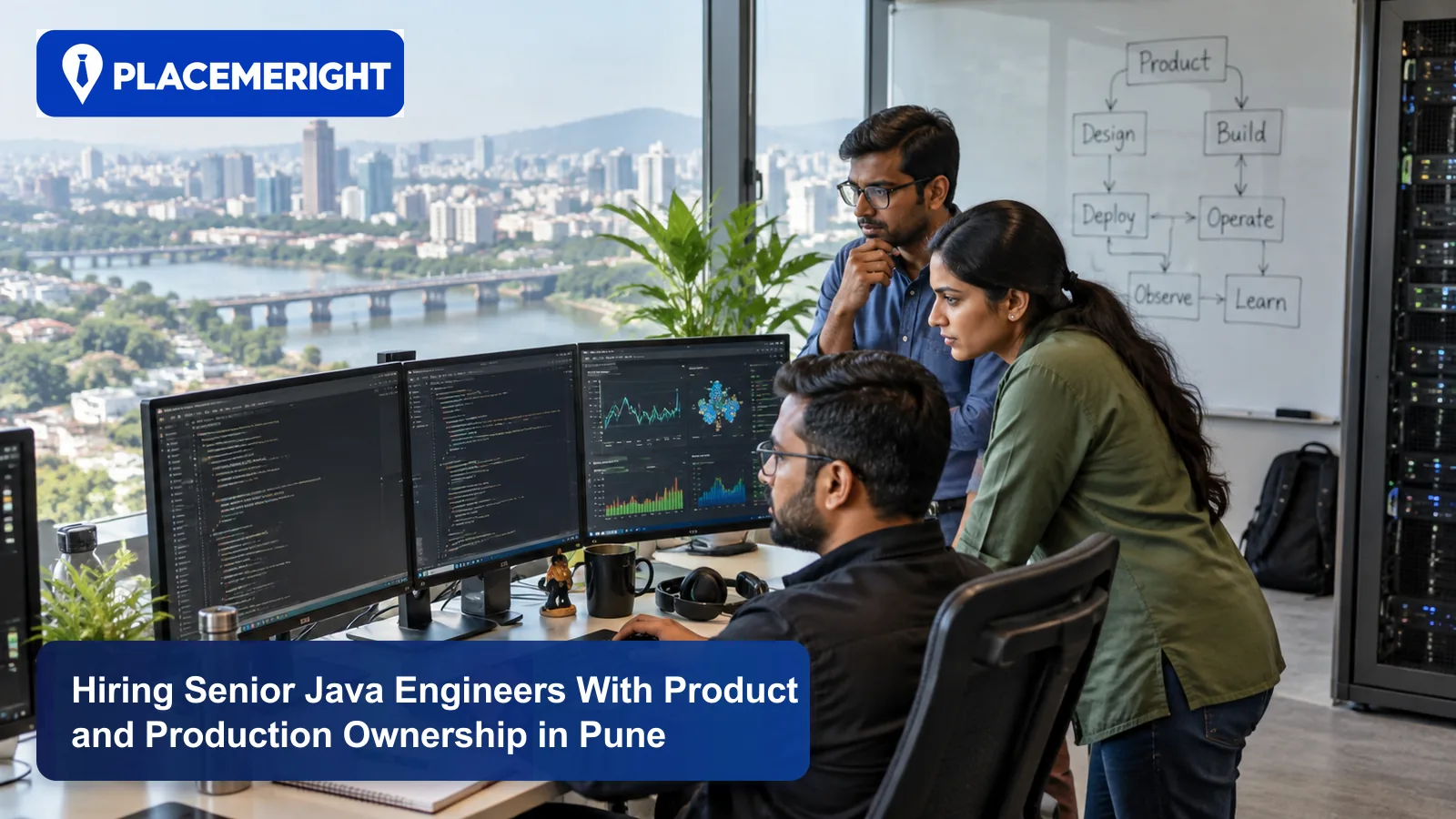
Java experience is easy to count and difficult to interpret.
Ten years with the language can describe a developer who delivers well-defined tickets, a backend specialist who owns complex distributed behaviour, a technical lead who shapes a product domain, or an engineer who designs, releases, operates, and improves a service in production.
For a Pune employer, "senior Java engineer" should therefore describe an ownership level, not a collection of Spring keywords.
An evidence-led brief connects a product or business outcome to architecture, code, test evidence, deployment, observability, incident response, and learning after release.
That full loop is what the interview should measure.
Read current Pune roles without copying them
Current Pune employer material shows why production ownership belongs in the search.
Mastercard describes a Pune senior Java backend role covering analysis, design, development, testing, release and rollback planning, system maintenance, production incidents, root-cause work, remediation, on-call support, performance, security, and mentoring.
Barclays describes a Pune Java engineering role involving roadmap and stakeholder work, scalable microservices, secure coding, automated tests, Kubernetes or OpenShift, delivery pipelines, distributed-system analysis, log investigation, production support, performance tuning, and incident resolution.
SAP's current job listings include Java product and development work in Pune, while Mastercard's Pune location page identifies its Kalyani Nagar and Yerawada office context and current technology openings.
These sources show contemporary responsibility patterns. They do not prove a standard seniority level across companies or establish how many candidates can meet a specific ownership bar.
Use PlaceMeRight's Pune technology recruitment context for the wider search. Define the employer's system, domain, operating model, and worksite before outreach.
Follow the feature-to-failure ownership loop
Assess the role across eight connected stages.
1. Product and domain decision
Senior engineers should understand why a system changes.
The person may need to reason about:
- payment or financial state;
- customer identity;
- order or workflow rules;
- permissions;
- risk controls;
- operational deadlines;
- service commitments;
- data retention;
- user impact.
Ask candidates to describe a product decision they influenced and the technical consequence of getting it wrong.
2. Service and data design
The role may own APIs, domain models, state transitions, persistence, events, and dependencies.
Test:
- boundaries;
- invariants;
- consistency;
- concurrency;
- idempotency;
- failure states;
- schema evolution;
- access;
- performance;
- backward compatibility.
Framework fluency does not replace the ability to define a stable contract.
3. Java implementation
The required depth depends on the service.
It may include:
- modern Java language features;
- concurrency and memory;
- collections;
- JVM behaviour;
- Spring Boot;
- security;
- persistence;
- messaging;
- testing;
- profiling;
- build tooling.
Use code to expose reasoning, readability, failure handling, and test design. Avoid trivia that never appears in the role.
4. Integration and distributed behaviour
Java services rarely operate alone.
Assess:
- synchronous and asynchronous calls;
- timeouts;
- retries;
- circuit breaking;
- ordering;
- duplicate handling;
- message contracts;
- partial failure;
- dependency ownership;
- reconciliation.
Ask what happens when a downstream system completes work but the caller never receives confirmation.
5. Release and change control
A senior engineer should help a change reach production safely.
Relevant evidence includes:
- code review;
- automated quality gates;
- migration sequencing;
- feature flags;
- canary or phased release;
- compatibility;
- deployment checks;
- rollback;
- contingency;
- release communication.
The role charter should state whether the engineer can stop or reverse a release.
6. Observability
Production ownership requires evidence of user and system behaviour.
The person may define:
- service-level indicators;
- latency distributions;
- error categories;
- traces;
- structured logs;
- business events;
- queue depth;
- dependency health;
- alerts;
- dashboards.
Ask which signal would show the feature failing before a support ticket arrives.
7. Incident and recovery
Senior ownership becomes visible under uncertainty.
Assess whether the candidate can:
- define affected users and transactions;
- establish the timeline;
- distinguish symptom from cause;
- choose bounded containment;
- preserve evidence;
- coordinate other teams;
- communicate impact;
- prove recovery.
On-call attendance is not the same as incident leadership.
8. Product learning
After recovery, the team should improve code, architecture, tests, telemetry, process, or product rules.
Ask how the candidate turns an incident into:
- a corrected invariant;
- a safer interface;
- a new test;
- better detection;
- simpler operation;
- a roadmap decision;
- reduced customer friction;
- documented ownership.
The loop ends when learning reaches the maintained system.
Separate senior Java role families
Senior product engineer
This person connects product intent, domain rules, delivery, telemetry, and iterative improvement.
Look for evidence beyond feature output. The candidate should explain adoption or business consequence, production behaviour, and what changed after feedback.
Senior backend engineer
The primary depth may be service design, Java, data, integration, performance, and reliability.
State whether the role owns a complete domain service, a component, or a technical layer. "Backend" alone does not define production authority.
Platform Java engineer
This role may build shared identity, messaging, data, workflow, developer, or cloud capabilities.
Assess internal consumer needs, API or library compatibility, multi-tenancy, scale, rollout, migration, observability, and support. Platform output should have a product contract.
Modernisation engineer
The person may move a monolith, framework, runtime, database, or deployment model toward a newer architecture.
Test dependency discovery, incremental change, compatibility, data migration, parallel operation, rollback, and retirement. Rewriting code is not the full modernisation outcome.
Engineering lead
The lead may still write code while shaping design, quality, delivery, mentoring, and cross-team decisions.
Define the expected hands-on proportion, formal people responsibility, architecture authority, and incident role. Do not combine every senior duty into an impossible individual position.
Production or reliability-focused developer
This role may own availability, performance, observability, automation, incident reduction, and difficult defects inside Java services.
Look for engineering changes that remove recurring work, not only experience resolving tickets.
Build the charter around one service outcome
Use eight fields:
1. Domain outcome: the customer, product, financial, risk, or operational result. 2. Service boundary: APIs, data, events, and dependencies owned. 3. Technical depth: Java, framework, distributed systems, data, cloud, or platform. 4. Change authority: design, review, release, rollback, and migration decisions. 5. Production duty: telemetry, on-call, incident, problem management, and capacity. 6. Product interface: product manager, users, operations, risk, and support. 7. Leadership: mentoring, standards, coordination, or formal team accountability. 8. Proof: measurable behaviour before and after a change.
For example:
> Own the Java services that validate and execute account instructions. Shape domain and API design, deliver backward-compatible changes, define production signals, participate in on-call, lead bounded recovery, and turn incidents into maintained engineering improvements.
That statement gives seniority a practical meaning.
Run one release-to-incident exercise
Present this case:
> A Java service release changes executor and timeout behaviour to improve throughput. Traffic volume is normal, but queue delay rises. Callers begin retrying, one downstream service reports possible duplicate commands, and aggregate CPU remains within its usual range.
Ask for the evidence sequence
Strong candidates request:
- affected service versions and instances;
- request and command identifiers;
- queue depth and age;
- executor pool and rejection metrics;
- latency percentiles;
- timeout and retry configuration;
- trace spans across dependencies;
- downstream completion evidence;
- deployment timeline;
- affected business operations.
Normal CPU does not prove healthy request flow.
Add an ambiguous acknowledgement
Reveal that the downstream service completed some commands, but acknowledgements arrived after the caller timed out.
Look for idempotency, command status, duplicate detection, reconciliation, and a pause before broad replay.
Require bounded containment
Possible actions include:
- reducing or disabling the new execution path;
- routing a cohort to the prior version;
- limiting retries;
- pausing risky command types;
- increasing targeted telemetry;
- draining queues under controlled rules.
The candidate should state blast radius, reversibility, decision authority, and expected signal.
Ask for a permanent design
The response may include explicit command identity, durable status, safer timeout budgets, backpressure, queue-age alerts, dependency contracts, load tests, and a replay runbook.
Score the connection between the incident and the proposed design change.
Score seniority through evidence
Domain and architecture
- 4: connects business state to service boundaries, data, failure, and trade-offs;
- 3: designs the primary service well and identifies dependencies;
- 2: produces a technical design without domain invariants;
- 1: begins with a framework preference.
Java and distributed-systems depth
- 4: reasons through runtime behaviour, concurrency, queues, retries, identity, and data consequences;
- 3: demonstrates strong Java depth with one limited distributed area;
- 2: codes a happy path but cannot explain failure;
- 1: lists versions and annotations.
Production judgement
- 4: scopes impact, contains reversibly, reconciles uncertain work, and proves recovery;
- 3: reaches a safe decision with one evidence gap;
- 2: restarts or replays broadly;
- 1: waits for infrastructure saturation.
Product and team leadership
- 4: makes outcome, risk, ownership, and learning clear to product and engineering partners;
- 3: communicates well but misses one stakeholder consequence;
- 2: reports technical activity without a product decision;
- 1: treats production as another team's responsibility.
Use written individual scores before consensus.
Keep Pune location and support expectations precise
Mastercard's current Pune material identifies Kalyani Nagar and Yerawada. Other Pune searches may involve Kharadi, Magarpatta, Hadapsar, Baner, Hinjawadi, or another location, but employers should verify the exact office rather than assigning a current role to a corridor.
State:
- regular worksite;
- office days;
- on-call rotation;
- production-access rules;
- late incident transport;
- release windows;
- global-team overlap;
- regulated-environment constraints;
- relocation or remote-work terms.
Senior candidates should evaluate the real operating commitment before interviews.
Onboard through one production change
Provide:
- domain and service maps;
- coding and review standards;
- release pipeline;
- telemetry catalogue;
- on-call and incident process;
- recent post-incident reviews;
- technical-debt priorities;
- product and support contacts.
Assign one bounded change that reaches production with a feature flag or other controlled path. Ask the hire to define expected business behaviour, tests, rollout signals, rollback criteria, and a post-release review.
At the first-month checkpoint, inspect the full path from requirement to production evidence.
Add a production-ownership trace to reference checks
A conventional reference check can confirm dates, conduct, and broad performance while missing the ownership expected from this role.
With the candidate's consent and within the former employer's policy, ask a previous manager or senior collaborator about one change that reached production. Keep the questions behavioural:
- What decision did the engineer personally own?
- Which operational risk did they identify before release?
- How did they respond when evidence challenged the original design?
- Did they communicate trade-offs clearly to product, support, or operations?
- What changed in the service or team process after the incident?
Do not ask the referee to reveal confidential architecture, customer information, source code, security weaknesses, or protected personal data.
Interpret the answers carefully. A candidate from a tightly controlled bank or platform may have worked inside narrow release permissions while still demonstrating strong diagnosis and influence. Another candidate may have broad deployment access but little accountability for outcomes.
The useful signal is not whether the engineer acted alone. It is whether they understood the decision chain, brought the right owners together, used evidence, protected the service, and converted the result into durable learning.
Record this evidence against the same scorecard used in the interview. A polished referee narrative should not erase weak technical evidence, and a terse reference should not outweigh a well-supported work sample. The hiring decision remains the employer's documented judgement across all stages.
Quick checklist
- Define seniority as ownership, not years alone.
- Connect the role to a domain and service boundary.
- Test Java depth through relevant system behaviour.
- Include distributed failure and reconciliation.
- State release and rollback authority.
- Require observability and incident evidence.
- Use one release-to-failure exercise for every candidate.
- Score product learning after recovery.
- Disclose the exact Pune office and on-call pattern.
- Recheck live role sources before publication.
Frequently asked questions
How many years make a Java engineer senior?
There is no universal threshold. Years can help screen for exposure, but the interview should test domain decisions, architecture, code, production judgement, communication, and influence at the level the role needs.
Should every senior Java engineer be on call?
Only if the operating model requires it. State the rotation, authority, escalation, access, and support available. Production ownership can include incident learning even when another team provides first response.
Is Spring Boot experience enough for a backend role?
No. It may be necessary, but employers should also test contracts, data, concurrency, distributed failure, security, performance, observability, release, and the relevant domain.
How should employers assess product ownership?
Ask candidates to connect a user or business problem to design, delivery, production evidence, feedback, and a later product decision. Shipping a requested feature is only one part.
Do current Pune postings prove a deep Java candidate pool?
No. They show employer role design and activity at a point in time. Candidate availability, compensation, work-mode acceptance, and notice periods require the employer's own funnel data.
Should a senior engineer also manage people?
Not automatically. Technical leadership, mentoring, and formal people management are different responsibilities. Define the expected combination explicitly.
Related reading
- Hire Java developers
- Hire senior Java and backend engineers
- Explore employer-side technology recruitment
- Discuss a Pune Java engineering brief
Conclusion
Senior Java hiring improves when the employer follows one change from product intent to production learning.
Define the domain, service, implementation depth, distributed behaviour, release authority, telemetry, incident duty, and improvement loop. Then test those responsibilities through one uncertain production event.
The shortlist will reflect ownership rather than keyword tenure.
CTA
PlaceMeRight helps Pune employers calibrate senior Java roles, assess production evidence, and separate coding depth from product and operational ownership.
Share your senior Java hiring requirement
References
- Mastercard Careers: Pune senior Java backend engineer
- Mastercard Careers: Pune jobs and office context
- Barclays Careers: Pune Java developer
- Barclays Careers: current technology opportunities
- SAP Careers: current Pune Java and product roles
- Deutsche Bank Careers: Java engineering and product context
- Deutsche Bank Careers: Pune and Bangalore technology programmes
Related PlaceMeRight resources
Our Tech Recruitment Services by City
Looking to hire vetted software engineers or scale your engineering teams in India's leading tech hubs? Explore our localized recruitment services: