
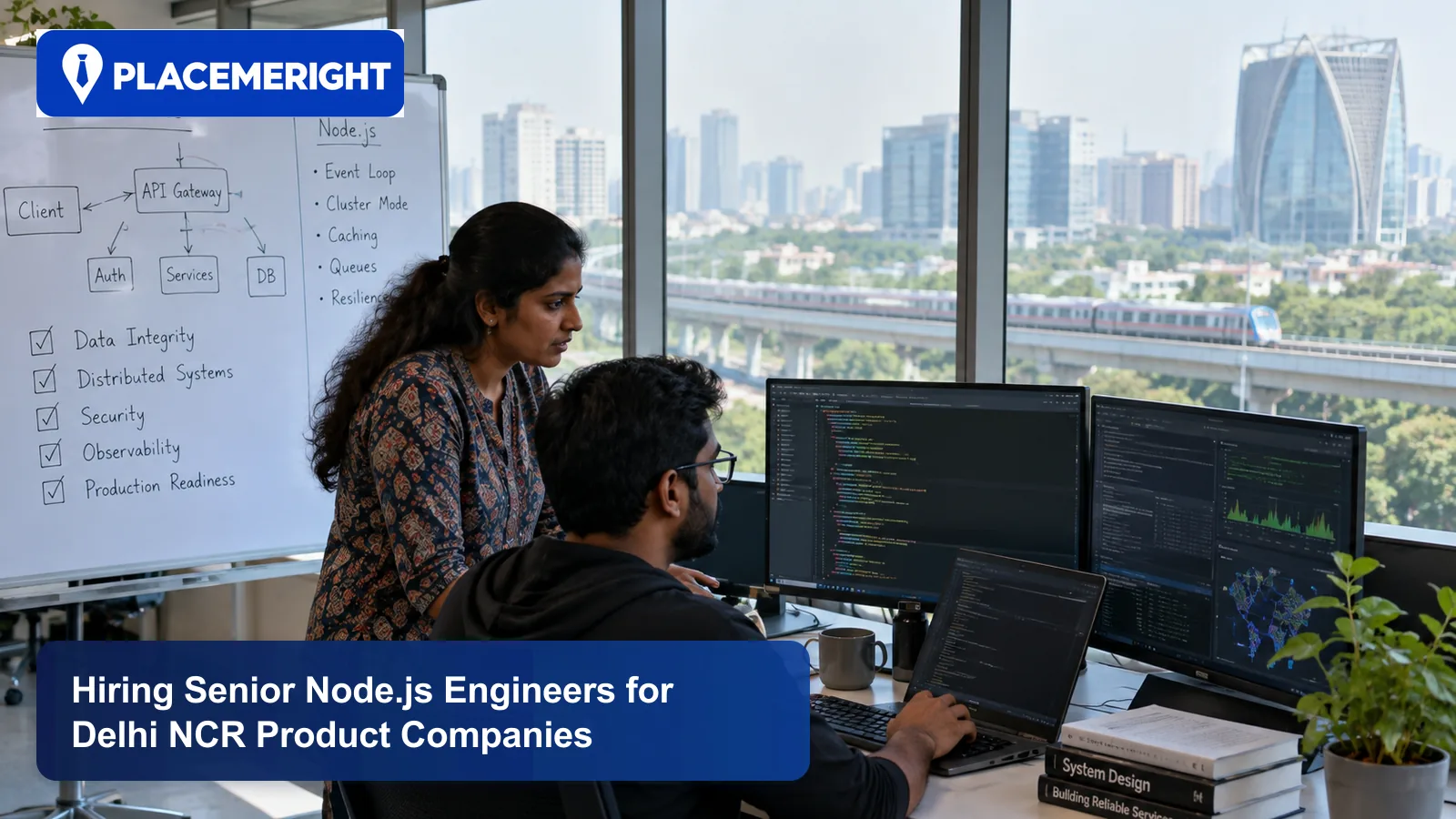
Node.js fluency is not the same as senior backend ownership.
A candidate may build REST endpoints quickly while having limited evidence in API evolution, data integrity, asynchronous failure, security, observability, capacity, migration, or incident response.
Delhi NCR product companies should define which backend decisions the hire will own, then test one realistic service across its lifecycle.
The useful brief names the traffic pattern, data boundaries, deployment model,
production exposure, security obligations, and the people who can change the system. It also states what remains with staff engineers, architects, platform teams, or product leadership. That specificity gives the interview panel one shared standard for seniority.
Delhi NCR Node.js roles sit in varied product contexts
Delhi NCR includes SaaS, fintech, ecommerce, media technology, logistics, business automation, enterprise platforms, analytics products, and service delivery.
STPI Noida identifies Gautam Buddh Nagar as a major North India IT cluster. Official Gurugram district material describes the wider corporate and technology setting. Those sources provide ecosystem context, not a count of Node.js jobs.
Current employer roles show different backend boundaries. Liberin Technologies' Sector 62 role includes Node.js, AWS services, databases, microservices, security, and technical leadership.
Sumo Logic's current Noida backend openings focus on distributed systems, high-volume data, reliability, and end-to-end ownership, even when the specific role is not a Node.js benchmark. It is useful evidence for the product-engineering bar around the language.
Source across Noida Sectors 16, 62 and 63, the Expressway around Sectors 125 and 132, Gurugram Cyber City, Golf Course Road, Udyog Vihar, and Delhi corridors such as Okhla, Jasola, and Aerocity. Use PlaceMeRight's Delhi NCR technology recruitment context after confirming the worksite.
Define seniority through the service boundary
Write what the person owns:
- API and domain design;
- persistence and data integrity;
- asynchronous workflows;
- integrations;
- authentication and authorisation;
- performance and capacity;
- deployment and migration;
- observability;
- incident response;
- mentoring and technical decisions.
Then mark dependencies owned by platform, SRE, security, data, product, or another backend team.
A bounded service owner differs from an engineer shaping a shared platform, although both may use Node.js and TypeScript.
Level should reflect ambiguity, consequence, and influence rather than a fixed number of years.
Separate Node.js from full-stack ambiguity
Many searches ask for Node.js, React, cloud, DevOps, databases, architecture, and leadership.
Clarify the durable centre of gravity:
- backend product engineering;
- full-stack feature ownership;
- API and integration engineering;
- platform tooling;
- real-time systems;
- serverless workflows;
- frontend-for-backend support.
If frontend work is occasional, label it as collaboration or a secondary capability. If the hire must own both sides, define the proportion and senior bar for each.
Test API design as a contract
Use a product workflow:
> A business customer creates an order, reserves inventory, authorises payment, and receives an entitlement. Partner systems may retry requests, and fulfilment can complete later.
Ask the candidate to define:
- resources and domain language;
- request and response contracts;
- validation;
- authentication and authorisation;
- idempotency;
- concurrency;
- partial failure;
- status transitions;
- pagination and filtering;
- error representation;
- versioning;
- audit and support visibility.
Then introduce a new partner requirement that conflicts with the first design.
Senior evidence appears in contract stability, explicit state, migration, and operational consequences, not in choosing REST or GraphQL by reflex.
Examine the event loop through production behaviour
Node.js documentation explains the event loop, timers, asynchronous work, and guidance against blocking the event loop.
Use production symptoms rather than trivia:
> Latency rises during large report generation. CPU is elevated on some instances, health checks pass, and ordinary API requests begin timing out.
Ask how the candidate would investigate:
- synchronous CPU work;
- large serialisation;
- regular-expression or parsing behaviour;
- event-loop delay;
- memory pressure and garbage collection;
- thread-pool activity;
- downstream calls;
- connection pools;
- request size;
- instrumentation gaps.
Assess measurement, containment, and redesign. A candidate should know when work belongs in a worker, queue, separate service, streaming response, or bounded chunk.
Test asynchronous workflows and failure
Move the order scenario into a message-based workflow.
Events may be duplicated, delayed, reordered, or replayed. A consumer can succeed after the caller times out. One downstream service may remain unavailable.
Ask the candidate to design:
- event identity;
- idempotent handling;
- state transitions;
- transactional boundary;
- outbox or equivalent reliability;
- retry and backoff;
- dead-letter handling;
- ordering assumptions;
- reconciliation;
- observability;
- operator intervention.
Look for explicit business semantics. "Exactly once" should not be accepted as a magic infrastructure property without defining the end-to-end effect.
Assess database ownership
A senior Node.js engineer should reason beyond selecting an ORM.
Provide a PostgreSQL or MongoDB model for orders, inventory, payment attempts, and entitlement. Ask about:
- access patterns;
- schema and constraints;
- indexes;
- transactions;
- consistency;
- concurrency control;
- migration;
- data correction;
- query plans;
- retention;
- backup and recovery;
- tenant boundaries.
Add a race where two requests reserve the last unit.
Strong answers connect domain invariant, database mechanism, retry behaviour, and customer outcome. They do not move every consistency problem into application code automatically.
If the role uses both SQL and NoSQL, state which system owns which data and why.
Include TypeScript as a design tool
TypeScript can improve clarity and change safety, but types do not validate untrusted runtime input.
Use a small code review containing:
- an external payload;
- optional fields;
- domain conversion;
- asynchronous error handling;
- database write;
- emitted event;
- response mapping.
Ask the candidate to improve:
- runtime validation;
- domain types;
- error boundaries;
- null and undefined handling;
- exhaustive decisions;
- dependency isolation;
- testability;
- logging context.
Avoid scoring obscure type-system tricks unless the product genuinely requires them. The goal is maintainable production code and clear contracts.
Test security inside the workflow
OWASP ASVS provides a basis for application-control verification. Use relevant controls as prompts rather than a memorisation test.
In the order service, ask:
- Who can create, view, cancel, or fulfil an order?
- How is tenant context established?
- Can an identifier expose another customer's resource?
- How are service credentials managed?
- What data enters logs?
- How are webhook signatures and replay handled?
- How are rate and abuse controls applied?
- What appears in an audit trail?
- How are dependencies and secrets updated?
Senior candidates should integrate security with API, data, and operation. "The security team handles it" is not enough for basic product controls.
Make observability an engineering responsibility
OpenTelemetry provides vendor-neutral concepts and tooling for traces, metrics, and logs.
Ask the candidate to instrument the order journey across HTTP, database, queue, payment, and entitlement boundaries.
Useful questions include:
- Which identifiers connect the journey?
- Which attributes are useful but sensitive?
- What measures customer impact?
- How are retries and duplicates visible?
- Which service-level indicators matter?
- How will cardinality be controlled?
- What evidence supports incident triage?
- How will instrumentation be tested?
Logging every object is not observability. It can create cost, privacy, and investigation problems.
Review production incidents in depth
Ask for one incident the candidate personally handled.
Follow the timeline:
1. How was the problem detected? 2. Who was affected? 3. Which hypothesis came first? 4. What evidence changed the diagnosis? 5. How was harm contained? 6. What was rolled back or repaired? 7. How did the team communicate? 8. What caused or contributed to the failure? 9. Which technical and operating changes followed?
Verify the candidate's role.
The candidate should show disciplined reasoning, collaboration, and prevention in the boundary they owned.
Test migration rather than greenfield design only
Product companies often need to change a working service while customers use it.
Give the candidate a monolithic Node.js service with a large table, synchronous integrations, and slow releases. Ask them to improve one boundary.
Require:
- current-state evidence;
- target outcome;
- incremental steps;
- compatibility;
- data migration;
- dual read or write only if justified;
- observability;
- rollback;
- ownership;
- deletion of the old path.
Avoid rewarding a microservices rewrite without a transition plan.
Senior product engineering includes preserving revenue, customer commitments, and supportability while architecture evolves.
Use one bounded implementation exercise
Give all candidates the same small task based on the order workflow.
For example:
- validate an idempotent create request;
- persist state safely;
- enqueue a follow-up action;
- return a stable contract;
- handle one failure;
- add tests and telemetry notes.
Allow standard documentation. State whether AI assistance is permitted and how its use should be explained.
Evaluate:
- code clarity;
- domain model;
- async error handling;
- data integrity;
- tests;
- security;
- operational thinking;
- communication.
Do not expect production-ready free work or a complete service.
Build a senior Node.js scorecard
Use role-specific weights:
| Dimension | Evidence | | --- | --- | | API and domain | stable contracts and explicit state | | runtime | event-loop, memory, dependency, and failure reasoning | | data | integrity, query, migration, and recovery | | distributed workflow | retry, idempotency, ordering, reconciliation | | security | identity, authorisation, validation, and secrets | | operation | observability, incident, capacity, and support | | product judgment | scope and customer consequence | | influence | reviews, mentoring, standards, and alignment |
Record evidence before debrief.
Do not use one broad "system design" score to hide weak implementation or production depth.
Distinguish senior, lead, and staff scope
A senior engineer should independently own a meaningful service or product boundary, operate it, and improve team practice.
A lead may coordinate delivery and technical decisions across a team while mentoring engineers and aligning product work.
A staff engineer may shape architecture and standards across several teams, lead migrations, and resolve system-wide trade-offs without relying on line authority.
An engineering manager owns conditions and outcomes through a team in addition to technical understanding.
Ask what changed because of the candidate's influence and how adoption was achieved. Do not infer staff scope from title alone.
Make Delhi NCR work conditions precise
Noida, Gurugram, and Delhi create different commute and office decisions.
State the exact location, nearest practical transit, office days, fixed hours, global overlap, on-call, late-hours support, relocation, and team distribution before interviews.
A Sector 62 role differs from a Noida Expressway role. Cyber City, Golf Course Road, Udyog Vihar, Okhla, Jasola, and Aerocity are not one interchangeable "NCR hybrid" location.
If the role is remote, explain whether production support, security access, or team events create location requirements.
Do not widen or change the worksite after sourcing without telling candidates.
Keep the candidate decision coherent
Before offer, confirm:
- product and service boundary;
- assessed level;
- team and manager;
- architecture maturity;
- on-call and support;
- worksite and cadence;
- compensation components;
- first six-month priorities;
- known constraints;
- remaining questions.
The offer-stage role should match the one tested.
Do not add team leadership, DevOps ownership, or full-stack delivery because a strong candidate appears capable. Recalibrate the job if its scope changes.
Quick checklist
- Define the owned backend service and product outcome.
- Separate backend from optional full-stack work.
- Test API contracts, state, and migration.
- Use runtime symptoms instead of event-loop trivia.
- Include asynchronous failure and reconciliation.
- Test database invariants and query reasoning.
- Review TypeScript with runtime validation.
- Include identity, authorisation, secrets, and abuse paths.
- Ask for incident and operational evidence.
- Use one bounded, equal implementation exercise.
- Weight a senior Node.js scorecard before interviews.
- State the exact Delhi NCR worksite and on-call model.
Frequently asked questions
Is Express or NestJS experience mandatory for a senior Node.js role?
Require a framework when immediate productivity in that environment is essential. Otherwise test transferable Node.js, TypeScript, API, data, security, and production evidence. Strong engineers can learn a framework more easily than they can acquire missing operating judgment.
Should the interview include data structures and algorithms?
Use them when they predict the job. Product-backend roles also need API, data, distributed-system, security, and production evidence. A puzzle-heavy loop should not replace those dimensions.
Can a frontend JavaScript engineer move into senior Node.js backend work?
Possibly, but seniority must be assessed in backend ownership: runtime behaviour, data integrity, APIs, asynchronous systems, security, deployment, incidents, and operation. Shared language syntax is not enough.
How important is prior product-company experience?
It is one context, not a universal requirement. Ask candidates from service or enterprise teams to demonstrate long-lived ownership, user outcomes, production decisions, and influence that transfer to the product environment.
Should a senior Node.js engineer own DevOps?
They should understand deployment, observability, reliability, and production support for their service. Platform infrastructure may remain with another team. Define the handoff instead of using "DevOps" as an unlimited responsibility.
What is the best practical exercise?
Use a small version of the real product workflow with validation, persistence, one asynchronous step, a failure path, tests, and operational notes. Keep it bounded and consistent for all candidates.
Related reading
- Hire Node.js developers
- Greater Noida software hiring: reach, commute, and retention
- Okhla and Jasola corporate IT, SaaS, and support hiring
- Delhi NCR cloud-support role calibration
- Hire developers in India
Conclusion
Senior Node.js hiring in Delhi NCR becomes more accurate when the employer evaluates a service from contract through production.
API design, runtime behaviour, data integrity, asynchronous failure, security, observability, migration, and incident ownership reveal seniority more reliably than framework lists alone.
A stable role boundary, consistent exercise, written scorecard, and precise NCR work model give candidates and interviewers the same job to evaluate.
CTA
PlaceMeRight helps Delhi NCR product companies calibrate backend roles, map relevant sourcing, design evidence-based interviews, and coordinate employer-side recruitment. Share your senior Node.js hiring requirement.
References
- Software Technology Parks of India, Noida, About STPI Noida
- Gurugram District Administration, About District
- Liberin Technologies, Senior Backend Engineer, Sector 62 Noida
- Sumo Logic, Senior Backend Engineer - Distributed Systems and Agentic AI, Noida
- Node.js, The Node.js Event Loop
- Node.js, Do Not Block the Event Loop
- Node.js, Diagnostics Channel API
- OpenTelemetry, JavaScript documentation
- OWASP, Application Security Verification Standard
Related PlaceMeRight resources
Our Tech Recruitment Services by City
Looking to hire vetted software engineers or scale your engineering teams in India's leading tech hubs? Explore our localized recruitment services: