
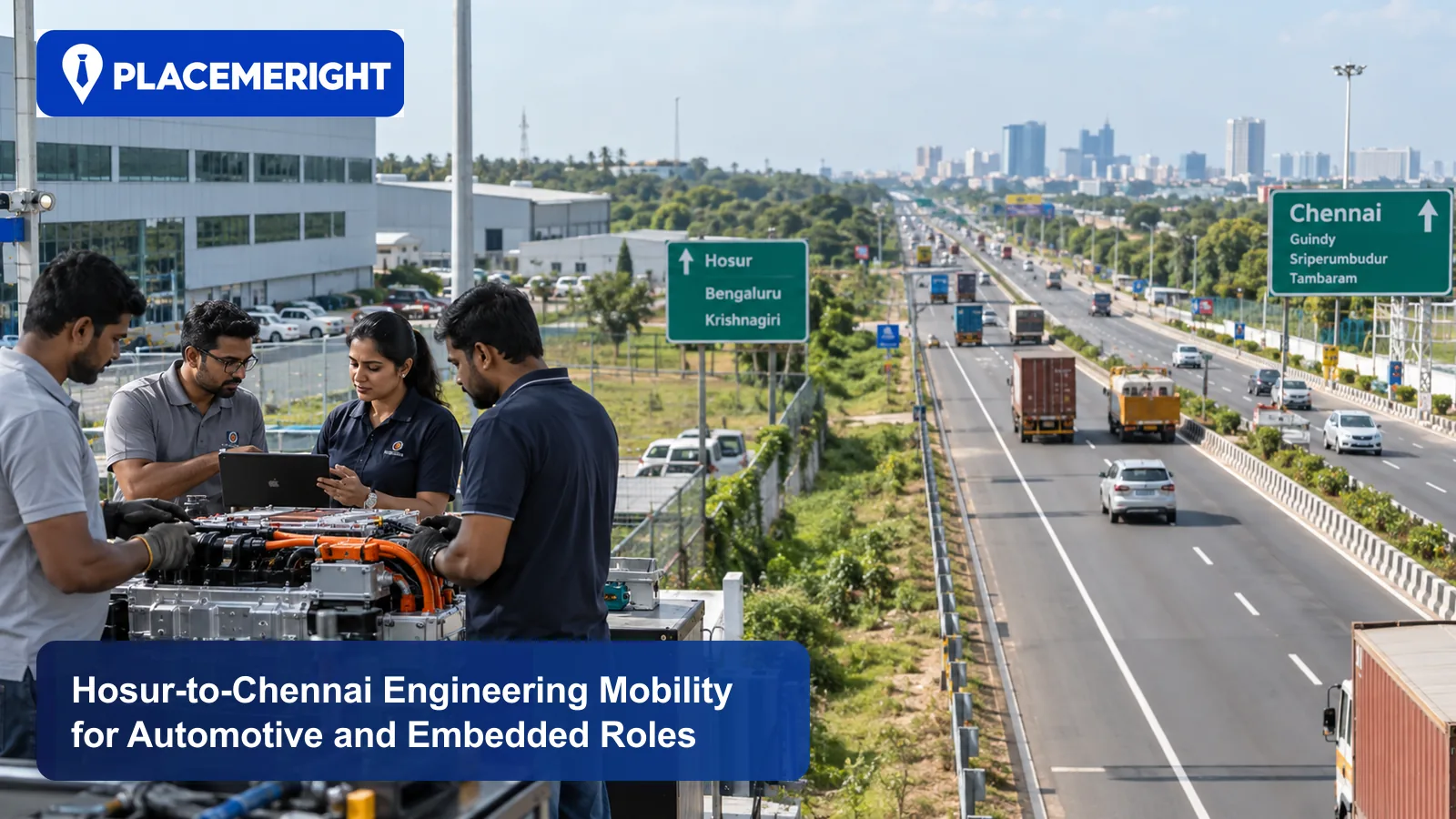
Hosur and Chennai are connected by Tamil Nadu's automotive and industrial economy, but they are not one daily labour market.
Tamil Nadu's official logistics plan describes the Hosur-to-Chennai route as a roughly 300-kilometre industrial corridor carrying automobiles, components, electronics, machinery, and other goods.
That makes the corridor commercially important. It does not make routine daily commuting a sensible hiring assumption.
For employers, the useful opportunity is engineering mobility: relocation, planned transfer, project travel, remote-compatible work, and capability exchange between two distinct clusters.
Hosur and Chennai contribute different engineering contexts
Hosur's industrial environment can expose engineers to plants, suppliers, production systems, controls, hardware, quality, validation, and manufacturing operations.
Chennai and its wider automotive corridor combine vehicle and component engineering, global engineering centres, embedded software, AUTOSAR, testing, cybersecurity, data, enterprise technology, and product-development teams.
Tamil Nadu investment material presents the state as an automobile, auto-components, and electric-vehicle ecosystem. SIPCOT provides industrial infrastructure across the state. These sources support cluster context, not a count of available engineers.
Current ZF Chennai roles show several software layers: AUTOSAR basic software, integration, cybersecurity, tooling, virtual ECU, HIL, diagnostics, communication protocols, and commercial-vehicle systems.
The employer should map the capability that can transfer, then choose a sustainable mobility model.
Use PlaceMeRight's Chennai technology recruitment context after defining the engineering site and role boundary.
Reject the daily-commute shortcut
A job description should not imply that Hosur and Chennai are neighbouring office zones.
The realistic models are:
- relocation to the Chennai region;
- relocation toward Hosur for a plant or engineering role;
- remote-first work with defined site visits;
- planned project travel;
- a temporary assignment;
- a staged transfer between company locations.
Daily travel may be an individual choice in unusual circumstances, but employers should not design the role or operating plan around it.
State the actual facility, frequency, shift, and travel burden at first contact.
Define the engineering layer before sourcing
"Automotive embedded engineer" can refer to very different work.
Create a layer map:
| Layer | Example ownership | | --- | --- | | application software | vehicle function, control logic, feature behaviour | | AUTOSAR basic software | communication, diagnostics, memory, OS, mode management | | middleware and integration | interfaces, configuration, generated artefacts, subsystem integration | | drivers and hardware abstraction | peripherals, microcontrollers, board interfaces | | diagnostics | UDS services, fault memory, service workflows, tooling | | verification | unit, software integration, SIL, HIL, test automation | | safety | requirements, traceability, analysis, verification evidence | | cybersecurity | secure boot, crypto, keys, access, threat and vulnerability work | | tooling | build, static analysis, test frameworks, CI/CD, virtual ECU | | plant and field systems | flashing, end-of-line, diagnostics, manufacturing support |
A Hosur engineer with plant controls experience is not automatically an AUTOSAR integrator. A Chennai BSW developer is not automatically ready to own end-of-line manufacturing systems.
Source for transferable evidence, not the word "automotive."
Build a capability passport
For each relevant candidate, record evidence under consistent headings.
Product and domain
Record passenger, commercial, two-wheeler, off-highway, industrial, or another domain; the ECU or subsystem; customer and supplier context; and production or prototype stage.
Software layer
Record application, BSW, MCAL, diagnostics, integration, test, tooling, cybersecurity, and connected-services evidence.
Standards and process
Record AUTOSAR, V-model activities, requirements traceability, functional-safety exposure, cybersecurity process, coding and review standards, and configuration and change control.
Tools and hardware
Record the microcontroller, compiler and debugger, CAN tools, configuration tools, static analysis, unit and integration test, HIL or SIL, and CI/CD.
Ownership
Record artefacts produced, decisions made, defects diagnosed, releases supported, stakeholders coordinated, and evidence reviewed.
The passport avoids treating a keyword-rich resume as proof of depth.
Distinguish plant-adjacent and engineering-centre work
Hosur sourcing may surface candidates whose strongest evidence is close to manufacturing.
Possible strengths include:
industrial automation; PLC or controls; manufacturing execution; traceability; end-of-line test; flashing; quality systems; supplier coordination; field diagnostics; production incident response; and ERP or plant integration.
Chennai roles may require:
ECU software; AUTOSAR configuration; middleware; embedded C; communication stacks; safety or cybersecurity evidence; HIL; architecture; and global engineering collaboration.
Some candidates bridge both. The interview should establish how.
Do not reject plant experience as "not software" without examining the systems, code, diagnostics, and ownership involved. Do not convert it into automotive product-software depth without evidence.
Choose mobility after checking site dependency
Create a site-dependency matrix.
| Activity | Remote possible? | Site frequency | Required facility | | --- | --- | --- | --- | | requirements and design | often | planned workshops | secure collaboration | | coding and review | often | team cadence | approved development environment | | ECU debugging | depends | milestone or frequent | bench, debugger, hardware | | HIL validation | depends | scheduled | HIL lab | | plant flashing support | limited | event or shift-based | manufacturing site | | incident analysis | depends | defined response | logs, bench, vehicle, or plant | | cybersecurity review | often partly | secure sessions | approved systems |
The matrix should drive the work model.
If the employee needs a Chennai HIL lab several days each week, relocation is more credible than calling the role remote. If site access occurs at planned releases, periodic travel may work.
Design relocation as an engineering transfer
A Hosur-to-Chennai move is not only a housing change.
The candidate may be changing:
- employer type;
- product layer;
- development process;
- toolchain;
- customer proximity;
- shift;
- reporting culture;
- city;
- family routine.
Build a staged transfer.
Before acceptance
- share exact Chennai facility;
- explain role layer and product;
- disclose office and lab cadence;
- define travel and on-call;
- provide package and relocation terms;
- allow a technical team meeting;
- identify learning gaps.
Before joining
- confirm move date;
- provide temporary support if approved;
- plan access and equipment;
- assign technical guide;
- share process and system material;
- schedule site induction.
After joining
- begin with a bounded artefact;
- pair on the toolchain;
- validate assumed capability;
- provide lab or hardware training;
- review household and commute stability;
- update the capability passport.
This reduces the risk of recruiting for one layer and onboarding into another.
Make project travel predictable
Some roles can remain based in Hosur with planned Chennai visits, or vice versa.
State:
expected destinations; frequency; duration; notice period; shift implications; transport; accommodation; reimbursement; weekend or holiday handling; and incident exceptions.
Do not use "as required" for a recurring pattern.
Engineering projects contain genuine uncertainty. The employer can still define normal expectations and an escalation process.
Use current Chennai roles as capability evidence
ZF's current Chennai AUTOSAR BSW role includes communication stacks, diagnostics, fault management, Embedded C, configuration tools, safety, debugging, static analysis, and testing.
Its cybersecurity role includes AUTOSAR crypto integration, secure hardware modules, requirements, embedded development, and stakeholder work.
Its tool-focused role includes build systems, static analysis, unit-test frameworks, scripting, virtual ECU, and CI/CD.
These examples demonstrate different role families within one automotive employer. They should not be combined into a single screening checklist.
Select the two or three evidence categories that determine success in the actual job.
Build an evidence-transfer interview
Ask the candidate to bring one prior engineering problem from their permitted experience. Do not request confidential material.
Use this sequence:
1. What system and layer did you own? 2. What requirements and constraints mattered? 3. Which artefact did you create or change? 4. How did you verify it? 5. What failed? 6. How did you debug the failure? 7. Which team or supplier boundaries mattered? 8. What evidence supported release? 9. What would change in our target environment?
Then present a relevant scenario.
AUTOSAR integration scenario
A communication or diagnostics module behaves differently after an ECU configuration change.
Assess:
- hypothesis;
- artefact and interface map;
- configuration reasoning;
- trace and debugging plan;
- test boundary;
- change control;
- escalation.
Plant-to-product transfer scenario
A field or end-of-line failure suggests a software, calibration, hardware, or process issue.
Assess:
- containment;
- evidence collection;
- fault isolation;
- reproducibility;
- cross-team communication;
- corrective action;
- prevention.
The panel should score reasoning and evidence, not tool-name recall alone.
Assess standards at the required depth
AUTOSAR exposure can mean:
awareness; application integration; BSW configuration; module development; architecture; tooling; testing; or ownership across release.
Ask which artefacts the candidate handled and which decisions they made.
Apply the same depth check to functional safety, cybersecurity, diagnostics, HIL, MISRA, and communication protocols.
Do not require every standard at expert depth when the role uses only a bounded part. An inflated checklist narrows the search without improving fit.
Test supplier-to-OEM and OEM-to-supplier transfer
Candidates may move between component suppliers, engineering service providers, tool vendors, vehicle manufacturers, and plant organisations.
Ask what changes in the target environment:
requirement ownership; customer access; release authority; interface negotiation; documentation burden; defect escalation; commercial pressure; reuse versus programme-specific work; verification independence; and supplier coordination.
A strong engineer may adapt successfully without having worked in the same employer type. The interview should test whether they understand the new decision boundary and can translate prior evidence.
Do not treat an OEM logo as automatic ownership, or supplier experience as narrow execution. Trace the actual artefacts, decisions, reviews, and failures.
Calibrate level through ownership
Years in automotive do not define level by themselves.
Compare:
- subsystem scope;
- ambiguity;
- independence;
- failure consequence;
- release ownership;
- supplier or customer interaction;
- mentoring;
- architecture influence;
- process responsibility;
- incident and field exposure.
A candidate with fewer years but complete ownership of a difficult boundary may fit better than a longer-tenured candidate who executed narrow tasks. The reverse may also be true.
Use the role's evidence, not a universal rule.
Prepare compensation and relocation separately
The employer should define:
- fixed pay;
- variable pay;
- benefits;
- shift or on-call provisions;
- relocation support;
- temporary accommodation;
- project travel;
- review timing;
- title and level.
Do not assume Hosur-based candidates should accept a different level because of current location.
Relocation support covers the move. Compensation covers the role and total employment proposition.
Build a two-cluster onboarding plan
The new hire needs engineering and location integration.
First 30 days
- complete site, safety, security, and tool access;
- map ECU, plant, product, or test context;
- meet Chennai and Hosur stakeholders where relevant;
- trace one requirement to evidence;
- deliver a bounded fix or test;
- review mobility conditions.
Days 31-60
- own one module, integration, test boundary, or production workflow;
- participate in a real review;
- improve one artefact;
- complete scheduled lab or plant exposure;
- identify one capability gap.
Days 61-90
- operate the agreed boundary;
- diagnose a representative failure;
- coordinate one cross-site handoff;
- document a reusable practice;
- confirm sustainable location and travel.
Do not treat travel fatigue or relocation administration as a lack of technical commitment without checking the support provided.
Measure mobility quality
Track employer process evidence:
- source location;
- capability passport completeness;
- selected mobility model;
- site-dependency match;
- interview evidence;
- relocation questions;
- work-model withdrawals;
- access delays;
- early travel changes;
- onboarding outcomes.
Do not publish the sample as proof of regional supply or retention.
Use it to discover whether the employer is targeting the wrong layer, hiding site needs, testing irrelevant knowledge, or onboarding without tools.
Quick checklist
Treat Hosur and Chennai as distinct clusters; reject a routine daily-commute assumption; define the embedded engineering layer; build a capability passport; separate plant and product evidence; create a site-dependency matrix; choose relocation, transfer, remote work, or planned travel; state the exact facility and cadence; use current-role evidence carefully; run an evidence-transfer interview; test standards at the required depth; calibrate level through ownership; separate compensation and relocation; build cross-site 30-60-90 onboarding; and measure employer process, not market supply.
Frequently asked questions
Is Hosur close enough for daily work in Chennai?
Employers should not plan the role around routine daily commuting. Use relocation, planned transfer, periodic travel, or remote-compatible design based on site dependency.
Are Hosur engineers suitable for Chennai automotive software roles?
Some may have highly relevant evidence; others may work in different industrial layers. Map software, hardware, process, tools, standards, and ownership before deciding.
Which automotive skills transfer most easily?
Transfer depends on the target role. Diagnostics, embedded C, communication protocols, testing, failure analysis, configuration control, and cross-functional work can be valuable, but depth must be demonstrated.
Should every candidate know AUTOSAR?
Only when the job needs it. Plant systems, industrial automation, validation, connected services, data, and manufacturing technology may require different evidence.
Can the role remain based in Hosur?
Yes when the engineering work, security, lab access, customer constraints, and manager system support it. Document travel and site requirements before hiring.
How can PlaceMeRight support this search?
PlaceMeRight can calibrate the engineering layer, map Hosur and Chennai sourcing, screen technical ownership, coordinate mobility decisions, and support employer-side closure.
Related reading
- Hire embedded software engineers
- Chennai automotive software hiring for embedded C++, AUTOSAR, and safety
- Ambattur industrial technology hiring
- Chennai first-90-day retention for technology hires
- Technical recruitment support
Conclusion
Hosur-to-Chennai engineering mobility is valuable when employers connect the right capability, site, and movement model.
The search should define the automotive software layer, recognise plant and engineering-centre differences, verify transferable evidence, disclose facility needs, and support relocation or project travel through a staged operating plan.
The corridor is real. Sustainable employment still requires two-cluster honesty.
CTA
PlaceMeRight helps Chennai employers calibrate automotive and embedded roles, map Hosur and Chennai talent, assess technical ownership, and coordinate mobility. Share your automotive hiring brief for employer-side support.
References
Tamil Nadu Government, Logistics Policy and Integrated Logistics Plan 2023 Guidance Tamil Nadu, Automobile, auto-components, and EV sector SIPCOT, State Industries Promotion Corporation of Tamil Nadu
- ZF Group, Current Chennai engineering roles
- ZF Group, AUTOSAR BSW Engineer, Chennai
- ZF Group, Senior Software Engineer - Cybersecurity, Chennai
- ZF Group, AUTOSAR BSW and tooling role, Chennai
- AUTOSAR, Standards
- PeopleLogic, State of Hiring Report - June 2026
Related PlaceMeRight resources
Our Tech Recruitment Services by City
Looking to hire vetted software engineers or scale your engineering teams in India's leading tech hubs? Explore our localized recruitment services: