
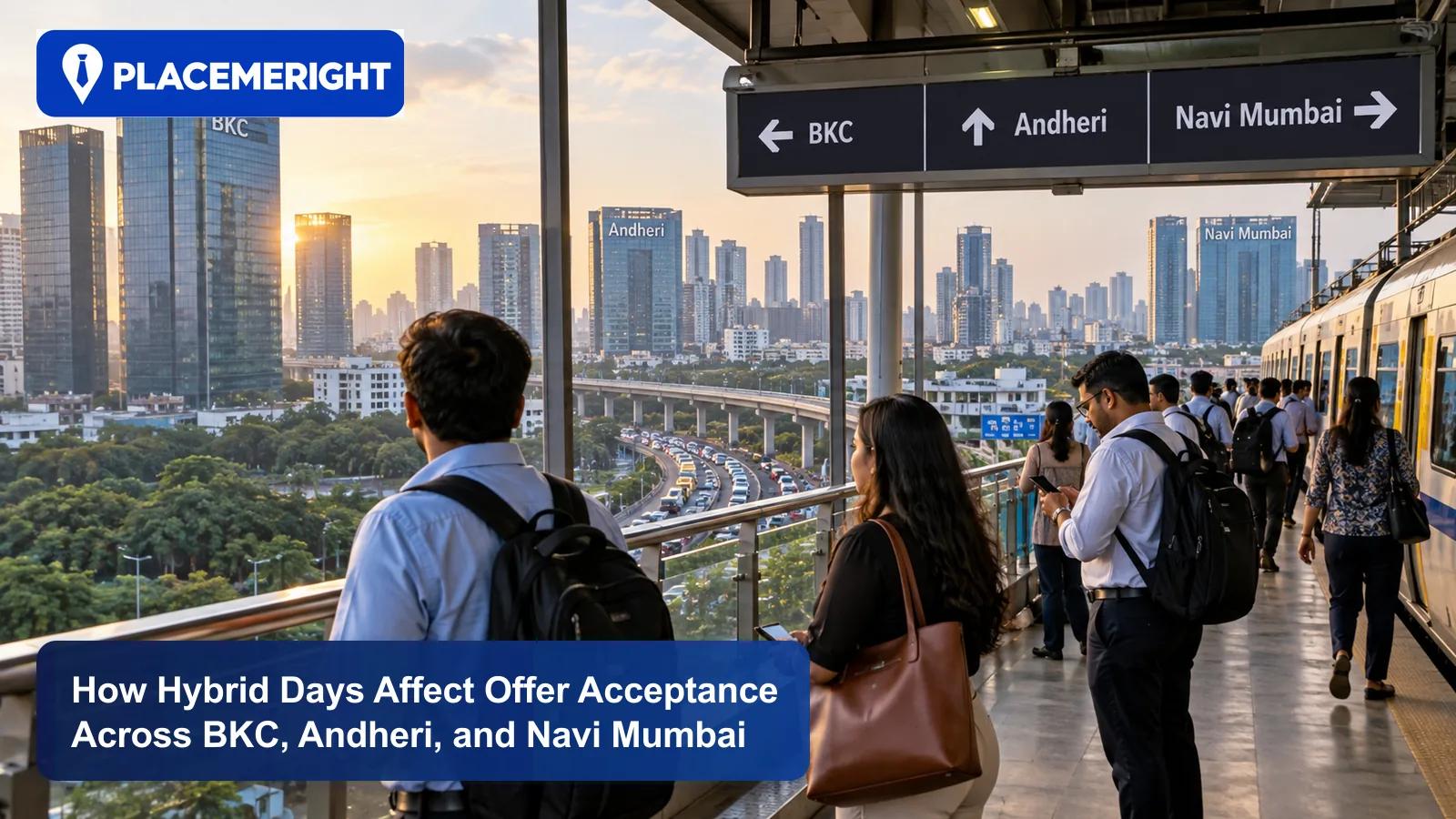
Hybrid days do not affect a Mumbai technology offer in isolation.
Their effect depends on where the office is, when attendance is expected, why the team meets, whether the pattern is stable, and what the candidate would need to reorganise to comply.
Three office days in Bandra Kurla Complex are not the same proposition as three days in Andheri East, Andheri West, Ghansoli, Airoli, Vashi, or another Navi Mumbai location. The number may match while the travel network and household decision differ.
Employers should therefore treat hybrid work as a material offer term, not a policy footnote revealed after interviews.
A current disclosure audit shows the first problem
On 28 July 2026, PlaceMeRight reviewed the 120 newest published Mumbai records in its live employer-demand database. They were drawn from 840 published Mumbai records and carried posting dates from 20 to 23 July 2026.
All 120 public records used the broad location label "Mumbai." None contained a structured workplace-type value in the public feed.
This is a disclosure audit, not a survey of every Mumbai vacancy. The database aggregates published employer signals, the sample contains only the newest 120 records, and missing fields may reflect source ingestion rather than the employer's full policy. It cannot measure acceptance, candidate preference, travel time, or hiring speed.
It does reveal a practical information gap: a city label alone does not let a candidate test an offer.
By contrast, Citi's current Mumbai quantitative-developer listing describes a hybrid model of three office days and two remote days. That is more decision-useful, although a candidate still needs the exact workplace and attendance pattern.
Use PlaceMeRight's Mumbai technology recruitment context after the office and work model are approved.
Separate three workplace systems
Do not build one "Mumbai hybrid" message.
BKC and nearby finance corridors
BKC contains financial services, technology, regulators, professional services, and international business activity. MMRDA describes it as a financial and business district with financial-services and IT use.
Roles there may include markets technology, risk, payments, cybersecurity, quantitative engineering, data, compliance platforms, and enterprise systems. Office presence may connect to controlled environments, trading or business stakeholders, production support, or senior decision forums.
The employer should state which of those reasons applies. Prestige is not an operating reason.
Andheri and the western technology belt
Andheri spans different east-west travel patterns and connects with areas such as SEEPZ, MIDC, Marol, Chakala, Saki Naka, JB Nagar, DN Nagar, Oshiwara, Goregaon, Powai, and the airport corridor.
An "Andheri" office can therefore mean very different last-mile conditions. MMRDA's current network material shows Line 2A operating to Andheri West, while Line 7 serves the eastern side and Line 6 is designed to connect western and eastern corridors through SEEPZ and Powai.
The hiring brief needs the side of Andheri, nearest useful station, and real entry time.
Navi Mumbai and distributed business campuses
Navi Mumbai technology work can sit around Vashi, Sanpada, Juinagar, Nerul, Belapur, Airoli, Ghansoli, Kopar Khairane, Mahape, Turbhe, or other nodes.
Jio's careers material identifies its Reliance Corporate Park campus in Ghansoli and publishes Navi Mumbai roles. That is a more precise proposition than "Mumbai."
Employers should not assume that a candidate living in Greater Mumbai, Thane, or another part of the region sees Navi Mumbai as an easy substitute. Test the actual journey and cadence.
Define the office-day contract
Before sourcing, write one approved work-mode card:
| Field | Required detail | | --- | --- | | workplace | full address or confirmed business park | | cadence | fixed number of days or team-led pattern | | days | named days, manager choice, or rotating schedule | | hours | normal arrival, departure, shift, and time-zone overlap | | purpose | decisions, production access, customer work, planning, or another need | | exceptions | on-call, release, incident, quarter-end, or travel | | remote setup | equipment, access, security, and communication | | change control | approver, notice, review point, and candidate communication |
"Hybrid as per company policy" is not enough. It transfers uncertainty to the candidate while preserving flexibility only for the employer.
If policy may change, explain the current approved state and the governance for changes. Do not promise permanence that the business cannot approve.
Calculate attendance as a pattern, not a number
Three office days can appear in several forms:
- Monday, Wednesday, and Friday;
- three consecutive days;
- any three days chosen by the employee;
- team anchor days plus one flexible day;
- a monthly minimum;
- office presence whenever a leader visits;
- a nominal cadence that expands around releases.
Each pattern changes planning.
Consecutive days may support temporary stays for some regional hires. Alternating days create more journeys. Flexible days can reduce coordination if every team chooses differently. Event-driven attendance can become unpredictable.
The employer should publish the real pattern used by the future manager, not only the corporate maximum or minimum.
Test candidate feasibility before final interviews
Ask for a practical work-mode discussion without collecting irrelevant personal detail.
Cover:
1. current residential area or preferred starting point; 2. office location understood by the candidate; 3. feasible attendance days; 4. shift or global overlap; 5. on-call and incident expectations; 6. relocation or temporary movement if relevant; 7. conditions attached to the candidate's answer; 8. any difference between current and proposed work mode.
The objective is not to reject people based on postcode. It is to identify whether both sides are evaluating the same job.
A candidate may accept the technical scope but decline the travel pattern. Another may value office collaboration when the purpose is credible. Neither response can be reduced to a universal preference.
Build an office-day purpose map
Every required office day should have a reason that survives scrutiny.
Possible reasons include:
- secure system or controlled-data access;
- production or market-operation coordination;
- architecture and product decisions;
- customer or regulatory meetings;
- hardware, lab, or device dependency;
- incident review;
- mentoring and onboarding;
- planning that genuinely benefits from shared context.
Weak reasons include visibility, habit, or a manager's preference that is applied inconsistently.
Create a simple map:
| Office activity | Participants | Frequency | Evidence produced | Can it be redesigned? | | --- | --- | --- | --- | --- | | architecture review | platform and product leads | fortnightly | recorded decision | partly | | controlled release | authorised engineers | scheduled | release evidence | limited | | team planning | delivery team | weekly | committed plan | yes, if tooling works | | leadership update | managers | monthly | decisions and owners | often |
This protects the policy from becoming attendance without outcome.
Show the candidate the real team week
Job descriptions often describe hybrid work abstractly. A pre-closure conversation should describe:
- which colleagues attend on each day;
- whether the manager is colocated;
- how remote colleagues participate;
- where decisions are recorded;
- how focused work is protected;
- whether office days include late global calls;
- how incidents alter attendance;
- what happens during onboarding;
- whether different teams follow different policies.
If the candidate would travel to an office only to join calls with a distributed team, say so and explain why presence is still required.
Credibility improves when the employer can describe work rather than defend a slogan.
Keep compensation and work-mode decisions connected but separate
Candidates may evaluate recurring travel, time, flexibility, benefits, and compensation together. The employer should not infer a fixed monetary value for an office day.
Instead:
1. calibrate compensation for role, level, skills, industry, and internal equity; 2. disclose the workplace and cadence; 3. define transport, shift, meal, parking, or relocation support where approved; 4. record candidate concerns; 5. decide whether the job or support can change; 6. avoid informal side promises.
A manager should not privately offer extra remote days to close one candidate when the policy owner has not approved them. That creates an unstable offer and an equity problem.
Use a pre-closure travel simulation
Before offer approval, ask the candidate to test the proposition using current information.
The simulation should include:
- exact office pin;
- intended arrival and departure;
- office days;
- likely first and last mile;
- late-call or incident scenario;
- monsoon or disruption contingency;
- household handoffs that matter to the candidate;
- cost components the candidate chooses to assess.
This is not a commute-time promise. Conditions vary by route, day, weather, service, and personal choice.
The candidate should own the final feasibility judgement. The employer should provide accurate inputs and enough time to evaluate them.
Design interviews around the actual work mode
A hybrid role needs evidence beyond generic communication.
Test how the candidate:
- documents a technical decision;
- coordinates an incident across locations;
- asks for missing context;
- separates synchronous and asynchronous work;
- mentors without constant proximity;
- protects secure information remotely;
- escalates a blocked decision;
- plans a shared office session;
- communicates across business and engineering teams.
Use one realistic scenario from the role. Score the response against observable criteria.
Do not use hybrid-work questions to reward one personality style. The evidence is reliable operation across the approved model.
Prevent policy drift during the process
Policy drift occurs when recruiter, manager, HR, and interviewer describe different jobs.
Control it with one source of truth and five checkpoints:
1. intake approval; 2. first outreach; 3. interview invitation; 4. pre-closure meeting; 5. written offer.
At each point confirm address, days, hours, exceptions, and change owner.
Record deviations. If a leader changes the cadence during hiring, reopen candidate consent instead of treating earlier interest as acceptance of the new term.
Compare BKC, Andheri, and Navi Mumbai without ranking them
No corridor is universally better.
Use a role-specific comparison:
| Decision factor | BKC | Andheri | Navi Mumbai | | --- | --- | --- | --- | | business proximity | often finance and enterprise stakeholders | mixed technology, media, services, airport, and industrial links | large campuses, telecom, services, operations, and product teams | | location precision needed | building and access route | east or west, station, business park | exact node and campus | | office purpose | regulated or business interaction may matter | varies sharply by employer and team | campus, operation, or colocated team may matter | | sourcing message | explain business workflow | explain exact micro-corridor | explain regional feasibility and campus model |
These are planning prompts, not claims about every employer in each area.
Track decision evidence instead of an acceptance claim
The topic asks how hybrid days affect offer acceptance. A responsible employer should measure its own funnel rather than quote a city-wide rate.
Track:
- candidates told the exact location at first contact;
- candidates told the cadence at first contact;
- work-mode questions raised;
- candidates withdrawing before interview;
- candidates withdrawing after office disclosure;
- approved exceptions requested;
- offers accepted;
- offers declined with a coded, candidate-confirmed reason;
- policy changes during the process;
- post-joining mismatches.
Do not force one reason when several factors influenced a decision. A decline may involve scope, manager, compensation, location, timing, risk, or personal circumstances alongside hybrid days.
Use the data to improve the brief, not to pressure the next candidate.
Quick checklist
- Publish the exact Mumbai workplace.
- Name BKC, the side of Andheri, or the Navi Mumbai node.
- State office days and who chooses them.
- Explain the purpose of attendance.
- Disclose normal hours and global overlap.
- Separate recurring cadence from incident exceptions.
- Test candidate feasibility before final interviews.
- Show the real team week.
- Keep work-mode promises approved and written.
- Run a pre-closure travel simulation.
- Use role-relevant hybrid interview evidence.
- Track candidate-confirmed decision reasons.
- Reopen consent when policy changes.
Frequently asked questions
Do more remote days always improve Mumbai offer acceptance?
No. Candidate decisions differ, and the role may have legitimate presence needs. The useful step is to disclose the exact model and measure the employer's own decision evidence.
Is "Mumbai hybrid" a sufficient job-location description?
No. Candidates need the office pin or business park, attendance pattern, hours, and exceptions. BKC, Andheri, and Navi Mumbai are not interchangeable travel propositions.
When should office days be disclosed?
In the first substantive outreach. Confirm them again before interviews and in the written offer.
Can teams choose their own anchor days?
Yes when the company permits it, but the candidate should know who chooses, how often days change, and whether cross-team meetings create extra attendance.
Should employers promise that a hybrid policy will never change?
Only if authorised to make that commitment. Otherwise state the current policy, approval owner, review process, and how changes will be communicated.
Can PlaceMeRight measure whether hybrid days caused a decline?
PlaceMeRight can help employers capture structured, candidate-confirmed decision reasons. It should not convert mixed decisions into an unsupported city-wide acceptance rate.
Related reading
- Why hybrid policy matters for senior BKC roles
- Mumbai compensation beyond one city premium
- Long banking interview-process dropouts
- Technical recruitment support
Conclusion
Hybrid days influence a Mumbai offer through the complete workplace proposition.
BKC, Andheri, and Navi Mumbai require different location detail. Employers should disclose the exact office, attendance pattern, hours, purpose, exceptions, and change control; test candidate feasibility; and measure their own funnel without inventing an acceptance rate.
The useful offer is not defined by the fewest office days. It states why the work model exists, how precise it is, who approved it, and what the employee should understand.
CTA
PlaceMeRight helps Mumbai employers calibrate technology roles, define office and hybrid terms, screen relevant evidence, and coordinate pre-closure decisions. Share your Mumbai hiring brief for employer-side support.
References
- PlaceMeRight, Mumbai live employer-demand snapshot, accessed 28 July 2026
- Mumbai Metropolitan Region Development Authority, Bandra Kurla Complex overview
- Mumbai Metropolitan Region Development Authority, Metro Line 2A present status
- Mumbai Metropolitan Region Development Authority, Mumbai Metro master-plan corridors
- Mumbai Metropolitan Region Development Authority, Metro Line 6 overview
- Citi, Quantitative Developer, AVP, hybrid Mumbai role
- Citi, Current Mumbai technology jobs
- Reliance Jio, Careers and Ghansoli campus
- PeopleLogic, State of Hiring Report - June 2026
Related PlaceMeRight resources
Our Tech Recruitment Services by City
Looking to hire vetted software engineers or scale your engineering teams in India's leading tech hubs? Explore our localized recruitment services: