
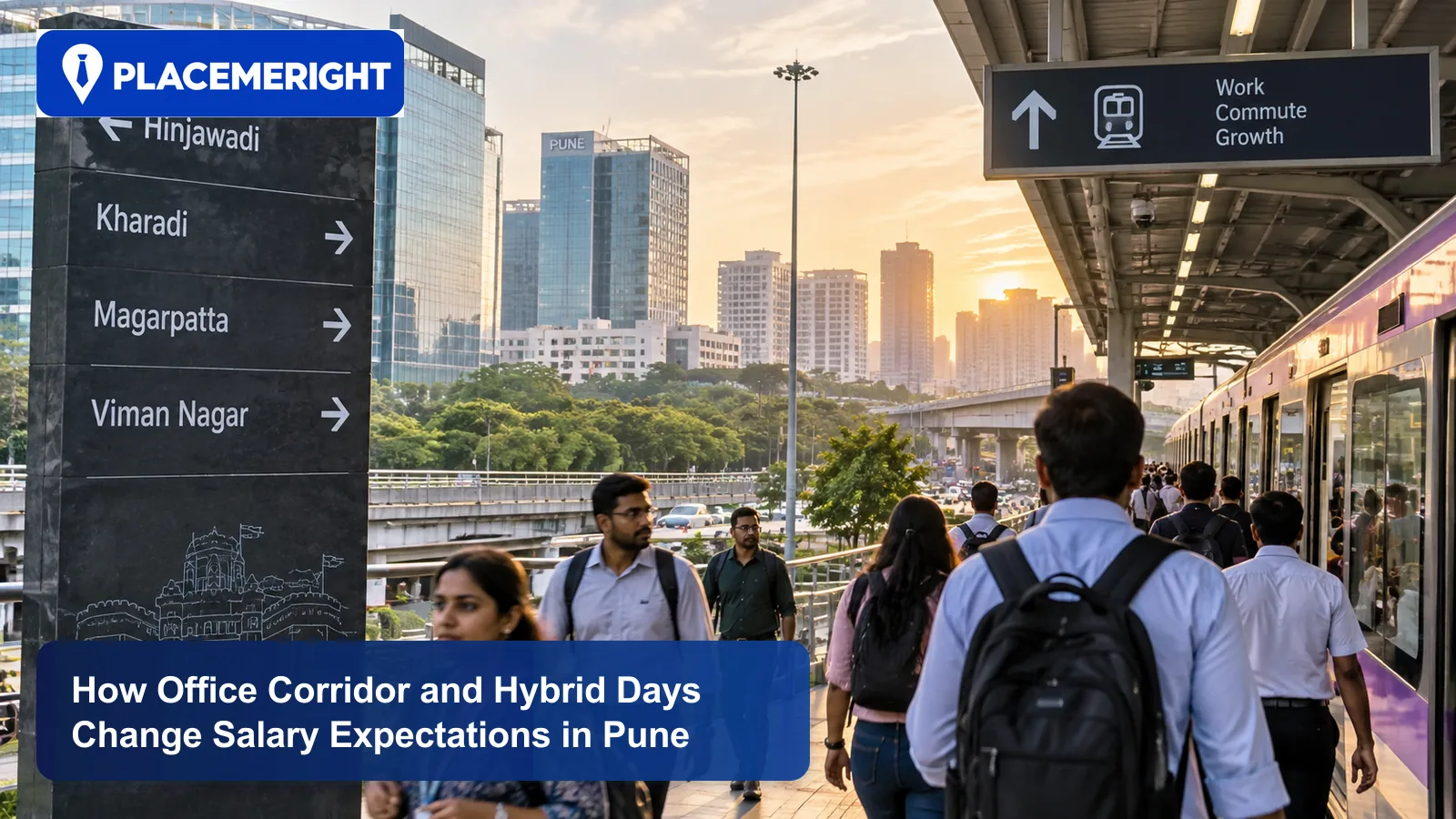
A Pune technology offer can become a different offer without the title or base pay changing.
Move the office from Kharadi to Hinjawadi. Increase attendance from two days to four. Add a late production-support window. Replace a stable team day with manager-selected attendance. Require travel to Chakan or a customer site. Each change alters the time, predictability, and operating responsibility attached to the job.
Candidates may then reopen their compensation expectations, ask for a different work arrangement, or leave the process. That response should not automatically be labelled negotiation behaviour. The employer first needs to check whether it changed the role after the candidate formed an initial view.
This is an employer guide to that check. It does not provide Pune salary averages or claim that one corridor commands a fixed premium.
Use a declared evidence sample, not a corridor myth
This article reviewed five current sources on July 28, 2026.
Three were employer postings for Pune technology roles on Citi's careers site. Each described the position as hybrid. The other two were official infrastructure sources: Panchshil's EON Free Zone I page identifies a technology office complex in Kharadi, while PMRDA describes the Hinjawadi-Shivajinagar Metro Line 3 project and its connection to Rajiv Gandhi IT Park.
That small, purposive sample establishes two things only: hybrid technology roles are being advertised in Pune, and Kharadi and Hinjawadi are distinct employment corridors with their own transport context. It does not establish a representative salary difference, preferred attendance pattern, offer-acceptance rate, or commute time.
Employers should repeat the posting review when a role opens and use their own dated candidate-conversation records for compensation decisions.
PlaceMeRight's Pune technology recruitment page provides the wider city and industry context once the particular job conditions are clear.
Define the employment proposition before discussing pay
Create one role baseline that a recruiter, hiring manager, candidate, and compensation approver can all read.
Role outcome
State what the person will own in the first six to twelve months. A backend engineer maintaining a regulated payments service has a different operating burden from a developer working on an internal reporting tool, even when both use Java.
Exact worksite
Publish the office address or named campus, not "Pune".
Kharadi, Hinjawadi, Hadapsar, Kalyani Nagar, Baner, Viman Nagar, Yerawada, Wakad, and Pimpri-Chinchwad are not interchangeable labels. Do not ask candidates to infer the eventual site from a parent company's other offices.
Attendance rule
Record:
- expected office days each week;
- whether days are fixed or selected by the manager;
- whether full-team attendance is required;
- the policy for release weeks or incidents;
- whether the arrangement is contractual, team practice, or currently under review;
- who can change it.
"Hybrid" alone answers none of these questions.
Time boundary
Clarify standard hours, overlap with another region, shift rotation, weekend work, on-call duty, and travel. A role may be hybrid and still require time-sensitive production coverage from home.
Compensation components
Explain the base, variable structure, joining or retention component if applicable, benefits, review cycle, and any condition attached to a component. Do not let a candidate compare a fixed component with a target component as though they were identical.
Decision date
Note when each condition was approved. A policy announced after screening should be treated as a role change, not hidden inside the offer call.
Build an office-condition ledger
Use a compact ledger for every active position.
One row should record the condition, candidate-facing wording, evidence owner, date verified, and whether it affects the search.
Useful fields include:
- office name and address;
- corridor;
- weekly attendance;
- fixed or flexible days;
- shift or time-zone overlap;
- on-call frequency;
- customer or plant travel;
- relocation expectation;
- transport support, if any;
- equipment and remote-access limits;
- policy owner;
- last verification date.
The recruiter verifies the published proposition before first outreach and again before the offer. The hiring manager signs off on exceptions. Compensation reviews the complete operating proposition rather than a title in isolation.
This ledger is more useful than assuming every candidate living in Pune experiences a corridor in the same way.
Ask what changed, not what a corridor is "worth"
An employer does not need to assign a universal monetary value to Hinjawadi, Kharadi, or Hadapsar.
It needs to identify the change between the candidate's original assumption and the final role.
Corridor change
Did the office move from the east to the west of Pune, or from a central location to an industrial site? The relevant question is the candidate's feasible journey and schedule, not a citywide commute stereotype.
Attendance change
Did the job move from two predictable office days to four manager-selected days? That can affect travel planning, housing, care responsibilities, and the value the candidate assigns to flexibility.
Operating-duty change
Was on-call, weekend release support, plant travel, or customer-site work added? These are job-scope changes even when the codebase is unchanged.
Certainty change
Did a clearly stated policy become "subject to business needs"? Ambiguity has value consequences because candidates cannot plan against it.
Timing change
Was the information disclosed before salary expectations were collected, after the interview, or only at offer stage? Late disclosure creates preventable rework.
Maintain an offer-expectation change record
When a candidate revises an expectation, record the sequence without turning it into a judgement about attitude.
The record should contain:
1. the role conditions first shown; 2. the candidate's initial expectation and date; 3. each material condition changed by the employer; 4. the date and channel of disclosure; 5. the candidate's stated effect; 6. the employer's available responses; 7. the final decision and owner.
Do not infer personal finances or pressure candidates to disclose family circumstances. The employer needs enough information to assess role feasibility and offer alignment, not a private-life audit.
Use consistent categories across candidates. That allows the hiring team to see whether repeated offer friction comes from the search market or from its own changing brief.
Separate compensation calibration from bargaining
Compensation calibration asks whether the role, level, and operating conditions are accurately represented in the approved package.
Bargaining asks where the two parties can agree within approved boundaries.
The order matters.
First, confirm that the job is still the job that was priced. Then decide whether the candidate evidence supports the level. Only then handle the offer conversation.
If the site, attendance, or duty changed, possible employer responses include:
- restore the earlier condition;
- approve a role-specific exception;
- adjust the package through the normal governance process;
- change the level or scope;
- offer a different vacancy;
- close the process respectfully when the role is no longer feasible.
No response is automatically correct. Concealing the change is not an acceptable response.
Compare candidates on role evidence
Do not pay an arbitrary "corridor premium" to compensate for weak assessment.
Evaluate the evidence that determines level:
Technical ownership
What production boundary has the candidate owned? What design, delivery, reliability, security, or data decisions did the person make?
Scale and consequence
What happened when the system failed? Was the candidate responsible for customer, financial, plant, or internal workflow outcomes?
Independence
Could the person diagnose ambiguity, coordinate dependencies, and make bounded decisions without constant escalation?
Communication
Can the candidate explain trade-offs to product, operations, security, finance, or customer teams?
Operating fit
Can the person meet the disclosed office, shift, support, and travel conditions? This is feasibility, not a proxy for competence.
Score the first four areas before discussing the fifth. A commute does not make someone a stronger engineer.
Run a late-change offer exercise
Use a fictional scenario in recruiter and hiring-manager training.
Present the original brief
A platform engineer is screened for a Kharadi office with two fixed team days. There is a shared on-call rotation and no regular travel. The candidate states an expectation based on those conditions.
Introduce the change
Before the final interview, the team is reassigned to Hinjawadi. Attendance becomes four days, selected weekly by the manager. Quarterly customer travel and one late support window are added.
The candidate reopens compensation and asks whether the original arrangement can be honoured.
Ask the team to diagnose the issue
A weak response says the candidate is changing numbers.
A stronger response reconstructs the timeline, confirms who authorised each change, compares the current role with the approved level, and identifies which conditions can be restored or changed.
Require a candidate message
The recruiter should state:
- what changed;
- when it becomes effective;
- what remains unchanged;
- what is still undecided;
- which alternatives are approved;
- when the candidate will receive a final answer.
The message should not promise an exception before approval.
Add a second candidate
The second candidate lives closer to the new site and keeps the original expectation.
Ask whether the first candidate should be rejected for asking again. The correct analysis is individual feasibility and role evidence. One candidate's easier journey does not invalidate another candidate's response to an employer-made change.
Score offer-process quality
Accuracy
Were the office, attendance, time, travel, and support conditions correct at every candidate touchpoint?
Timing
Were material conditions disclosed before expectations and interviews?
Change control
Can the team identify who changed the proposition and which candidates were affected?
Level consistency
Is compensation anchored to demonstrated role evidence and internal governance?
Candidate clarity
Did the candidate receive a direct explanation without pressure or vague promises?
Learning
Did repeated objections lead to a corrected job description, sourcing brief, or approval process?
Review these measures by role and hiring team. Do not publish an acceptance rate from a small or selectively recorded sample.
Keep corridor language factual
Kharadi contains established office developments such as EON Free Zone. The official Pune Metro map currently lists the eastward corridor through Yerawada, Kalyani Nagar, and Ramwadi. PMRDA's Line 3 material connects Hinjawadi with Shivajinagar and describes the project status.
These references help an employer explain where a site sits in Pune's changing transport network. They do not prove a candidate's actual door-to-door time.
For every role, provide:
- a map pin;
- gate or building information;
- nearest practical public-transport options;
- office-day arrival window;
- parking or shuttle facts that the employer can verify;
- travel expected beyond the office.
Refresh infrastructure statements before publishing or reusing them. Project status can change.
Review a small internal sample responsibly
An employer can audit its own recent Pune searches without presenting the result as the whole market.
Select a defined period and include every candidate who reached the same stage for the same role family. Record the role, site, attendance, first disclosed conditions, later changes, expectation movement, reason stated by the candidate, and outcome.
Publish the sample size and exclusions internally. Separate "candidate changed preference" from "employer changed role". Do not infer causation from a few conversations.
The objective is to find process defects:
- inconsistent recruiter wording;
- missing office address;
- attendance changed after screening;
- on-call disclosed late;
- target variable described as fixed;
- level revised without updating the package;
- approvals too slow for a clear response.
Correct those defects before inventing a city rule.
Quick checklist
- Publish the exact Pune office.
- Define hybrid days and who selects them.
- Disclose shifts, on-call, travel, and release support.
- Date every material role condition.
- Recheck the proposition before the offer.
- Record employer-made changes separately.
- Calibrate level from role evidence.
- Avoid universal corridor premiums.
- Use candidate-specific feasibility facts.
- Refresh current posting and infrastructure evidence.
Frequently asked questions
Does Hinjawadi always require higher compensation than Kharadi?
No. This article establishes no universal corridor premium. Compare the exact role conditions, candidate evidence, internal level, and individual feasibility.
Should hybrid work reduce a Pune salary?
There is no automatic rule. "Hybrid" can describe very different attendance, timing, support, and travel arrangements. Price the role through the employer's compensation governance after defining those conditions.
When should office days be disclosed?
Before collecting expectations and before substantive interviews. Reconfirm them before offer approval because policies and team practices can change.
Can an employer ask where a candidate lives?
Ask only for job-relevant feasibility information and handle personal data under the employer's privacy process. A candidate can assess a disclosed office without the employer making assumptions about private circumstances.
What if the worksite changes after an offer is accepted?
Escalate through HR, legal, compensation, and business owners as applicable. Explain the change promptly and review the accepted terms and available options rather than assuming the candidate must absorb it.
Are current job postings reliable salary evidence?
Not when they omit compensation or represent a narrow, non-random sample. They can show current role wording and work model, but not a Pune-wide salary benchmark.
Related reading
- Explore employer-side technology recruitment
- Review specialist engineering hiring support
- Discuss a Pune hiring brief
Conclusion
Pune compensation conversations become more stable when the employer treats office location, hybrid cadence, time boundaries, and support duties as part of the job.
The practical question is not what a corridor is universally worth. It is whether the final offer still matches the role the candidate assessed, and whether level and compensation are supported by consistent evidence.
CTA
PlaceMeRight helps Pune employers define worksite conditions, calibrate role evidence, structure candidate communication, and coordinate employer-side technology hiring.
Share your Pune hiring requirement
References
- Panchshil Realty: EON Free Zone I in Kharadi
- Pune Metro: current route map
- PMRDA: Pune Metro Line 3 between Hinjawadi and Shivajinagar
- Citi Careers: Pune Senior Java Engineer listed as hybrid
- Citi Careers: Pune Full Stack AI-Enabled Developer listed as hybrid
- Citi Careers: Pune Java Full Stack Developer listed as hybrid
Related PlaceMeRight resources
Our Tech Recruitment Services by City
Looking to hire vetted software engineers or scale your engineering teams in India's leading tech hubs? Explore our localized recruitment services: