
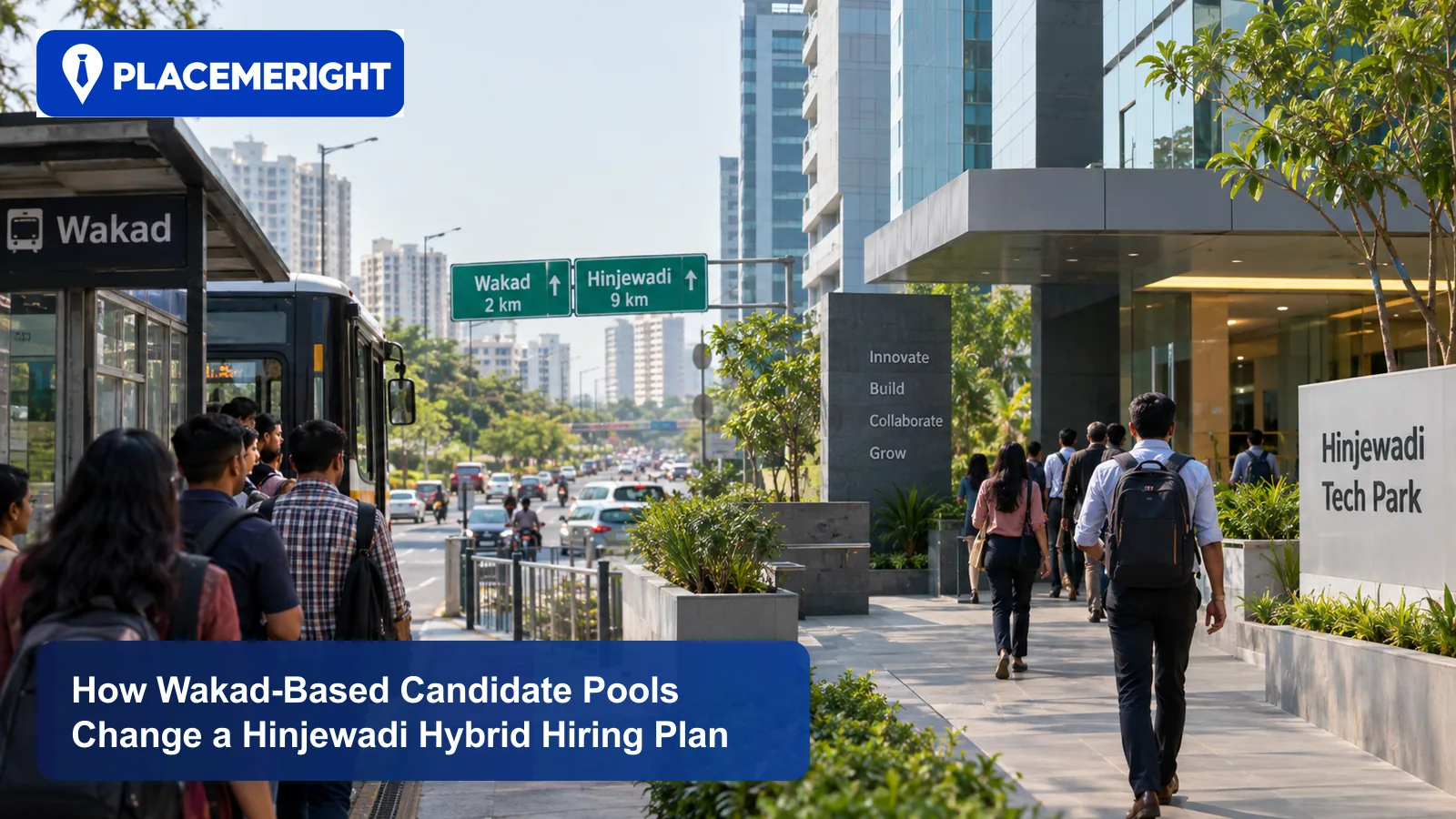
Wakad can make a Hinjewadi hybrid search look geographically simple.
It is nearby on a map. It is associated with West Pune's residential and technology corridor. Current transport planning connects Wakad and the Rajiv Gandhi IT Park more visibly than before.
None of that proves that every Wakad-based candidate can reach every Hinjewadi office on the same schedule.
A useful hiring plan begins with the actual journey and the work that needs to happen in person.
Define the corridor with current evidence
The Pune Metropolitan Region Development Authority describes Pune Metro Line 3 as a 23.203-kilometre elevated route with 23 stations connecting Hinjawadi and Shivajinagar.
PMRDA says the project is intended to address traffic problems around Rajiv Gandhi IT Park and nearby areas. Its station context includes Maan, Hinjawadi, Wakad Chowk, Balewadi, Baner, and the route toward Shivajinagar.
PMRDA's separate project-status page reported physical progress of 94.58 percent at the end of January 2026. A June 2026 PMRDA press release discussed a first phase from Maan-Hinjawadi toward Baner.
Those official facts establish a relevant transport corridor.
They do not establish:
- a door-to-door commute for a specific candidate;
- service availability on a future joining date;
- a convenient last mile to a particular office phase;
- a candidate's preferred travel mode;
- the acceptability of an employer's office hours.
Use completed, operating access at the time of the conversation. Treat announced or phased infrastructure as context to verify, not a benefit to promise.
Start with a dated Pune hiring snapshot
On 28 July 2026, PlaceMeRight reviewed the newest 120 published records returned by its Pune live-jobs endpoint.
The records were posted from 20 to 23 July. They represented 92 named employers and 102 distinct normalized titles. The endpoint reported 1,269 published Pune records in total.
Use PlaceMeRight's Pune technology recruitment context when moving from this city observation to a calibrated search.
The sample contained 40 titles with a senior, lead, staff, principal, manager, director, or architect signal. Eighteen matched a cloud or platform rule, 17 matched a data rule, and five contained product.
These categories overlap and describe titles, not qualified candidate pools.
Workplace type, compensation, and experience fields were absent across the 120 records. Location was reported only as Pune.
One published title itself included "Pune | Hybrid", but a title string is not enough to infer the schedule, office, or policy for the rest of the sample.
The dataset cannot measure how many candidates live in Wakad or will accept a Hinjewadi commute. It demonstrates why those fields must be collected inside the employer's own process.
Replace the radius assumption with a journey map
Do not source against a circular distance around the office.
Create a journey map with four layers.
Candidate origin
Capture the practical starting point rather than only a postcode or broad locality.
Wakad itself contains different access points. Tathawade, Punawale, Ravet, Pimple Saudagar, Balewadi, Baner, Mahalunge, Maan, and Hinjewadi create different routes and last-mile choices.
Office destination
"Hinjewadi" may refer to different phases, buildings, entrances, campuses, or nearby Maan locations.
Record:
- building and phase;
- employee entrance;
- reporting floor or campus;
- parking and shuttle access;
- nearest usable public transport stop;
- expected arrival and departure windows.
Workday pattern
Two office days can be harder than three when both are fixed at peak time, paired with late calls, or changed without notice.
Capture fixed days, anchor events, timing flexibility, exceptions, and the policy owner.
Journey resilience
Ask what happens during rain, a late production incident, a client call, a missed shuttle, or an early interview panel.
The aim is not to reject candidates with complex journeys. It is to prevent a hidden mobility problem from appearing after the offer.
Give every office day a purpose
A hybrid policy becomes more credible when office presence has a defined outcome.
| Office activity | Why co-location may help | What must be planned | | --- | --- | --- | | product discovery | rapid clarification with product, design, and engineering | participants and decision target | | architecture review | shared system context and trade-off discussion | pre-read and decision owner | | incident learning | cross-team evidence review | blameless record and follow-up | | onboarding | access, relationships, and system orientation | named guide and agenda | | customer or plant session | direct workflow understanding | travel, security, and timing | | team planning | dependency and capacity decisions | prepared backlog and outcome |
Do not require a commute merely to join separate video calls from an office desk.
When an office day has no distinct work purpose, candidates may see the travel as an unmanaged cost.
Audit current employer work-model language
Current Pune employer pages show why "hybrid" needs interpretation.
Citi's current Pune technology listings identify hybrid roles across Java, full-stack, data, platform, risk, and production engineering. Western Union's Pune staff software engineering listing identifies a hybrid work model and describes API-platform modernization. Zebra's Pune software role describes hybrid work and broader flexibility language. Regal Rexnord's Pune engineering listing says the role follows a hybrid model with work at a designated location and remote flexibility.
These examples do not prove one common Pune schedule.
They show that candidates can compare several employer-authored versions of hybrid work, attached to different industries and responsibilities.
For each competing role, a candidate may ask:
- Is hybrid a contractual category, a team norm, or manager discretion?
- How many days are expected?
- Which office is designated?
- Are days fixed?
- Can hours shift around travel?
- Does the team operate across time zones?
- Does on-call duty create extra journeys?
An employer should answer those questions before promoting flexibility as a benefit.
Segment the Wakad conversation without claiming supply
"Wakad-based candidate pool" should mean a sourcing and feasibility segment, not an estimate of available people.
Use four practical segments.
Already travelling to Hinjewadi
These candidates understand part of the corridor, but their current office, phase, timing, and transport may differ.
Ask what works today and what would change.
Working elsewhere in West Pune
A candidate travelling to Baner, Balewadi, Aundh, or another office may accept Hinjewadi only if the work pattern and role value justify the change.
Do not assume West Pune journeys are interchangeable.
Remote or distributed workers
The person may have reorganized care, housing, or daily life around remote work.
A nearby office does not make a new attendance requirement minor. Discuss transition timing and actual expectations.
Relocating into the corridor
Relocation may make the role feasible, but the employer should not turn an unconfirmed move into a closure assumption.
Capture who decides, the timing, housing constraints, and whether temporary arrangements are needed.
These segments improve questions. They do not quantify supply or acceptance.
Build a candidate-specific feasibility record
Use one short record for every serious profile.
| Field | Example of acceptable evidence | | --- | --- | | origin | locality and practical starting landmark | | usual mode | company shuttle, two-wheeler, car, bus, metro, mixed | | office destination | exact Hinjewadi phase and building | | office days | fixed, flexible, or event-led | | arrival window | candidate-tested feasible range | | late-work constraint | transport, safety, care, or support issue | | transition | immediate, trial period, or relocation dependency | | confidence | confirmed, needs validation, or unresolved |
Do not ask for unnecessary personal information. Record only what helps assess role feasibility with consent.
Screen role fit and location fit separately
A strong engineer should not be marked weak because the office proposition is unclear.
Use two scorecards.
Capability scorecard
Assess:
- system or product ownership;
- evidence of delivery;
- technical decisions;
- quality and reliability;
- stakeholder communication;
- learning and debugging;
- leadership expected at the level.
Feasibility scorecard
Assess:
- workplace clarity;
- attendance alignment;
- journey realism;
- support-hour fit;
- relocation dependency;
- unresolved policy risk.
The hiring team can then see whether to improve the role, the schedule, transport support, or candidate targeting.
Combining everything into one "fit" score hides the corrective action.
Use a consistent recruiter conversation
Try this sequence:
1. "The office is in [building and phase]. Does that destination match what you understood?" 2. "The team currently meets in person on [days or event pattern]." 3. "The useful office work is [specific activity]." 4. "Which starting location and travel mode would you normally use?" 5. "Which arrival, departure, or late-support conditions could make this difficult?" 6. "Are you comparing roles with a different work model?" 7. "What would you need to verify before treating the arrangement as feasible?"
The recruiter should not promise policy exceptions without the authorised owner.
Where flexibility exists, describe the boundary clearly.
Design interviews around the same hybrid reality
The interview should reveal how the team actually collaborates.
For a platform engineer, use a production scenario requiring written diagnosis, an architecture discussion, and a cross-team decision.
For a product engineer, use a customer problem that requires asynchronous preparation and a focused working session.
For a data role, ask the candidate to clarify consumers, data contracts, quality, and operating ownership.
Let the candidate meet the manager and at least one future collaborator.
If the role will work across Pune and global time zones, discuss the normal collaboration windows. Do not allow "hybrid" to hide a second schedule of late calls.
Run a two-week hybrid calibration before launch
Before broad sourcing:
1. Ask current team members to document actual office attendance. 2. List work that genuinely benefited from co-location. 3. Record office arrival and departure expectations. 4. Identify unplanned attendance and late-work events. 5. Confirm shuttle, parking, and public-transport information. 6. Check whether policy language matches manager practice. 7. Review the role with HR, manager, and recruiter. 8. Publish one consistent version in the brief and interview pack.
This internal audit is more useful than copying a competitor's hybrid label.
Measure your own process
Track employer-owned evidence:
- profiles contacted by verified origin segment;
- candidates who understood the exact office;
- unresolved work-model questions after the first call;
- interviews lost because the schedule was disclosed late;
- offers where office expectations changed;
- accepted candidates whose joining feasibility was reconfirmed;
- first-month variance between stated and actual attendance.
These measures help improve the process.
They should not be published as Pune-wide facts unless the method, sample, and limits justify that use.
Add one monthly policy check. Ask the manager, recruiter, and two recent joiners whether the office pattern described during hiring matched the pattern actually experienced. Record any difference in days, timing, meeting purpose, or late-work expectation. Correct the brief before the next search instead of allowing an outdated hybrid label to persist.
Quick checklist
- [ ] Exact Hinjewadi building, phase, and entrance are documented.
- [ ] Wakad is treated as a set of journeys, not a uniform radius.
- [ ] Current operating transport is separated from future milestones.
- [ ] Every office day has a work purpose.
- [ ] Manager practice matches written hybrid language.
- [ ] Office hours, fixed days, and exceptions are disclosed early.
- [ ] Candidate origin and travel mode are confirmed with consent.
- [ ] Capability and commute feasibility use separate scorecards.
- [ ] Global calls and on-call journeys are visible.
- [ ] Offer-stage feasibility is reconfirmed.
- [ ] No supply, commute-time, or acceptance claim is inferred.
Frequently asked questions
Does living in Wakad automatically make Hinjewadi hybrid work feasible?
No. The exact origin, office phase, transport mode, work hours, office days, and last mile still matter. Verify the candidate's real journey.
Should employers wait for Pune Metro Line 3 before changing a hiring plan?
Build the plan around service and access that are operating at the relevant time. Official project information can support future scenario planning, but it should not be promised as a current benefit before verification.
How many office days fit a Hinjewadi team?
There is no universal number. Start with work outcomes that benefit from co-location, then design the smallest reliable pattern that supports them.
Can a job posting simply say Pune hybrid?
It can, but that wording leaves material questions unanswered. Include the exact office, current attendance pattern, normal hours, and who controls exceptions.
Does the PlaceMeRight vacancy sample measure Wakad candidate supply?
No. The sample reports recent Pune titles and employers. It does not provide candidate residence, commute, salary, or workplace-policy data.
What should be reconfirmed before an offer?
Reconfirm location, office days, hours, transport assumptions, on-call expectations, relocation dependencies, and any exception approved during the process.
Related reading
- PlaceMeRight technology recruitment services
- Hire developers for Pune product and engineering teams
- Share a Pune hiring requirement
Conclusion
Wakad can be a valuable sourcing lens for a Hinjewadi role, but proximity is not proof of feasibility.
Employers need an exact destination, purposeful office days, current transport evidence, and a candidate-specific journey conversation.
That discipline makes hybrid hiring clearer for both sides without inventing a West Pune talent-pool statistic.
CTA
PlaceMeRight helps Pune employers define role ownership, Hinjewadi workplace reality, hybrid operating norms, candidate feasibility, and interview evidence before sourcing starts.
Discuss a Hinjewadi hybrid hiring brief
References
- PlaceMeRight, Pune live employer-demand snapshot, accessed 28 July 2026
- Pune Metropolitan Region Development Authority, Pune Metro Line 3 overview
- Pune Metropolitan Region Development Authority, Maan-Hinjawadi-Shivajinagar project status
- Pune Metropolitan Region Development Authority, Metro Line 3 first-phase press release
- Pune IT City Metro Rail, Line 3 station list
- Citi, Applications Development Intermediate Programmer Analyst, Pune, hybrid
- Citi, Full Stack AI-Enabled Developer, Pune, hybrid
- Western Union, Staff Software Engineer, Pune, hybrid
- Zebra Technologies, Software Engineer, Pune, hybrid work
- Regal Rexnord, Engineer Design, Pune, hybrid
Related PlaceMeRight resources
Our Tech Recruitment Services by City
Looking to hire vetted software engineers or scale your engineering teams in India's leading tech hubs? Explore our localized recruitment services: