
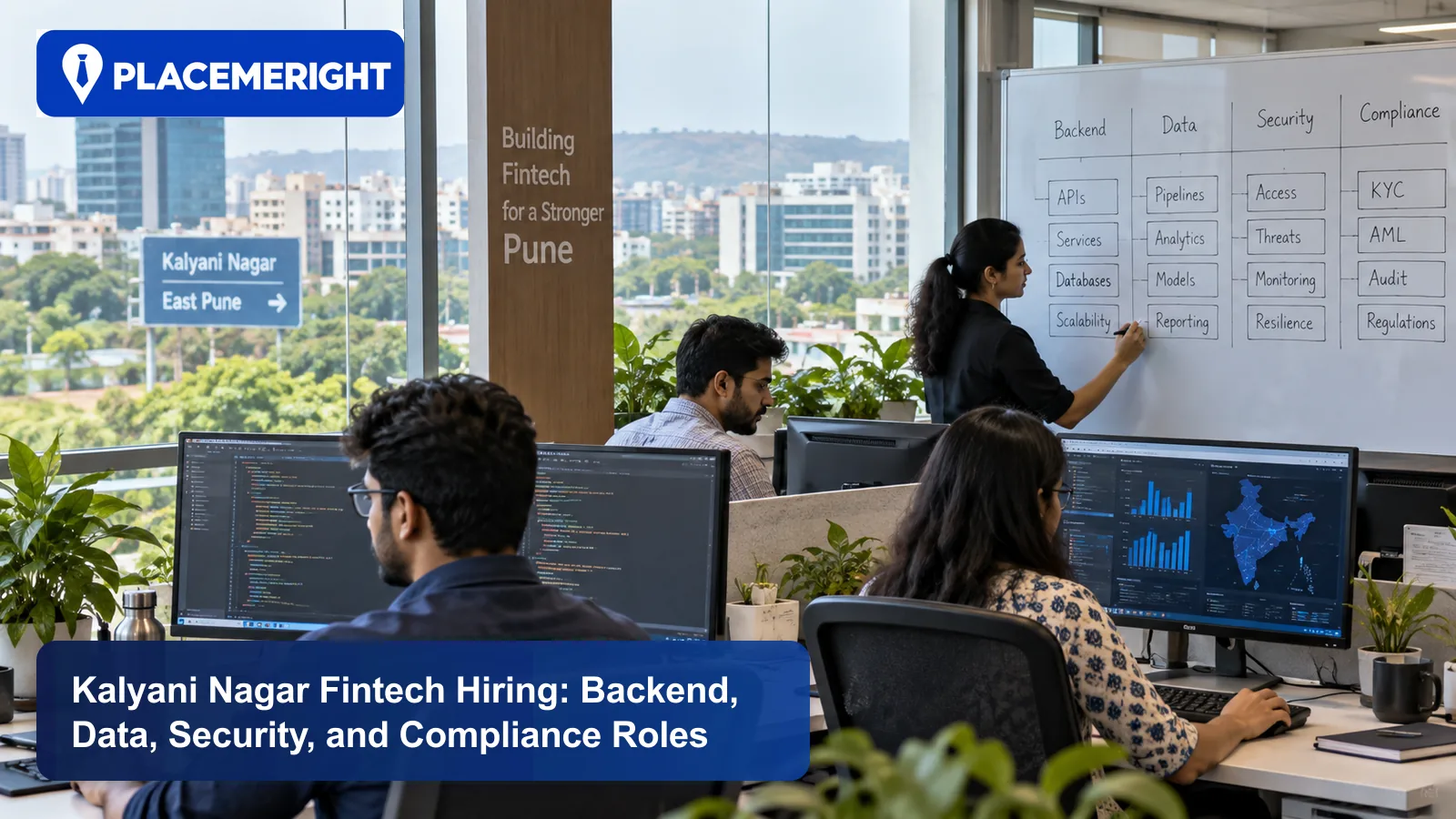
A fintech team does not become complete by hiring one backend engineer, one data engineer, one security specialist, and one compliance professional.
The four roles must agree on what is true, what is allowed, what can fail, and what evidence remains after a customer or transaction workflow runs.
That connection is the real hiring problem for employers building around Kalyani Nagar and the wider East Pune corridor.
Use Pune evidence without manufacturing a locality statistic
On 28 July 2026, PlaceMeRight reviewed the newest 120 records returned by its Pune live-jobs endpoint. They were published from 20 to 23 July, while the endpoint reported 1,269 Pune records at collection time.
Use PlaceMeRight's Pune technology recruitment context when translating this bounded observation into a specific employer search.
A broad title-only filter identified 56 records containing at least one term associated with software engineering, development, backend, data, security, risk, compliance, payments, banking, fraud, or fintech. Examples included Lead Software Engineer, Senior Data Scientist, Senior Database Developer, Python Backend Developer for cybersecurity work, Architect - Cloud & Data, and several application roles.
The count is deliberately broad and overlapping. It is not a fintech vacancy share.
The source also creates firm limits:
- every record used the broad location Pune;
- it did not identify Kalyani Nagar, Yerawada, Viman Nagar, Koregaon Park, Kharadi, or another neighbourhood;
- compensation, workplace type, and experience fields were unpopulated;
- titles alone cannot prove financial-domain depth or regulatory responsibility.
The article therefore uses Kalyani Nagar as a workplace-planning anchor. It does not assign Pune-wide vacancies to that locality.
Map one regulated workflow before opening four roles
Choose a real workflow such as merchant onboarding, payment processing, loan servicing, transaction monitoring, dispute handling, reconciliation, or regulatory reporting.
Then map it across four responsibilities.
| Workflow question | Primary role | Required collaboration | | --- | --- | --- | | How does the product execute the transaction or decision? | backend | product, security, data | | What data enters, changes, and supports the outcome? | data | backend, compliance, risk | | Which threats, privileges, and controls matter? | security | engineering, operations, compliance | | Which rule, evidence, review, or exception must be maintained? | compliance | product, legal, data, security |
The "primary" role is not the sole owner.
A backend engineer cannot decide retention policy alone. A compliance professional should not specify an implementation without engineering input. A data engineer cannot infer lawful use from technical access. A security specialist cannot make a customer journey usable by adding controls after design.
Hire for the interfaces as well as the disciplines.
Define the backend mandate around financial state
For fintech work, backend depth should connect to a state transition with a business consequence.
The brief should state:
- the initiating event;
- the authoritative record;
- expected transaction semantics;
- external providers and failure modes;
- recovery or reversal paths;
- latency and throughput shape;
- reconciliation responsibility;
- on-call or incident ownership;
- security and data constraints.
Current official Pune roles show the difference between generic coding and consequential systems. Citi's current Pune Java Backend Developer brief connects enterprise-scale services with authentication, authorisation, data integration, resilience, security, technical leadership, and architectural stewardship.
Those examples should not be copied as a universal stack. They demonstrate why a backend interview needs state, failure, and control evidence.
Ask candidates to explain one system where an external dependency and internal state disagreed. What detected the mismatch? Who could repair it? How was the event reconstructed? What design changed afterwards?
Define the data mandate around lineage and use
"Data engineer for fintech" is too broad.
The data may serve:
- transaction processing;
- risk or fraud decisions;
- customer analytics;
- finance and reconciliation;
- regulatory reporting;
- machine-learning features;
- operations and service monitoring;
- product experimentation.
For each consumer, define freshness, accuracy, completeness, access, retention, traceability, and recovery expectations.
Citi's current Pune Senior Data Engineer brief connects Python and PySpark pipelines, scalable data processing, analytics, AI integration, and cross-team delivery. Its current Finance Technology product role connects data lineage, conceptual and logical models, finance processes, regulatory alignment, AI, automation, and risk controls.
These are different data jobs. One centres analytical work; the other joins data to product, transformation, and governance.
The interview should test the actual mandate. For a platform data engineer, use a late and duplicated event scenario. For a risk-data role, test feature provenance and decision trace. For reporting, test reconciliation and change control. For analytics, test whether the candidate distinguishes correlation, operational evidence, and a decision-ready result.
Define security as engineering work
Security roles can cover application security, cloud security, identity, security operations, governance, testing, architecture, or third-party assurance.
Do not combine all of them under "cybersecurity expert".
Mastercard's current cybersecurity careers page shows that its security work spans monitoring, controls, security engineering, programme security, and specialised technology domains. Apex Group's current Viman Nagar technology-assurance role focuses on third-party services, cloud and data processing, compliance, operational resilience, and oversight.
The work boundaries differ:
- application security partners with software delivery;
- cloud security shapes infrastructure and identity;
- security operations detects and responds;
- assurance evaluates whether services and suppliers meet controls;
- architecture establishes repeatable patterns;
- governance coordinates risk ownership and evidence.
CERT-In's secure-application guidance addresses design, development, implementation, operations, API keys, rate limits, trust boundaries, and vulnerable components. Use it as an engineering baseline source, not as a substitute for role-specific legal or regulatory advice.
Define compliance as decision and evidence ownership
Compliance hiring fails when the employer asks for "knowledge of all regulations" without naming the product, entity, jurisdiction, and workflow.
Clarify:
- which business activity is regulated;
- which entity owns the obligation;
- whether the role interprets, implements, monitors, tests, or reports controls;
- which evidence must be maintained;
- who decides exceptions;
- how product or system change is reviewed;
- where legal, risk, audit, privacy, and security responsibilities begin and end.
RBI's directions for non-bank payment system operators address governance, cyber resilience, architecture, third-party linkages, and digital-payment security. Their hiring relevance is not that every Pune fintech is covered identically. It is that operational controls have owners, timelines, evidence, and dependencies.
The employer should obtain its own legal interpretation. The hiring team should translate confirmed obligations into observable work.
Build four briefs from one dependency canvas
Create a one-page canvas with:
1. customer or operational workflow; 2. entities and systems involved; 3. state changes; 4. data sources and consumers; 5. privileges and trust boundaries; 6. applicable control decisions; 7. evidence and retention needs; 8. exceptions and escalation; 9. incident and recovery ownership; 10. planned changes over the next two quarters.
Then write each role's decisions.
Backend decisions
Service boundaries, state transitions, APIs, failure handling, deployment, observability, and production recovery.
Data decisions
Contracts, lineage, pipeline design, quality controls, access, transformation, timeliness, and consumer communication.
Security decisions
Threat analysis, identity, cryptography, secure design, testing, detection, vulnerability treatment, and architecture review.
Compliance decisions
Requirement interpretation, control mapping, evidence, monitoring, exception governance, review, and regulator- or audit-facing coordination.
If all four descriptions contain the same responsibilities with different tool lists, the ownership model is unresolved.
Interview all four roles with one shared scenario
Use a fictional lending or payment workflow:
> A customer submits a transaction through a mobile application. The backend calls two external services, records an interim state, and publishes an event used by risk and reporting systems. A delayed callback creates disagreement between the customer view, the ledger-adjacent record, and a downstream report.
Change the lens by role.
For backend, ask about state, idempotency, retries, recovery, and service ownership.
For data, ask about contracts, event time, duplication, lineage, repair, and consumer notification.
For security, ask about trust, callback validation, privilege, secrets, abuse, detection, and incident containment.
For compliance, ask which facts must be preserved, who reviews the exception, how a control failure is documented, and how obligations are confirmed.
The shared scenario lets interviewers compare how the functions connect. It also exposes gaps between teams before those gaps reach production.
Score depth and interface behaviour separately
Use two scorecards.
Discipline depth
| Dimension | Evidence | | --- | --- | | domain model | understands the relevant workflow and consequence | | technical or professional depth | makes defensible role-specific decisions | | controls | integrates prevention, detection, response, and evidence | | operational ownership | explains incidents, exceptions, and recovery |
Cross-functional interface
| Dimension | Evidence | | --- | --- | | boundary clarity | states what the role owns and what requires another owner | | translation | explains implications to another function | | challenge | raises risk without blocking by reflex | | documentation | leaves assumptions, decisions, and evidence traceable |
A candidate can be deep but difficult to integrate. Another can be collaborative but lack the required discipline. Record both.
Make Kalyani Nagar feasibility factual
Kalyani Nagar connects to Yerawada, Viman Nagar, Koregaon Park, and routes toward Kharadi, but each office creates a different journey.
State:
- exact building and entrance;
- normal office days;
- core collaboration hours;
- support, release, or on-call timing;
- parking or employer transport;
- where the manager and adjacent teams sit;
- whether regulatory, client, or global meetings extend the day.
An official role that says "Pune" is not evidence of a Kalyani Nagar office. One current technology-assurance role explicitly states Viman Nagar; other reviewed employer postings identify only Pune or a postal code. Preserve that distinction.
Candidates should assess the actual workplace, not an attractive corridor label.
Use policy context without stretching it
Maharashtra's official fintech policy established a statewide support framework and described financial technology as the use of innovative technology to deliver financial services. It also contemplated Smart FinTech centres in qualifying urban areas.
The policy is useful historical and ecosystem context. It does not prove present demand for a particular Kalyani Nagar role.
Employers should rely on:
- their current product and regulatory position;
- recent role evidence;
- the exact Pune workplace;
- candidate-specific capability and feasibility;
- verified specialist advice where obligations are involved.
Local SEO should not turn a policy document into a vacancy statistic.
Plan the hiring sequence
The right sequence depends on the existing team.
If product growth is blocked by unreliable state handling, backend ownership may come first.
If reporting, risk, and operational decisions cannot trust the data, data-platform work may be the first dependency.
If the team is shipping into unreviewed trust boundaries, security may need to enter before scale.
If the product or entity has unresolved obligations and evidence paths, compliance clarification may precede implementation hiring.
Often the answer is not four simultaneous hires. It is one accountable owner, specialist support, and a staged plan.
Write what must be true before the next hire starts. That prevents each new person from inheriting undefined interfaces.
Avoid common East Pune fintech hiring errors
- Calling every banking-technology role fintech.
- Assigning Pune-wide openings to Kalyani Nagar without an address.
- Combining backend, data, security, and compliance into one vacancy.
- Using regulation names as keyword filters without defining work.
- Treating security as a final approval gate.
- Treating data as reporting infrastructure only.
- Asking compliance candidates to promise certainty outside a defined fact pattern.
- Hiding on-call, late global calls, or office expectations until offer stage.
Quick checklist
- Choose one regulated customer or operational workflow.
- Map state, data, trust, evidence, and exception boundaries.
- Write separate decision rights for four role families.
- Use current role evidence without copying another employer's stack.
- Run one shared scenario through four functional lenses.
- Score discipline depth and cross-functional interface separately.
- State the exact East Pune workplace.
- Verify which obligations actually apply with qualified advisers.
- Sequence hires around the current constraint.
- Do not infer pay, supply, or speed from vacancy titles.
Frequently asked questions
Is Kalyani Nagar a standalone fintech talent pool?
It is better treated as a workplace anchor within East Pune. Candidate movement may involve Yerawada, Viman Nagar, Koregaon Park, Kharadi, and other areas. Assess each role and journey directly.
Can one senior engineer own backend, data, and security?
One person may contribute across boundaries in a small team, but decision rights must still be explicit. High-consequence work often needs independent review or specialist support.
Does a banking background prove fintech product experience?
No. Inspect the workflow, technology ownership, customer proximity, production responsibility, and regulatory interface. The labels overlap but are not interchangeable.
Should compliance interview engineers?
Where controls materially affect the system, compliance or risk input can improve the scenario and scorecard. The technical evaluation should still be led by qualified engineering interviewers.
What should a security candidate know about payments?
The required depth depends on the role. Define the application's trust boundaries, data, architecture, threats, and applicable controls rather than asking for generic payments familiarity.
Can current Pune job counts show which role is hardest to hire?
No. A title sample does not measure qualified supply, competition, compensation, or closure difficulty. Use search-specific evidence and document the limitations.
Related reading
- Hire technical specialists across India
- Explore employer-side tech recruitment
- Discuss a Pune fintech hiring plan
Conclusion
Backend, data, security, and compliance are not four parallel boxes.
They are four views of the same financial workflow: execution, truth, trust, and accountable evidence.
Pune employers that define those interfaces before sourcing can avoid overloaded job descriptions and build interviews that test the work their Kalyani Nagar or East Pune team will genuinely own.
CTA
PlaceMeRight helps employers calibrate fintech roles, map Pune talent, structure specialist screening, and coordinate interviews around the real workflow and workplace.
Share your East Pune fintech hiring requirement
References
- Government of Maharashtra: FinTech Policy and Global FinTech Hub
- Startup India: Maharashtra state policy and fintech incentives
- Mastercard Careers: Engineering jobs in Pune
- Citi Careers: Java Backend Developer, Pune
- Citi Careers: Senior Data Engineer, Python and Spark, Pune
- Mastercard Careers: Cybersecurity and Corporate Security roles
- Citi Careers: Technology Product Manager, AI and Data Strategy, Pune
- Apex Group Careers: Third Party Technology Assurance, Pune Viman Nagar
- Reserve Bank of India: Cyber Resilience and Digital Payment Security Controls
- CERT-In: Secure Application Design, Development, Implementation and Operations
Related PlaceMeRight resources
Our Tech Recruitment Services by City
Looking to hire vetted software engineers or scale your engineering teams in India's leading tech hubs? Explore our localized recruitment services: