
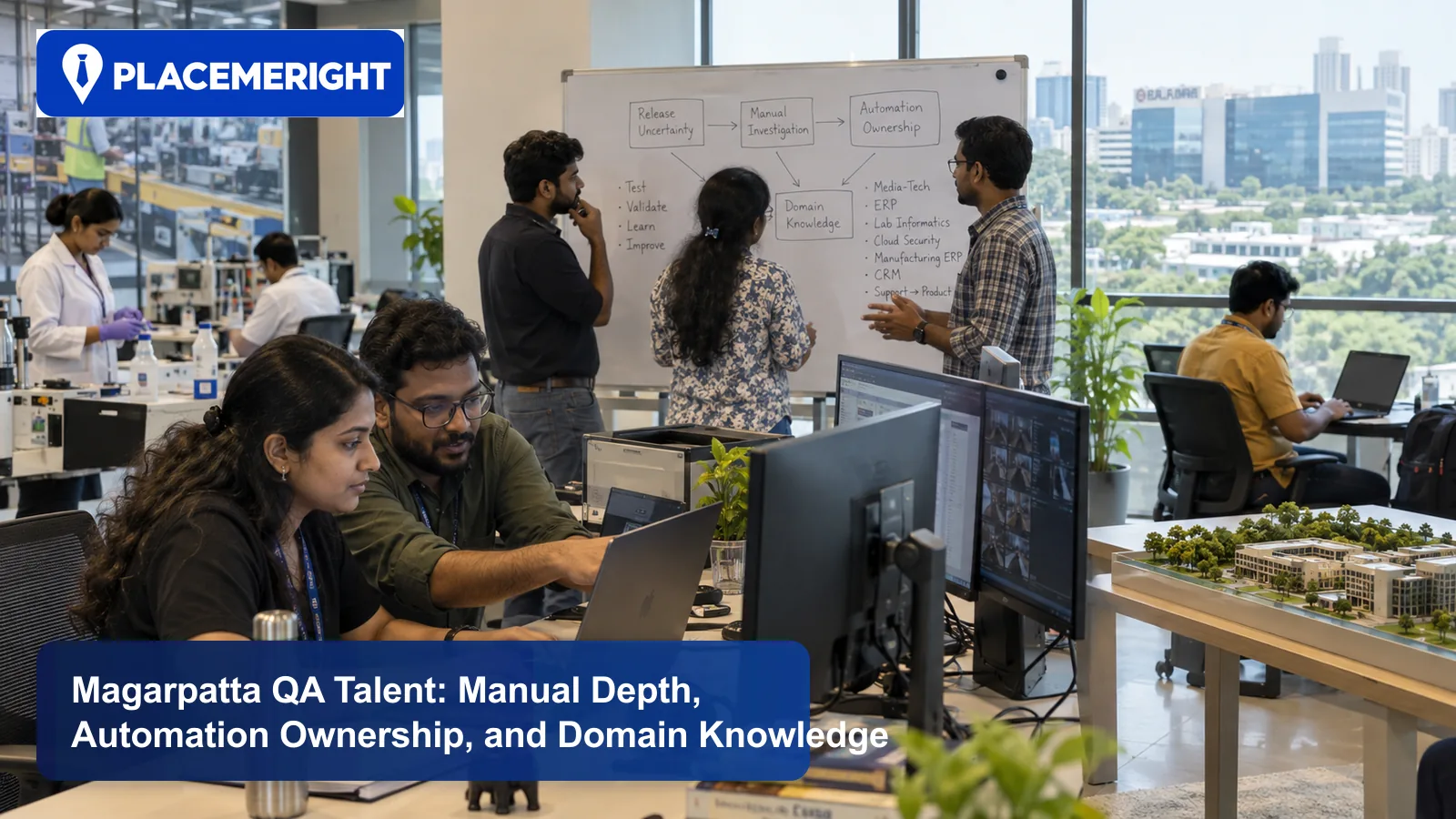
A QA resume can contain every familiar word and still leave the hiring decision unresolved. "Manual testing" may mean thoughtful investigation or repetitive execution. "Automation" may mean designing a maintainable test system or only editing scripts. "Domain knowledge" may mean understanding why a business rule exists or recalling terminology without tracing its effect.
For employers around Magarpatta, the useful question is not whether a candidate belongs to one category. It is whether the person can identify uncertainty in a release, choose an appropriate way to examine it, create trustworthy evidence, and help the team learn when reality differs from expectation.
Build a release uncertainty ledger. Each entry names a product change, the uncertainty it introduces, the consequence of being wrong, the most suitable evidence, the data and environment required, the automation decision, the owner, and the post-release observation. The ledger makes manual depth, automation ownership, and domain knowledge visible in the same hiring exercise.
Define quality for the product being changed
"High quality" is too broad for a job description. Write the properties that matter to this product:
- business rules produce authorised and explainable outcomes;
- state changes remain complete, ordered, and recoverable;
- data is accurate, permitted, and reconcilable;
- interfaces behave across supported devices and accessibility modes;
- APIs preserve contracts and failure semantics;
- performance stays within approved product expectations;
- security controls operate without blocking valid work;
- releases can be observed, diagnosed, and safely corrected;
- evidence exists for any regulated or audited decision.
Product, engineering, security, accessibility, compliance, operations, and business owners should agree which properties apply. The QA hire contributes evidence and judgement; the role should not silently inherit every decision.
PlaceMeRight's Pune technology recruitment context describes the wider employer market. This guide focuses on one precise choice: how to evaluate quality talent for a Magarpatta-area team without reducing the search to manual-versus-automation labels.
Use Magarpatta as a worksite fact
Magarpatta City material identifies IT park and commercial uses within its mixed development. STPI Pune describes Pune as a major software and hardware cluster and records its own base in Rajiv Gandhi Infotech Park, Hinjawadi. These sources establish a broader technology setting; they do not measure QA candidate supply in Magarpatta.
Magarpatta, Hadapsar, Amanora, Mundhwa, and Kharadi can appear close on a regional map while producing different daily travel decisions. Publish the exact office, office pattern, shift or release windows, client contact, test-lab access, and exceptional support expectation. Ask each candidate to confirm feasibility after seeing the full arrangement.
Current Capgemini Pune roles reviewed on July 28, 2026 provide a limited employer sample. One role described Playwright framework design, UI and API automation, cross-browser testing, test data, CI/CD integration, reporting, and debugging. Another described automation across UI, API, integration, data, regression, performance, and continuous testing in a medical-device validation context. These examples show role breadth at one employer, not a universal Pune template.
Create the release uncertainty ledger
Use one row per material uncertainty:
| Field | Question | | --- | --- | | change | What behaviour, data, interface, dependency, or control is changing? | | uncertainty | What is not yet known with sufficient confidence? | | consequence | Who or what is affected if the assumption is wrong? | | evidence | Which observation could support or challenge the claim? | | method | Example, exploration, review, static check, automated test, simulation, or production observation? | | oracle | How will the team decide what is correct? | | data | Which valid, invalid, boundary, historical, synthetic, or restricted data is needed? | | environment | Where can the behaviour be reproduced without misleading differences? | | ownership | Who investigates, fixes, accepts residual risk, releases, and reviews? | | learning | What will be monitored after release and fed back into the suite? |
This is not a demand for exhaustive testing. It forces prioritisation. A strong candidate can explain why one uncertainty deserves automation, another requires exploratory work, and a third needs a domain owner before any test can be meaningful.
Look for manual depth
Manual depth is structured inquiry performed by a person who can notice, adapt, compare, and question. It may include:
- exploring state transitions that were not fully specified;
- challenging business rules with examples and counterexamples;
- following a user task across systems;
- checking language, accessibility, and recovery cues;
- comparing visible behaviour with API and data evidence;
- investigating an intermittent or context-dependent failure;
- observing how a workflow behaves under interruption;
- asking whether the documented outcome is actually useful.
Give the candidate a new feature and fifteen minutes to prepare a test approach. Do not reward the longest list. Ask why each investigation matters, which risk it addresses, and what would change the plan.
Useful follow-up questions are:
1. Which assumption would you test first? 2. What would make the result misleading? 3. How would you vary data, role, sequence, device, or dependency? 4. Which issue needs a domain decision rather than a defect ticket? 5. What evidence would you preserve for another person to reproduce the finding?
Test automation ownership
Automation ownership begins before code. The candidate should decide whether a check is stable, valuable, observable, appropriately placed, and maintainable.
Use a proposed browser test for a critical workflow. Ask the person to define:
- the business claim being checked;
- the narrowest useful test layer;
- setup and isolation;
- test data ownership;
- deterministic assertions;
- dependency control;
- failure diagnostics;
- execution trigger;
- maintenance owner;
- removal or redesign criteria.
Playwright documentation emphasises actions, assertions, auto-waiting, and isolated browser contexts. Those mechanisms are useful, but a tool cannot supply the oracle. A script that reliably asserts the wrong business rule is not quality evidence.
Look for candidates who can move checks down to unit, component, contract, API, or data layers when that improves speed and diagnosis, while keeping a small number of end-to-end journeys where cross-system behaviour is the real risk.
Distinguish ownership from script production
A person owns an automation asset when they can:
- explain the risk it covers;
- review the test design;
- maintain fixtures and data;
- diagnose failures without habitual reruns;
- control flakiness and quarantine transparently;
- evolve the suite with product architecture;
- connect execution to release decisions;
- remove checks that no longer provide useful evidence.
Counted scripts, pass percentages, and coverage numbers can be supporting signals. None proves that the right uncertainty is being tested. Ask for one example where the candidate deleted or redesigned an automated check and why.
Assess domain knowledge through decisions
Domain knowledge should improve the test oracle. For a payments workflow, the candidate might reason about authorisation, capture, reversal, settlement, reconciliation, and dispute states. For an automotive system, they may trace product configuration, service events, safety boundaries, or plant records. For healthcare software, they may distinguish clinical, operational, privacy, and billing decisions.
Use a small domain packet containing:
- a glossary;
- one business rule;
- sample events;
- a state diagram;
- an exception;
- a control;
- an incomplete acceptance criterion.
Ask the candidate to identify ambiguity, construct examples, and name the authorised decision maker. Prior employer experience can accelerate understanding. It should not replace the ability to learn the employer's actual workflow.
Evaluate test data stewardship
Many weak test strategies fail because the data does not represent the state being claimed. Ask how the candidate would create and control:
- valid and invalid records;
- boundary values;
- role and permission combinations;
- time-dependent states;
- historical sequences;
- duplicate and delayed events;
- partial or conflicting records;
- masked or synthetic sensitive data;
- cleanup and repeatability;
- lineage from scenario to expected result.
Security, privacy, legal, and data owners must approve sensitive-data handling. A QA hire should recognise those boundaries and avoid copying production information into an uncontrolled environment.
Add contract and integration reasoning
Pact documentation frames contract testing around interactions between services. Use a scenario where a provider changes a field, error response, or event. Ask:
- Which consumers are affected?
- Is compatibility syntactic, semantic, or both?
- Where should the contract be checked?
- What happens when versions overlap?
- How are optional, unknown, and deprecated fields handled?
- Which integration still requires broader validation?
A contract check reduces a class of uncertainty. It does not prove that the complete customer workflow, data meaning, performance, or operational recovery is correct.
Include security and accessibility evidence
OWASP's Application Security Verification Standard provides a basis for testing web application technical security controls. Use it to clarify relevant verification areas, not to turn a QA interview into unauthorised penetration testing.
Accessibility also needs product-specific evidence. Ask how the candidate would check keyboard operation, focus order, labels, status messages, error recovery, contrast, zoom, and assistive-technology behaviour. Specialist review may still be required.
The hiring signal is boundary awareness: the candidate knows what they can test, what requires a specialist, and how findings enter an owned remediation process.
Connect pre-release tests to production learning
OpenTelemetry describes traces, metrics, logs, and related context as distinct signals. Give the candidate a release where automated tests passed but customers encounter failures. Ask how they would:
1. define the affected workflow; 2. compare expected and observed states; 3. identify relevant telemetry; 4. preserve correlation and timing; 5. separate code, configuration, data, dependency, and user-context hypotheses; 6. support rollback or remediation decisions without claiming authority; 7. add the learning to tests, monitoring, documentation, or design.
Quality ownership includes learning from escaped behaviour. It does not mean the QA person alone operates production.
Use a four-part interview
Part one: uncertainty review
Give a compact change brief. Ask the candidate to create five ledger entries and prioritise them.
Part two: exploratory session
Provide a safe test product with one seeded issue and several legitimate variations. Observe questions, note-taking, adaptation, evidence, and stopping judgement.
Part three: automation design
Ask for a test design and small code review rather than a large take-home framework. Score placement, isolation, assertions, diagnostics, and maintenance reasoning.
Part four: domain and release discussion
Introduce a disputed business rule and a production signal. Ask the candidate to separate facts, decisions, owners, and follow-up evidence.
Use the same packet and time allowance for comparable candidates. Offer reasonable accessibility adjustments and do not request unpaid work from a live employer backlog.
Build an anchored scorecard
| Dimension | Strong evidence | | --- | --- | | uncertainty framing | identifies what is unknown and why it matters | | manual investigation | varies conditions deliberately and records reproducible evidence | | automation judgement | selects an appropriate layer and owns maintainability | | domain reasoning | converts rules and states into useful oracles | | test data | controls representation, privacy, repeatability, and cleanup | | integration thinking | traces contracts, dependencies, failures, and reconciliation | | production learning | connects runtime evidence to revised tests or design | | collaboration | preserves decision rights and communicates risk clearly |
Record observed evidence before the panel reaches a recommendation. A confident tool recital should not compensate for weak reasoning.
Calibrate the role level
A junior role may execute well-defined checks, record defects, maintain bounded automation, and learn a product domain with guidance. A mid-level quality engineer may design coverage for a feature, automate across suitable layers, manage data, and support release analysis. A senior or lead may shape quality architecture, coach teams, govern suites, connect production learning, and challenge product risk across services.
Specify whether the employer needs:
- a manual-focused investigator;
- an automation-focused quality engineer;
- an SDET with software-design depth;
- a domain test analyst;
- a data or platform quality specialist;
- a quality lead who changes team practice.
Hybrid profiles exist, but the brief should not turn five full roles into one vague vacancy.
Quick checklist
- [ ] Define the product quality properties and authorised owners.
- [ ] Create a release uncertainty ledger for the actual work.
- [ ] Test manual depth through structured exploration.
- [ ] Evaluate automation placement, diagnostics, data, and maintenance.
- [ ] Assess domain knowledge through rules, states, exceptions, and decisions.
- [ ] Include contract, accessibility, security, and production-learning boundaries where relevant.
- [ ] Use the same realistic packet across interview stages.
- [ ] Anchor scores in observed evidence.
- [ ] Publish the exact Magarpatta-area worksite and schedule.
- [ ] Treat current vacancies as examples rather than market estimates.
Frequently asked questions
Is manual testing less valuable than automation?
No. They answer different questions. Automation is powerful for repeatable checks; human investigation is useful where learning, variation, judgement, and incomplete specification matter. The role should combine them according to product risk.
Should every QA candidate know Playwright?
Only if it reflects the employer's stack and work. Test design, programming foundations, browser behaviour, assertions, isolation, and debugging may transfer across tools. Name true must-haves separately from learnable tools.
How much domain experience is necessary?
Set it from consequence and learning time. Deep prior experience may be important for specialised regulated workflows. Other roles can assess the ability to learn rules and reason carefully with domain owners.
Can an automation percentage measure QA maturity?
Not by itself. It says nothing about risk relevance, oracle quality, flakiness, maintenance, missing layers, accessibility, security, or production learning.
Should a Magarpatta role include Kharadi candidates?
Source by capability and confirmed feasibility, not assumptions about locality. Give every candidate the exact worksite, office pattern, hours, and travel expectation.
Who decides whether a release is acceptable?
The employer should name the authorised product, engineering, business, security, compliance, operations, or release owner. QA supplies evidence and risk analysis within that governance.
Related reading
- Hire QA and test automation professionals
- Hire developers and quality engineers
- Employer-side technology recruitment
- Discuss a Pune QA requirement
Conclusion
The strongest Magarpatta QA hire is not defined by a manual label, an automation tool list, or years in one domain. The person creates trustworthy evidence about the uncertainty that matters to a release.
A release uncertainty ledger makes that work visible. It connects risk, method, oracle, data, environment, automation, ownership, and production learning. Pune employers can then assess whether a candidate investigates deeply, automates responsibly, understands business meaning, and collaborates within clear decision boundaries.
CTA
PlaceMeRight helps Pune employers define and recruit QA, SDET, automation, and quality-engineering roles around product risk, domain workflows, technical evidence, and realistic worksite requirements.
Share your Pune quality hiring brief
References
- Magarpatta City: Sustainability Report
- STPI Pune: About STPI Pune
- Capgemini: Test Automation Engineer, Pune
- Capgemini: Test Automation, AI, and Medical Devices, Pune
- ISTQB: Certified Tester Foundation Level syllabus
- Playwright: Writing tests
- Playwright: Assertions
- Playwright: Best practices
- Pact: Contract testing documentation
- OWASP: Application Security Verification Standard
- OpenTelemetry: Signals
Related PlaceMeRight resources
Our Tech Recruitment Services by City
Looking to hire vetted software engineers or scale your engineering teams in India's leading tech hubs? Explore our localized recruitment services: