
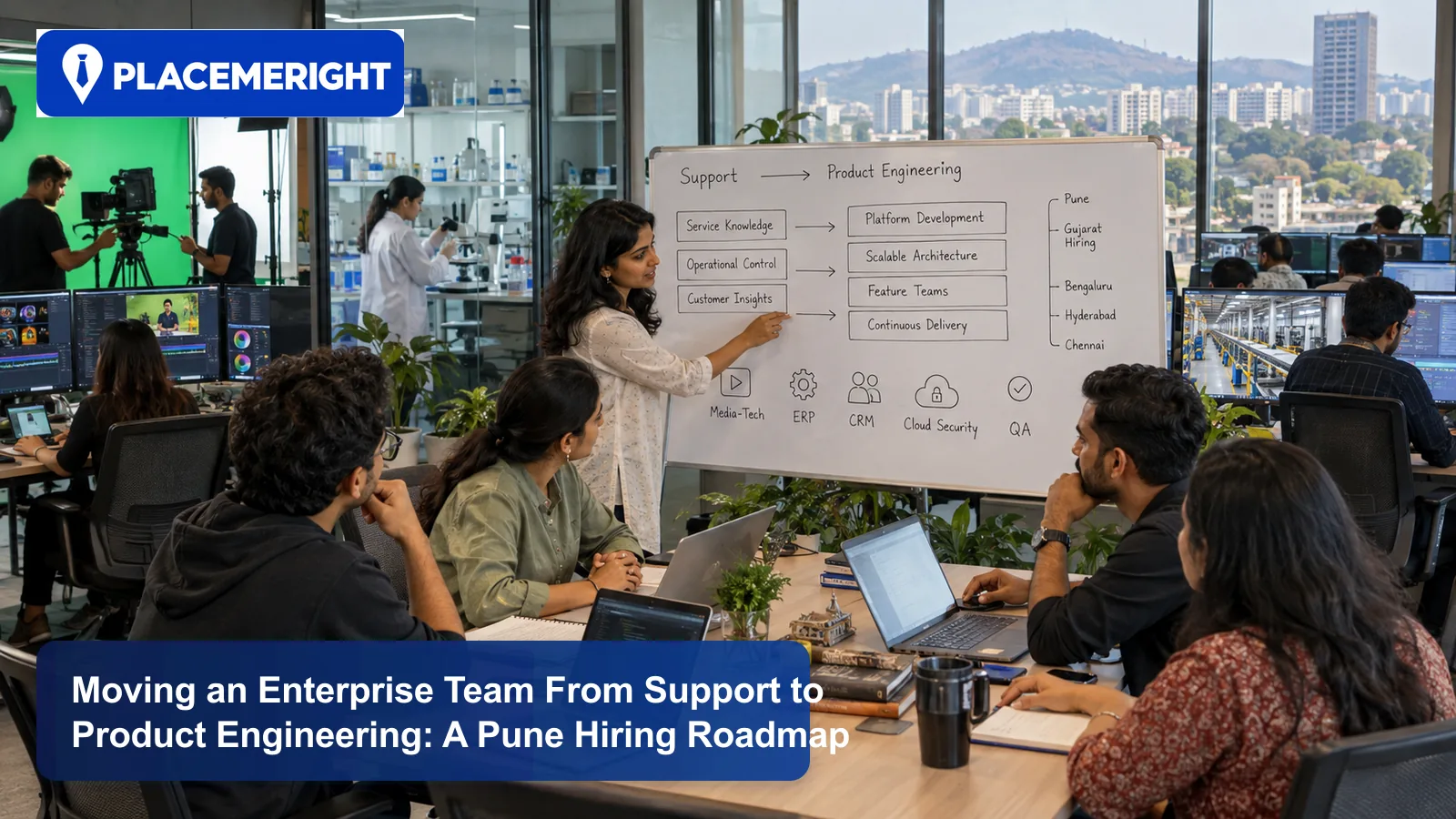
An enterprise support team may know more about a system's real behaviour than anyone else. It sees recurring incidents, customer workarounds, data defects, brittle interfaces, release regressions, and the operational cost of design decisions. Yet that knowledge may remain trapped in tickets, escalation calls, and individual memory.
Moving toward product engineering should not discard that capability. The change is to convert repeated service evidence into owned product decisions, maintainable software, observable operation, and a planned lifecycle. It also requires authority: a team cannot own outcomes if another group controls every backlog, architecture, test environment, and release.
Pune employers can plan the change with a support-to-product capability migration ledger. It records what the current team knows, what it can change, what engineering evidence is missing, and which capability should be developed, hired, borrowed, or retained elsewhere.
Define the intended product responsibility
"Become a product engineering team" is not an operating model. Name the product or service boundary:
- users and business outcomes;
- code, configuration, data, and infrastructure included;
- upstream and downstream dependencies;
- product decisions the team may make;
- service and reliability commitments;
- security, risk, and compliance owners;
- release and change authority;
- lifecycle, support, and decommissioning responsibility.
Clarify whether the team will own an internal platform, customer-facing product, enterprise application, integration layer, data product, manufacturing system, or modernisation programme. The required engineering and hiring plan will differ.
PlaceMeRight's Pune technology recruitment context describes the broader city market. This guide focuses on the narrower organisational problem of adding product engineering capability while preserving operational knowledge.
Use Pune context to shape the operating model
STPI Pune is located in Rajiv Gandhi Infotech Park, Hinjawadi, and describes Pune as a major IT cluster with software, services, and hardware activity. MIDC identifies the Pune-Chakan-Talegaon-Satara belt with engineering, automotive, components, ESDM, logistics, and related sectors. PMRDA's industrial-connectivity work also identifies links among Chakan, Talegaon, and Ranjangaon.
This mix matters because enterprise technology in Pune may support SaaS products, banking and payments, manufacturing execution, automotive engineering, industrial operations, supply chains, or global service delivery. A support-to-product transition for a plant-connected MES is not the same as one for a multi-tenant SaaS platform.
Magarpatta and Hadapsar, Kharadi, Hinjawadi, Baner-Balewadi, Pimpri-Chinchwad, and industrial sites create different collaboration and on-site needs. Publish the actual base, office days, plant or customer travel, support window, on-call model, and access restrictions.
Current Pune roles reviewed on July 28, 2026 illustrate overlapping responsibilities. A Mindtickle product and engineering operations role connected organisational execution with product and engineering leadership. Another Mindtickle role described customer support engineering across distributed systems, APIs, data, logs, traces, product quality, and collaboration with engineering, product, quality, and DevOps. These are individual employer examples, not a market estimate. They show that support, operation, and product work often overlap before an organisation formally recognises it.
Build the capability migration ledger
For each product responsibility, record:
| Capability | Current evidence | Missing authority or practice | Decision | | --- | --- | --- | --- | | user and domain understanding | tickets, calls, workarounds, process maps | structured discovery and outcome ownership | develop or hire product capability | | code ownership | scripts, fixes, vendor changes | repository, standards, review, maintainers | transfer or establish ownership | | architecture | dependency knowledge | documented boundaries and decision records | assign technical authority | | quality | incident checks, manual regression | layered automated tests and acceptance evidence | build quality engineering | | delivery | change requests and release support | controlled pipeline, small changes, rollback | add delivery engineering | | operation | monitoring, triage, escalation | service objectives, telemetry, runbooks, learning | evolve existing strength | | security and risk | access procedures, audit response | design controls and engineering integration | partner with authorised owners | | product learning | repeated request categories | prioritisation and feedback loop | create product decision process |
Avoid scoring current staff as deficient against a future job they were never authorised or trained to perform. The ledger evaluates organisational capability first. Individual assessment follows with clear opportunity, evidence, and support.
Preserve service knowledge before changing structures
Create a service-knowledge inventory:
- top user journeys and business deadlines;
- common incident signatures;
- manual controls and workarounds;
- data corrections and reconciliation;
- high-risk integrations;
- vendor and internal escalation routes;
- release-sensitive processes;
- undocumented configuration;
- access and compliance constraints;
- recurring requests that indicate product debt.
Convert representative cases into product artifacts: problem statements, acceptance examples, automated tests, telemetry requirements, architecture decisions, runbooks, and backlog options. Remove personal or customer-sensitive information under the employer's policy.
Do not ask support staff to write exhaustive documentation before the transition begins. Pair them with product and engineering owners around real flows. Knowledge becomes useful when it changes design, test, operation, and priority.
Decide what can be converted, hired, or partnered
Use four routes.
Develop from the current team
Choose people who demonstrate problem framing, code or system reasoning, learning ability, quality discipline, and interest in broader ownership. Provide protected learning time, mentoring, bounded engineering work, and transparent assessment.
Hire missing depth
External hiring may be needed for product management, architecture, software engineering, quality automation, data, platform engineering, security engineering, design, or technical leadership. Hire against a defined product boundary, not a generic transformation label.
Borrow or embed specialists
Security, SRE, data, UX research, or platform specialists may embed temporarily while standards and interfaces are established. Define the exit and continuing support model.
Retain a distinct support function
Product engineering does not eliminate service operations. Keep clear intake, incident, request, knowledge, and customer-communication responsibilities where needed. Design the interface with engineering instead of renaming support and expecting the same queue to produce a roadmap.
Establish backlog authority
A team cannot act like a product team if its backlog is a list of escalations sorted by the loudest stakeholder. Create separate but connected views:
- user and business outcomes;
- service health and risk;
- defects and recurring incidents;
- product discovery;
- engineering enablement;
- security and compliance obligations;
- lifecycle and technical debt;
- committed delivery.
Define who may prioritise, who advises, and who accepts risk. Support evidence should influence priorities, but every ticket should not become a feature. Product management must translate patterns into problems and options.
DORA's customer-feedback guidance places user feedback alongside visibility of work, small batches, and experimentation. Use this to create a loop from service evidence to product decision and then back to observed outcome.
Introduce engineering practices through one product slice
Choose a bounded flow with meaningful support pain and manageable risk. For example, replace a manual reconciliation, improve an error-prone integration, expose reliable job status, or remove a repeated access request.
Build the slice end to end:
1. define the user and business outcome; 2. map current behaviour and failure evidence; 3. agree architecture and ownership; 4. place code and configuration under controlled versioning; 5. create unit, integration, contract, and acceptance evidence; 6. automate build and deployment where appropriate; 7. add telemetry and a runbook; 8. release through an approved path; 9. operate and review real outcomes; 10. update the product and service knowledge.
This slice tests whether the new operating model works. It also provides a realistic internal work sample for people moving into engineering roles.
Replace handoff volume with lifecycle ownership
Map one change from request to operation. Count neither tickets nor story points as proof of product capability. Ask:
- Who clarified the user problem?
- Who owned the design?
- Who implemented and reviewed the change?
- Who proved compatibility and acceptance?
- Who approved release?
- Who observed production behaviour?
- Who responded when it failed?
- Who decided the next improvement?
DORA's current software-delivery metrics cover change lead time, deployment frequency, failed deployment recovery time, change fail rate, and deployment rework rate. Use metrics in the context of one service and over time. Do not set arbitrary targets or use them to compare unlike teams.
Google SRE guidance on service-level objectives can help a team connect reliability work to user expectations. A product team should understand the service it operates, but authorised business and risk owners must approve commitments.
Redesign roles around enduring accountability
Possible role boundaries include:
| Role | Enduring accountability | | --- | --- | | product manager | problem, outcome, priorities, evidence, stakeholder decision | | engineering manager | team system, delivery environment, people, execution health | | technical lead | architecture, engineering decisions, coherence, technical risk | | product engineer | design, code, tests, telemetry, operation, improvement | | quality engineer | quality strategy, testability, automation, release evidence | | platform engineer | paved paths, developer workflows, runtime capabilities | | service owner or SRE | reliability method, objectives, incident learning, operability | | support engineer | diagnosis, service response, knowledge, escalation evidence |
Small teams may combine roles. Keep decision rights explicit. Team Topologies distinguishes stream-aligned, platform, enabling, and complicated-subsystem team purposes; use such concepts to make interaction intentional, not to copy an organisational diagram.
Assess internal and external candidates fairly
Use the same product-slice evidence where possible. Give candidates a user problem, service history, simplified code or architecture, incident evidence, and constraints. Ask them to:
- clarify the outcome;
- identify system and ownership boundaries;
- propose a small change;
- define tests and release evidence;
- design telemetry;
- handle one failure;
- describe operation and learning.
Internal candidates may know the domain deeply but have less formal engineering evidence. External candidates may have stronger engineering patterns but less domain context. Score both dimensions separately. Do not mistake unfamiliar terminology for lack of potential, or previous title for proven product ownership.
Sequence hiring by constraint
Do not open every future role simultaneously. Identify the constraint in the first product slice.
If decisions are unclear, product or technical leadership may come first. If safe change is impossible, platform, quality, or senior engineering capability may be the constraint. If the team cannot understand user outcomes, product discovery and domain work matter. If production is opaque, observability and service ownership may need attention before feature growth.
For each hire, record:
- capability unlocked;
- decisions owned;
- dependencies;
- first ninety-day evidence;
- mentoring or transfer expectation;
- risk if delayed;
- worksite and coverage need.
This is a roadmap, not a promise that one senior hire will transform the system.
Run transition gates
Use evidence-based gates rather than a ceremonial launch.
Gate one: boundary
The product, users, dependencies, decision rights, service commitments, and risk owners are defined.
Gate two: controlled change
The team can make, review, test, deploy, observe, and reverse one bounded change through an approved path.
Gate three: operational ownership
The team can diagnose a failure, communicate impact, recover, preserve evidence, and feed learning into design.
Gate four: repeatable delivery
More than one change can pass through the system without exceptional coordination or hidden heroics.
Gate five: lifecycle stewardship
The team can make explicit choices about investment, maintenance, compatibility, risk, and retirement.
Failure at a gate indicates an organisational constraint. It should not automatically trigger more hiring.
Protect people and service continuity
A transition affects careers and live operations. Communicate which roles are changing, which are not, how assessment works, what learning support exists, and how decisions are made. Keep staffing, performance, and employment decisions within approved HR and legal processes.
Run service continuity explicitly:
- retained escalation coverage;
- dual ownership during transfer;
- change freeze or risk controls where needed;
- access and approval continuity;
- vendor and customer communication;
- rollback and contingency;
- knowledge capture;
- named decision owner.
Product engineering built on an unstable handover will inherit mistrust before it inherits a roadmap.
Quick checklist
- [ ] Define the product boundary and decision rights.
- [ ] Inventory support knowledge around real user and system flows.
- [ ] Build the capability migration ledger.
- [ ] Choose develop, hire, embed, or retain for each gap.
- [ ] Establish product and backlog authority.
- [ ] Prove the model through one bounded product slice.
- [ ] Add tests, delivery, telemetry, operation, and learning together.
- [ ] Assess domain and engineering evidence separately.
- [ ] Sequence hiring by the actual constraint.
- [ ] State Pune worksite, plant, travel, shift, and on-call expectations.
- [ ] Protect service continuity and fair people processes.
Frequently asked questions
Should the existing support team be renamed product engineering?
No. Change accountability, authority, practices, skills, and interfaces first. A title change alone creates confusion and unfair expectations.
Can support engineers become product engineers?
Some can and may bring valuable system knowledge. Use transparent evidence, training, mentoring, bounded work, and the same role standards applied fairly to external candidates.
Does product engineering remove the need for support?
Usually not. It can reduce repeated failure and improve diagnostic quality, but customers and users may still need service response, communication, and structured escalation.
Which role should be hired first?
Hire against the current constraint. That may be product direction, technical architecture, software engineering, quality, platform, reliability, or domain leadership.
How should a Pune employer describe location?
Name the exact office or plant, office days, travel between sites, shift or customer coverage, and on-call. "Pune hybrid" is too broad for a reliable feasibility decision.
What shows that the transition is real?
A team that can own one product slice from problem through design, controlled change, release, operation, and learning has stronger evidence than a new org chart.
Related reading
- Hire developers for enterprise product teams
- Technology recruitment support for employers
- Discuss a product engineering team requirement
Conclusion
Support-to-product engineering is not a move from lesser work to greater work. It is an organisational decision to preserve service knowledge while adding product authority, software engineering, controlled delivery, operability, and lifecycle stewardship.
The capability migration ledger gives Pune employers a practical route. It shows what already exists, which authority is missing, what can be developed, and where hiring is justified. Most importantly, it tests the future model through real product work before a large structural change is declared complete.
CTA
PlaceMeRight helps Pune employers define and recruit product engineering teams around real capability gaps, operating boundaries, and transition evidence.
Share your product engineering hiring brief
References
- STPI Pune: About STPI-Pune
- MIDC: About MIDC and regional sector clusters
- MIDC: Automobile sector in Maharashtra
- PMRDA: Industrial connectivity
- DORA: Software delivery performance metrics
- DORA: Customer feedback capability
- Google SRE: Service Level Objectives
- Team Topologies: Key concepts
- Mindtickle: Product and Engineering Operations Manager, Pune
- Mindtickle: Customer Success Engineer II, Pune
Related PlaceMeRight resources
Our Tech Recruitment Services by City
Looking to hire vetted software engineers or scale your engineering teams in India's leading tech hubs? Explore our localized recruitment services: