
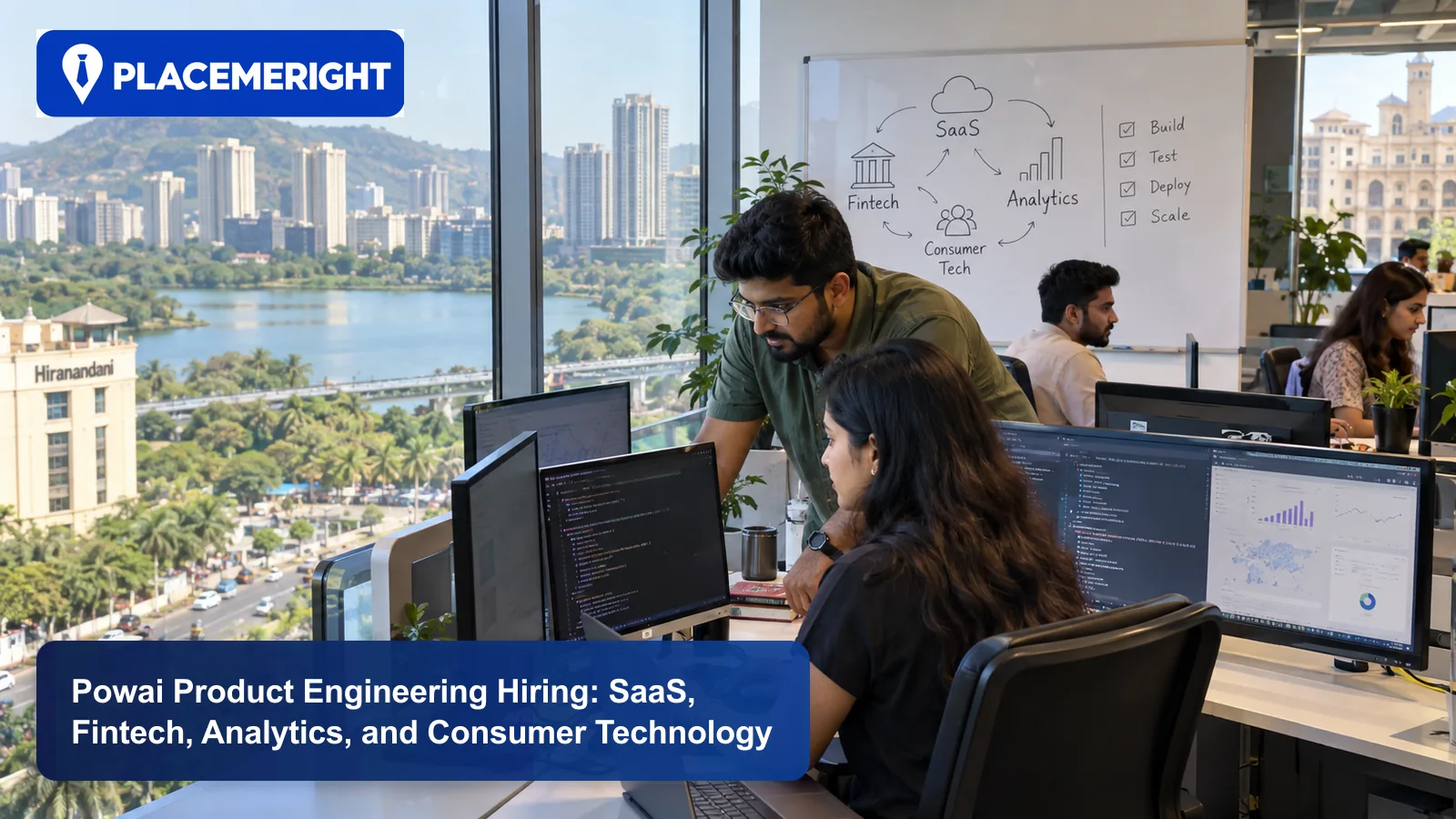
Powai product teams may review similar-looking profiles shaped by different operating conditions. SaaS work can emphasise tenant isolation, fintech work transaction correctness, analytics work data lineage, and consumer technology controlled experimentation under load.
All four can write services, work with cloud infrastructure, and discuss scale. That overlap is why a generic "product engineer" search creates avoidable interviews.
Powai's local context makes the distinction relevant. IIT Bombay, SINE, the IIT Bombay Research Park, Hiranandani Gardens, Chandivali, Saki Naka, Vikhroli, and Andheri East place research, startups, financial institutions, consumer companies, and enterprise teams in one planning conversation. Each candidate's operating model still matters.
Cushman & Wakefield reported 4.1 million square feet of Mumbai office leasing in Q2 2026 and 10.7 million in the first half. It identified BFSI, IT-BPM, and engineering and manufacturing among active occupier groups, with new Grade A space in Powai. The figures do not measure engineering supply, availability, or recruitment competition.
For broader market planning, use PlaceMeRight's Mumbai technology recruitment guide. This article concentrates on one narrower decision: which kind of product engineering evidence a Powai employer should hire.
Four businesses can use the same stack differently
Consider four employers using React, Java or Node.js, PostgreSQL, cloud services, containers, and automated delivery.
The SaaS company builds configurable workflows for hundreds of business customers. The fintech platform processes money movement and reconciles with external systems. The analytics product ingests events and produces decision-ready metrics. The consumer application handles unpredictable traffic and rapid experiments.
The technologies overlap. The engineering consequences do not.
| Product model | Failure the business fears | Engineering evidence that matters | | --- | --- | --- | | B2B SaaS | One customer's change affects another or makes releases unsafe | tenancy, permissions, configuration, API compatibility, observability | | Fintech | Incorrect, unauthorised, or unreconciled transaction | idempotency, ledger reasoning, controls, audit trail, recovery | | Analytics | Decision is based on incomplete, late, or misdefined data | lineage, data contracts, quality, orchestration, metric definition | | Consumer technology | Users abandon a slow, unstable, or confusing experience | latency, mobile reliability, experimentation, traffic management, telemetry |
The interview should reproduce the relevant engineering trade-off. A generic data-structures round cannot carry the full hiring decision.
A current Mumbai sample supports a mixed product market
PlaceMeRight reviewed 120 records from its Mumbai live-job feed on 27 July 2026. Those records were dated 20 to 23 July. A title-and-tag scan identified 29 product or application-engineering records, 18 cloud or DevOps records, 12 data or analytics records, and ten QA or testing records.
The categories overlap and cover Mumbai rather than Powai alone. A cloud-oriented product engineer may appear in more than one category, while a job title cannot prove product ownership. These figures should not be read as vacancy shares.
The sample's value is limited but useful: the reviewed role labels span connected engineering families. A title scan cannot establish individual capability, yet it shows why a broad brief can mix candidates whose experience was formed under different product models.
Powai is an ecosystem, not just an office pin
IIT Bombay and the SINE founder network
IIT Bombay anchors research, engineering education, and entrepreneurial activity in Powai. The Government of India's science and technology portal describes its Society for Innovation and Entrepreneurship as a technology incubator, while the IIT Bombay Research Park is designed to connect industry and academic research.
Do not turn institutional proximity into a pedigree filter. The local institutions justify questions about research translation, early product building, deep technology, and founder-led problem solving. Test the work rather than infer it.
Hiranandani Gardens and Powai's office cluster
The Hiranandani and Powai office environment includes startups, technology businesses, consulting teams, financial operations, and enterprise functions. Experience there may involve mature product practice or narrow ownership; the office label does not reveal which.
Ask what the person owned between customer problem, system design, release, and production result. "Worked on a high-scale platform" is context, not proof of individual scope.
Chandivali, Saki Naka, and Andheri East
Chandivali and Saki Naka extend the workplace map toward Andheri East. Employers should state whether the role belongs to SaaS, enterprise software, media, consumer technology, services, or an operations-heavy team.
State the exact office point, office days, and typical hours before screening. A map distance alone cannot establish whether an arrangement is feasible for a particular candidate.
Vikhroli and the eastern suburbs
Vikhroli, Kanjurmarg, and nearby eastern suburbs add enterprise and technology workplace contexts to the eastern Mumbai map. A hybrid team hiring for platform, data, finance technology, internal products, or business systems should specify which context actually applies.
Do not restrict sourcing to candidates already working in Powai. Define a workable travel radius and test the candidate's actual plan.
SaaS hiring: look for boundaries and repeatability
An effective B2B SaaS engineer understands that one codebase often serves customers with different permissions, configurations, integrations, and usage patterns.
Relevant evidence includes:
- tenant isolation and access control;
- configurable workflow without customer-specific forks;
- versioned APIs and backward compatibility;
- safe schema and data migrations;
- feature release, rollback, and observability;
- supportability for customer-facing teams;
- product decisions that reduce repeated implementation work.
Ask for one change that had to work for many customers without exposing one customer's data or breaking another's workflow. Follow the answer through design, migration, release, monitoring, and correction.
A candidate from internal enterprise software can transition well when they show reusable product thinking. A services engineer can transition when they can replace one-off customisation with controlled configuration or a maintained extension point.
Fintech hiring: test correctness before velocity theatre
Mumbai's financial-services context makes "fintech experience" a common search term, but it covers payment interfaces, lending systems, wealth products, insurance technology, risk platforms, reconciliation, compliance tooling, and internal finance systems.
The employer should identify the financial invariant. Examples include:
- a transaction is applied once;
- balances remain explainable;
- an approval cannot be bypassed;
- every material change is attributable;
- failed external calls can be recovered safely;
- source and settlement records can be reconciled;
- sensitive data is visible only to authorised actors.
Give the candidate a failed-payment or duplicate-event scenario. Ask how the system records state, handles retries, identifies uncertainty, reconciles later, and communicates to operations. This reveals more than asking for a list of payment gateways.
Regulated or control-heavy experience can be valuable, but avoid selecting only for company names. Test whether the candidate understands why a control exists and how it affects software design.
Analytics hiring: separate pipeline volume from trusted meaning
An analytics product is not reliable because it moves a large volume of data. It is reliable when users can understand where the data came from, when it arrived, how it changed, and whether a metric means the same thing across teams.
Relevant hiring evidence includes:
- source contracts and change handling;
- batch or streaming trade-offs;
- orchestration and recovery;
- data quality checks and ownership;
- lineage and observability;
- warehouse or lakehouse modelling;
- access controls and sensitive-data handling;
- metric definitions connected to business decisions.
Use a scenario in which a key business metric changes after a source release. Ask how the candidate identifies whether the cause is user behaviour, source logic, ingestion, transformation, late data, or definition drift.
Data-tool familiarity is useful, but the stronger signal is the candidate's method for making data dependable.
Consumer technology hiring: measure learning under real load
Consumer products can create high traffic, short feedback cycles, mobile constraints, and intense pressure around release impact. Effective candidates do not simply "move fast." They design feedback and containment into the system.
Look for:
- latency and reliability decisions grounded in user journeys;
- mobile network and device variability;
- feature flags and controlled rollout;
- experimentation with valid guardrail metrics;
- event design and product telemetry;
- caching and traffic-spike management;
- incident learning and rollback;
- abuse, fraud, privacy, or content-safety awareness where relevant.
Ask for an experiment that appeared positive on one metric but created a harmful secondary effect. A mature candidate should discuss measurement design, segmentation, novelty, operational cost, and reversal, not just conversion uplift.
Choose a role architecture before choosing seniority
Product organisations often ask for a "senior full-stack engineer" when the real gap is architectural ownership, platform leverage, data reliability, or product execution.
Use this sequence:
1. Name the product model. 2. Identify the system or user outcome without an owner. 3. Define the decisions the new hire must make independently. 4. List the interfaces with product, design, data, security, operations, and customer teams. 5. Set the expected balance of building, operating, mentoring, and coordination. 6. Then choose level and title.
A senior title should indicate decision scope and consequence, not a fixed number of years. A staff-level search should include cross-team technical influence. An engineering-manager search should not quietly require the person to remain the team's primary individual contributor.
Use one common interview spine and one model-specific case
A fair process can retain consistency without treating every product model as identical.
Common interview spine
Evaluate every product engineer on:
- problem clarification;
- system-boundary reasoning;
- maintainable implementation;
- testing and release thinking;
- production evidence;
- communication and trade-offs.
Model-specific case
Add one relevant case:
- SaaS: introduce a configurable feature without weakening tenant isolation.
- Fintech: recover from uncertain transaction state without creating duplication.
- Analytics: diagnose a trusted metric that changed after an upstream release.
- Consumer: release a feature to a large user base while protecting reliability.
Publish the scoring dimensions to interviewers before interviews begin. Independent written scores reduce the chance that presentation style overrides technical evidence.
Build a candidate evidence portfolio
Ask each finalist to provide four short examples during the process:
1. a design decision with a rejected alternative; 2. a production issue they personally investigated; 3. a change measured after release; 4. a disagreement resolved with product, operations, security, or another engineer.
For each example, capture:
- starting constraint;
- candidate's decision;
- evidence used;
- consequence;
- lesson or later correction.
This creates a comparable record across candidates from different company types. It is particularly useful in Powai searches, where a startup generalist and an enterprise specialist may otherwise be judged through incompatible assumptions.
Avoid four common Powai hiring shortcuts
Treating fintech as a stack
Fintech is a consequence and control environment, not a programming language. Define the financial workflow and invariant.
Assuming startup means end-to-end ownership
Some startup roles are broad; others are narrowly directed. Ask for decision boundaries and production accountability.
Equating scale with traffic
Scale may mean data volume, transaction value, customer count, regulatory complexity, integrations, or organisational coordination. Name the form that matters.
Using commute as a late-stage negotiation
State the Powai office location, working hours, office frequency, and any on-call requirement in the initial brief.
Quick checklist for a Powai product-engineering search
- Identify SaaS, fintech, analytics, consumer, or a deliberate hybrid.
- Name the primary business failure the engineer must prevent.
- Define system ownership and production responsibility.
- Separate product engineering from implementation and internal IT.
- Specify office location and hybrid rhythm.
- Use one model-specific system case.
- Ask for production evidence, not only architecture vocabulary.
- Score business-domain depth separately from software fundamentals.
- Test transferable experience without demanding an identical title.
- Align interview feedback before discussing compensation or offer.
Frequently asked questions
Is Powai only relevant for startup hiring?
No. Documented local institutions and office contexts include startups, established technology businesses, financial organisations, research-linked ventures, consulting teams, and enterprise operations. That context does not prove applicant supply; employers should assess relevant product evidence rather than one company category.
Can a SaaS engineer move into fintech?
Yes, if the candidate can learn the financial workflow and demonstrate correctness, auditability, security, and failure-recovery thinking. An interview should test those missing constraints directly.
Should we require prior consumer-scale experience?
Only when traffic pattern, user volume, mobile constraints, or experimentation speed are essential on day one. Candidates from other models may transfer when they show strong performance reasoning and controlled release practice.
How far should a Powai search extend?
The research geography may include Hiranandani Gardens, Chandivali, Saki Naka, Andheri East, Vikhroli, Kanjurmarg, Ghatkopar, and selected Mumbai or Navi Mumbai locations. Define it from the actual work mode, then confirm feasibility directly with each candidate rather than assuming supply or willingness.
What is a useful work sample for product engineers?
Use a short system problem that reflects the company's real failure mode. Ask the candidate to clarify requirements, identify risks, design a solution, plan release and observability, and respond to a failure.
How should an early-stage company compare a generalist with a specialist?
Score both against the next 12 to 18 months of actual decisions. Breadth is valuable when the role has broad ownership. Depth is valuable when one difficult system constraint determines product success.
Related reading
- Assess high-volume mobile engineering in Powai
- Compare Powai and BKC for a fintech product team
- Use product ownership as the Powai hiring filter
- Discuss a product-engineering requirement
Conclusion
Powai's documented research, startup, financial-services, SaaS, analytics, consumer, and enterprise contexts make a four-model comparison locally relevant. They do not establish who is available or willing to join, so the hiring team still needs role-specific evidence.
Define the product model and its most important failure. Translate that into system ownership, a model-specific interview case, and a consistent scorecard. Then assess transferable experience rather than screening only for matching titles or employer names.
The result is a search built around the product the engineer must protect, not a generic list of technologies.
CTA
PlaceMeRight helps Mumbai employers calibrate product-engineering roles across SaaS, fintech, analytics, consumer technology, platform, data, and application teams. Share your Powai hiring requirement to build the role brief, sourcing map, technical scorecard, and interview process.
References
- Cushman & Wakefield: Mumbai MarketBeat, Q2 2026
- IIT Bombay: about the institute
- Government of India Science and Technology portal: SINE at IIT Bombay
- IIT Bombay Research Park
- Government of Maharashtra: FinTech Policy
- Government of Maharashtra: policies and guidelines
Related PlaceMeRight resources
Our Tech Recruitment Services by City
Looking to hire vetted software engineers or scale your engineering teams in India's leading tech hubs? Explore our localized recruitment services: