
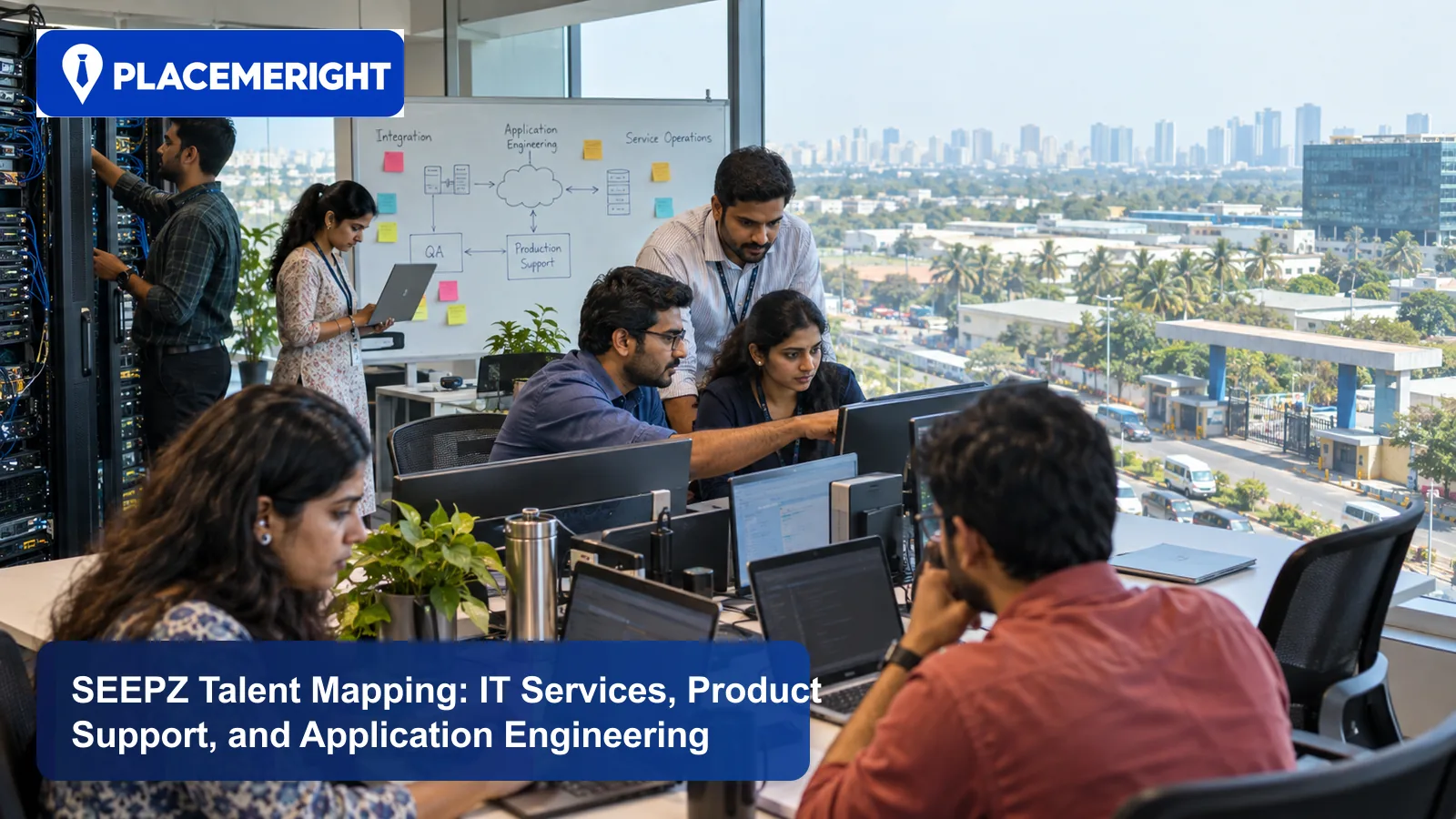
SEEPZ is not one technology job.
An employer may need a developer who builds an enterprise application, an integration engineer who moves data safely, a quality engineer who designs release evidence, or a support leader who keeps a business-critical system available.
All may appear under IT services or application engineering. Their ownership starts and ends in different places.
Map the application lifecycle before searching titles.
Use official SEEPZ context carefully
SEEPZ's official site describes an operating special economic zone in Andheri East and provides sector-wise unit information. Current government material identifies a multi-sector zone with IT and ITeS activity alongside other industries. Current official unit records include services businesses inside SEEPZ and technology-services organisations across the wider jurisdiction.
The RISe platform, built for SEEPZ governance, offers a useful example of application scope. Its published modules cover registration, unit and vendor services, allotment, billing, waste monitoring, contracts, claims, finance, inventory, approvals, facilities, and grievances. It describes role-based access, audit trails, workflows, dashboards, and document access.
That is an operating-system landscape, not just a web page.
These sources establish real enterprise-software context. They do not show the number of engineers available, the current hiring volume of each unit, or the capability of candidates living near SEEPZ.
Use PlaceMeRight's Mumbai technology recruitment context for the wider search. State whether the office is inside SEEPZ SEZ, elsewhere in Andheri East, MIDC, Marol, Chakala, Powai, BKC, Navi Mumbai, or another Mumbai location.
Trace the application through seven stages
Each stage needs different evidence.
Stage 1: business and service definition
Work may include:
- user and stakeholder discovery;
- process mapping;
- service levels;
- regulatory or contractual constraints;
- permission boundaries;
- exception handling;
- outcome and acceptance definition.
The candidate should explain who uses the system and what happens when the workflow is wrong.
Stage 2: application engineering
Work may include:
- domain and data models;
- APIs;
- web or mobile interfaces;
- workflow engines;
- batch processing;
- security controls;
- maintainability;
- performance.
Ask what the engineer designed, not only which language appeared in the project.
Stage 3: integration and data movement
Work may include:
- API and event contracts;
- identity;
- transformation;
- master-data alignment;
- scheduled files or jobs;
- retries;
- reconciliation;
- failure queues;
- third-party dependencies.
Integration evidence should include operation after launch.
Stage 4: quality and release evidence
Work may include:
- unit and integration tests;
- service virtualisation;
- regression;
- performance;
- security;
- test data;
- environment control;
- deployment validation;
- rollback.
Quality is a risk model, not merely execution of prepared cases.
Stage 5: production support
Work may include:
- monitoring;
- triage;
- impact assessment;
- incident command;
- restoration;
- stakeholder communication;
- root-cause analysis;
- known-error management.
A current Citi Mumbai applications-support role, for example, asks for oversight across applications, a holistic production view, coordination with development managers, and tracking long-term fixes. It is a current city role, not evidence about one SEEPZ unit.
Stage 6: service management
Work may include:
- service-level reporting;
- capacity and availability;
- change and problem management;
- vendor coordination;
- audit evidence;
- knowledge management;
- support model design;
- operating cost.
This layer connects technical operation to a business service.
Stage 7: improvement and retirement
Work may include:
- recurring-issue removal;
- automation;
- architecture modernisation;
- data migration;
- decommissioning;
- contract exit;
- user transition;
- retained records.
An application has a lifecycle after its first release.
Write the role as a lifecycle boundary
Complete:
> This role owns Stages [numbers], contributes to Stages [numbers], and must understand Stages [numbers] because [business or operational consequence].
Application engineer
> Owns application design and build, contributes to integration and release evidence, and understands production support because customer and operational failures must feed back into the code.
Production-support engineer
> Owns detection, triage, restoration, and incident evidence, contributes to problem removal, and understands architecture and integration because symptoms can cross several services.
QA automation engineer
> Owns risk-based test design and release evidence, contributes to observability and environment design, and understands the business workflow because technical coverage must protect service outcomes.
Service delivery lead
> Owns service commitments, coordination, reporting, and improvement, contributes to incident and change decisions, and understands application boundaries because operational promises need technical evidence.
The boundary prevents a broad title from hiding the real job.
Distinguish four ownership patterns
Build ownership
The person designs and implements capability.
Evidence:
- technical decision;
- code or configuration;
- validation;
- release;
- maintainability.
Run ownership
The person keeps the service available and understandable.
Evidence:
- monitoring;
- incident response;
- restoration;
- operational documentation;
- reliability improvement.
Change ownership
The person moves the application or operating model safely.
Evidence:
- dependency mapping;
- migration;
- coexistence;
- release governance;
- rollback;
- adoption.
Service ownership
The person connects business commitments, technical health, suppliers, users, and improvement.
Evidence:
- service definition;
- metrics;
- escalation;
- stakeholder decision;
- capacity;
- recurring-problem removal.
A candidate can combine patterns. The interview should identify the primary one.
Use a SEEPZ-style workflow case
The example below is inspired by common enterprise-governance functions, not by confidential SEEPZ operations.
> A zone-management application registers units and vendors, issues documents, bills services, tracks contracts, and records approvals. A renewal was approved in one module, but the billing status did not update. The user cannot download the final document, while the dashboard shows completion. Month-end reporting begins tomorrow.
Give each candidate the same event.
For an application engineer
Ask:
- Which state model is incomplete?
- Where should transaction boundaries sit?
- How should partial completion appear?
- Which change is safe before month end?
- What test prevents recurrence?
For an integration engineer
Ask:
- Which system owns approval, billing, and document status?
- How are identifiers correlated?
- What happens on delayed or duplicate events?
- How is reconciliation performed?
- Which team owns the failure queue?
For a quality engineer
Ask:
- Which business risks have highest priority?
- What data and environment are required?
- Which end-to-end tests are essential?
- How are partial states verified?
- What release evidence is sufficient?
For a support engineer
Ask:
- How is user and reporting impact bounded?
- What immediate restoration is acceptable?
- Which logs, events, and records are needed?
- How should status be communicated?
- What becomes a problem-management item?
For a service lead
Ask:
- Which commitment is at risk?
- Who decides the temporary process?
- What is communicated to users and leadership?
- Which teams must remain coordinated?
- How is the follow-up measured?
The case exposes handoffs while preserving role-specific depth.
Test the handoff explicitly
After the first answer, introduce:
> The development team says its API returned success. The integration team says the message was delivered. Support sees no alert. The business user still cannot complete the task.
Ask the candidate to create:
- a shared incident statement;
- an evidence list;
- a temporary owner;
- the next diagnostic action;
- a communication cadence;
- a closure condition.
Strong candidates do not defend their function's green status. They trace the user outcome across boundaries.
Evaluate application-support depth
Production support varies substantially.
Monitoring operator
Follows alerts and documented actions.
Technical analyst
Investigates logs, jobs, databases, interfaces, and application behaviour.
Production engineer
Improves observability, automation, recovery, performance, and reliability through engineering.
Support lead
Coordinates service impact, technical teams, stakeholders, and long-term correction.
Service owner
Owns the complete business service, risk, suppliers, metrics, and improvement.
Do not rank these as one ladder automatically. Match the employer's service and authority.
Score lifecycle evidence
User and service understanding
- 4: connects workflow, exception, consequence, and service commitment;
- 3: demonstrates clear application context;
- 2: sees only the assigned component;
- 1: cannot identify the user or business effect.
Technical ownership
- 4: explains decision, implementation, evidence, release, and operation;
- 3: owns a bounded technical outcome;
- 2: lists tasks without trade-offs;
- 1: relies on tools or team claims.
Handoff quality
- 4: defines contracts, evidence, ownership, escalation, and closure across teams;
- 3: collaborates effectively with a minor gap;
- 2: transfers tickets without preserving context;
- 1: treats another team's acknowledgement as the user outcome.
Improvement discipline
- 4: converts incidents and service evidence into durable technical or operating change;
- 3: contributes to root cause and prevention;
- 2: restores repeatedly without removing the pattern;
- 1: closes on symptom disappearance.
Require examples, not preferred vocabulary.
Calibrate IT-services experience
Client delivery can provide deep evidence in:
- varied enterprise landscapes;
- integration;
- release governance;
- stakeholder communication;
- service levels;
- distributed teamwork;
- production support;
- migration.
It can also fragment ownership when a person sees only one phase.
Ask:
- What authority did you hold?
- Which client decision did you influence?
- What artefact did you create?
- What system behaviour did you validate?
- What happened after handoff?
- What production evidence returned to your team?
Do not assume services experience is broad or narrow from the employer name.
Present SEEPZ workplace conditions accurately
An office inside a controlled SEZ can have entry and access procedures that differ from an ordinary Andheri East office. Official SEEPZ material describes a high-security entry environment and facilities within the zone.
The employer should disclose:
- exact unit and gate process;
- documents or access lead time;
- office days and shifts;
- production-support or on-call expectations;
- late releases;
- transport arrangements;
- client or alternate-site travel;
- device or data restrictions;
- whether work begins before permanent access is issued.
Confirm current rules with the relevant authority. Do not turn historical tender language into universal employee instructions.
Make operational documentation part of the assessment
Application teams often discover a candidate's real system model through the document they produce.
Give the candidate the shared workflow incident and ask for one short artefact suited to the role.
Application engineer
Create a decision note covering the incorrect state, proposed model, compatibility risk, migration, validation, and rollback.
Integration engineer
Create an interface contract covering ownership, identifiers, states, errors, retry, reconciliation, observability, and escalation.
Quality engineer
Create a risk note covering user consequences, required environments, data variants, automation boundary, release evidence, and residual risk.
Support engineer
Create an incident handoff covering impact, timeline, evidence, actions, current hypothesis, temporary restoration, owner, and next checkpoint.
Service lead
Create a stakeholder update that separates confirmed impact, current uncertainty, restoration work, decision required, and next communication time.
Score:
- factual precision;
- audience fit;
- decision usefulness;
- ownership clarity;
- treatment of uncertainty;
- ability to support the next action.
Do not score visual polish heavily unless documentation design is part of the job. Allow the candidate to state missing information instead of inventing it.
This work sample can be completed during the interview using fictional data. Do not request confidential employer artefacts or customer information from past work.
The exercise matters particularly where several IT-services, internal, vendor, and operations teams share one application. Good documentation is not administrative residue. It is the structure that lets evidence and authority cross a handoff.
Require the final owner to record the user-visible outcome, technical correction, verification result, monitoring change, and remaining risk. A closed ticket without those five elements may conceal an unresolved service.
Quick checklist
- Map the application through seven lifecycle stages.
- Define the role's owned, contributing, and awareness stages.
- Separate build, run, change, and service ownership.
- Use one cross-function workflow failure.
- Test the handoff after each team reports success.
- Distinguish application-support levels.
- Score service context, technical ownership, handoff, and improvement.
- Verify what an IT-services candidate personally owned.
- State the exact SEEPZ or Andheri East workplace.
- Recheck access and operating conditions before outreach.
Frequently asked questions
Is SEEPZ only a jewellery and manufacturing location?
No. Official SEEPZ material also identifies IT and ITeS and records software-related units. The zone is multi-sector.
Is product support the same as a help desk?
Not necessarily. Product or application support can involve deep diagnosis, production engineering, business-critical incidents, automation, and permanent reliability improvement. Define the level.
Should developers be assessed on production support?
Assess the production responsibility the role genuinely requires. Even when a separate support team exists, developers may need observability, incident collaboration, and durable-fix evidence.
Can a QA engineer own release quality alone?
No. Quality is shared. A QA specialist can own risk models, test systems, and evidence, while product, engineering, security, and operations retain their responsibilities.
Does a SEEPZ unit list prove current hiring?
No. It establishes organisational or approval context at a point in time. Verify the employer's current operation and hiring requirement directly.
Should SEEPZ and Navi Mumbai be one search?
They may be part of a wider Mumbai search, but the workplaces and travel propositions are different. Disclose each site and schedule separately.
Related reading
- Hire application and platform engineers
- Explore PlaceMeRight technical recruitment
- Discuss a Mumbai application hiring brief
Conclusion
SEEPZ technology hiring becomes clearer when the employer traces one application from business definition through build, integration, quality, release, support, service, and improvement.
Titles such as application engineer, product support, and IT services do not reveal that boundary.
Define the lifecycle ownership, test the handoff, and hire for the user and service consequence the person must protect.
CTA
PlaceMeRight helps Mumbai employers map application lifecycles, source role-specific evidence, and structure interviews across engineering, integration, quality, support, and service operations.
Share your SEEPZ or Andheri East technology requirement
References
- SEEPZ official portal and sector-wise unit information
- SEEPZ: July 2026 approval-committee agenda directory
- SEEPZ: current facility-management scope and zone overview
- SEEPZ: current official unit and services records
- RISe: digital governance platform for SEEPZ
- RISe: secure access, workflow visibility, and analytics
- Citi: current Mumbai applications-support leadership role
- Citi: current Mumbai technology roles
Related PlaceMeRight resources
Our Tech Recruitment Services by City
Looking to hire vetted software engineers or scale your engineering teams in India's leading tech hubs? Explore our localized recruitment services: