
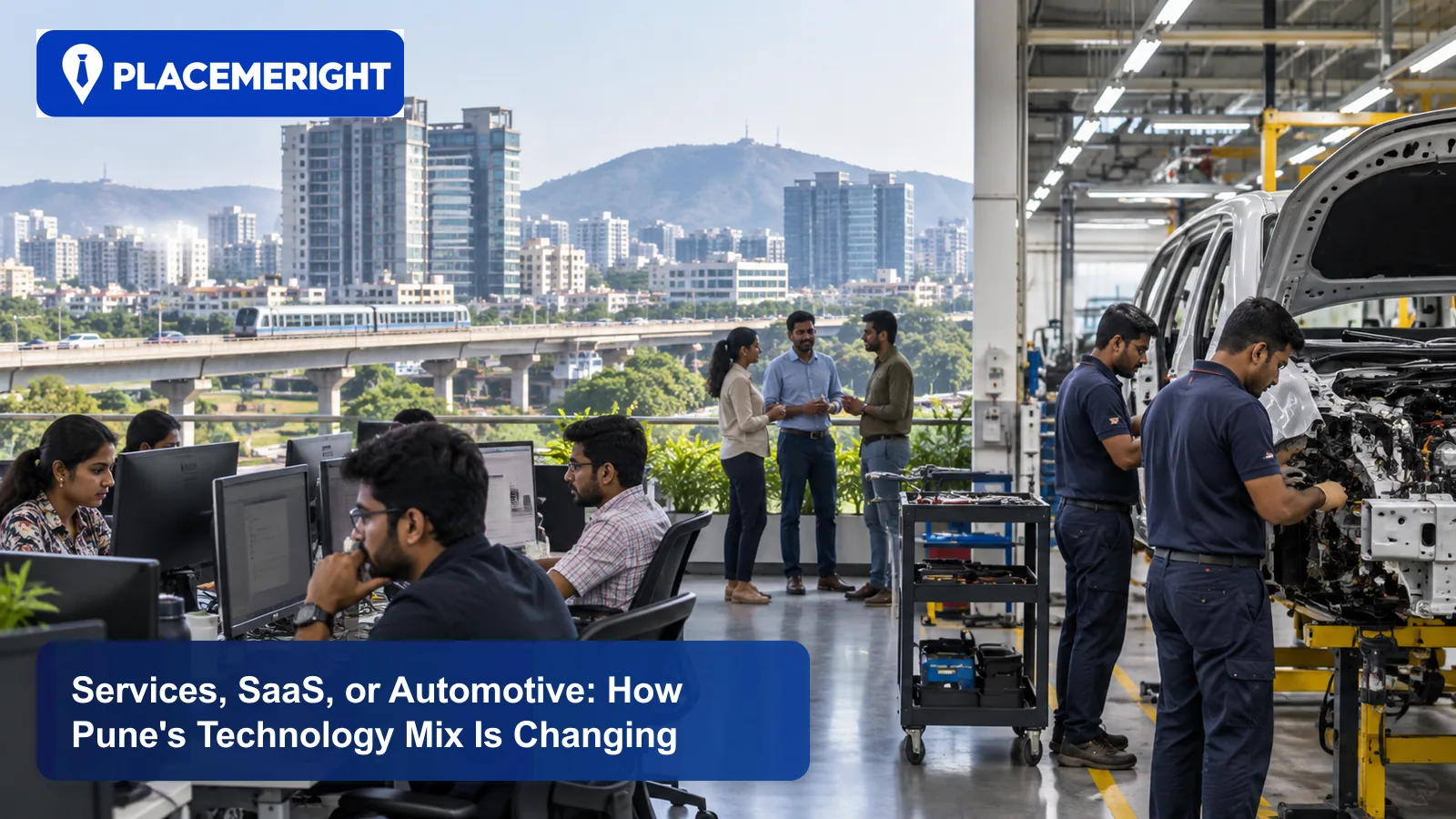
Pune technology hiring cannot be explained by one label.
An employer may be building a client-delivery team in Hinjawadi, a cloud or payments product group in east Pune, or an automotive software and validation capability connected to Chakan and the wider industrial corridor. The same Java, cloud, data, testing, or systems vocabulary can appear across all three. The operating evidence behind it can be entirely different.
That creates a practical hiring question: is Pune's technology mix moving toward services, software products, or automotive engineering?
One article and one job-posting snapshot cannot prove that trend. A defensible answer requires comparable historical data, stable classifications, and repeated collection. What employers can do today is study the workflows that are visibly being hired and build a ledger that can be refreshed.
This guide shows that method through a dated, purposive 12-role sample.
Define the evidence and its limits
The sample was collected on July 28, 2026. It selected four publicly accessible role descriptions for each of three workflow groups.
Customer-delivery sample
Four Accenture Pune roles covered Spring Boot, Azure, microservices, and business-process applications; Java full-stack delivery; data pipelines using Python, Kubernetes, and CI/CD; and Java cloud migration work connected to banking. The roles were classified by their stated custom, data, stakeholder, or business-process delivery context.
Software-product sample
Four Pune product roles covered HackerOne's AI-powered security platform, Entrata's property-management software, Ontic's security SaaS platform, and OpenGov's public-sector ERP products. They were classified by stated product, platform, lifecycle, user, reliability, and adoption responsibilities.
Automotive-engineering sample
Four current roles covered Accenture ADAS feature engineering, Accenture automotive BSP and software-defined-vehicle platform work, Luxoft technical delivery for an ADAS domain-controller project, and Bosch active-safety or braking-system application engineering in Chakan.
This is a deliberately balanced editorial sample, not a random or representative sample of Pune vacancies. It cannot estimate market share, hiring growth, candidate availability, employer size, salary, or closing difficulty. Role pages can also change or close.
PlaceMeRight's Pune technology recruitment page provides broader local employer context beyond this sample.
Read the official ecosystem context carefully
Official sources explain why several workflows can coexist, but they do not measure the sample for us.
Software Technology Parks of India locates its Pune centre in Rajiv Gandhi Infotech Park, Hinjawadi. STPI Pune also describes MOTION, a Centre of Entrepreneurship associated with autonomous, connected, electric, and shared mobility, formed with government, industry, and academic partners.
Maharashtra Industrial Development Corporation presents automobiles as a focus sector. That official context supports investigation of automotive and industrial technology work. It does not prove that automotive software vacancies outnumber product or services roles.
The evidence supports a more modest conclusion: Pune has institutional and operating contexts relevant to export technology, client delivery, software products, mobility, and industrial engineering. Employers still need role-level evidence to understand a particular search.
Build a workflow-mix ledger
Give every sampled role the same fields.
Published role identity
Record employer, title, location, collection date, URL, and whether the page remained active at the time of review. Do not merge duplicate postings without checking whether they represent separate requisitions.
Primary value recipient
Identify whether the work primarily serves an external client programme, a software product and its users, or a vehicle, plant, engineering, or mobility programme. Some roles cross categories; record the primary classification and a secondary tag.
Delivery object
What must the person deliver: application enhancement, migration, managed operation, product feature, platform capability, experiment, ECU function, diagnostic interface, test evidence, or vehicle calibration?
Operating evidence
What does the role ask the person to run, support, observe, validate, or recover after release?
Stakeholder environment
List customer teams, product managers, users, business owners, OEMs, suppliers, hardware engineers, plant teams, control owners, or global delivery groups named or implied by the work.
Quality boundary
Record security, reliability, compliance, safety, performance, test, governance, or production requirements stated in the description.
Location dependency
Identify a named Pune office, Hinjawadi delivery site, Chakan vehicle environment, hybrid rule, customer location, lab, or other physical dependency. Do not infer an attendance policy when the page does not state one.
What the services sample asks employers to screen
The four services roles do not form one interchangeable pool.
Delivery discipline
The Spring Boot and Azure role connects application development with microservices, API design, databases, stakeholder requirements, and scalable delivery. Screen for how the candidate handled requirements, code quality, deployment, security, and production troubleshooting within a customer or project environment.
Modernisation judgement
The Java full-stack role should be read beyond its framework list. Ask how the candidate translated a business process, divided front-end and service responsibility, preserved data integrity, tested interfaces, and controlled release or maintenance risk.
Distributed application work
The data-engineering role requires evidence around source boundaries, pipeline design, quality, orchestration, Kubernetes, CI/CD, failure handling, and deployment. Do not accept a keyword list without an owned flow.
Cloud operations
The Java cloud-migration role connects application delivery to Azure, data, integration, release, and a banking context. Examine change control, testing, access, deployment, and support rather than treating cloud migration as a tool-upgrade exercise.
Across these roles, the common hiring signal is accountable delivery inside constraints. Customer communication and change control may be as important as stack familiarity.
What the software-product sample asks employers to screen
Product work is not defined merely by an employer selling software.
User and outcome ownership
The sampled roles connect engineering to security teams, property users, risk operations, and public-sector administrators. Ask how the candidate understood the user, measured behaviour, and prioritised trade-offs.
Full lifecycle
Look for contribution from problem or design through implementation, testing, release, observability, support, and iteration. A candidate may have built features without owning roadmap or production.
Platform reliability
Security, property, risk, and government systems can require secure, scalable, observable, or high-availability behaviour. Test the candidate's actual decisions and incident evidence without asking for confidential data.
Product collaboration
Examine work with product management, quality, architecture, data, operations, and geographically distributed teams. "Worked in Agile" is not enough.
Adoption and feedback
Ask how user, customer, performance, defect, or experiment evidence changed the product. Product potential is visible in decision loops, not the company category.
These signals help employers avoid treating every services candidate as delivery-only or every product candidate as automatically outcome-oriented.
What the automotive sample asks employers to screen
Automotive technology roles connect software to physical systems and engineering controls.
System boundary
The Accenture and Luxoft examples include ADAS, ECU, AUTOSAR, QNX, sensors, middleware, and vehicle-control interfaces. Ask the candidate to place their component inside the complete system.
Safety and process
Where the role states ISO 26262, ASPICE, requirements traceability, or validation duties, assess practical application. Acronym recall is not evidence of safety judgement.
Hardware-software interaction
Camera pipelines, braking systems, vehicle networks, diagnostic tools, and prototype testing require attention to timing, interfaces, calibration, and observed behaviour. A cloud-only interview will miss this.
Verification
Ask how requirements became test cases, how faults were reproduced, what environments were used, how evidence was documented, and who accepted the result.
Customer or OEM coordination
The candidate may work across supplier and OEM boundaries. Test change control, issue communication, release dependency, and technical decision ownership.
Physical validation or customer access can create location constraints that a generic "Pune hybrid" label fails to describe.
Compare capabilities without forcing one hierarchy
Services, product, and automotive experience each contain transferable and non-transferable elements.
Transferable foundations
Examples include structured problem solving, coding, testing, architecture reasoning, version control, CI/CD, observability, incident response, documentation, and stakeholder communication.
Context-dependent depth
Client contract and delivery governance, product discovery and adoption, payment controls, functional safety, vehicle networks, and hardware-in-loop validation require specific evidence or a credible learning plan.
Different definitions of production
For a services role, production may be a customer's managed environment. For a SaaS role, it may be a continuously operated platform. For automotive software, production can include release into a controlled vehicle programme and validation chain. Interviewers must use the destination definition.
Different feedback speeds
Software products may receive telemetry and user feedback frequently. Automotive programmes can include longer validation and release cycles. Client delivery may follow contractual milestones. Do not interpret one cadence as stronger without context.
Different ownership language
"Led delivery", "owned a product area", and "owned an ECU function" are not equivalent. Translate each claim into decisions, artefacts, dependencies, and consequences.
Use the ledger to design a Pune search
The ledger is useful only when it changes employer action.
Name the destination workflow
Start with the target value chain. A Java engineer for client modernisation, a payments platform, and an ADAS backend needs a different sourcing and assessment plan.
Search for evidence nouns
Use business and system objects alongside tools: migration, managed service, decision engine, authorization, experiment, AUTOSAR, camera pipeline, calibration, validation, or diagnostics.
Write a transfer hypothesis
For adjacent candidates, state which prior evidence may transfer and what case will test the gap. Do not reject solely on employer category.
Assign interview owners
Give technical foundation, workflow context, production judgement, and stakeholder evidence to named assessors. Prevent several panels from repeating generic coding questions.
Publish location reality
Name Hinjawadi, Kharadi, Balewadi, Chakan, or the actual site only when it is the approved workplace. State lab, plant, customer, or vehicle access requirements separately.
Refresh the sample before claiming change
The title asks how the mix is changing. A single collection cannot answer direction.
Preserve the July baseline
Keep the URLs, role text, classifications, inclusion rules, and notes. Mark closures rather than deleting them.
Repeat on a fixed cadence
Collect another balanced or comprehensive sample using the same employer set, keywords, locations, and classification rules. If the method changes, record the break.
Compare workflows, not only titles
A "software engineer" role may move from customer delivery to product platform or vehicle integration while retaining the same title.
Report uncertainty
Small changes may reflect posting timing, one employer campaign, expired pages, or classification judgement. Do not call them a structural shift without sustained evidence.
Add employer evidence
Interview hiring leaders about approved work, team design, and capability changes. Anonymise observations and keep them separate from public role data.
Until that repeated evidence exists, the responsible conclusion is coexistence, not a measured trend.
Quick checklist
- Date every role sample and preserve the inclusion method.
- Keep the three workflow groups balanced when the goal is comparison.
- Do not use a purposive sample to estimate market share.
- Classify by delivered work, not employer label or job title alone.
- Screen services roles for delivery, modernisation, and operating discipline.
- Screen product roles for user outcomes, lifecycle, platform reliability, and feedback.
- Screen automotive roles for system boundary, safety, hardware interaction, and validation.
- Write transfer hypotheses for adjacent experience.
- State the actual Pune worksite and physical dependencies.
- Repeat the sample before claiming that the mix is changing.
Frequently asked questions
Is Pune becoming more of a product city than an IT services city?
This 12-role sample cannot answer that question. It shows current examples of several workflows. A trend claim needs repeated, comparable data and clear classification.
Does automotive software require only embedded C or C++?
No. Current work can involve middleware, systems architecture, validation, Python, simulation, cloud integration, data, diagnostics, tooling, and stakeholder coordination. The actual system boundary determines the brief.
Can an IT services engineer move into a SaaS product team?
Potentially. Employers should test transferable system ownership, production judgement, user or business understanding, and decision evidence rather than relying on the prior employer category.
Are job postings a reliable measure of candidate supply?
No. They show employer-published demand language at a point in time. They do not establish applications, qualified candidates, availability, acceptance, or joining.
How often should the workflow ledger be refreshed?
Choose a cadence the employer can repeat consistently, such as quarterly. The method matters more than a frequent but unstable collection.
Related reading
- Explore PlaceMeRight's technology recruitment approach
- Review developer hiring support
- See PlaceMeRight credentials
Conclusion
Pune's visible technology work spans customer delivery, software products, and automotive engineering. The useful employer question is not which label wins. It is which workflow the vacancy serves and what evidence proves readiness for that workflow.
A dated role ledger makes that distinction concrete. It also stops a small posting sample from becoming an exaggerated market claim. Repeated with a stable method, the ledger can eventually show how the observed mix changes. Today, it gives employers a sharper brief, sourcing map, and interview design.
CTA
Need to separate services, product, and automotive evidence in a Pune technology search? Share the hiring requirement with PlaceMeRight for employer-side role calibration, sourcing, screening, and shortlist support.
References
- Software Technology Parks of India: Pune centre
- STPI Pune: About STPI Pune and MOTION
- Maharashtra Industrial Development Corporation: Automobiles
- Accenture: Custom Software Engineer, Spring Boot and Azure, Pune
- Accenture: Custom Software Engineer, Java Full Stack, Pune
- Accenture: Data Engineer, Pune
- Accenture: Custom Software Engineer, Java cloud migration, Pune
- HackerOne: Senior Software Engineer, Pune
- Entrata: Software Engineer, Pune
- Ontic: Associate Software Engineer Backend, Pune
- OpenGov: Staff Software Engineer Full Stack, Pune
- Accenture: Custom Software Engineer, automotive ECU and ADAS, Pune
- Accenture: Custom Software Engineer, automotive BSP and SDV platform, Pune
- Luxoft: Technical Delivery Expert, Pune
- Bosch: Active Safety and Braking Systems Application Engineer, Chakan
Related PlaceMeRight resources
Our Tech Recruitment Services by City
Looking to hire vetted software engineers or scale your engineering teams in India's leading tech hubs? Explore our localized recruitment services: