
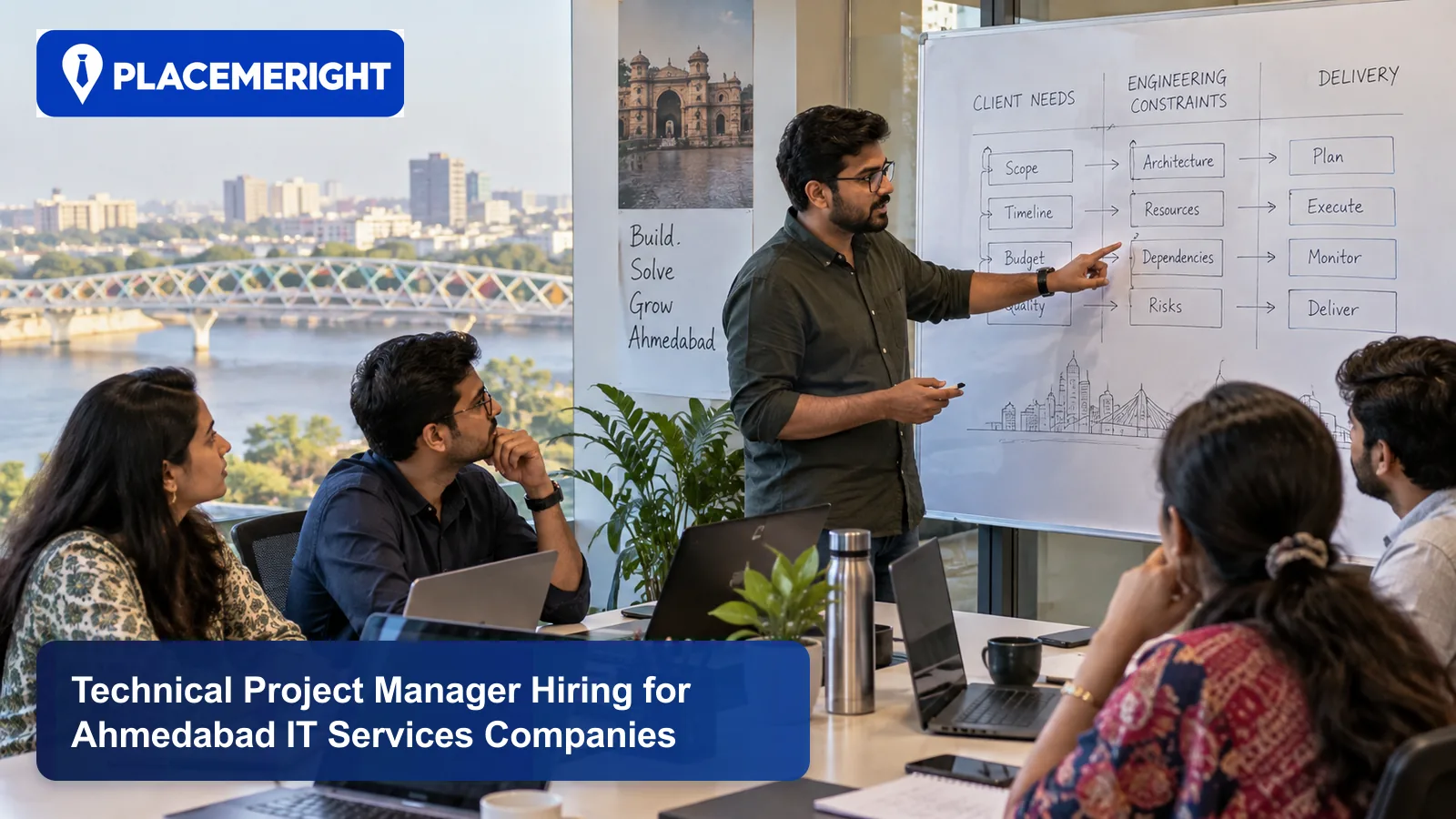
Technical Project Manager can mean the person who protects delivery across architecture, people, risk, quality, and client commitments.
It can also mean the person who schedules meetings and updates a tracker after decisions have already been made.
Ahmedabad IT services companies should resolve that ambiguity before they source. The role has value when it owns interfaces that would otherwise fail between client expectations and engineering reality. Without that boundary, the company hires a title and asks the person to improvise authority later.
Begin with Ahmedabad's delivery context
Ahmedabad supports IT services, digital engineering, cloud, data, business-software, and product-development teams across several office corridors. Current employer material provides concrete examples.
Solvative's careers page lists a Technical Project Manager opening requiring more than five years of experience and gives an Ahmedabad office in the Nehru Nagar area. Simform describes a co-engineering model spanning digital products, cloud, data, AI, platform engineering, and managed services.
These examples show that technical delivery leadership is locally relevant. They do not prove a universal Ahmedabad job specification or a volume of available candidates.
Use PlaceMeRight's Ahmedabad technology recruitment context to frame the broader employer search, then define the exact delivery model.
Prahlad Nagar, Makarba, SG Highway, Thaltej, Bodakdev, Nehru Nagar, and Gandhinagar should not be collapsed into one workplace label. State the actual office and travel expectations.
Identify the interface the TPM will own
Complete this statement:
> The TPM owns the interface between [client or business commitment] and [engineering system], with authority to [sequence, challenge, escalate, stop, or approve] under [quality, security, commercial, or operational constraints].
Possible interfaces include:
- discovery to engineering scope;
- sales commitment to delivery plan;
- architecture to work sequencing;
- development to quality and release;
- client dependency to project risk;
- one vendor to another;
- build team to managed service;
- incident response to client communication;
- programme roadmap to team capacity.
If the employer cannot identify the interface, the role may be a project coordinator, scrum facilitator, engineering manager, product manager, or account manager instead.
Separate adjacent leadership roles
The boundaries vary by company, but they must be written.
| Role | Primary question | | --- | --- | | technical project manager | Can the committed technical outcome be delivered and operated under the stated constraints? | | engineering manager | Can the engineering team perform, grow, and maintain technical quality? | | product manager | Which user or business problem should be solved, and why now? | | architect or technical lead | Which system design and technical standards should govern the solution? | | scrum master | Is the agreed team process visible, understood, and improving? | | delivery manager | Can multiple workstreams, commercial expectations, and governance remain controlled? | | account manager | Is the client relationship healthy and commercially aligned? |
One person can carry more than one role in a smaller company. The scorecard should still distinguish them.
Do not advertise a TPM role while expecting sole ownership of sales, architecture, people management, product strategy, and account renewal.
Choose one of four TPM mandates
Mandate 1: project delivery controller
Best when scope is reasonably defined and coordination risk is high.
Core ownership:
- work breakdown;
- milestone and dependency control;
- risk and issue handling;
- delivery reporting;
- release readiness;
- client communication.
Technical depth must be sufficient to interrogate estimates and consequences, but the person may not design the architecture.
Mandate 2: engineering-led TPM
Best for cloud-native, integration-heavy, data, AI, platform, or modernisation work.
Core ownership:
- translating architecture into delivery paths;
- identifying technical dependency;
- challenging sequencing;
- coordinating environments and non-functional work;
- making risk visible;
- connecting design decisions to schedule and operation.
This route often requires prior engineering, architecture, quality, or DevOps depth.
Mandate 3: client solution TPM
Best when discovery and stakeholder alignment materially shape the solution.
Core ownership:
- problem and process discovery;
- scope boundary;
- assumption control;
- decision records;
- acceptance logic;
- client dependency;
- change impact.
The role must know when to involve architecture, security, data, or domain specialists.
Mandate 4: programme integration TPM
Best when several teams, vendors, systems, or releases must converge.
Core ownership:
- integrated plan;
- cross-team interfaces;
- decision forums;
- shared risks;
- critical path;
- release train;
- executive visibility;
- recovery strategy.
This is not simply a larger project. The evidence should show interdependent workstreams and distributed authority.
Build a project packet before interviewing
Give every candidate the same two-page packet.
Include:
- client outcome;
- users and stakeholders;
- current system;
- target change;
- five workstreams;
- known technical constraints;
- commercial date;
- external dependency;
- quality or security requirement;
- current team;
- one ambiguous requirement;
- one hidden operational consequence disclosed later.
Example:
> A retail client is replacing a legacy order platform. The programme includes a new web application, mobile workflow, payment integration, product-data migration, and cloud deployment. A seasonal launch date is commercially important. The client's ERP team owns one API, data quality is uncertain, and the new platform must coexist with the old system during transition.
The packet creates comparable evidence without asking candidates to reveal confidential client work.
Interview 1: turn commitment into a controlled plan
Give 60 minutes for clarification and planning.
Evaluate:
- outcome definition;
- scope and exclusions;
- assumptions;
- workstream boundaries;
- dependency order;
- technical discovery;
- quality strategy;
- release and migration thinking;
- client decisions needed;
- risk language.
A strong candidate does not convert every line into a date immediately.
They distinguish:
- known work;
- discovery required;
- external dependency;
- decision deadline;
- reversible choice;
- irreversible commitment;
- contingency.
Ask which information must exist before a credible baseline can be established.
Interview 2: intervene in a failing delivery
Two weeks before integration testing, disclose:
- the ERP API is late;
- migrated product data has duplicate identifiers;
- mobile and web teams interpreted an approval rule differently;
- automated regression coverage is incomplete;
- the client asks whether the launch date is still safe.
Ask for actions over the next:
- two hours;
- two days;
- two weeks.
Look for a controlled response.
In the first two hours
The candidate should establish facts, owners, immediate impact, and a decision forum. They should avoid announcing a new date before understanding the critical path.
In the next two days
Expect options:
- isolate or simulate the delayed API;
- define data-cleansing ownership;
- resolve the approval rule with one source of truth;
- identify risk-based test coverage;
- protect or revise scope;
- set client decision deadlines;
- update release criteria.
In the next two weeks
Expect a recovery baseline, verified dependencies, quality evidence, migration rehearsal, communication cadence, and an explicit go or no-go process.
The candidate should explain what they would not compress.
Interview 3: test technical interrogation
The TPM does not need to write production code for every role. They must ask questions that expose delivery consequences.
Give an architecture with:
- two application services;
- one third-party payment interface;
- a shared database;
- a batch migration;
- CI/CD pipeline;
- logging but weak tracing;
- one production and one staging environment.
Ask:
- Which assumptions threaten sequencing?
- Where could integration fail late?
- Which non-functional requirements need early evidence?
- What is hard to roll back?
- Which environment constraints affect parallel work?
- What must be observable before launch?
- Which decision belongs to the architect, client, security partner, or TPM?
Score the quality of interrogation, not whether the candidate redesigns the system.
Interview 4: run a difficult client conversation
Scenario:
> A senior client sponsor expects the original date. The engineering team believes removing automated regression work will create unacceptable release risk. The contract language is ambiguous, and the account lead wants a positive message.
The candidate prepares and delivers a ten-minute update.
Strong evidence includes:
- plain statement of current facts;
- impact rather than internal activity;
- clear unknowns;
- options with consequences;
- requested client decision;
- owner and next checkpoint;
- no blame;
- no unsupported assurance.
Do not reward a candidate for sounding reassuring while hiding risk.
Distinguish reporting from control
Ask for one real example of each:
1. a risk identified before impact; 2. a dependency that changed sequencing; 3. a technical decision translated for a client; 4. a scope request challenged; 5. a release delayed or stopped; 6. a project recovered; 7. a repeated problem converted into process or platform improvement.
For every example, ask:
- What did you know at the time?
- What authority did you have?
- What action did you take?
- Who disagreed?
- What evidence changed the decision?
- What happened next?
A status report describes the project. Control changes its trajectory.
Score the role with behavioural anchors
For technical delivery reasoning:
- 4: connects architecture, dependencies, quality, operation, and commercial consequence into a controlled plan;
- 3: produces a credible delivery path with minor gaps;
- 2: tracks work but identifies technical risk late;
- 1: relies on engineering leads to reveal every consequence.
For risk ownership:
- 4: identifies cause, probability, impact, trigger, response, owner, and decision deadline;
- 3: records and actively manages material risks;
- 2: maintains a risk list without changing action;
- 1: reports issues only after impact.
For client leadership:
- 4: communicates facts, uncertainty, options, consequences, and decisions with calm precision;
- 3: keeps the client informed and escalates appropriately;
- 2: gives activity updates but weak decision framing;
- 1: hides risk or transfers blame.
For engineering credibility:
- 4: asks technically consequential questions and earns trust without taking over specialist ownership;
- 3: understands the stack, lifecycle, and quality implications;
- 2: follows technical discussion but cannot probe it;
- 1: treats technical work as an opaque set of tickets.
Calibrate certifications correctly
PMP, PRINCE2, Scrum, SAFe, cloud, or security certifications can support vocabulary and structured learning.
They do not prove:
- technical judgment;
- client leadership;
- recovery under uncertainty;
- architecture comprehension;
- quality advocacy;
- delivery authority.
The official Scrum Guide defines accountabilities and a lightweight framework. It is useful for checking whether a candidate understands Scrum, not for assuming that Scrum experience equals technical programme ownership.
Use certification as one input. Use the project packet for evidence.
Design the first 90 days before making an offer
Define three stages without promising fixed outcomes.
Understand
- delivery portfolio;
- client contracts and expectations;
- architecture;
- team roles;
- quality gates;
- reporting;
- escalation;
- commercial and security constraints.
Control
- decision log;
- dependency map;
- risk language;
- release criteria;
- client cadence;
- ownership gaps;
- metrics and evidence.
Improve
- recurring failure pattern;
- estimation or discovery weakness;
- handoff friction;
- test or environment bottleneck;
- portfolio-level visibility;
- reusable delivery practice.
Candidates can then assess whether the role has authority, sponsorship, and usable information.
Make Ahmedabad workplace and client conditions explicit
State:
- exact office;
- onsite, hybrid, remote, or client-site model;
- office days;
- client time zones;
- travel;
- after-hours release or incident expectations;
- programme size;
- reporting line;
- authority over scope, dates, and quality gates;
- whether the role manages people.
An SG Highway label is not enough. A Makarba office, Prahlad Nagar office, Gandhinagar client site, and distributed delivery model create different daily work.
Also identify who can approve a revised baseline. A TPM held accountable for dates but denied access to scope, staffing, architecture, or client decisions is being asked to report risk without controlling it.
Quick checklist
- Define the interface the TPM owns.
- Separate adjacent leadership roles.
- Choose one primary TPM mandate.
- State decision and escalation authority.
- Give every candidate the same project packet.
- Test planning before dates.
- Add a controlled delivery failure.
- Test technical interrogation without demanding architecture ownership.
- Simulate a difficult client decision.
- Score intervention, not reporting polish.
- Explain the exact Ahmedabad workplace and client model.
Frequently asked questions
Must a technical project manager have been a developer?
Not always. Engineering experience can help for technically intensive mandates, but architecture, QA, DevOps, business analysis, or delivery backgrounds may also produce relevant evidence. Test the actual technical interrogation required.
Is a project manager the same as a delivery manager?
Not necessarily. A delivery manager may own a portfolio, commercial governance, or several workstreams. Define the scope and authority rather than relying on titles.
Should the TPM estimate engineering work?
The TPM should make estimation assumptions, dependencies, confidence, and risk visible. Technical contributors should own or materially inform estimates for work they understand.
How do we test client communication without a presentation round?
Use a short risk-update simulation inside the project exercise. Score clarity, options, consequences, decision requests, and honesty about uncertainty.
Is Scrum Master certification enough for the role?
No. It may demonstrate framework knowledge. A TPM role also requires evidence across technical delivery, dependency, risk, quality, stakeholder decision, and operation.
Should Ahmedabad employers prefer candidates from IT services?
Services experience can be highly relevant for client delivery. Product, consulting, platform, implementation, and enterprise programme backgrounds may also fit when the ownership evidence matches.
Related reading
- Explore PlaceMeRight technical recruitment
- Review employer hiring support
- Discuss an Ahmedabad technical delivery role
Conclusion
A strong Technical Project Manager does not make engineering uncertainty disappear. The person makes it visible early enough to support a controlled decision.
For Ahmedabad IT services employers, the most useful hiring signal comes from an explicit interface, a realistic project packet, a delivery failure, and evidence of intervention across engineering and client boundaries.
That produces a clearer decision than certification lists, generic agile questions, or confidence in a status meeting.
CTA
PlaceMeRight helps Ahmedabad employers calibrate technical project-management roles, source delivery leaders, and build interviews around real architecture, quality, risk, and client evidence.
Share your Technical Project Manager hiring brief
References
- Gujarat Department of Science and Technology: IT and ITeS policy
- Solvative careers: current Ahmedabad Technical Project Manager opening
- Solvative Ahmedabad office information
- Simform: company and delivery model
- Simform: product and platform engineering
- Simform: application managed services and delivery governance
- Simform careers: technical project-management context
- The Scrum Guide
Related PlaceMeRight resources
Our Tech Recruitment Services by City
Looking to hire vetted software engineers or scale your engineering teams in India's leading tech hubs? Explore our localized recruitment services: