
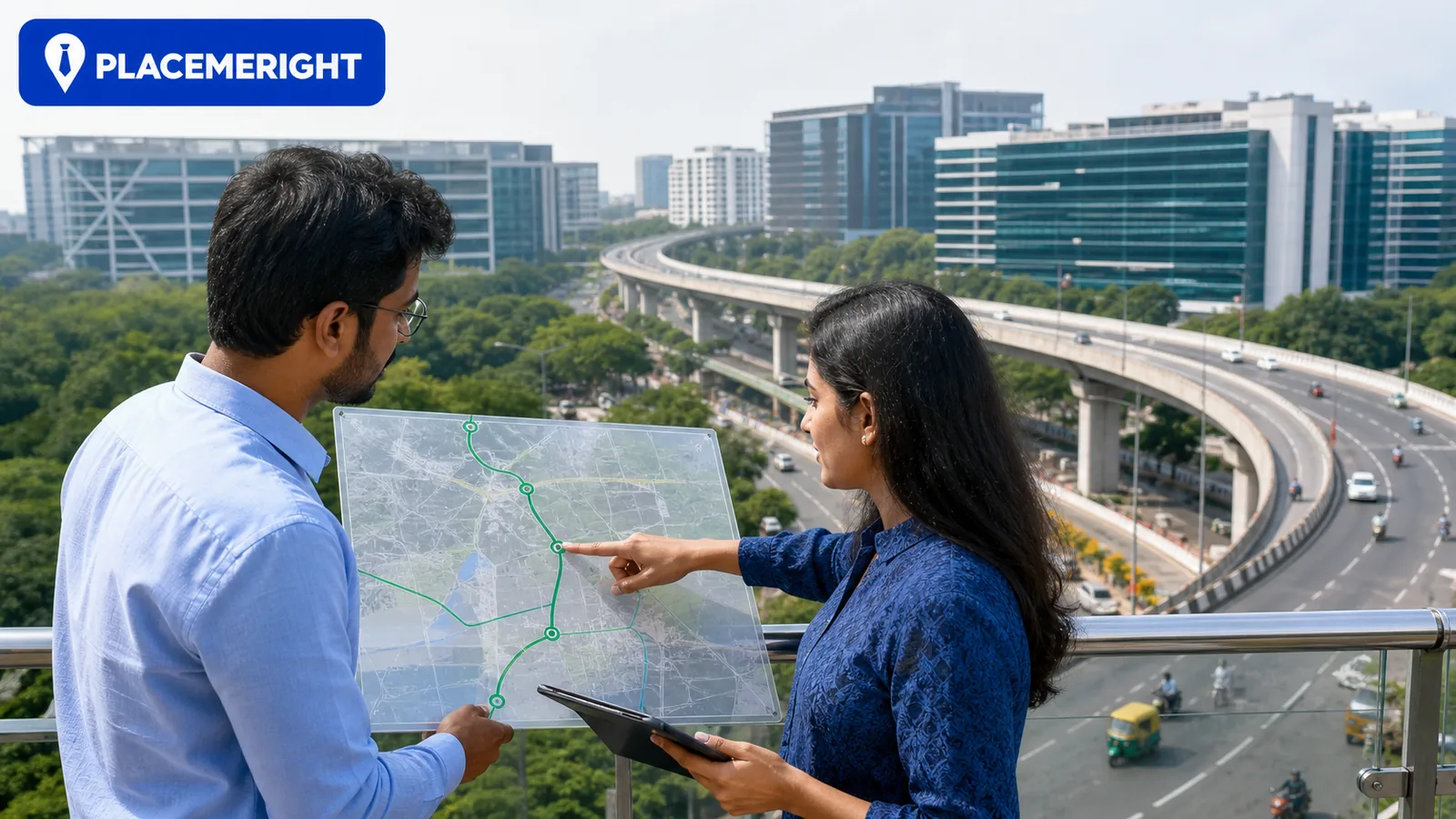
Bellandur, Kadubeesanahalli, and Marathahalli do not manufacture three different classes of engineer.
People move, change jobs, work hybrid patterns, relocate, reject impractical schedules, and evaluate an exact office rather than a search marketer's corridor label. A Bengaluru job post often names only the city. Assigning that post to a neighbourhood would create evidence that the employer did not publish.
What the Outer Ring Road does contain is a set of distinct work anchors.
RMZ identifies Ecoworld in Bellandur. Embassy places Embassy TechVillage on Outer Ring Road at Devarabisanahalli and Kadubeesanahalli. Embassy's current public market material describes the Sarjapur-Marathahalli and Marathahalli-KR Puram stretches and several commercial developments. Those are worksite facts. They can shape attendance, team adjacency, secure access, and candidate feasibility after the employer names the building.
The honest hiring map therefore needs three layers: verified worksite evidence, public role evidence, and employer-collected individual feasibility.
Correct the premise before using the map
The headline asks how three localities produce different candidate pools. The useful answer is that public evidence cannot support that causal claim.
A candidate who lives near Bellandur may work in Whitefield. Someone employed at Kadubeesanahalli may live far beyond the ORR corridor. A role advertised as Bengaluru may sit in an undisclosed building. An employer may change its office cadence after the posting was collected.
PlaceMeRight's Bangalore technology recruitment page provides broader employer context for software, product, GCC, cloud, data, semiconductor, and engineering hiring across the city.
Use locality in three defensible ways:
- to identify the exact workplace and access conditions;
- to map recurring work events that make that workplace relevant;
- to let each candidate assess feasibility after full disclosure.
Do not use it as a proxy for capability, interest, availability, or belonging to a presumed pool.
Build the three-layer evidence map
Layer one: exact worksite evidence
Record the office owner or employer's current address, building, campus access, operating hours, attendance policy, secure zones, transport provisions, and required movement between sites.
This layer answers where work happens and which conditions are fixed.
Layer two: public role evidence
Read current official job posts to understand types of accountable work visible in Bengaluru: product engineering, platform, data, AI, payments, security, networking, research, quality, or another discipline.
This layer answers what selected employers publicly describe. It does not answer which ORR micro-location owns the work unless the page names it.
Layer three: candidate-feasibility evidence
After disclosing building, schedule, manager location, and attendance events, collect each candidate's own constraints and preferences consistently. Record whether the stated model is feasible, uncertain, or unsuitable, with the person's explanation where appropriate and consented.
This layer answers whether one specific opportunity can work for one person. It cannot be replaced by postcode assumptions.
Verify the ORR anchors
Bellandur
RMZ's official Ecoworld page identifies Bellandur and Outer Ring Road. It describes a large office campus and its amenities. An employer within or near that campus should still name its tower, entry process, attendance cadence, and any customer or laboratory access requirement.
Bellandur can be a precise worksite context. It is not a skill category.
Kadubeesanahalli and Devarabisanahalli
Embassy's official TechVillage page gives an Outer Ring Road address near New Horizon College and names Devarabisanahalli and Kadubeesanahalli. Its published campus services include internal transport and operational amenities.
For hiring, record whether the team sits at Embassy TechVillage, another park, or a separate building. Similar locality names do not make access arrangements interchangeable.
Marathahalli
Marathahalli can describe a junction, a broader neighbourhood, or the end of an ORR commercial stretch. Embassy's current public valuation material separates Sarjapur-Marathahalli from Marathahalli-KR Puram and lists established developments in the micro-market.
An employer should avoid advertising "Marathahalli" when the actual gate is in Kadubeesanahalli or Bellandur. The distinction affects honest candidate evaluation even when all three appear in one informal corridor description.
Metro and changing access
BMRCL publishes current network information. Embassy's sustainability reporting discusses a Kadubeesanahalli station connected to the developing ORR corridor. Recheck operational status immediately before publication or recruitment communication.
Planned connectivity is not current commute evidence. Even an operating station would address only part of an individual's route.
Public role sample: method and limits
To test what current Bengaluru work architecture looks like, we collected nine official employer role records on July 28, 2026.
Inclusion rules
Each record had to:
- be on an employer-controlled career site or its official recruitment platform;
- name Bangalore or Bengaluru as a work location;
- describe current software, platform, data, AI, security, networking, or product-engineering work;
- remain accessible on an official career page on the collection date;
- contain enough responsibility detail for classification.
Exclusions
We excluded aggregator copies, staffing reposts, roles without a Bengaluru location, sales-only positions, pages that stated the vacancy was no longer available, and search snippets without a stable source page.
Sample composition
The purposive sample contains four Visa roles, two Salesforce roles, one ServiceNow role, and two current Microsoft Bengaluru listings:
1. Visa senior software engineering for B2B payments and acceptance; 2. Visa software engineering for data solutions and products; 3. Visa staff data engineering for an MLOps and fraud-data platform; 4. Visa open-banking engineering using Java, cloud, APIs, and AI-assisted development; 5. Salesforce backend platform engineering across cloud, Kubernetes, and multi-tenant SaaS; 6. Salesforce data engineering for distributed systems and infrastructure decision tools; 7. ServiceNow senior staff engineering for enterprise agentic systems; 8. Microsoft Windows enterprise-security software engineering; 9. Microsoft applied research into efficient enterprise AI systems.
What the sample measures
It reveals selected public work boundaries: regulated payments, product delivery, data platforms, MLOps, cloud-native services, distributed systems, AI safety and operation, networking software, and AI infrastructure.
What it cannot measure
The sample is not a census. It is concentrated among four employers, excludes private searches, changes after collection, and reflects title and publishing choices. It cannot estimate vacancy share, candidate supply, compensation, closure difficulty, or offer competition.
Most importantly, the pages name Bengaluru rather than Bellandur, Kadubeesanahalli, or Marathahalli. The sample cannot be redistributed across those areas.
Translate role evidence into work families
Product and payment systems
The Visa B2B and data-solutions roles describe architecture, design, coding, testing, operations, cross-functional delivery, security, scalability, and global product use.
An ORR employer hiring similar work should define transaction boundaries, reliability, compliance, customer impact, and production ownership. "Payments background preferred" should not replace a real scenario.
Data and ML platforms
Visa's staff data-engineering role describes pipelines, model experimentation, deployment, monitoring, drift, traceability, and platform consumers. Salesforce's data role describes distributed systems and tools for infrastructure decisions.
These are not interchangeable data-engineer jobs. One centres an ML product lifecycle; another supports internal capacity and cost decisions. The hiring map should follow the data product, not the corridor.
Cloud and SaaS platform engineering
Salesforce's current backend posting covers Kubernetes, cloud, multi-tenant SaaS, performance, scale, and software lifecycle ownership.
The brief should identify platform consumers, reliability obligations, tenancy boundary, deployment model, and on-call expectations. If teams or secure environments sit at a particular ORR campus, state that separately.
Agentic AI systems
ServiceNow's current role focuses on production agent systems, orchestration, enterprise context, safety, governance, observability, and human control.
An employer should distinguish model experimentation from operating an agent that can act in enterprise workflows. The latter needs permissions, evaluation, recovery, and product accountability.
Enterprise security and applied AI research
Microsoft's Bengaluru career page showed current work in foundational Windows security and enterprise management, alongside applied research into efficient agentic AI systems.
These charters may depend on hardware, security review, research infrastructure, cross-region collaboration, or close work with specialised teams. Such dependencies can make exact site and attendance more important than they are for an independently deployable web service.
Map recurring work events to the site
For each role, list the events that may benefit from or require co-presence:
- architecture reviews with adjacent platform owners;
- secure data or hardware access;
- lab bring-up and failure reproduction;
- incident command and recovery;
- regulated design or evidence review;
- customer or partner integration workshop;
- planning across product, engineering, and operations;
- mentoring or onboarding that cannot yet be supported remotely.
Record frequency, participants, duration, evidence produced, and why the event must happen at that site.
If the only answer is "collaboration", the attendance model is not ready for recruitment. If the answer is a weekly hardware integration session in Kadubeesanahalli, publish that fact.
Build one feasibility form
After presenting the exact role and site, ask every candidate the same practical questions.
Workplace
Can the person attend the named building on the stated days and hours? Are there accessibility, safety, caregiving, or transport constraints the process should accommodate?
Operating duty
Can the person meet disclosed on-call, incident, lab, customer, or release responsibilities? Avoid adding duties late in the process.
Team structure
Is the manager at the same site? Are key collaborators in Bellandur, another Bangalore office, another Indian city, or another time zone? Explain expected overlap.
Change risk
Which conditions are approved policy and which may change? Do not market a work model that the hiring manager cannot authorise.
Use the form to find fit and reasonable adjustments, not to rank neighbourhoods or infer personal circumstances.
Compare locations through employer facts
A practical comparison table can use:
| Factor | Bellandur site | Kadubeesanahalli site | Marathahalli-side site | | --- | --- | --- | --- | | exact building | employer verified | employer verified | employer verified | | required events | named and evidenced | named and evidenced | named and evidenced | | secure or lab access | actual requirement | actual requirement | actual requirement | | manager and team anchors | confirmed locations | confirmed locations | confirmed locations | | attendance cadence | approved policy | approved policy | approved policy | | inter-site movement | measured obligation | measured obligation | measured obligation | | candidate feasibility | collected individually | collected individually | collected individually |
Do not fill the final row from general traffic narratives. The same route and schedule affect people differently.
Use one role-location interview case
Give hiring managers a platform incident:
A service supports a regulated payments workflow. A release creates intermittent latency, and logs suggest a dependency issue. A secure trace can be accessed only from the primary office. The platform owner is at Bellandur, a network specialist is at Kadubeesanahalli, and the product leader is remote. A review is scheduled at Marathahalli-side client premises the next morning.
Ask the candidate to:
- define the first operating response;
- identify evidence needed and access constraints;
- separate remote work from required physical access;
- propose communication and handoffs;
- avoid unnecessary travel;
- improve the system so future diagnosis is less site-dependent.
The exercise tests work design and judgement. It should not reward prior familiarity with ORR landmarks.
Review the map with collected evidence
After a hiring cycle, examine:
- candidates who received the exact building and cadence before interview;
- feasibility concerns by stated condition, not assumed locality;
- work events that actually occurred at the required site;
- exceptions to the advertised attendance model;
- inter-site travel requested and its operational purpose;
- offers or withdrawals with documented, voluntarily shared reasons;
- role requirements changed after manager review;
- source pages and transport facts that became outdated.
Do not infer causation from a small count. Use the evidence to correct the role and workplace description.
Quick checklist
- Separate worksite, public-role, and candidate-feasibility evidence.
- Name the exact ORR building, not only the corridor.
- Keep Bengaluru-wide postings at city level unless a source gives a site.
- Disclose sample date, rules, composition, and limitations.
- Map required attendance to recurring work events.
- Collect feasibility directly and consistently.
- Keep location out of capability scoring.
- Distinguish current metro access from planned infrastructure.
- Review inter-site movement and work-model exceptions.
- Refresh every role and campus source before publication.
Frequently asked questions
Does Bellandur have a different candidate pool from Kadubeesanahalli?
Public sources used here do not establish that. The locations contain different confirmed workplaces, but candidates can live and work across the city. Assess each opportunity against individual feasibility.
Can employers say a role is in Marathahalli when it is in Kadubeesanahalli?
Use the exact building and locality available from the workplace owner. A broad familiar label may help orientation, but it should not conceal the actual reporting gate.
What does the nine-role sample prove?
It shows work architectures described by four selected employers on July 28, 2026. It does not measure the entire market, neighbourhood supply, compensation, or hiring difficulty.
Should ORR attendance be mandatory for platform roles?
Only when the employer has a valid work reason and approved policy. Name secure access, lab work, incident duty, or recurring collaboration events instead of relying on a general preference.
How often should the map be refreshed?
Recheck workplaces, roles, transport, and policies immediately before publishing or opening a search. Review employer-collected feasibility after each hiring cycle.
Related reading
- Technical recruitment for Bangalore teams
- Developer-team hiring support
- PlaceMeRight employer evidence
Conclusion
The defensible ORR hiring map does not claim that Bellandur, Kadubeesanahalli, and Marathahalli produce different kinds of candidate.
It verifies where work happens, reads city-level role evidence at the level the sources support, and asks each person whether the disclosed opportunity is feasible. The map becomes useful when it removes assumptions rather than decorating them with locality names.
That approach gives Bangalore employers a clearer workplace decision, a more truthful role, and evidence they can review when the team or corridor changes.
CTA
Need to turn an ORR workplace into an evidence-led role and candidate-feasibility process? Talk with PlaceMeRight about employer-side Bangalore technology recruitment.
References
- RMZ: Ecoworld in Bellandur
- RMZ: Ecoworld 30 on Outer Ring Road
- Embassy REIT: Embassy TechVillage in Kadubeesanahalli
- Embassy REIT: ORR micro-market and commercial developments, April 2026
- Embassy REIT: ESG report and Kadubeesanahalli metro context
- Bengaluru Metro Rail Corporation: Current network information
- Visa Careers: B2B payments software engineering, reviewed July 28, 2026
- Visa Careers: Data solutions and products engineering, reviewed July 28, 2026
- Visa Careers: Staff data engineering for MLOps, reviewed July 28, 2026
- Visa Careers: Open-banking engineering, reviewed July 28, 2026
- Salesforce Careers: Backend, Kubernetes, and cloud platform engineering, reviewed July 28, 2026
- Salesforce Careers: Distributed-systems data engineering, reviewed July 28, 2026
- ServiceNow Careers: Agentic systems engineering, reviewed July 28, 2026
- Microsoft Careers: Current Bengaluru enterprise-security and AI research listings
Related PlaceMeRight resources
Our Tech Recruitment Services by City
Looking to hire vetted software engineers or scale your engineering teams in India's leading tech hubs? Explore our localized recruitment services: