
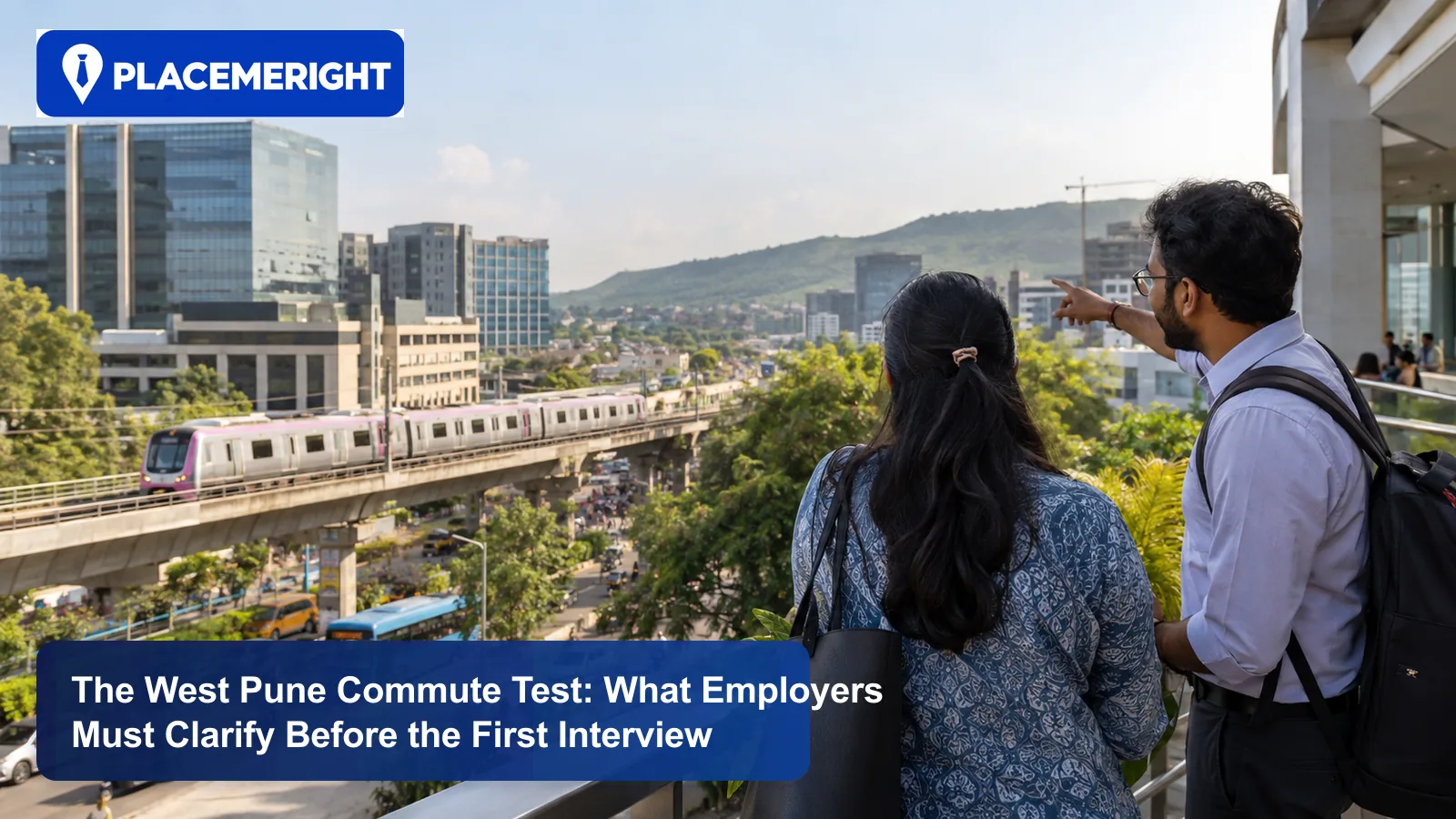
A recruiter invites a senior developer to a first interview for a West Pune role. The posting says Hinjawadi and hybrid. Ten minutes into the call, the candidate learns that the office is in Phase III, the team gathers early on two fixed days, month-end support can extend the working window, and company transport is available only on one route.
The candidate may still accept those conditions. The problem is that they invested time before receiving them.
An employer should not use the first interview to discover whether its own work arrangement is clear. It should issue a work-arrangement truth card before the interview invitation is accepted. The card records the exact site, recurring schedule, operational exceptions, current transport support, infrastructure status, and person authorised to change the model.
The West Pune commute test is not a travel-time estimate. It is a test of whether the employer has disclosed enough verified information for an individual to make an informed feasibility decision.
Define West Pune without shortcuts
West Pune hiring can involve different workplaces across Hinjawadi phases, Maan, Marunji, Wakad, Tathawade, Punawale, Balewadi, Baner, Mahalunge, Pashan, Aundh, and nearby corridors.
"Hinjawadi," "Wakad side," or "near the metro" is not an exact worksite.
The truth card should name:
- employing entity;
- office or facility name;
- full address and map pin;
- phase, campus, building, tower, and gate;
- public entrance and badge process;
- primary worksite;
- any secondary worksite;
- current attendance expectation;
- working and support windows;
- transport support currently available;
- exceptional events;
- date verified;
- owner authorised to correct it.
PlaceMeRight's Pune technology recruitment guide provides broader city context. This article focuses on disclosure before a candidate enters the interview process.
Build the truth card
Keep the first version short enough to read before a call.
| Field | Required employer fact | | --- | --- | | exact worksite | address, phase, campus, tower, and entry point | | normal cadence | expected days or event-based presence | | fixed versus selectable | who chooses days and with what notice | | working window | team, customer, release, or support overlap | | transport | verified employer service and eligibility, if any | | site access | badge, device, parking, shuttle, security, or safety condition | | exceptional presence | launch, incident, customer, audit, or planning event | | future infrastructure | labelled under construction, planned, or unverified | | change authority | person who may alter site, cadence, or window | | version | date, owner, and revision history |
The card does not need the candidate's home location.
Verify the site internally
Recruitment should not create the card alone.
Ask workplace, HR, hiring manager, engineering or business operations, transport, security, and finance owners to verify the relevant fields. Different functions may be carrying different versions.
Run an internal arrival replay:
1. Which gate does a new employee use? 2. What identification or access is required? 3. Where does the person go on day one? 4. What happens if transport, parking, or badge access fails? 5. Who is reachable before the normal workday? 6. Does the advertised office contain the actual team? 7. Are any events at a different phase or customer site?
If the employer cannot answer, mark the field unresolved and close it before sourcing.
Separate current and future mobility
PMRDA's official material identifies the Maan-Hinjawadi-Shivajinagar Metro Line 3 project and publishes dated progress information. Its July 2026 page should be reviewed for current status immediately before a draft is uploaded or a candidate is advised.
Do not infer commercial operation from construction progress, a target date, a press statement, station visibility, or a map.
PMRDA also publishes current industrial-connectivity and urban-growth-centre work around Hinjawadi, including named roads involving Mhalunge, Maan, Marunji, Punawale, and other localities. Those projects establish planning activity. They do not prove a candidate's door-to-door route.
The truth card should use:
- operating and verified: service the employer has checked for the relevant date and shift;
- under construction: project exists but is not represented as current travel;
- planned: approved or proposed future context;
- unknown: evidence not yet confirmed.
Future infrastructure should never make an otherwise unworkable current arrangement appear feasible.
Define attendance through events
"Three days hybrid" is incomplete. Name the events that require presence.
Examples:
- sprint or product-planning decision;
- architecture workshop;
- customer or vendor session;
- secure-environment access;
- laboratory or hardware interaction;
- release or cutover;
- incident review;
- team coaching;
- onboarding;
- quarterly planning.
For each event, state:
- objective;
- attendees;
- location;
- recurrence;
- notice;
- working window;
- acceptable remote substitute;
- exception owner;
- evidence produced.
When the event has no distinct in-person outcome, review whether attendance is necessary.
Test the normal week
The employer should describe one representative week, not ask a candidate to guess.
For example:
- Tuesday: product and engineering decisions at the primary office;
- Thursday: team collaboration and coaching at the same site;
- other days: approved remote or employer-defined locations;
- release event: scheduled office or secure-site attendance with notice;
- incident: role-specific remote-first response, with on-site attendance only under defined conditions.
This is an example structure, not a recommended cadence.
Ask internally:
- Are fixed days actually fixed?
- Can the manager change them?
- How much notice is normal?
- Are teams co-located on those days?
- Do support windows extend the day?
- Are customer calls scheduled around another time zone?
- Is focused work possible at the site?
- What happens during a short-term personal constraint?
Publish the answers relevant to the role.
Test the difficult week
A truthful model includes exceptions without making them unlimited.
Use scenarios:
Release week
A production change needs late validation. Define the role, location, safe transport, next-day expectation, meal or expense support, and authority to stop.
Customer escalation
A client requests an on-site session at another Pune location. State whether travel is normal, reimbursed, scheduled, and within the role.
Workplace disruption
The primary site or route is unavailable. Define remote continuity, alternate-site authority, and communication.
Policy change
Leadership proposes another office day. Identify consultation, approval, notice, candidate communication, and exceptions.
Team relocation
The office moves between phases or corridors. Treat it as a material work-condition change, not an administrative detail.
Qualified HR, legal, safety, security, operations, and workplace owners should approve relevant policies.
Put the card before screening
The recommended sequence is:
1. recruiter verifies the current truth card; 2. candidate receives it with the outreach or invitation; 3. candidate asks factual questions; 4. employer corrects unresolved fields; 5. candidate confirms the stated arrangement is worth exploring; 6. capability screening begins; 7. location feasibility is recorded separately; 8. any material change triggers redisclosure.
Do not score a candidate lower for requesting clarification.
If the person declines based on the arrangement, record the reason at a useful category level without collecting unnecessary private details.
Run a recruiter correction drill
Before opening the role, test whether the truth card survives ordinary recruiting conversations.
Give the recruiter five candidate questions:
1. Is the stated office the team's normal worksite? 2. Are the office days fixed or chosen by the manager? 3. Does company transport cover a late release? 4. Will Metro Line 3 be operating for this role's start date? 5. Can the workplace move to another Hinjawadi phase?
The recruiter should answer only from verified fields.
Use response states:
- verified answer;
- approved policy with named source;
- hiring-manager decision required;
- workplace or transport confirmation required;
- unknown and not to be represented;
- material change requiring a revised card.
The correct answer to the metro question may be, "We have not verified an operating service for your start date, so please assess the role using the current work arrangement." That is more credible than a confident forecast.
Next, test manager language. A manager may say "we are flexible," "office days are usually optional," or "late support rarely happens." Each phrase needs an operating definition and owner.
Ask:
- Who approved the flexibility?
- Does it apply to every member of this role?
- Can it change after joining?
- What evidence supports the frequency statement?
- Which event overrides the normal model?
- How is the exception communicated?
Correct the card or correct the language before interviews begin.
Record the drill date, participants, unresolved questions, and final approver. Repeat it after a policy, office, transport, customer, or team change.
Ask a neutral feasibility question
Use:
> The role is based at the stated site under the current work arrangement in the truth card. Is that arrangement feasible for you, or is there a work-related condition you need us to clarify?
Avoid:
- Where exactly do you live?
- Do you own a vehicle?
- Can your family manage the commute?
- You worked in Hinjawadi before, so this is fine, right?
- The metro will solve this soon.
- Everyone comes in, so can you?
Candidates may voluntarily share relevant constraints. Handle personal information under approved employer privacy and hiring practices.
Keep capability and commute separate
The interview scorecard should contain distinct records:
Capability evidence
- technical or functional depth;
- problem solving;
- system ownership;
- stakeholder communication;
- production judgement;
- leadership where required.
Work-arrangement feasibility
- exact site understood;
- cadence understood;
- working windows understood;
- travel or secondary-site requirement understood;
- candidate confirmation;
- unresolved employer fact;
- approved accommodation or exception process, where applicable.
A strong candidate with an infeasible arrangement is not a weak candidate. The employer may redesign the role, use a different sourcing lane, or close respectfully.
Protect parity across candidates
Every candidate for the same role should receive the same current card.
Audit:
- version sent;
- send date;
- recruiter;
- candidate questions;
- employer correction;
- manager deviation;
- final offer terms;
- post-offer change.
If a manager privately offers one person a different site or cadence, record and approve the exception. Hidden arrangements create inequity and future conflict.
Design transport support honestly
If the employer offers a bus, cab, shuttle, parking, or reimbursement, state:
- current routes or eligibility;
- pickup or service model;
- relevant working window;
- booking or registration;
- cost responsibility;
- late-event coverage;
- change or cancellation authority;
- source and verification date.
Do not advertise a service that works only for a different shift or building.
Public route information changes. Link to an authoritative current source where appropriate and avoid copying a timetable into a long-lived job post without a refresh owner.
When no employer transport exists, say so plainly. Do not replace the missing fact with a list of general public options that the employer has not verified for the role's site and work window.
Measure disclosure quality
Use employer-controlled signals:
- candidates receiving the card before the first interview;
- unresolved fields at invitation;
- corrections issued during process;
- withdrawals after new location information;
- offer-stage work-model surprises;
- manager deviations from the card;
- new hires reporting inaccurate site or cadence information;
- low-value attendance events removed.
These signals improve recruitment operations. They are not claims about West Pune candidates as a group.
Review the card on a set cadence and whenever the office, team, policy, route, customer need, shift, or infrastructure status changes.
Quick checklist
- Name the exact phase, campus, tower, and gate.
- Verify the worksite with workplace and hiring owners.
- State normal cadence and who chooses the days.
- Disclose working, release, and support windows.
- List secondary sites and customer travel.
- Verify employer transport and eligibility.
- Separate operating mobility from construction and plans.
- Explain the in-person events behind attendance.
- Test release, escalation, disruption, policy, and relocation scenarios.
- Send the truth card before the first interview.
- Ask a neutral feasibility question.
- Keep capability scoring separate.
- Version every material correction.
- Use the same current card for every candidate.
Frequently asked questions
Should we publish a commute-time estimate?
No universal estimate is reliable for an individual. Publish exact work facts and authoritative current transport information, then let candidates assess their own route.
Can we say the office is near Hinjawadi?
Use the exact address, phase, campus, building, and gate. "Near" can hide a materially different destination.
Is Pune Metro Line 3 operating?
Check the current official PMRDA status immediately before communication. Do not infer operation from progress, target dates, or visible construction.
What if office days are flexible?
Explain who chooses them, required notice, core events, team overlap, and circumstances in which flexibility can change.
Do candidates need to disclose their home address?
Not to understand the employer's work facts. Ask whether the stated arrangement is feasible and follow approved hiring and privacy practices.
What if the site changes after interviews begin?
Issue a revised truth card promptly, allow candidates to reassess, and record the change. Do not wait until offer or joining.
Related reading
- Plan employer-side technology recruitment
- Build specialised engineering teams
- Review PlaceMeRight's recruitment approach
Conclusion
The West Pune commute test is passed by the employer before it is passed by a candidate.
A versioned truth card makes the site, phase, gate, cadence, working window, transport, exceptional events, infrastructure status, and change authority visible before the first interview. It lets the person make an informed decision without turning personal geography into a screening proxy.
Clear disclosure saves both sides from discovering the real job too late.
CTA
Hiring for a Hinjawadi, Wakad, Baner, or wider West Pune site? Discuss the work arrangement with PlaceMeRight for employer-side role calibration, specialised sourcing, and transparent candidate screening.
References
- PMRDA: Maan-Hinjawadi-Shivajinagar Metro Line 3
- PMRDA: Industrial connectivity around Hinjawadi
- PMRDA: Hinjawadi Urban Growth Center
- MIDC GIS: Rajiv Gandhi Infotech Park, Hinjawadi Phase I
Related PlaceMeRight resources
Our Tech Recruitment Services by City
Looking to hire vetted software engineers or scale your engineering teams in India's leading tech hubs? Explore our localized recruitment services: