
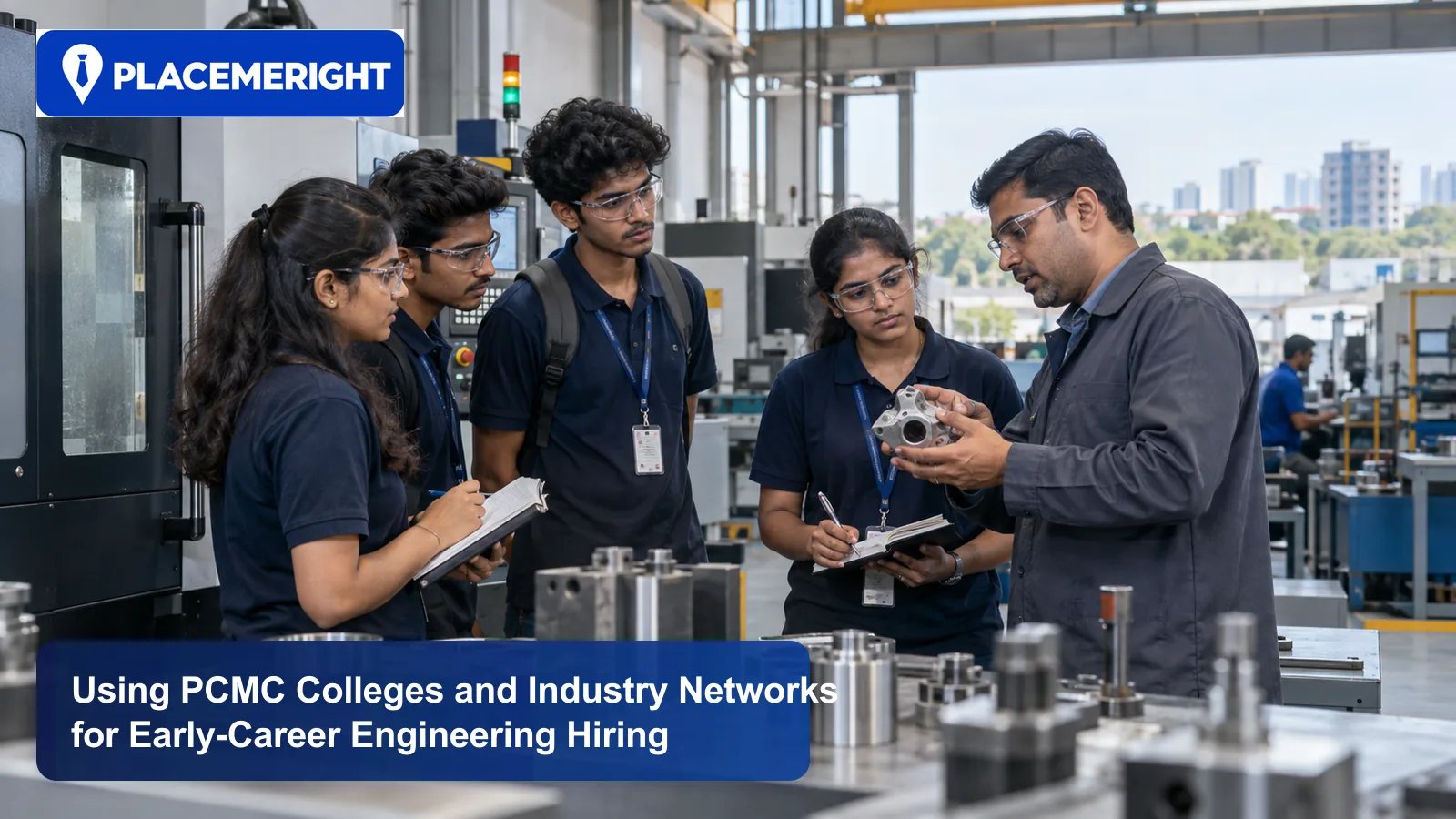
Early-career engineering hiring around Pimpri-Chinchwad can become fragmented quickly.
One employer visits a familiar campus every year. Another collects resumes from multiple placement cells but gives each group a different test. A third launches internships without enough mentors or safe work boundaries. The result may look like a large funnel while producing weak evidence about who can contribute to real engineering work.
A better model treats colleges and industry networks as access channels, not quality labels. Every applicant should move through a common evidence ladder: foundational reasoning, individual build, team contribution, testing, release discipline, and supported production work.
This article shows how Pune employers can build that ladder across Pimpri, Chinchwad, Akurdi, Nigdi, Ravet, Bhosari, and nearby industrial corridors without publishing college rankings or claiming that any institution guarantees job-ready talent.
Establish what the local sources actually show
This article reviewed official sources on July 28, 2026.
Savitribai Phule Pune University's college directory identifies engineering institutions and locations across the Pune and Pimpri-Chinchwad corporation areas. Current entries include Pimpri Chinchwad College of Engineering and Research in Ravet and Dr. D. Y. Patil Institute of Engineering, Management and Research in the Ravet-Nigdi-Akurdi area. These records confirm affiliation, geography, and programmes; they do not establish candidate quality or placement outcomes.
AICTE's internship policy asks industry to define goals, duties, schedules, learning outcomes, supervision, and a written plan. The AICTE internship portal provides a structured national access channel. The National Apprenticeship Training Scheme supports eligible graduates and diploma holders through an apprenticeship framework.
PCMC's 2025-26 budget describes a municipal collaboration on employment-oriented diploma programmes designed with industry needs in view. MCCIA's Higher Education and Skill Development Committee describes work intended to bridge industry and academia.
Together, these sources show possible institutions and operating mechanisms. They do not prove a particular volume, skill distribution, hiring conversion, or retention result.
PlaceMeRight's Pune technology recruitment page provides the wider employer context across the city's software and industrial corridors.
Start with work, not a campus list
Define the entry role before contacting an institution.
First useful outcome
What is the smallest business-relevant outcome an early-career hire can own with supervision? It might be extending automated tests, fixing a bounded application defect, building a data-quality check, improving an internal workflow, or diagnosing a device log.
Risk boundary
Specify what a learner cannot do alone: approve a production release, access unrestricted customer data, change a safety-critical controller, alter financial records, or communicate a commitment externally.
Required foundations
List the reasoning, programming, data, electronics, mechanical, test, documentation, or communication foundations actually needed. Do not convert every technology used by the team into an entry requirement.
Learning environment
Name the mentor, code or design-review cadence, sandbox, documentation, feedback route, and escalation process. A role that depends on rapid learning needs designed support.
Employment route
Clarify whether the opening is a regular entry role, paid internship, or apprenticeship under the applicable framework. The candidate should know the status, duration, expectations, compensation or stipend structure, and decision process before starting.
Map access across PCMC without creating a closed club
An employer can use local relationships while preserving open access.
Institution outreach
Create a current contact record for placement or industry-interface teams in Pimpri, Chinchwad, Akurdi, Nigdi, Ravet, and nearby areas. Verify programmes through official sources instead of relying on copied lists.
Common role brief
Give every participating institution the same role outcomes, eligibility logic, assessment format, timeline, accessibility route, and candidate-facing contact.
Open application lane
Publish an equivalent route for eligible candidates from other institutions, diploma pathways, apprenticeships, career transitions, or independent project backgrounds. A partnership should expand access, not make a private campus route the only route.
Industry-network coordination
Use organisations such as MCCIA to discuss shared skill gaps, mentor practice, faculty interaction, or work-readiness problems. Do not treat network membership as candidate endorsement.
Geography record
Capture where activity will occur: a college lab, employer office, Bhosari industrial unit, Chakan or Talegaon site, remote learning environment, or mixed arrangement. Travel and access conditions should be disclosed before participation.
Use a campus-to-first-production evidence ladder
The ladder lets an employer compare different educational backgrounds through progressively stronger work evidence.
Level 1: Foundation explanation
Ask the candidate to explain a core concept and apply it to a small scenario. For software, this might involve data structures, API behaviour, database consistency, debugging, or test design. For embedded or industrial roles, it could involve signals, interfaces, control logic, measurement, or failure modes.
Score reasoning and correction, not memorised vocabulary.
Level 2: Individual build
Provide a bounded, time-respectful exercise in a supplied environment. The candidate should produce working output, tests or checks, and a short explanation of assumptions.
Do not ask applicants to build unpaid production features or solve a live commercial backlog.
Level 3: Team modification
Place the candidate in a small collaborative task using a safe codebase, design artifact, or simulated system. Observe clarification, version control, review response, documentation, and handoff.
Level 4: Release evidence
Ask the learner to prepare a release candidate: test results, known limitations, rollback or recovery step, and an operator note. The system can be synthetic; the discipline should be real.
Level 5: Supported production contribution
After joining through the correct employment route, assign a low-risk production outcome with a named reviewer. Track quality, escalation, learning, and follow-through.
Progression should depend on evidence and risk, not an automatic calendar.
Design one fair assessment for varied curricula
Colleges may teach different languages, tools, projects, and semester structures. The assessment should focus on destination work.
Supply the context
Give all candidates the same problem statement, starter materials, data definitions, environment instructions, time expectation, and allowed resources.
Separate dimensions
Score problem clarification, technical reasoning, implementation, validation, communication, and learning response separately. A polished interface should not hide weak correctness.
Allow equivalent tools
When the role does not depend on one language, allow approved alternatives and score the underlying engineering decisions. When a specific tool is essential, explain why.
Include a correction round
Give each candidate one piece of feedback and observe the revision. Early-career potential is often visible in how a person responds to a precise correction.
Audit access
Check whether the assessment depends on high-end hardware, continuous bandwidth, paid software, English fluency beyond the role, or travel not disclosed in advance. Provide a reasonable alternative where the job permits it.
Convert internships into learning contracts
AICTE's industry guidance supports written planning, defined duties, outcomes, supervision, and monitoring. Employers can use that principle even when a particular placement is outside the portal.
Written outcome
Name the learning and work outcome. "Support the engineering team" is not adequate.
Defined supervisor
One person owns task selection, review, safety, and feedback. A general team mailbox is not supervision.
Work boundary
State data, system, customer, plant, and production-access restrictions. Provide a sandbox and synthetic data where possible.
Feedback cadence
Schedule review moments and document evidence. Avoid waiting until the final week to tell a learner that work was off track.
Fair consideration
Explain whether completion may lead to an employment assessment, what evidence will be reviewed, and that conversion is not automatic.
Paid and lawful design
The employer should use the appropriate paid internship, apprenticeship, or employment framework and obtain qualified HR or legal review. A learning label should not be used to extract free production work.
Plan mentor capacity before cohort size
A cohort is limited by review capacity, not by the number of resumes available.
Create a capacity sheet containing:
- mentors and their normal responsibilities;
- review hours available each week;
- safe starter projects;
- test and sandbox environments;
- equipment or lab capacity;
- data-access approvals;
- maximum concurrent learners per mentor;
- backup reviewer;
- escalation owner;
- decision dates.
If the team can support eight learners well, opening forty seats creates hidden risk. The correct capacity depends on task complexity, system consequence, and mentor availability; this article does not prescribe a universal ratio.
Recognise mentoring in workload planning. Do not ask engineers to absorb it invisibly beside unchanged delivery commitments.
Run a failed-release learning incident
Use one simulation across institutions and pathways.
A small early-career team is asked to add a validation rule to an internal supplier-quality application used by a PCMC manufacturing operation. The change passes the visible examples but rejects a valid record format during a staged release. No live production data is used.
Candidate task
Ask the team to:
1. reproduce the failure; 2. identify the missing assumption; 3. add a failing test; 4. propose the smallest correction; 5. check adjacent cases; 6. prepare a release note and rollback step; 7. explain when a mentor must approve.
What to observe
Look for evidence handling, calm debugging, collaboration, test design, documentation, and escalation. Do not reward the first person who guesses the answer.
Mentor intervention
At a defined point, provide new information: the format is generated by an approved legacy system. Observe whether candidates update their model and protect compatibility.
Production gate
No candidate pushes the change independently. The exercise assesses preparation for reviewed work, not unsupervised authority.
Connect software learning with PCMC industry context
Early-career technology work around PCMC may sit close to manufacturing, automotive, engineering, logistics, or enterprise operations. Employers should expose the domain without assuming every graduate already knows it.
Useful learning modules include:
- how a plant or supplier workflow generates data;
- why traceability matters;
- what happens when an interface fails;
- how software changes reach controlled equipment;
- how quality, maintenance, operations, and engineering communicate;
- which systems are safety-sensitive;
- what data cannot leave the approved environment.
A web developer may need to understand an industrial user's workflow. An electronics graduate may need modern software testing and version control. Cross-domain learning should be designed, not treated as a screening trap.
Review cohort outcomes without ranking colleges
The employer can improve its programme while avoiding simplistic institutional comparisons.
Evidence progression
How many participants reached each ladder level, and where did progression stop?
Assessment consistency
Did candidates receive equivalent instructions, environments, feedback opportunities, and scoring?
Mentor load
How much planned and unplanned review work occurred? Which tasks caused avoidable support burden?
Work quality
Track defects, test completeness, documentation, rework, and escalation at the appropriate learner level.
Access and completion
Record withdrawals and candidate-stated reasons such as schedule, travel, equipment, unclear status, or another commitment. Do not infer reasons that were not supplied.
Hiring decision quality
Did the final role match the evidence collected? Review by cohort and period, but do not publish small samples as college placement performance.
Quick checklist
- Define the first useful outcome and production-risk boundary.
- Verify institutions and programmes through current official records.
- Give every channel the same role brief and assessment.
- Maintain an open application route beyond partner campuses.
- Use the five-level evidence ladder.
- Keep selection exercises bounded and separate from unpaid production work.
- Give interns or apprentices a written plan and named supervisor.
- Set cohort size from mentor and environment capacity.
- Use common scoring anchors and a correction round.
- Review programme outcomes without ranking institutions.
Frequently asked questions
Which PCMC college should an employer hire from first?
This article does not rank institutions. Employers should verify relevant programmes, create broad and fair access, and compare candidates through common work evidence.
Are campus projects enough to predict production readiness?
They can provide useful evidence, but employers should examine ownership, constraints, testing, collaboration, and documentation. The ladder adds progressively stronger evidence before production responsibility.
Should early-career assessments use the employer's exact technology stack?
Only where the technology is essential to the job. Otherwise, assess transferable reasoning and provide an approved choice of tools.
Can an internship replace an entry-level employee?
An internship or apprenticeship should have a defined learning purpose, supervision, safe boundaries, and the appropriate legal and compensation framework. Employers should not use learners as unsupervised substitutes for necessary roles.
How can industrial employers attract software graduates to PCMC roles?
Explain the real engineering outcome, technology, users, site, access needs, mentorship, and progression evidence. Avoid describing the opportunity only as "manufacturing IT".
Related reading
- Review PlaceMeRight's developer hiring support
- Explore technical recruitment services
- See PlaceMeRight's employer credentials
Conclusion
PCMC colleges and industry networks can widen early-career access, but the hiring system still needs to produce trustworthy work evidence.
The campus-to-first-production ladder gives employers a common method across institutions and pathways. It starts with foundations, adds individual and team work, tests release discipline, and permits production contribution only with supervision and appropriate risk controls.
When an open application lane, a written learning contract, and real mentor capacity sit beside the ladder, local relationships become a useful hiring infrastructure rather than a closed list of campuses.
CTA
Planning an early-career engineering cohort in Pune or Pimpri-Chinchwad? Share the hiring requirement with PlaceMeRight for employer-side role calibration, outreach, assessment design, shortlist coordination, and closure support.
References
- Savitribai Phule Pune University: Affiliated college search
- Savitribai Phule Pune University: Pimpri Chinchwad College of Engineering and Research record
- Savitribai Phule Pune University: Dr. D. Y. Patil Institute of Engineering, Management and Research record
- AICTE: Internship Policy
- AICTE: National Internship Portal
- National Apprenticeship Training Scheme
- PCMC: Budget Estimate 2025-26
- MCCIA: Higher Education and Skill Development Committee
Related PlaceMeRight resources
Our Tech Recruitment Services by City
Looking to hire vetted software engineers or scale your engineering teams in India's leading tech hubs? Explore our localized recruitment services: