
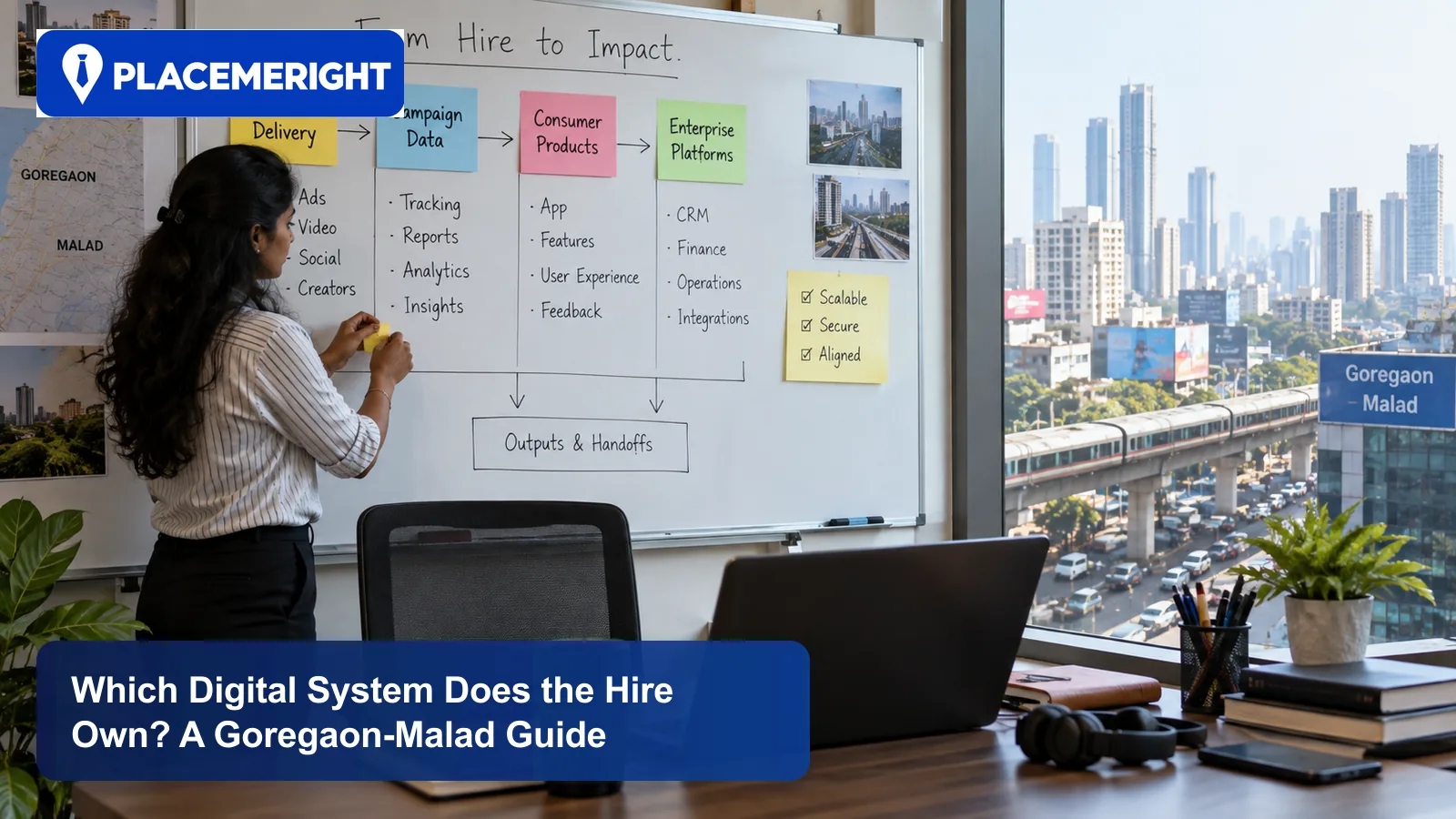
Goregaon and Malad technology hiring sits at the meeting point of two business systems that are often treated as one.
The first is Mumbai's media, advertising, content, and consumer-digital economy. The second is a substantial office market supporting IT, IT-enabled services, banking, enterprise applications, data, cloud operations, and shared business functions.
These systems can use similar job titles. A data engineer may support campaign measurement, a consumer platform, or a regulated enterprise warehouse. A product designer may work on a streaming experience, an internal workflow, or a customer-service tool. A cloud engineer may own a digital product or maintain business-critical infrastructure.
A search for "digital talent in Mumbai" has no clear evidence boundary until the workflow is named. The useful local question is not whether a candidate has worked in Goregaon or Malad. It is whether their evidence matches the product, customer, data, control, and operating rhythm of the role.
Verify more than one operating environment
Goregaon East includes Dadasaheb Phalke Chitranagari, Nirlon Knowledge Park, and office developments along the Western Express Highway. Goregaon West and Malad West include commercial offices, media and service businesses, Link Road, and established IT-park infrastructure.
The distinction is visible in primary sources:
- Maharashtra's Film City describes an operating production complex in Goregaon East with studios and outdoor shooting locations.
- Nirlon's reporting identifies Nirlon Knowledge Park in Goregaon East as an IT park whose licensees primarily operate in IT/ITeS and financial services.
- Mindspace describes its Malad asset as an IT park within the Malad-Goregaon commercial market.
- MMRDA lists operational Line 7 stations serving Goregaon East and operational Line 2A stations at Malad West, Lower Malad, Pahadi Goregaon, and Goregaon West.
These facts establish local business and access context. They do not prove that every media engineer sits near Film City or that every enterprise candidate works in an IT park.
For wider city sourcing after the role is defined, use PlaceMeRight's Mumbai technology recruitment context.
Map the corridor by operating environment
| Local market | Verified employer context | Workflows to investigate | | --- | --- | --- | | Goregaon East and Film City Road | production, post-production, media operations, corporate offices | media platforms, workflow tools, content operations, creative technology | | Nirlon and Western Express Highway | IT/ITeS, financial services, enterprise offices | software, data, cloud, security, business systems, support | | Goregaon West and Link Road | consumer, agency, services, commercial offices | digital product, martech, analytics, design, implementation | | Malad West and Mindspace | IT park, enterprise delivery, service operations | application engineering, QA, cloud operations, data, CRM, ERP | | Wider western suburbs | Andheri, Jogeshwari, Kandivali, Borivali, Powai | separate workplaces that may inform employer research |
Use this map to plan employer research and worksite conversations, not to pre-label candidates. Ask what system the person owned and where recurring work events occurred.
A current Mumbai sample shows why broad titles are unreliable
For this guide, PlaceMeRight examined 120 Mumbai live-job-feed records on 27 July 2026. The records were posted from 20 to 23 July. A title-and-tag scan found 16 records using media, advertising, content, video, creative, design, marketing, growth, or consumer language; 24 using enterprise, platform, cloud, DevOps, support, infrastructure, ERP, or major business-application terms; and 15 using data, analytics, AI, or machine-learning language.
The categories overlap. They cover Mumbai, not Goregaon and Malad, and the source titles do not reveal office location, production access, campaign ownership, customer scale, or shift expectations.
The sample is useful for one conclusion: keyword searches will mix creative, product, data, platform, and operational work. Employers need evidence filters before sourcing.
Separate four hiring lanes before writing the job description
Media platform and content workflow engineering
These roles may support content intake, metadata, asset movement, rights, scheduling, publishing, playback, quality checks, or production collaboration. The right candidate is not simply a developer who likes entertainment.
Clarify whether the person owns:
- media processing or a business workflow around media;
- live, scheduled, or on-demand delivery;
- content metadata, rights, or catalogue logic;
- internal production users or external audiences;
- integrations with editing, storage, distribution, or measurement systems;
- release support during fixed programming or campaign windows.
Ask candidates to trace one asset or content item from creation to delivery. Useful evidence includes failure handling, version control, approvals, observability, and recovery without corrupting the source.
Advertising technology and campaign data
An advertising role can mean audience systems, campaign operations, measurement, creative tooling, marketing automation, experimentation, or agency reporting. These responsibilities should not be bundled automatically.
A useful brief names the decision the system supports. Is the team improving delivery, attribution, lead quality, creative performance, budget control, or reporting trust? Then define the data available, privacy boundary, latency, and human review.
For an interview, provide a campaign whose platform metrics and internal conversion data disagree. Ask the candidate how they would identify definitions, inspect event flow, test attribution assumptions, communicate uncertainty, and prevent a bad budget decision.
Consumer digital product and experience
Consumer roles require more than attractive interfaces. Product engineers, designers, analysts, and product managers should connect customer behaviour with reliability, accessibility, performance, experimentation, and commercial outcomes.
For engineers, test how they protect a high-traffic journey during a release. For designers, review problem framing, interaction states, research evidence, and design-system decisions. For analysts, test metric definitions and experiment interpretation. For product managers, examine prioritisation when user value, revenue, technical debt, and operational capacity conflict.
Enterprise applications, cloud, and operations
Goregaon and Malad also support teams whose users are employees, business partners, financial-services operations, or enterprise customers. These roles may involve CRM, ERP, data platforms, identity, infrastructure, service management, implementation, or production support.
Specify the boundary:
- configuration, custom development, or integration;
- project implementation or ongoing product ownership;
- ticket resolution or root-cause removal;
- cloud provisioning or platform engineering;
- dashboard delivery or governed data products;
- office-hours support or a defined shift and escalation model.
An enterprise title should disclose permissions and ownership. Calling support "DevOps" or reporting work "data engineering" may attract candidates who will reject the real job later.
Publish worksite facts without creating a talent radius
For a Goregaon East office, record the exact campus, gate, nearest Line 7 station or road approach, normal hours, and any late production or release event. Do not infer that a named suburb creates a reliable candidate pool.
For Goregaon West or Malad West, record whether the relevant approach is Western Railway, Line 2A, Link Road, office transport, or another route. Powai, Vikhroli, Thane, Navi Mumbai, and other origins require individual validation rather than a recruiter-drawn reach claim.
Do not screen by current-office pin code. Ask:
1. Where will the candidate normally start the journey? 2. Which office entrance or campus is the destination? 3. How many days are fixed onsite? 4. Are late releases, shoots, campaign launches, or support shifts part of the role? 5. Is transport provided when work extends beyond normal transit hours?
Keep each person's answer separate from the technical score. The east-west distinction matters because "Goregaon" alone does not describe the destination.
Write the brief around an observable output
Replace broad requirements with a short operating statement.
Media example: Own the services that validate, enrich, and publish digital assets from production intake to downstream distribution, including failed-job recovery and metadata quality.
Advertising example: Build and govern the event and reporting flow used to evaluate campaign delivery and conversion, with clear definitions, privacy controls, and discrepancy investigation.
Consumer-product example: Improve a high-volume customer journey through reliable frontend and backend changes, measurable experiments, and coordinated release learning.
Enterprise example: Maintain and improve a business-critical application across integrations, access, release, incident response, and recurring-problem removal.
After the outcome, list the necessary systems, technical depth, stakeholders, office location, work mode, and operating conditions. Avoid a combined vacancy asking one person to own product design, campaign analytics, backend systems, cloud, cybersecurity, and client delivery.
Use a lane-specific interview scorecard
All candidates can share four common dimensions:
- personal ownership;
- problem and user understanding;
- technical or functional judgement;
- communication and delivery reliability.
Add specialised dimensions for each lane.
| Lane | Additional evidence | | --- | --- | | Media workflow | asset state, metadata, rights, quality, release windows | | Advertising data | event definitions, attribution limits, experimentation, privacy | | Consumer product | performance, accessibility, customer states, measurement | | Enterprise platform | permissions, integrations, change control, recovery |
Use one realistic case instead of several trivia rounds. Introduce an incomplete requirement, a dependency failure, and a post-release signal. Ask the candidate to revise the plan as information changes.
The debrief should quote evidence from the case. "Strong communicator" is not enough. Record what the candidate clarified, decided, protected, measured, and escalated.
Check the handoffs around the role
A corridor vacancy can be miscalibrated as an isolated technical seat even though the employee will work across several operating teams. Map those handoffs before deciding seniority.
A media-platform engineer may depend on production operations, metadata owners, rights teams, storage vendors, and distribution partners. An advertising-data specialist may receive campaign definitions from marketing, events from product engineering, and conversion records from sales systems. An enterprise-application hire may coordinate with business users, implementation partners, information security, and service support.
Ask the hiring manager to draw the first 90 days as a sequence of decisions:
- which team supplies the requirement or input;
- what the new hire is expected to decide independently;
- where approval is still required;
- which failure the person must diagnose;
- which business user needs a clear explanation;
- what evidence will show that the workflow improved.
This exercise helps the employer decide whether it needs an individual contributor, a delivery coordinator, a platform owner, or a manager. It replaces an empty "stakeholder management" requirement with an observable handoff.
Disclose conversion-critical facts before the final interview
Media, advertising, and enterprise teams may have very different working rhythms in the same corridor. Disclose fixed office days, campaign or release peaks, shift expectations, client calls, on-call responsibility, and the precise office side early.
Explain the role's actual creative and technical authority. State whether the work is repetitive operation, system ownership, research and design-system decision-making, or production execution. Do not let the employer's sector or brand stand in for the work.
Keep compensation aligned with the scope, not the label. Compare candidates only after the employer has decided which outcomes are genuinely mandatory.
Quick checklist for Goregaon and Malad employers
- Name the workflow before naming tools.
- Separate media, advertising, consumer product, and enterprise lanes.
- State Goregaon East, Goregaon West, or Malad and the exact office pattern.
- Explain production, campaign, release, support, and shift duties.
- Treat nearby western suburbs as worksite context, not proof of skills or supply.
- Test one end-to-end outcome and one failure.
- Record personal decisions rather than company-brand impressions.
- Discuss compensation, notice period, commute, and competing processes early.
- Use city-wide job data only as directional context.
Frequently asked questions
Is Goregaon mainly a media hiring market?
No. Film City gives Goregaon a strong media context, but the area also includes IT parks, financial-services offices, enterprise technology, data, cloud, support, and business systems. Employers should define the workflow instead of treating the whole locality as one sector.
Which enterprise contexts exist around Malad?
Malad and the wider Goregaon-Malad market include documented IT-park and enterprise-service environments. That does not establish role availability. The brief still needs a precise boundary across application development, implementation, cloud operations, data, QA, support, or business systems.
Should media-tech candidates have film or television experience?
Require it when rights, broadcast, production, asset, or distribution workflows must be understood immediately. For general platform, frontend, cloud, QA, security, or data roles, relevant high-scale product or workflow experience may transfer if the interview tests the real media constraint.
Which nearby locations should the worksite discussion distinguish?
Depending on the office side and work mode, distinguish Jogeshwari, Andheri, Kandivali, Borivali, Oshiwara, Powai, Vikhroli, Thane, and wider Mumbai only where relevant. Validate the journey and schedule with each candidate.
How can employers avoid mixed digital profiles?
Define the user, output, data, system boundary, production responsibility, and success measure before sourcing. Then screen for one comparable example. This separates campaign, content, product, design, analytics, and enterprise work more effectively than adding keywords.
Related reading
- Build a specialist MarTech engineering team across Goregaon and Malad
- Design Goregaon hybrid work around Western Line access
- Hire software developers across India
- PlaceMeRight technical recruitment services
- Powai product-engineering hiring guide
Conclusion
Goregaon and Malad contain documented media, enterprise, service, and office contexts. Those facts become useful only after the role is separated by workflow, ownership, operating rhythm, and worksite reality.
CTA
PlaceMeRight helps Mumbai employers calibrate media-tech, digital-product, advertising-data, cloud, enterprise-application, and technical operations roles. Share your Goregaon or Malad hiring requirement to build the local sourcing map, evidence filters, scorecard, and interview process.
References
- Maharashtra Film, Stage and Cultural Development Corporation, Film City Mumbai
- India Cine Hub, Film City Mumbai production infrastructure
- Nirlon Limited, Nirlon Knowledge Park business overview
- Nirlon Limited, Business Responsibility and Sustainability Report 2024-25
- Mindspace Business Parks, Paradigm Mindspace Malad
- Mumbai Metropolitan Region Development Authority, Metro Line 7 overview
- Mumbai Metropolitan Region Development Authority, Metro Line 2A overview
- Cushman & Wakefield, Mumbai MarketBeat, Q2 2026
Related PlaceMeRight resources
Our Tech Recruitment Services by City
Looking to hire vetted software engineers or scale your engineering teams in India's leading tech hubs? Explore our localized recruitment services: