
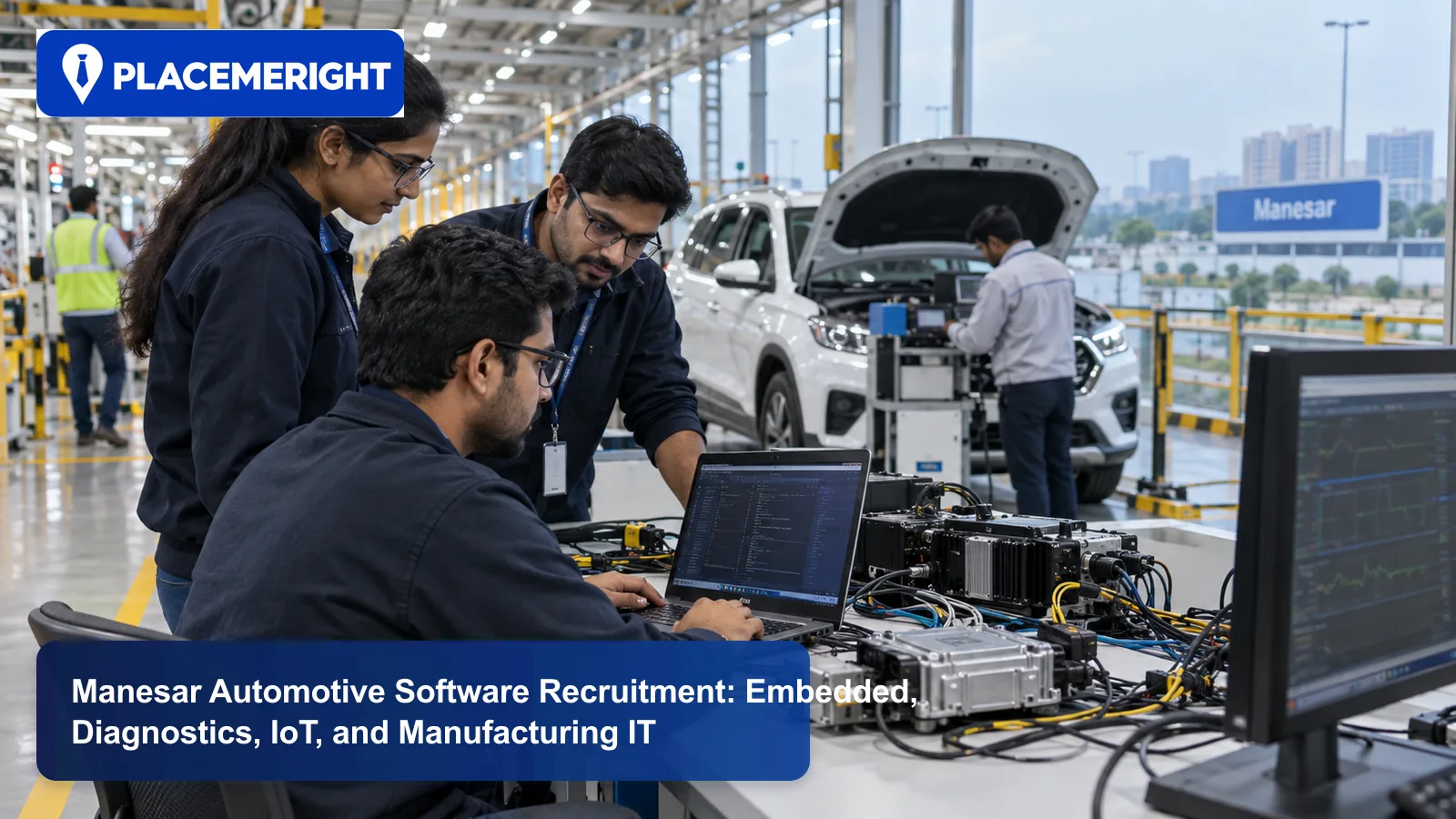
An automotive software vacancy in Manesar can sit inside a vehicle, beside a production line, across a service network, or between factory equipment and an enterprise platform.
Those settings may all mention C++, diagnostics, APIs, IoT, data, testing, or integration. They do not describe the same engineer.
A controller developer works with constrained hardware and timing. Diagnostic, connected-product, manufacturing IT, OT integration, and validation engineers own different paths from faults and field data to production flow and system evidence.
Manesar employers improve automotive software recruitment when they identify the controlled asset, interfaces, evidence, and worksite reality before searching resumes.
Manesar combines vehicle engineering and production technology
Maruti Suzuki identifies its Manesar manufacturing facility in IMT Manesar. Its 2024 capacity announcement also referred to technologies used to improve productivity, ergonomics, and traceability. More recent company releases describe the in-plant railway siding and its connection with vehicle dispatch operations.
These local signals show how vehicle engineering, plant applications, production data, quality, logistics, maintenance, and enterprise systems can meet around one operation. They do not prove that every employer is hiring every software profile.
The practical search area can include IMT Manesar and the NH-48 industrial belt, Gurugram engineering and corporate teams, and connected supplier locations towards Dharuhera and Bawal. Kharkhoda may matter for wider Haryana automotive planning, but it should not be presented as the same daily commute. PlaceMeRight's Delhi NCR technology recruitment context can support the broader market view after the role boundary is clear.
Start with the asset and the failure consequence
Before selecting a title, write four sentences.
1. The asset: What product, machine, application, data set, or workflow does the person change? 2. The interface: Which hardware, network, system, supplier, plant, or user boundary must they understand? 3. The failure: What happens if the software is late, wrong, unavailable, unsafe, or untraceable? 4. The evidence: What design, code, test, diagnostic, deployment, or operating artefact proves competence?
Consider two vacancies that both request C++ and Python.
The first develops software on an ECU, reads sensors, controls an actuator, and must behave predictably under hardware constraints. The second builds a HIL automation service that stimulates inputs, collects outputs, compares results, and publishes test evidence. Their programming overlap is real, but their ownership and interview proof are different.
The same discipline applies to IoT. A device engineer who acquires signals is not automatically a backend engineer who manages ingestion, identity, storage, tenancy, observability, and fleet operations.
Lane 1: embedded and ECU software
Embedded automotive roles can cover application logic, basic software, drivers, middleware, bootloaders, communication, controls, or integration.
The brief should name:
- target controller, processor, or device family;
- bare-metal, RTOS, AUTOSAR Classic, embedded Linux, or other platform;
- application, middleware, driver, or platform ownership;
- communication such as CAN, LIN, Ethernet, UDS, SPI, or UART;
- memory, timing, start-up, power, or safety constraints;
- model-based, hand-coded, or mixed development;
- unit, integration, HIL, and vehicle test responsibility;
- coding, traceability, review, and release expectations.
AUTOSAR's Classic Platform is designed for deeply embedded systems with predictable behaviour and constraints. That context is different from an Adaptive or Linux-based high-compute environment. A job description should not use "AUTOSAR" as one undifferentiated keyword.
Use a debugging case in the interview. A controller works on a bench but fails intermittently after integration. Provide logs, timing observations, bus traces, and a recent change. Ask the candidate to form hypotheses, isolate hardware and software causes, add instrumentation, reproduce the issue, and define regression tests.
Strong evidence may include interface design, resource decisions, fault handling, code review, test traces, and a clear explanation of what the candidate personally owned.
Lane 2: vehicle diagnostics and service engineering
Diagnostics connects product behaviour with engineering, manufacturing, workshop, and field support.
The work may include diagnostic services, DTC design, UDS, OBD, flashing, calibration support, service tools, troubleshooting logic, data interpretation, or guided fault finding. Some roles develop diagnostic capability inside the ECU. Others build tester software, service applications, or validation suites.
Clarify the primary user:
- ECU developer;
- end-of-line production station;
- vehicle test engineer;
- authorised workshop technician;
- field-service team;
- supplier quality or warranty analyst.
Use a case in which a vehicle reports an intermittent communication fault after a software update. Ask how the candidate would separate network, ECU, power, configuration, flashing, and application causes. Then ask what evidence a workshop or plant user needs.
The assessment should test diagnostic reasoning and user context, not only protocol recall. A technically correct tool that produces ambiguous field instructions can extend downtime and misdirect part replacement.
Lane 3: connected vehicle and automotive IoT
Connected-product work spans more than sending telemetry to a dashboard.
It can include device identity, secure communication, protocol translation, edge buffering, over-the-air workflows, data contracts, cloud ingestion, event processing, device management, observability, privacy, and customer-facing services.
Divide ownership across the path:
| Boundary | Questions for the brief | | --- | --- | | sensor to device | Who acquires, filters, timestamps, and validates signals? | | device to network | Who owns connectivity, retry, buffering, and offline behaviour? | | network to cloud | Who authenticates devices and validates messages? | | platform to product | Who owns storage, APIs, rules, alerts, and customer context? | | operation to support | Who investigates missing, delayed, duplicated, or implausible data? |
Current Bosch role material illustrates IIoT gateways, edge systems, plant protocols, cloud IoT integration, embedded communication testing, automation, and hardware-level debugging. These are workflow examples, not evidence of Manesar vacancies.
Use an exercise involving an intermittently connected device. Ask the candidate to design identity, message ordering, retry, buffering, duplicate handling, observability, update safety, and support diagnostics. Score the trade-offs at the boundary they would own.
Lane 4: manufacturing IT and traceability
Manufacturing IT turns production requirements into dependable plant applications and data flows.
Responsibilities may include MES, production reporting, quality workflows, genealogy and traceability, work instructions, label systems, warehouse interfaces, maintenance applications, ERP integration, or shop-floor digitisation.
The hiring brief should state:
- plant process and users;
- production-critical applications;
- interfaces with machines, PLCs, scanners, quality systems, MES, WMS, and ERP;
- availability and recovery expectations;
- change windows and release controls;
- data lineage and traceability needs;
- vendor and central-platform dependencies;
- shift, escalation, and site-support model.
A current Bosch MES role describes shop-floor execution, quality gates, traceability, genealogy, warehouse flow, testing, training, go-live, and ERP or PLC integration. That blend illustrates why a pure application developer may not fit a plant-facing MES role.
Use a scenario in which a station produces valid parts but a traceability record fails to reach the central system. Ask the candidate to protect production, preserve evidence, prevent incorrect release, find the broken interface, recover data, communicate with operations, and stop recurrence.
Lane 5: OT, controls, and IT integration
Operational technology roles work closer to equipment, control networks, plant availability, and physical processes than conventional enterprise IT roles.
Potential scope includes PLC and SCADA integration, industrial protocols, line connectivity, edge gateways, historian data, asset inventory, network segmentation, remote access, monitoring, backup, patch coordination, and vendor access.
Do not hide this work inside "full-stack developer."
Define whether the engineer can change controller logic, only integrate data, administer the network, design controls, or coordinate vendors. State the production consequences of a bad change and the approvals required.
Use an interface failure case: a new edge gateway collects data correctly but creates unstable traffic on a production network. Ask how the candidate would contain risk, inspect topology and traffic, coordinate with controls and network owners, prove a revised design, and deploy without disrupting operations.
The interview should reveal respect for plant change control. Fast experimentation is useful only inside an environment where failure is safely bounded.
Lane 6: integration, verification, and validation
Automotive validation is not one generic testing role.
Employers may need:
- software unit and component testing;
- ECU integration testing;
- HIL rig development and automation;
- diagnostics validation;
- network and communication testing;
- vehicle-level functional testing;
- connected-service end-to-end validation;
- manufacturing system testing;
- regression, release, and evidence management.
Specify the system level, test environment, stimuli, expected outputs, automation stack, defect ownership, and release decision.
For a HIL-oriented role, ask the candidate to design a repeatable test for a sensor fault and degraded mode. Look for fixture design, deterministic stimulus, timing, data capture, oracle selection, failure diagnosis, reproducibility, reporting, and integration into continuous testing.
For connected validation, use a sensor-to-cloud scenario. For manufacturing IT, use a production transaction across equipment, MES, quality, and ERP. The test should follow the actual system boundary.
Separate standards knowledge from delivery evidence
Standards and process knowledge can matter. AUTOSAR provides platform specifications. ISO 26262 addresses functional safety for road-vehicle electrical and electronic systems. Automotive cybersecurity work may also connect with ISO/SAE 21434.
A vacancy should state why a standard is relevant.
Ask candidates for one concrete artefact:
- an AUTOSAR configuration or interface decision;
- a safety-related requirement and its verification evidence;
- a traceability chain from requirement to test;
- a diagnostic specification and validation result;
- a cybersecurity requirement translated into implementation;
- a release defect found through HIL or vehicle testing.
Certification or vocabulary can support a profile. It should not replace evidence of engineering decisions.
Map the team interfaces before sourcing
Automotive programmes cross mechanical, electrical, electronics, controls, embedded software, cloud, data, manufacturing, quality, service, cybersecurity, suppliers, and programme management.
Create an interface register for the vacancy.
| Partner | Decision or handoff | Required evidence | | --- | --- | --- | | systems engineering | requirements and interfaces | reviewed specification | | hardware | pins, timing, power, memory | integration result | | controls | behaviour and calibration | test trace | | cloud or data | message and API contract | end-to-end validation | | manufacturing | station and process need | production trial | | quality | defect and release criteria | traceable report | | supplier | component or tool delivery | acceptance evidence |
Then ask a candidate to describe one disagreement across an interface. Seniority appears in how they establish facts, protect the programme, document a decision, and close the loop.
Design the Manesar operating offer honestly
An industrial role may require access to a vehicle, rig, laboratory, line, secure network, supplier site, or workshop. The brief should disclose that operating requirement before interviews.
Disclose:
- exact site and gate, not only "Gurugram";
- normal shift and any production coverage;
- on-call and shutdown-window expectations;
- laboratory, track, plant, or supplier travel;
- transport arrangements for unusual hours;
- equipment and secure-access restrictions;
- whether remote work is possible for any part of the role;
- relocation or corridor flexibility.
A candidate living near central Gurugram may evaluate an IMT Manesar commute differently from a Gurugram office role. A role split between Manesar and Bawal is different again. Surface that operating pattern before interviews.
Run a four-part evidence interview
Use one connected case rather than unrelated trivia.
System map: Ask the candidate to draw the controlled asset, interfaces, users, data, and failure boundaries.
Engineering decision: Introduce a constraint such as memory, latency, production continuity, offline connectivity, or supplier dependency.
Failure investigation: Provide incomplete logs and ask for a safe diagnostic sequence.
Release evidence: Ask what must be tested, reviewed, documented, and monitored before and after deployment.
Score the candidate against the selected lane. A manufacturing IT applicant should not lose marks for lacking ECU driver development. An embedded applicant should not be rewarded for cloud vocabulary without device evidence.
Quick checklist for Manesar employers
- Name the vehicle, plant, device, application, or data asset.
- Choose embedded, diagnostics, IoT, manufacturing IT, OT, or validation as the primary lane.
- Define hardware, protocol, system, and user interfaces.
- State the failure consequence.
- Separate development from integration and testing.
- Ask for one role-relevant artefact.
- Map supplier and cross-functional handoffs.
- Define site, shift, travel, and access.
- Use a realistic diagnostic or design exercise.
- Write the first 90-day engineering outcome.
Frequently asked questions
Is an embedded engineer automatically suitable for automotive diagnostics?
No. There can be overlap, but diagnostics requires specific protocol, fault-model, tool, service, or validation context. Verify what the candidate designed, implemented, tested, and used.
Should a manufacturing IT engineer know PLC programming?
Only if the role owns controller logic. Many manufacturing IT roles integrate MES, applications, data, scanners, quality, warehouse, and ERP systems while controls engineers own PLCs.
What should an automotive IoT interview test?
Test the boundary the person will own: device identity, connectivity, buffering, protocol, ingestion, data contract, platform operation, API, observability, or end-to-end validation.
Can employers source across Gurugram for a Manesar role?
Yes, but disclose the exact Manesar worksite, attendance pattern, shift, transport, and travel. Do not present a plant-based role as a generic Gurugram office vacancy.
How should standards appear in the scorecard?
Link each required standard to a deliverable or decision. Assess applied evidence such as a requirement, configuration, test, traceability record, risk analysis, or release artefact.
Related reading
- Chennai automotive software hiring guide
- Sanand automotive and plant technology hiring
- Hire software developers across India
- PlaceMeRight technical recruitment services
- Dedicated hiring and RPO support
Conclusion
Manesar automotive software recruitment works best when employers stop sourcing from one broad technology label. Embedded code, diagnostics, connected products, manufacturing applications, OT integration, and validation meet around the same industrial ecosystem, but each demands different ownership and proof.
CTA
PlaceMeRight helps Manesar and Delhi NCR employers convert automotive programmes into evidence-led role briefs, scorecards, interview cases, and sourcing plans. Share your automotive software hiring requirement to calibrate the role before outreach begins.
References
- Maruti Suzuki, All offices and Manesar plant location
- Maruti Suzuki, Expansion of manufacturing capability at Manesar plant
- Maruti Suzuki, Manesar in-plant automobile railway siding starts operation
- Haryana Government, Haryana Electric Vehicle Policy 2022
- AUTOSAR, AUTOSAR standards
- AUTOSAR, Classic Platform
- ISO, ISO 26262-1:2018 road vehicles functional safety
- Bosch Global Software Technologies, MES Engineer role
- Bosch Global Software Technologies, IT-OT and industrial IoT integration role
- Bosch Global Software Technologies, Embedded Test Engineer role
Related PlaceMeRight resources
Our Tech Recruitment Services by City
Looking to hire vetted software engineers or scale your engineering teams in India's leading tech hubs? Explore our localized recruitment services: