
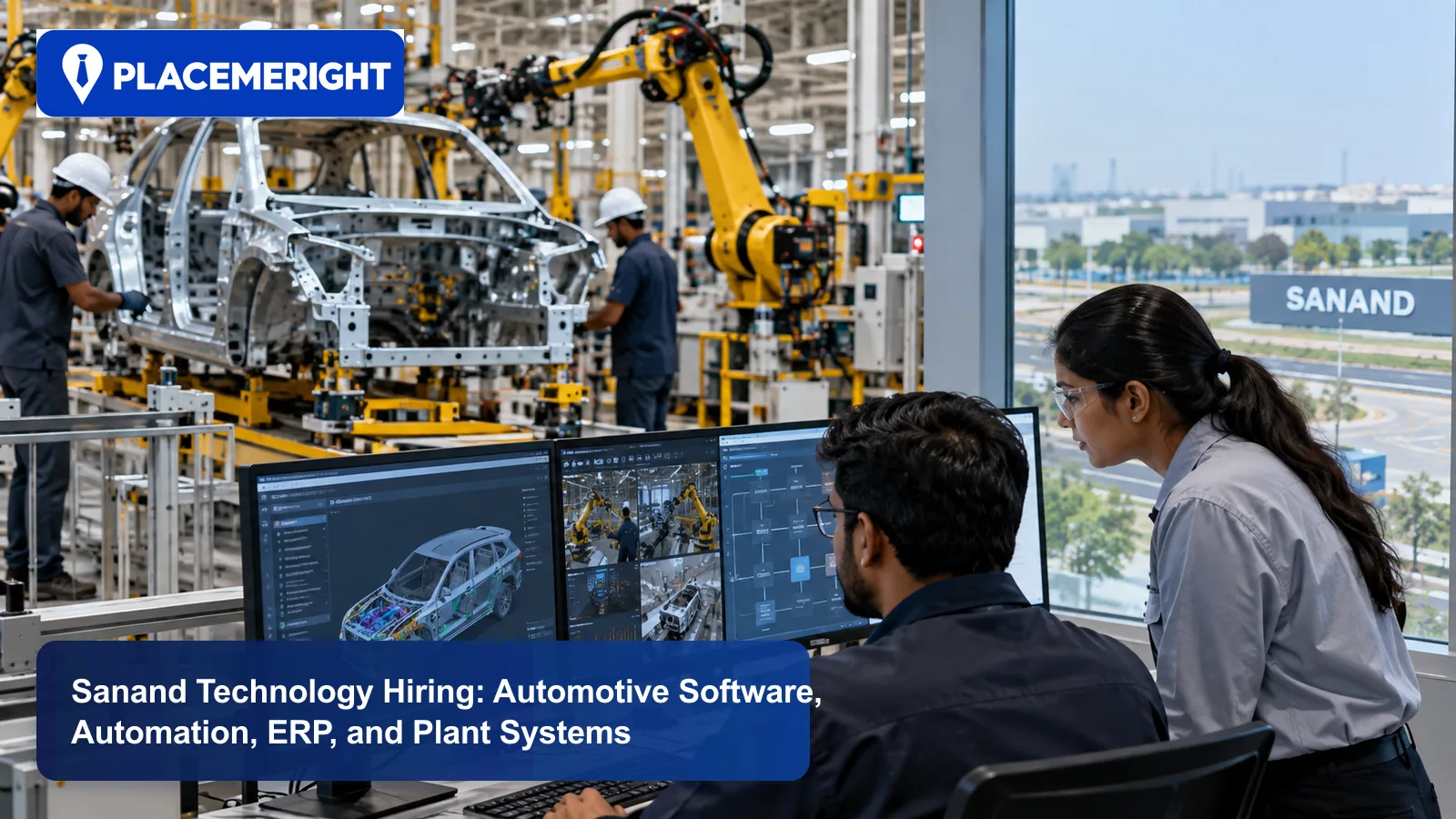
Sanand technology hiring begins with a distinction that many manufacturing job descriptions miss:
Is the software inside the product, or is the software operating the factory?
Automotive embedded engineers may work on vehicle controls, diagnostics, communication, validation, or software integration. Automation engineers may own robots, PLCs, drives, sensors, and production equipment. ERP and MES specialists may connect planning, material, production, quality, warehouse, and traceability workflows. Plant data, infrastructure, cybersecurity, and semiconductor manufacturing teams operate additional layers.
These roles meet inside a modern industrial programme. They should not be merged into one "Industry 4.0 engineer."
Sanand's industrial mix changes the hiring brief
GIDC's Sanand II material describes a large industrial estate with designated areas for automotive suppliers, electronics, engineering, pharma, medical devices, plastic engineering, and other industries. Its current estate material also identifies Sanand and Sanand II at Bol as separate industrial locations.
The local technology context is expanding beyond automotive. Micron opened its semiconductor assembly and test facility in Sanand in February 2026. The facility adds manufacturing, cleanroom, test, data, equipment, quality, infrastructure, and operational technology context to an established industrial corridor.
Current Tata Motors listings for Sanand include quality, warehousing, scheduling, procurement, and plant operations. A maintenance role for the Ahmedabad Plant or Sanand has also described robotic weld equipment, PLCs, conveyors, servo systems, and SAP plant-maintenance and materials modules. These are examples of real production interfaces, not a complete technology-demand count.
For city-wide sourcing beyond the plant corridor, use PlaceMeRight's Ahmedabad technology recruitment context.
Use the product-versus-plant test
Ask where the code or system has its primary effect.
| Work family | Primary effect | Typical evidence | | --- | --- | --- | | Vehicle or product software | behaviour of the vehicle, device, or embedded product | embedded C/C++, controls, diagnostics, communications, verification | | Test and validation systems | evidence that product behaviour meets requirements | benches, hardware-in-loop, test automation, traceability, defect analysis | | Factory automation | behaviour of equipment and production sequence | PLC, robot, drive, HMI, SCADA, commissioning, safety | | ERP and MES | planning, execution, material, quality, warehouse, and records | process design, configuration, integration, cutover, support | | Plant data and quality systems | trusted operational and traceability decisions | event models, lineage, quality rules, analytics, stewardship | | Plant IT, OT, and security | availability and controlled access across infrastructure | networks, identity, servers, backup, monitoring, segmentation | | Semiconductor manufacturing technology | equipment, test, yield, cleanroom, and manufacturing data | equipment integration, process data, test systems, quality, reliability |
A candidate can span adjacent families. The employer should still choose one primary consequence for the vacancy.
Charter 1: automotive and embedded software
An automotive software brief should identify the electronic or software domain. Possibilities include powertrain, body controls, vehicle communication, diagnostics, battery systems, infotainment, connected services, functional safety, calibration, or integration.
State whether the role owns:
- software requirements;
- architecture or component design;
- embedded implementation;
- model-based development;
- communication protocols;
- diagnostics;
- hardware or software integration;
- verification and validation;
- defect analysis;
- release evidence.
Do not ask for automotive software when the actual work is maintaining factory equipment. Both are technical, but their users, tools, risks, and evidence differ.
For an interview, provide a field or test failure that appears only under a particular operating condition. Ask the candidate to trace requirements, signals, software states, hardware interaction, logs, reproduction, root cause, fix, and regression evidence.
Charter 2: factory automation and controls
Automation roles operate closer to physical consequence.
The job description should name the production area, equipment, control environment, safety boundary, shift or callout pattern, commissioning needs, and vendor mix. Clarify whether the employee designs new systems, maintains existing lines, improves cycle time, reduces repeat faults, or leads projects.
Use a fault simulation. A robotic station stops intermittently after a tooling or logic change. The candidate must protect safety, inspect alarms and sequence, separate sensor, mechanical, electrical, network, and logic causes, restore production safely, and preserve evidence for a permanent fix.
Assess documentation and change control. A fast workaround that bypasses safeguards is not strong automation engineering.
Charter 3: ERP, MES, and plant workflow
Manufacturing ERP may cover planning, procurement, materials, production, maintenance, quality, warehouse, and finance. MES may cover dispatch, operator instructions, production state, traceability, genealogy, downtime, process data, and quality records.
The brief must reveal the interface.
For example:
> Own the production-order and material-consumption flow between ERP and MES for a multi-line plant, including master-data checks, interface monitoring, reconciliation, release testing, and operator escalation.
This is more useful than "SAP PP/MM with MES knowledge."
An interview case can introduce a production order that reaches the line with an incorrect material revision. Ask who can stop or correct the workflow, which record is authoritative, how to preserve traceability, what is communicated to production and quality, and how the defect is prevented.
Separate functional configuration, technical development, integration, data, testing, and support. One senior person may coordinate several, but the vacancy should not claim deep ownership of all modules and every plant application.
Charter 4: quality, traceability, and manufacturing data
Automotive, electronics, pharma, medical-device, and semiconductor environments all depend on trustworthy operational evidence, although their processes and control regimes differ.
A plant data role should identify the decision: defect containment, genealogy, process stability, test yield, maintenance, energy, material movement, or production attainment.
Ask:
- Which source creates the event?
- How are equipment, product, lot, shift, and process identifiers related?
- Which records can arrive late or change?
- Who owns the business definition?
- How are exceptions reviewed?
- Which system is authoritative?
- How can a result be traced back?
Use a case in which a dashboard shows a quality improvement but inspection records disagree. Strong candidates investigate definitions, filters, timestamps, sampling, source changes, lineage, and user behaviour before presenting a conclusion.
Charter 5: plant IT, OT, and cybersecurity
Plant infrastructure can include industrial and office networks, servers, endpoints, identity, remote vendor access, virtualisation, backup, monitoring, patching, asset inventory, and incident response.
The employer should show where IT and OT responsibility changes. Corporate IT may own identity and central services. Plant teams may own equipment networks and local availability. Vendors may retain specialised access. Security may define controls while operations approves timing.
Use a remote-support scenario for a production machine. Ask the candidate to design approval, identity, network path, least privilege, session recording, time limits, monitoring, revocation, and emergency alternatives.
The role should disclose maintenance windows, production shutdowns, on-call, travel between sites, and whether transport is available outside normal hours.
Charter 6: semiconductor manufacturing technology
Semiconductor assembly and test adds a distinct local context. It can involve equipment integration, manufacturing execution, automated test, process control, yield data, quality systems, cleanroom operations, facilities, infrastructure, and supply-chain systems.
Employers should avoid treating all semiconductor technology as chip design.
Define whether the vacancy supports:
- manufacturing equipment;
- test engineering;
- equipment or factory automation;
- manufacturing applications;
- data and yield analysis;
- quality and traceability;
- infrastructure and cybersecurity;
- process engineering interfaces;
- enterprise planning and supply systems.
Transferable profiles may come from electronics, automotive, industrial automation, high-volume manufacturing, test systems, data engineering, or regulated operations. The interview should test the exact manufacturing constraint rather than requiring semiconductor vocabulary for every role.
Find the first failure the new hire must own
Before sourcing, ask the hiring manager:
> What is the first failure this person must diagnose or prevent without waiting for someone else?
Possible answers:
- embedded software behaves incorrectly under a specific vehicle state;
- an automated cell stops and does not recover predictably;
- an ERP-MES interface creates inconsistent material records;
- equipment data becomes incomplete or misordered;
- quality traceability cannot connect a unit with its process history;
- a vendor requires urgent remote access;
- a test process produces an unexplained yield change.
The answer defines the interview.
It also reveals missing support. If the new employee is expected to resolve controls, network, application, process, quality, and vendor issues alone, the operating model is incomplete.
Build a 90-day ownership map
Use three columns:
| Period | Expected ownership | Required support | | --- | --- | --- | | First 30 days | learn system, process, safety, stakeholders, and current incidents | plant access, documentation, domain mentor | | Days 31 to 60 | own a bounded issue, analysis, or improvement | reviewer, data access, cross-functional time | | Days 61 to 90 | deliver one approved change and its operating evidence | change window, testing, user or production sign-off |
Tailor the output.
An embedded engineer may close a reproducible defect with regression evidence. An automation engineer may eliminate a recurring stoppage. An ERP analyst may stabilise a workflow and master-data control. A plant data engineer may publish an agreed metric with lineage and exception handling. An infrastructure engineer may improve a recovery or remote-access control.
This map improves candidate conversations because the role becomes real.
Source across Ahmedabad without hiding the journey
Sanand, Sanand GIDC, Sanand II at Bol, and nearby industrial sites are specific destinations. Changodar and Bavla are related industrial areas but not the same estate. Ahmedabad pools may include Bopal, Shela, South Bopal, Sarkhej, Prahlad Nagar, SG Highway, Thaltej, and other western or south-western areas depending on the route.
Do not advertise "Ahmedabad" and reveal a distant plant gate after the technical rounds.
State:
- exact estate, plant, and gate;
- general or rotational shift;
- company transport routes;
- shutdown and commissioning expectations;
- on-call or emergency support;
- remote-work limits;
- relocation support where applicable;
- travel to suppliers or other plants.
An industrial role can be technically relevant while still requiring a viable daily journey.
Assess cross-functional communication through an operating event
Manufacturing technology hires work with production, quality, maintenance, process engineering, supply chain, IT, security, vendors, and leadership.
During the interview, ask the candidate to give three updates during the same incident:
1. a technical handoff to another engineer; 2. an operational update to a plant leader; 3. a risk and recovery update to quality or business stakeholders.
The content should change without changing the facts. This is better evidence than a generic "stakeholder management" question.
Avoid five Sanand hiring mistakes
Combining product and factory software: Embedded vehicle work and plant automation can interact, but they require different core evidence.
Using Industry 4.0 as the job: Name the system, user, decision, and failure.
Treating ERP knowledge as plant ownership: Process configuration does not prove controls, equipment, or operational recovery depth.
Ignoring semiconductor-specific manufacturing roles: Sanand's current industry mix requires more precise distinctions across design, equipment, test, data, and operations.
Hiding site conditions: Worksite, shift, transport, shutdown, and plant-access expectations affect conversion.
Quick checklist for Sanand employers
- Run the product-versus-plant test.
- Choose one primary work family.
- Name the first failure the hire must own.
- Define physical and digital consequence.
- Separate ERP, MES, automation, data, infrastructure, and product software.
- Use one realistic failure simulation.
- Test technical, operational, and risk communication.
- Map the first 90 days.
- State the exact estate, gate, shift, and transport.
- Keep specialist ownership visible inside cross-functional roles.
Frequently asked questions
Is automotive software hiring the same as factory automation hiring?
No. Automotive software primarily affects vehicle or product behaviour. Factory automation affects production equipment and sequences. Some integration and validation work connects them, but the core skills and evidence differ.
Which ERP skills matter in a manufacturing plant?
The relevant skills depend on the workflow: production planning, materials, procurement, maintenance, quality, warehouse, finance, master data, integration, testing, or support. Define the process and project stage before naming modules.
Can engineers from other industries move into Sanand manufacturing roles?
Yes, when their evidence matches the system and consequence. Automotive, electronics, industrial equipment, pharma, medical devices, high-volume manufacturing, data platforms, and infrastructure can provide transferable experience for particular roles.
Which Ahmedabad areas can support a Sanand search?
Sanand and nearby local pools are the most direct. Bopal, Shela, Sarkhej, Prahlad Nagar, SG Highway, Thaltej, Changodar, Bavla, and wider Ahmedabad may be relevant depending on the plant gate, shift, and transport.
What should employers test for a plant systems lead?
Test architecture across systems, failure isolation, change control, traceability, vendor coordination, operational communication, and the ability to assign specialist ownership rather than personally claiming every layer.
Related reading
- Sanand automotive role-proposition dossier
- GIFT City financial platforms and cybersecurity hiring
- West Ahmedabad cloud and DevOps hiring guide
- Hire software developers across India
- PlaceMeRight technical recruitment services
- Dedicated hiring and RPO support
Conclusion
Sanand's automotive, electronics, semiconductor, engineering, pharma, and medical-device context creates several connected technology briefs. Employers can separate product software from factory systems, identify the first operational failure, and show the real site, authority, and first-90-day responsibilities.
CTA
PlaceMeRight helps Sanand and Ahmedabad employers calibrate automotive software, automation, ERP, MES, plant data, infrastructure, and semiconductor manufacturing roles. Share your Sanand technology hiring requirement to build the role charter, interview simulation, and local sourcing map.
References
- Gujarat Industrial Development Corporation, Sanand II industrial estate zone map
- Gujarat Industrial Development Corporation, Current estate allotment prices
- Gujarat Industrial Development Corporation, Sanand II industrial-estate sector material
- Gujarat Industrial Development Corporation, Sanand regional office and estate contacts
- Micron Technology, Opening of the Sanand semiconductor assembly and test facility
- Tata Motors, Current opportunities including Sanand operations
- Tata Motors, BIW maintenance role for Ahmedabad Plant or Sanand
- Tata Motors, Senior Manager, Quality Operations in Sanand
- Tata Motors, Warehousing Operations role in Sanand
Related PlaceMeRight resources
Our Tech Recruitment Services by City
Looking to hire vetted software engineers or scale your engineering teams in India's leading tech hubs? Explore our localized recruitment services: