
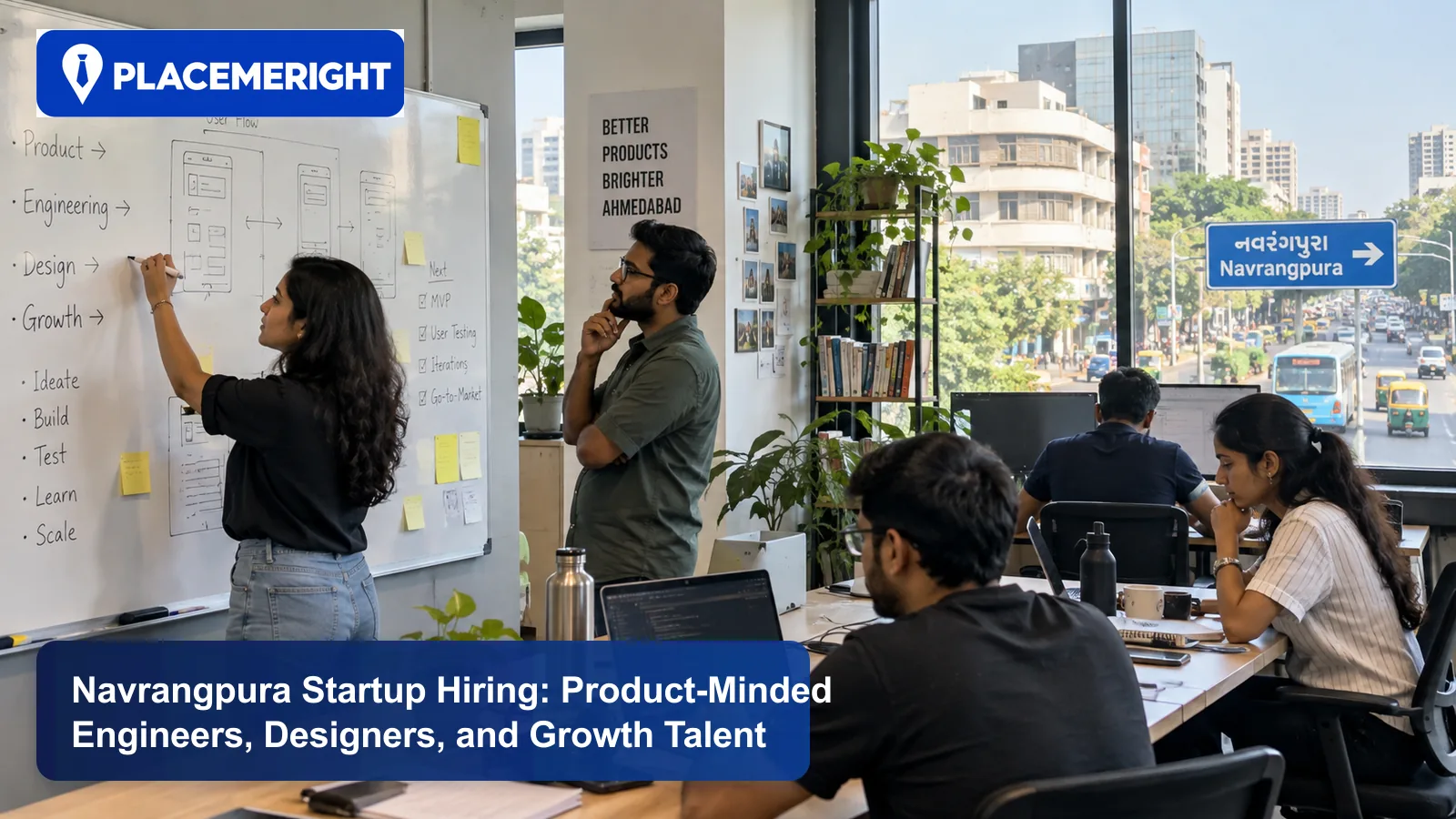
Navrangpura startup hiring is easy to describe badly.
Founders may ask for a "product-minded full-stack developer", a "creative UI/UX person", or a "growth hacker who can do everything". These labels sound flexible, but they often hide three unanswered questions: what stage the company has reached, which decision the employee will own, and which outcome matters during the next six months.
Navrangpura sits near universities, incubators, commercial streets, and other Ahmedabad business areas. Those are verifiable ecosystem and worksite facts, not evidence of founder access, candidate supply, or role capability.
Navrangpura has credible startup infrastructure, not one uniform talent pool
Gujarat University Startup and Entrepreneurship Council operates from the Gujarat University area and presents a portfolio of current incubated startups across varied sectors. Gujarat Student Startup and Innovation Hub, or i-Hub, is a Government of Gujarat initiative based in Navrangpura, with incubation and coworking programmes.
Recent i-Hub updates also show active founder and investor engagement. Its UrbanX session in May 2026 brought together more than 40 startups and 15 investors, while an April 2026 early-stage pitching programme involved more than 22 startups and 18 investment partners.
These sources establish a functioning innovation environment. They do not show that every startup is hiring, that every role is based in Navrangpura, or that candidates near an incubator have the same capabilities.
For wider employer sourcing, use PlaceMeRight's Ahmedabad technology recruitment context.
Define the startup stage before the job title
The same title changes meaning as the company develops.
| Company situation | Immediate hiring need | Common brief mistake | | --- | --- | --- | | Problem discovery | rapid learning, prototypes, customer conversations | hiring for scale before demand is clear | | Early product | reliable core journey, usable interface, basic measurement | calling every task "full stack" | | Repeatable sales | onboarding, integrations, analytics, growth operations | mixing sales, marketing, and product ownership | | Scaling delivery | platform reliability, design systems, quality, specialised channels | keeping a founder-generalist scorecard | | Regulated or operational expansion | controls, security, data quality, workflow depth | copying a consumer-startup JD |
Write the next business constraint in the first line of the brief. Examples include reducing onboarding failure, releasing a paid workflow, improving activation measurement, integrating a customer system, or establishing a repeatable acquisition channel.
Then decide whether the new hire owns that constraint or supports someone who already does.
Product-minded engineering needs a measurable product boundary
A product-minded engineer is not simply a developer who attends planning meetings. The person should connect technical choices with user behaviour, delivery risk, support load, and business learning.
Define:
- the user and core journey;
- current architecture and technical debt;
- which layer the role owns;
- expected release frequency;
- available product and design support;
- production, security, and data responsibilities;
- one outcome the engineer can influence.
For an early-stage role, ask the candidate to plan a feature when customer language is incomplete and engineering capacity is limited. A useful answer clarifies the user problem, reduces scope, identifies irreversible decisions, defines instrumentation, releases safely, and explains what will be learned.
For a scaling role, introduce a service that is slowing releases or creating support incidents. Look for evidence across system design, migration, observability, stakeholder communication, and incremental delivery.
Do not ask one engineer to be the backend owner, frontend specialist, mobile developer, cloud administrator, QA lead, data analyst, and product manager unless the company can explain which responsibility is temporary and what support exists.
Design hiring should move beyond attractive screens
Startup design can include product discovery, interaction design, visual systems, research, prototyping, content, and handoff. A role focused on marketing assets is different from one responsible for a complex product workflow.
Before sourcing, state:
1. whether a product manager or founder owns prioritisation; 2. how customer evidence reaches the designer; 3. whether the product has an existing design system; 4. which platforms and user states matter; 5. how design quality will be reviewed; 6. whether the role includes brand or campaign production.
Use a work sample based on the real product. Give the candidate a workflow with one confused user, one business constraint, and incomplete data. Ask them to frame the problem, identify necessary research, sketch states, handle errors and accessibility, and describe how they would validate the result.
Portfolio polish matters less than the candidate's explanation of decisions, rejected alternatives, evidence, collaboration, and outcome.
Growth roles need a channel and commercial model
"Growth" can mean performance marketing, content, lifecycle communication, product-led activation, partnerships, sales development, ecommerce operations, or analytics. Combining all of them creates noisy applications and unclear interviews.
Start with the commercial motion:
- self-serve product or sales-assisted purchase;
- business or consumer customer;
- short or long buying cycle;
- local, national, or international market;
- acquisition, activation, retention, or expansion constraint;
- budget and systems already available.
For a performance role, test campaign structure, measurement limitations, landing-page diagnosis, and budget decisions. For lifecycle, test segmentation, message timing, consent, and retention measurement. For product growth, test activation events, experimentation, instrumentation, and collaboration with engineering and design. For partnerships, examine pipeline quality, economics, execution, and handoff to sales or delivery.
A useful interview case starts with a falling conversion metric and incomplete attribution. A useful response defines the funnel, questions the data, prioritises investigation, proposes a controlled action, and states what would change the recommendation.
Use cross-functional range without hiring an imaginary generalist
Early startups do need people who can work across boundaries. The answer is a broad decision context, not an unlimited task list.
Describe the role as a primary craft plus adjacent responsibilities. For example:
- backend engineer who can collaborate on product scope and basic cloud operations;
- product designer who can support lightweight research and design-system setup;
- growth marketer who can improve landing-page briefs and measurement with product teams;
- product manager who can write clear analytics requirements and support customer discovery.
Label responsibilities as core, regular collaboration, or temporary founder-stage work. State what the person will not own. This makes adaptability visible without misleading experienced candidates.
Use Navrangpura geography as worksite and ecosystem context
Navrangpura, Gujarat University, Vijay Cross Roads, CG Road, Ellis Bridge, and Paldi provide central-city institutional, commercial, and worksite context. Vastrapur and Thaltej add other education and business settings. SG Highway, Prahlad Nagar, and Makarba contain larger technology and commercial offices.
Use these locations as travel and outreach context. Do not assume that Navrangpura produces generalists, SG Highway produces enterprise engineers, or a university-area candidate is junior.
Ask candidates about the actual office destination, fixed days, working hours, public transport or parking, and any late founder or customer calls. If the role is remote or hybrid, explain whether the company has documented work, reliable review practices, and equipment support.
Mention Gandhinagar or another Gujarat location only when the employer has approved the corresponding office, hybrid, remote, or relocation arrangement. Do not expand geography to compensate for an undefined role.
Check whether the founder is ready to manage the role
A specialist role can be mis-specified even when the applicant is capable. The founder may still hold every decision, change priorities without context, or expect independent execution before providing access and customer evidence.
Before interviews, identify:
- who sets weekly priorities;
- who reviews engineering, design, or growth work;
- how quickly the hire can reach customers or domain users;
- where decisions and product knowledge are documented;
- which tools, data, budget, and systems are ready;
- what the founder will stop owning after the person joins.
For a senior hire, explain the authority attached to the title. Can the person reject scope, change a process, select tools, hire team members, or control a budget? For an early-career hire, name the manager who will teach and review the craft.
Candidates should meet the person who will make daily decisions, not only an adviser or investor. Give them one honest example of a recent priority change and how the team handled it. This reveals the operating environment more clearly than claims about speed or ownership.
A dated Ahmedabad sample supports role separation, not supply claims
On 27 July 2026, PlaceMeRight examined 120 records in its Ahmedabad live-job feed. The records were posted between 14 June and 23 July. A broad title-and-tag scan associated 88 records with software or product-engineering language, seven with design language, and two with explicit growth or commercial language.
The categories overlap, titles can hide responsibilities, and the sample covers Ahmedabad rather than Navrangpura. It cannot establish vacancy share, candidate supply, or hiring difficulty.
It does show why one generic startup search is weak. Engineering titles dominate visible feeds, while design and growth work may appear under product, marketing, ecommerce, analytics, content, or operations labels. Direct outreach and evidence-led screening are essential.
Match the interview loop to startup stage
Keep the process compact but not casual.
Founder screen: clarify the company stage, constraint, role ownership, and motivation. Do not use this meeting as an unstructured personality test.
Craft case: one engineering, design, or growth problem based on the next six months. Provide enough context and score the reasoning.
Collaboration discussion: examine a disagreement, changed requirement, failed release, or weak campaign. Ask what the candidate personally did.
Closing conversation: align compensation, equity if offered, work mode, decision authority, manager access, and realistic uncertainty.
Use written scorecards before debrief. A founder's enthusiasm should not erase weak craft evidence, and a polished presentation should not erase poor ownership.
After joining, review whether the new hire received the promised access, decision authority, and first outcome. If priorities changed, explain why and reset the success measure. Early startup work will evolve, but undisclosed changes create two different versions of the role.
Use the first 30 days to improve the next search. Record which interview assumptions were correct, which responsibilities moved, where the new hire lacked context, and which founder decisions remained unclear. This converts onboarding evidence into a better brief instead of repeating the same attractive but imprecise startup language.
Share those findings with every interviewer before the next role opens.
Explain compensation and equity without theatre
A startup may offer learning, ownership, fast iteration, or access to meaningful decisions. Describe only what the operating model can demonstrate.
State fixed compensation, variable conditions, review timing, probation terms, and benefits clearly. If equity is part of the offer, explain the instrument, number or percentage basis, vesting, cliff, exercise conditions, dilution, and what happens when employment ends. Ask legal and finance advisers to verify the documents.
Never use an undefined future valuation to compensate for an under-scoped role or hidden working expectations.
Quick checklist for Navrangpura startup employers
- Name the company stage and next six-month constraint.
- Define one primary craft for the role.
- Separate core, adjacent, and temporary responsibilities.
- State the decision the person can make independently.
- Explain product, design, data, and founder support.
- Use Navrangpura and nearby corridors as worksite context only.
- Test one realistic work sample.
- Score decisions, evidence, and learning.
- Disclose office days, working rhythm, compensation, and equity terms.
- Ensure the post-join role matches the interview.
Frequently asked questions
Is Navrangpura a useful location for startup hiring in Ahmedabad?
The area has documented university, incubation, coworking, commercial, and transport context. That supports a local employer brief, not a claim about candidate availability or quality. Assess each person's evidence and worksite feasibility directly.
What does product-minded mean when hiring an engineer?
It means connecting technical decisions with the user problem, measurable outcome, delivery risk, support impact, and product learning. The brief should still define the engineer's primary technical ownership.
Should an early startup hire one person for engineering, design, and growth?
Usually not as three equal crafts. Choose the primary constraint and the most important required craft. Adjacent collaboration can be included, but unlimited ownership makes the role and assessment unclear.
How should founders assess startup designers?
Review problem framing, workflow states, research judgement, accessibility, systems thinking, collaboration, and validation. A portfolio should be discussed as evidence of decisions, not judged only by appearance.
Which Ahmedabad locations should the brief distinguish?
Depending on work mode, distinguish Gujarat University, Vijay Cross Roads, CG Road, Ellis Bridge, Paldi, Vastrapur, Thaltej, SG Highway, Prahlad Nagar, Makarba, wider Ahmedabad, or Gandhinagar only where each place is relevant.
Related reading
- Hire software developers across India
- Startup hiring support
- PlaceMeRight technical recruitment services
- Use the GIFT City control-to-role hiring method
- West Ahmedabad cloud and DevOps hiring
Conclusion
Navrangpura has a documented startup, university, incubation, and commercial context. Employers should use those facts accurately while defining the company stage, primary craft, decision ownership, and evidence expected from each candidate.
CTA
PlaceMeRight helps Ahmedabad startups calibrate engineering, product, design, data, and growth roles before sourcing. Share your startup hiring requirement to build a stage-specific brief, local outreach map, work sample, and interview scorecard.
References
- Gujarat University Startup and Entrepreneurship Council, GUSEC
- Gujarat University Startup and Entrepreneurship Council, Current startup portfolio
- Gujarat University Startup and Entrepreneurship Council, Startup hiring listings
- i-Hub Gujarat, Innovation and startup platform
- i-Hub Gujarat, Incubation programme
- i-Hub Gujarat, Coworking space
- i-Hub Gujarat, UrbanX investor engagement, May 2026
- i-Hub Gujarat, Startup RISE pitching sessions, April 2026
Related PlaceMeRight resources
Our Tech Recruitment Services by City
Looking to hire vetted software engineers or scale your engineering teams in India's leading tech hubs? Explore our localized recruitment services: