
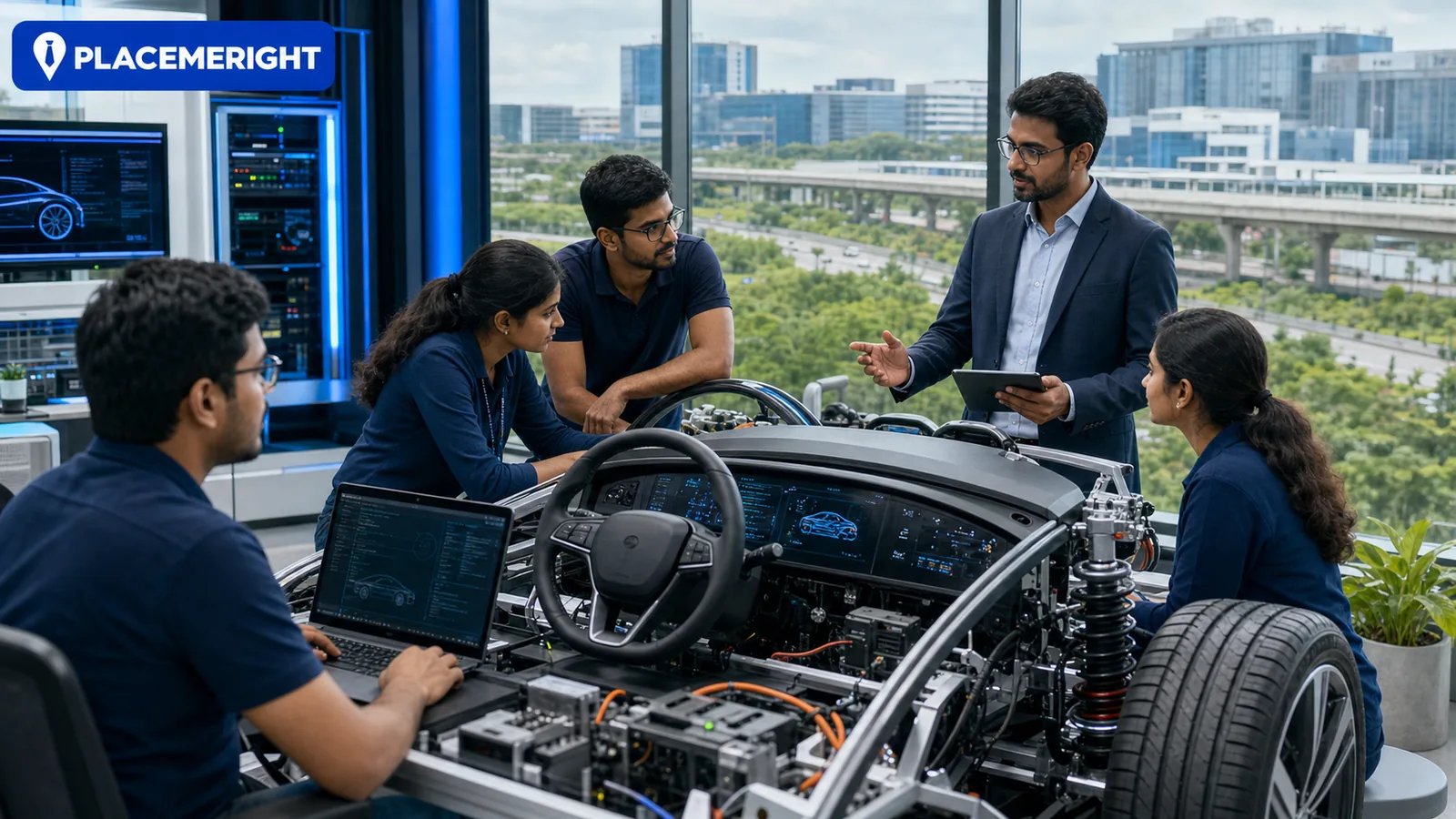
An automotive software vacancy can ask for C++, AUTOSAR, CAN, diagnostics, testing, and connected systems in one paragraph. That does not make it one role.
An embedded application engineer implements vehicle behaviour under real-time and hardware constraints. A basic-software engineer works closer to operating services, communication stacks, memory, and ECU abstraction. A diagnostics engineer designs or validates how faults are detected and serviced. A validation engineer builds evidence through simulation, benches, and vehicles. A connected-systems engineer crosses the boundary between the vehicle, mobile applications, cloud services, identity, data, and operations.
Employers across Electronic City Phase I and II, Singasandra, Bommasandra, Jigani, Chandapura, and the Hosur Road corridor need to decide which boundary the new hire owns before searching. "Automotive software engineer" is too broad to do that work.
Karnataka positions automotive, auto components, electric vehicles, and clean mobility as priority industries. STPI's IoT OpenLab in Electronic City includes automotive and mobility among its focus areas and describes facilities for electronics, testing, prototyping, and tools such as CANoe. ELCITA administers the Electronics City industrial township. Together, these sources establish a credible local engineering ecosystem. They do not establish the number of automotive software candidates available at any moment.
For wider city-level sourcing, see PlaceMeRight's Bangalore technology recruitment guide. This article maps the narrower automotive software search.
A note on current market evidence
PlaceMeRight reviewed ten pages, or 1,200 records, from its Bangalore live-job feed on 27 July 2026. The broad title scan did not produce a reliable automotive-software subset. Generic city feeds under-represent niche work when employers use internal titles, publish through different systems, or omit domain terms.
No vacancy count is claimed here.
Instead, the technical map below was checked against a targeted qualitative sample of current official role descriptions from automotive and mobility employers. The sample repeatedly asked for combinations of embedded C or C++, AUTOSAR basic or application layers, diagnostic protocols, CAN or Ethernet, model-based development, test automation, HIL or SIL, ASPICE, and functional-safety awareness. A targeted sample shows the shape of selected roles, not market prevalence.
That methodological limit is useful. A specialist search should begin with system evidence, not an inflated keyword statistic.
Read the southern corridor as workplace contexts
Electronic City Phase I and II
Electronic City is a major technology and industrial district in south Bangalore. Its documented mix makes embedded software, enterprise technology, product engineering, testing, data, cloud, electronics, and engineering services relevant workplace contexts.
For automotive hiring, those contexts justify a broad system-boundary brief; they do not establish specialist supply. Do not assume everyone working in Electronic City has automotive depth. Use the same technical evidence standard for local and relocating candidates.
Singasandra and the inner Hosur Road connection
Singasandra, HSR Layout, Kudlu, and Begur can appear in an employer's southern Bangalore workplace map. Their proximity does not establish who is available or willing to travel, so the brief should state the exact site and working pattern.
Office attendance should be stated by site. "Bangalore South" is not enough for a role involving lab equipment or secure vehicle systems.
Bommasandra and Jigani
Bommasandra and Jigani provide industrial and manufacturing context. For an automotive-software vacancy, the employer should state whether production, electronics, quality, suppliers, plant systems, or validation genuinely interfaces with the code.
That context is valuable when the role interfaces with hardware or manufacturing. It should not substitute for software-design evidence.
Chandapura and the state boundary toward Hosur
Chandapura sits farther along the corridor, while Hosur itself is in Tamil Nadu rather than Bangalore. Employers considering applicants based across that state boundary must describe the exact worksite, state, travel, and tax or employment arrangement correctly. The geography does not prove candidate supply or travel feasibility.
Distance on a map does not reveal peak travel or shift feasibility. Validate the candidate's working-week plan before the final interview.
Start with the ECU or system boundary
The hiring manager should answer five questions:
1. Which ECU, controller, vehicle domain, tool, or connected service is in scope? 2. Is the role application, middleware, basic software, platform, test, tools, or cloud? 3. Which decisions can the engineer make? 4. Which standard, safety level, process, or customer requirement constrains the work? 5. Where is the result validated: unit, simulation, SIL, HIL, bench, vehicle, cloud, or production?
These answers shape sourcing keywords and interview tasks.
A bootloader engineer and an infotainment application engineer both use C++. A diagnostics validator and a diagnostics-stack developer both discuss UDS. Their responsibilities and evidence differ.
Embedded C and C++: test constraints, not syntax trivia
Automotive embedded work may involve limited memory, timing requirements, hardware registers, interrupts, concurrency, communication buses, fault handling, and long product life cycles.
Useful evidence includes:
- ownership of a production embedded component;
- memory and timing reasoning;
- state-machine design;
- hardware-software interface;
- concurrency and race-condition diagnosis;
- build, flashing, and debugging;
- coding standards and static analysis;
- unit and integration testing;
- field or bench defect investigation.
Use a small scenario: an ECU task occasionally misses a deadline after a new communication feature is enabled. Ask the candidate to identify likely causes, measurements, and safe investigation steps.
Do not turn the interview into obscure C syntax questions. The role is about predictable behaviour in a constrained system.
AUTOSAR: specify layer and ownership
AUTOSAR is an architecture and standards ecosystem, not one skill level. A brief should distinguish:
- Classic Platform or Adaptive Platform;
- application software components;
- runtime environment;
- basic software modules;
- MCAL and hardware abstraction;
- communication, diagnostics, memory, or operating services;
- configuration and integration;
- tooling and generated artefacts;
- architecture, development, validation, or support.
Ask candidates to draw the path from an application event to the relevant communication or hardware boundary. Then identify where configuration, generated code, custom code, and validation sit.
A candidate who configured one module may not own stack integration. An engineer who worked on application components may not have basic-software depth. Both can be strong matches for the correct vacancy.
Diagnostics: follow the fault lifecycle
Automotive diagnostics work can involve Diagnostic Trouble Codes, Unified Diagnostic Services, diagnostic sessions, security access, data identifiers, routines, communication, service tools, and plant or after-sales workflows.
Interview around one fault:
1. How is the condition detected? 2. When is a fault stored or cleared? 3. Which diagnostic service exposes it? 4. What state, session, or security condition applies? 5. How is the response tested? 6. What happens when communication fails? 7. How does the service or manufacturing user interpret the result?
For development roles, assess implementation and integration. For validation roles, assess test design, trace analysis, negative cases, and evidence. For systems roles, assess requirement quality and interaction across teams.
Tool familiarity with CANoe or another environment is helpful. It should not replace protocol and failure reasoning.
Validation: distinguish MIL, SIL, HIL, bench, and vehicle evidence
Testing labels can hide different engineering depth.
| Validation level | Main purpose | Candidate evidence | | --- | --- | --- | | MIL | Evaluate model behaviour before production code | model assumptions, scenarios, coverage, numerical behaviour | | SIL | Evaluate software in a simulated environment | interfaces, test harness, automation, expected behaviour | | HIL | Exercise software or ECU against real-time simulated plant and networks | rig design, I/O, faults, timing, automation, diagnosis | | Bench | Validate integrated hardware and software | flashing, instrumentation, electrical and network evidence | | Vehicle | Confirm behaviour in representative system context | safety, repeatability, trace collection, defect isolation |
Ask which defects each level can reveal and which it cannot. Strong validation engineers understand evidence boundaries and do not treat a passing test at one layer as proof of the whole vehicle.
For automation roles, assess how scenarios, test data, reports, and trace analysis are maintained across releases.
ASPICE and functional safety: assess lived responsibility
ASPICE and ISO 26262 frequently appear in automotive job descriptions. Their presence can lead to interviews that reward vocabulary instead of execution.
For ASPICE-related experience, ask:
- Which work product did you create or review?
- How did a requirement connect to design, code, and test?
- What traceability gap did you find?
- How was a change controlled?
- What happened during an assessment or quality review?
For functional safety, identify the role's actual interaction with safety goals, technical safety requirements, ASIL decomposition, safety mechanisms, verification, or confirmation measures.
Not every engineer needs to be a safety specialist. Every role affecting a safety-related system needs the appropriate awareness and discipline.
Connected systems require a second architecture map
Connected-vehicle work extends beyond the ECU. It may include telematics, secure communication, device identity, mobile apps, over-the-air updates, cloud ingestion, command services, fleet operations, analytics, consent, and customer support.
The hiring brief should state where the person sits:
- in-vehicle client;
- telematics control unit;
- connectivity platform;
- cloud backend;
- mobile or web application;
- data platform;
- security or identity;
- site reliability and operations.
Use an end-to-end scenario: a remote command is accepted by the mobile application but not completed by the vehicle. Ask the candidate to map identifiers, states, retries, timeouts, security checks, observability, and customer communication.
This exposes whether "connected systems" means real cross-boundary ownership or work on one isolated component.
Avoid the universal automotive engineer brief
A weak brief asks for embedded C++, AUTOSAR Classic and Adaptive, diagnostics, cybersecurity, functional safety, HIL, cloud, mobile, and leadership.
A credible brief distinguishes:
- must own: the system boundary and decisions required immediately;
- must understand: adjacent interfaces needed for daily work;
- can learn: tools or domain details supported after joining;
- separate specialist: work owned by another team.
This structure allows adjacent backgrounds to be considered without lowering the evidence standard.
Build a system-evidence scorecard
Use six dimensions:
1. Boundary clarity: Can the candidate explain what their component controlled? 2. Technical depth: Can they reason below tool names? 3. Failure diagnosis: Can they move from symptom to traceable evidence? 4. Process discipline: Can they connect requirements, change, implementation, and validation? 5. Interface communication: Can they work with hardware, systems, test, safety, suppliers, and customers? 6. Delivery ownership: Can they explain a production, bench, or release consequence?
Weight these according to the role. Diagnostics development and HIL automation should not use identical scorecards.
A three-stage specialist interview
Stage 1: project evidence
Trace one component or system from requirement to validation. Clarify personal decisions and artefacts.
Stage 2: boundary-specific work sample
Use embedded timing, AUTOSAR layering, diagnostic fault flow, HIL strategy, or connected-command investigation. Provide enough context for reasoning; do not require confidential knowledge from a previous employer.
Stage 3: interface review
Introduce a disagreement between software, systems, hardware, validation, or safety teams. Ask how the candidate identifies missing evidence and moves the decision forward.
Interviewers should record scores independently before discussion. A candidate who speaks confidently about the automotive domain should still demonstrate the required system work.
Quick checklist for a Hosur Road automotive-software brief
- Name the ECU, vehicle domain, toolchain, or connected-service boundary.
- Specify Classic or Adaptive AUTOSAR where relevant.
- Separate development, configuration, integration, validation, and support.
- List required buses, protocols, and diagnostic depth.
- Define SIL, HIL, bench, vehicle, or cloud validation responsibility.
- State ASPICE and functional-safety responsibility precisely.
- Identify hardware, lab, travel, and office requirements.
- Give the exact Electronic City or Hosur Road site.
- Use one system-boundary work sample.
- Avoid combining an entire vehicle software stack into one vacancy.
Frequently asked questions
Is embedded C++ experience enough for automotive software?
It can establish a foundation, but the role may also require real-time constraints, hardware interfaces, communication, diagnostics, process, validation, safety, or domain depth. Test the actual boundary needed.
What is the difference between AUTOSAR development and configuration?
Development can involve implementing software components, modules, services, or integrations. Configuration uses tools and artefacts to assemble required behaviour. Many roles combine both, but employers should identify the expected depth and layer.
Should a diagnostics engineer know CANoe?
CANoe or similar tools can be valuable for communication and diagnostic development or validation. Protocol reasoning, test design, trace interpretation, and fault-lifecycle understanding are more durable than one tool name.
When is HIL experience essential?
It is essential when the role must design, automate, operate, or interpret real-time hardware-in-the-loop validation. It may be useful but not mandatory for application developers who work primarily before that validation stage.
Can Bangalore employers source candidates from Hosur?
Potentially, depending on work site, travel, employment setup, and candidate preference. Hosur is in Tamil Nadu, so briefs must not present it as a Bangalore locality. Validate the working arrangement directly.
How should employers assess confidential automotive work?
Ask candidates to explain methods, boundaries, trade-offs, and anonymised failures. Do not require proprietary code, customer identities, unreleased vehicle details, or protected documents.
Related reading
- Hire software developers across India
- PlaceMeRight technical recruitment services
- Compare automotive-software recruitment in Manesar
- Share an automotive software requirement
Conclusion
The Hosur Road corridor connects software, electronics, industrial, validation, and mobility contexts across south Bangalore. That breadth does not create one universal automotive engineer.
Employers should begin with the ECU or system boundary, specify the AUTOSAR layer or connected-system position, define the required validation evidence, and clarify process and safety responsibility. A targeted work sample can then test depth without depending on title, employer name, or confidential project detail.
The search becomes smaller in wording and stronger in relevance.
CTA
PlaceMeRight helps employers calibrate embedded software, AUTOSAR, diagnostics, HIL and SIL validation, connected-vehicle, functional-safety, and automotive-platform roles. Share your Bangalore automotive software requirement to build the role map, specialist search, and evidence-based interview process.
References
- Invest Karnataka: automotive, auto components, and electric vehicles
- Government of Karnataka: Clean Mobility Policy announcement
- Government of Karnataka: Clean Mobility Policy 2025-30
- STPI Bengaluru: IoT OpenLab in Electronic City
- STPI Bengaluru regional directorate
- Electronics City Industrial Township Authority
- ELCITA geographic information system
- AUTOSAR official website
- AUTOSAR: English Q1 newsletter 2026
- ISO: ISO 26262 road-vehicle functional safety overview
Related PlaceMeRight resources
Our Tech Recruitment Services by City
Looking to hire vetted software engineers or scale your engineering teams in India's leading tech hubs? Explore our localized recruitment services: