
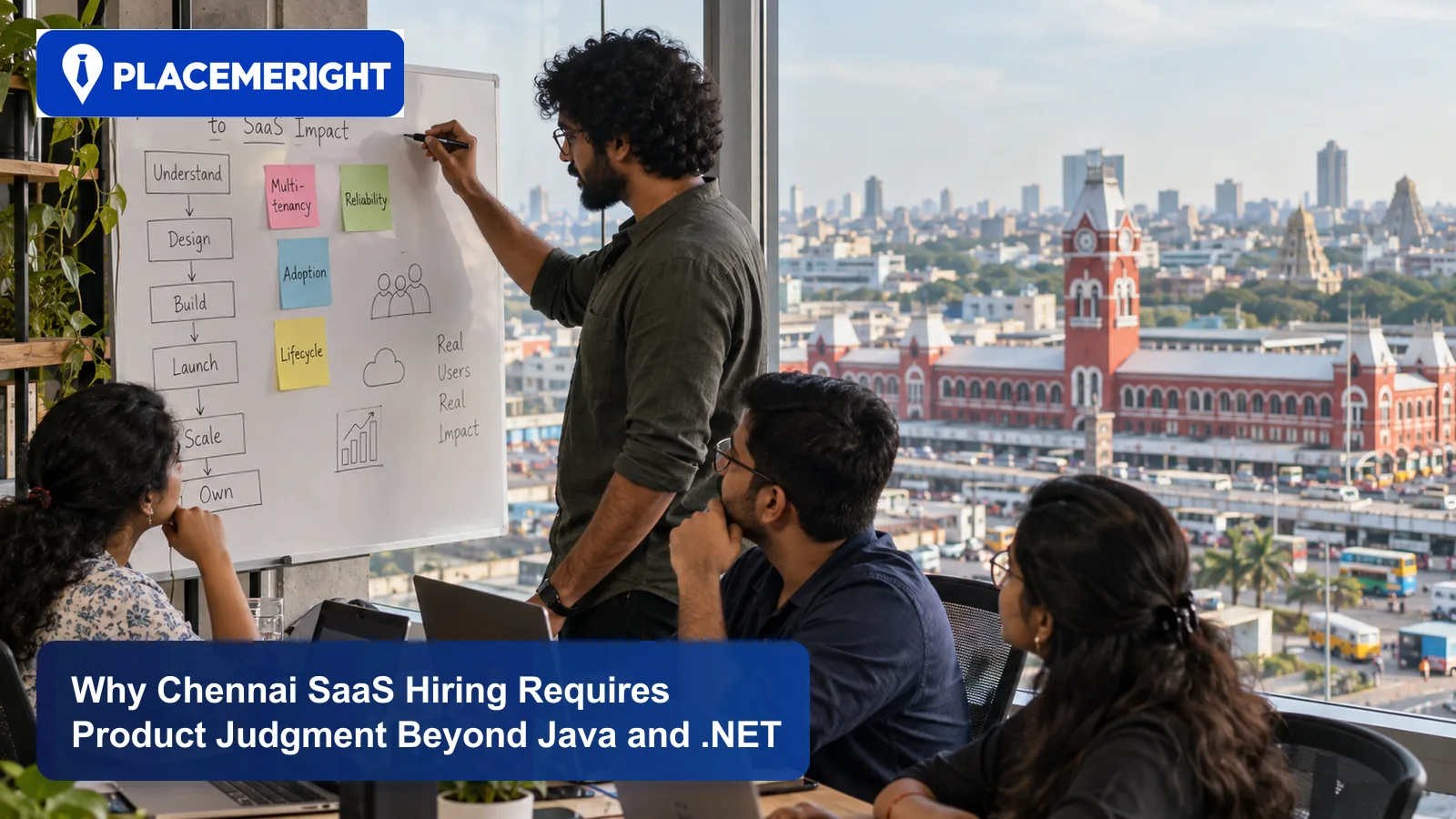
Java and .NET remain important in Chennai software hiring. They are not a complete definition of a SaaS product engineer.
A candidate can write clean service code and still make weak decisions about which customer problem to solve, what should remain configurable, how a feature affects tenant isolation, what telemetry proves adoption, or how an enterprise workflow should fail.
That gap matters because SaaS software is not handed over after one delivery. It is discovered, released, operated, supported, measured, and changed for many customers over time.
Chennai employers therefore need to test two forms of evidence together: engineering depth in the relevant stack and judgment across the product lifecycle.
Chennai role evidence connects code with product outcomes
Official Tamil Nadu investment material identifies SaaS, fintech, data centres, automotive, and other technology industries in Chennai's economic base. Its current IT and ITeS page describes a broad software, analytics, cybersecurity, AI, digital-engineering, and global-capability ecosystem.
Current employer roles show what that can mean in practice.
A Freshworks staff full-stack role links distributed architecture, multi-tenant fault tolerance, product vision, design partnership, production support, performance, and customer-facing capability. Its current staff product manager role describes customer empathy, problem framing, incremental delivery, adoption, and collaboration with engineering and design.
A PDI Technologies Chennai software role asks engineers to design and support software products, lead bounded work, assess risk, consult product management, and improve cloud maturity. ValGenesis also maintains an engineering-jobs listing for its product organisation.
These examples are not a census of Chennai demand. They are useful evidence that product-company engineering cannot be reduced to language syntax.
Employers can source across Taramani, Perungudi, Thoraipakkam, Sholinganallur, Siruseri, Guindy, Porur, and connected Chennai technology locations. Use PlaceMeRight's Chennai technology recruitment context after defining the product boundary and actual worksite.
Define product judgment in observable terms
"Product mindset" becomes vague when every interviewer gives it a different meaning.
For a SaaS engineer, define it as the ability to:
- understand the user and business workflow behind a request;
- separate the problem from a proposed feature;
- identify assumptions and missing evidence;
- choose a useful first scope;
- make technical trade-offs visible;
- protect reliability, security, and maintainability;
- define how success or failure will be observed;
- learn from customer, support, usage, and incident evidence;
- improve the product without creating avoidable exceptions.
None of these replaces coding skill. They determine whether coding effort produces a durable product result.
Write the required decisions into the role brief. An engineer maintaining a mature enterprise module needs different judgment from one exploring a new AI-assisted workflow.
Start with one real customer job
Choose a workflow the team actually supports:
- an IT administrator resolving employee requests;
- a finance operator reconciling transactions;
- a quality specialist approving regulated records;
- a retail manager acting on inventory exceptions;
- a support lead routing customer conversations;
- an enterprise administrator configuring access.
Document the user, trigger, desired outcome, current workaround, frequency, consequence of failure, and constraints.
Then ask the candidate to clarify the problem before proposing architecture.
Strong evidence includes questions about user roles, edge cases, data quality, audit needs, integration dependencies, frequency, reversibility, and how the user knows the task is complete. A candidate who immediately selects a framework may be solving the interviewer rather than the product.
Test problem framing before solution breadth
Use an ambiguous request such as:
> Enterprise customers want a bulk update feature because individual edits take too long.
Ask the candidate to identify:
- which users perform the work;
- how many records are involved;
- which fields can change;
- validation and permission rules;
- partial failure behaviour;
- audit and approval requirements;
- preview, confirmation, and rollback needs;
- progress and completion feedback;
- downstream integrations;
- evidence that the feature improves the workflow.
Product judgment appears in the quality of the questions and the boundaries created from them.
Do not reward feature expansion by default. A senior candidate may discover that saved rules, import validation, or an asynchronous job solves the underlying need better than a large editing interface.
Separate configuration from customer-specific code
SaaS teams repeatedly face requests from important customers. The hiring question is not whether engineers should ever support variation. It is how they classify it.
Ask whether a request should become:
- a general product capability;
- tenant configuration;
- role or entitlement logic;
- an integration;
- an extension point;
- an operational service;
- a temporary migration;
- a declined request.
Use a case in which one customer wants a unique approval chain with additional data and a different notification sequence.
Assess how the candidate protects the shared product model, avoids branching core behaviour by customer name, and makes ownership and support cost visible. Look for versioning, migration, observability, documentation, and removal thinking.
Include tenant and entitlement consequences
A seemingly simple feature can cross tenant, identity, and commercial boundaries.
Ask candidates to map:
- who can see and perform the action;
- how tenant context is established;
- whether plans or contracts affect access;
- which resources are shared;
- how caches, events, jobs, and exports remain scoped;
- what administrators can configure;
- what appears in an audit trail;
- how support investigates safely.
Use a feature that begins in the web application, creates an asynchronous job, emits events, and updates a customer integration. Ask where tenant and user authority must be preserved.
This exposes product judgment and distributed-systems depth in the same exercise.
Evaluate the smallest useful release
"Minimum viable product" should not mean an incomplete workflow that creates support burden.
Give the candidate a broad feature and limited delivery capacity. Ask for:
1. the outcome that must be possible; 2. the highest-risk assumption; 3. the smallest end-to-end release; 4. what will be deliberately excluded; 5. safeguards and operational visibility; 6. customer communication; 7. the next decision after evidence arrives.
A useful first release may include less functionality but complete permission, error, audit, and recovery behaviour.
Look for vertical slicing. Building every backend component before any user can complete the job is not automatically safer or more product-minded.
Make adoption observable
Deployment does not prove customer value.
Ask the candidate to define an evidence chain:
| Stage | Useful question | | --- | --- | | exposure | Did eligible users see the capability? | | activation | Did they begin the intended workflow? | | completion | Could they finish successfully? | | quality | Were errors, retries, or support contacts acceptable? | | repetition | Did relevant users return to it? | | outcome | Did the customer job improve? |
Metrics must respect customer context. Raw clicks can exaggerate adoption when users repeatedly fail. Completion can hide poor quality when support performs manual correction.
Ask how telemetry will be instrumented, governed, reviewed, and connected with qualitative feedback.
Test production and support judgment
SaaS engineers work on software while customers use it.
Use an incident in which a release works for most tenants but fails for customers with one integration and configuration combination.
Ask the candidate to:
- determine impact;
- identify the affected cohort;
- stop further harm;
- decide rollback, disablement, or targeted correction;
- preserve evidence;
- communicate uncertainty;
- restore the workflow;
- find the contributing product and engineering decisions;
- define prevention.
Good answers connect logs, metrics, traces, flags, configuration, customer communication, and ownership. They avoid blaming an unusual customer configuration when the product claims to support it.
Assess legacy decisions without contempt
Mature Chennai product teams may use Java or .NET systems that have supported customers for years.
Ask a candidate to improve one problematic module while feature work continues. Require a plan for:
- understanding current behaviour;
- identifying the expensive boundary;
- adding observability and tests;
- separating policy from implementation;
- changing incrementally;
- migrating data or callers;
- measuring improvement;
- retaining rollback;
- deleting the old path.
Product judgment includes respect for revenue, customer commitments, and operational history. A rewrite proposal without migration and risk analysis is not strategic merely because the target architecture is modern.
Review portfolios for decisions, not polished diagrams
For each project, ask:
- What customer problem existed?
- What evidence changed your understanding?
- Which decision did you personally own?
- What did you exclude?
- Which constraint mattered most?
- What failed after release?
- How did support or customer feedback reach engineering?
- Which metric or observation led to another change?
- What would you now design differently?
Verify individual contribution. Product delivery is collaborative, and senior candidates should distinguish their decisions from those of product, design, architecture, SRE, and other engineers.
An imperfect outcome with precise learning can be stronger evidence than a frictionless success story.
Do not turn the interview into product management
The engineer is not being hired to replace a product manager or designer.
Define the collaboration boundary:
- product owns outcome, priority, and roadmap decisions;
- design owns research and interaction craft where the team has that function;
- engineering owns technical feasibility, system quality, delivery, and operational consequences;
- support and success bring customer evidence;
- security, compliance, data, and operations contribute specialist constraints.
The senior engineer should influence problem framing and trade-offs while remaining accountable for engineering depth.
Score collaboration, not role takeover.
Use one connected Chennai SaaS exercise
Provide this scenario:
> A Chennai SaaS company serves mid-market and enterprise customers. Administrators want a bulk policy change. Tenants have different entitlements, one integration is slow, the current audit record is incomplete, and support cannot see job progress.
Run four stages:
1. Discovery: clarify users, outcome, frequency, and constraints. 2. Product scope: choose the smallest complete workflow. 3. Technical design: preserve tenancy, idempotency, progress, audit, and integration isolation. 4. Operation: define telemetry, rollout, incident handling, and learning.
Add a focused Java or .NET implementation review appropriate to the role. This keeps the stack bar visible while testing product judgment.
Score decisions through a common rubric
Use five dimensions:
| Dimension | Evidence | | --- | --- | | problem clarity | distinguishes request, user job, and outcome | | product boundary | makes configuration and scope choices explicit | | engineering quality | protects security, reliability, data, and changeability | | evidence loop | defines telemetry, feedback, and next decisions | | ownership | explains personal decisions and cross-functional handoffs |
Record evidence, not impressions such as "commercial" or "customer obsessed."
Require interviewers to cite what the candidate said, designed, or implemented.
Distinguish senior and staff-level judgment
A senior engineer should independently own a feature or service through design, delivery, operation, and iteration.
A staff engineer should additionally:
- shape product and technical boundaries across teams;
- identify repeated customer needs;
- improve platform leverage;
- establish decision and architecture patterns;
- manage migration and systemic risk;
- align product, design, engineering, and operations;
- mentor teams through ambiguous work.
Years and framework breadth do not establish either level alone.
Ask for influence without authority and a decision that protected both near-term customer value and long-term product health.
State Chennai work conditions precisely
The candidate needs the actual work model, not only "Chennai."
Disclose:
- office location;
- fixed attendance days;
- customer time-zone coverage;
- release and on-call expectation;
- production-access model;
- team distribution;
- travel or implementation involvement;
- relocation support;
- interview format.
Commuting to Siruseri is different from Taramani, Guindy, Porur, or Perungudi. Use each employer's real policy rather than a city-wide assumption.
Quick checklist for Chennai SaaS employers
- Define one customer workflow.
- Keep Java or .NET depth role-specific.
- Turn product judgment into observable decisions.
- Test problem framing before architecture.
- Separate configuration from customer-specific code.
- Include tenancy and entitlement consequences.
- Ask for the smallest complete release.
- Connect deployment to adoption evidence.
- Test one production and support failure.
- Score individual ownership and collaboration.
- Distinguish senior from staff scope.
- State the exact Chennai worksite and schedule.
Frequently asked questions
Should Chennai SaaS employers reduce the Java or .NET bar?
No. Set the implementation bar that the system requires, then add evidence for customer workflow, product boundary, production operation, and iteration. The two forms of depth reinforce each other.
What is the best product-judgment interview question?
Use a real ambiguous customer request. Ask the candidate to clarify the problem, choose a complete first scope, design the system, define success evidence, and handle a failure after release.
Can engineers learn product judgment after joining?
Yes, especially with strong product, design, support, and engineering collaboration. Hiring should still test the baseline expected for the level and provide a realistic scenario rather than rely on a personality label.
How can an employer avoid confusing product engineers with product managers?
Define ownership. Engineers should understand outcomes and influence scope while remaining accountable for feasibility, implementation, reliability, security, and technical change.
Which Chennai locations should employers include in sourcing?
Search broadly across Taramani, Perungudi, Thoraipakkam, Sholinganallur, Siruseri, Guindy, Porur, and nearby technology corridors, then validate commute against the exact office and attendance pattern.
Related reading
- Taramani SaaS, BFSI, data, and enterprise talent map
- SaaS customer engineering across Perungudi and Sholinganallur
- Product support hiring across Porur and Ramapuram
- Hire software developers across India
- PlaceMeRight technical recruitment services
Conclusion
Chennai SaaS hiring works better when employers preserve the Java or .NET bar and add evidence for product decisions. Customer workflow, scope, configuration, tenancy, adoption, production operation, and iteration reveal whether an engineer can help a shared product improve over time.
CTA
PlaceMeRight helps Chennai SaaS employers convert product responsibilities into calibrated role briefs, evidence scorecards, connected interview cases, and local sourcing plans. Share your SaaS engineering requirement to define the product boundary before outreach.
References
- Guidance Tamil Nadu, IT and ITeS sector
- Guidance Tamil Nadu, Chennai district and economic base
- Freshworks, Staff Engineer - Full Stack
- Freshworks, Staff Product Manager
- PDI Technologies, Software Engineer III
- ValGenesis, Current Chennai engineering roles
Related PlaceMeRight resources
Our Tech Recruitment Services by City
Looking to hire vetted software engineers or scale your engineering teams in India's leading tech hubs? Explore our localized recruitment services: