
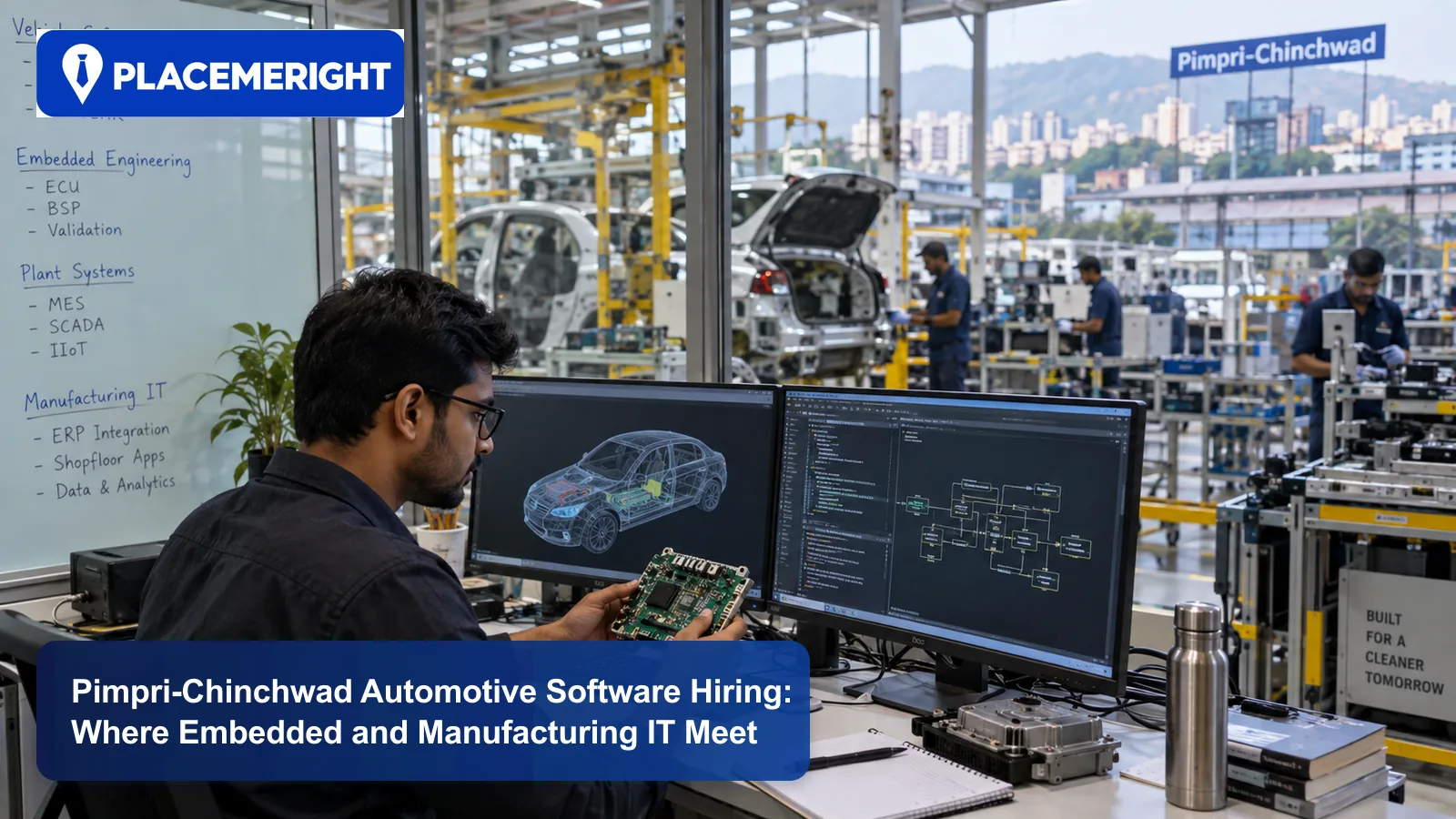
Pimpri-Chinchwad automotive software hiring covers two technology systems that share an industry but require different engineers.
The first runs in or around the vehicle: electronic control units, embedded software, communication networks, diagnostics, over-the-air updates, driver-assistance functions, validation, functional safety, and cybersecurity.
The second runs the factory and enterprise operation: manufacturing execution, product lifecycle management, ERP, plant data, quality systems, traceability, warehouse workflows, maintenance, and operational analytics.
They meet through product data, testing, release, production, quality, and field feedback. They should not be merged into one "automotive IT" vacancy.
The local corridor has a real automotive engineering base
Auto Cluster Development and Research Institute describes the Pune automotive district across Chinchwad, Bhosari, Talegaon, Chakan, and nearby industrial areas. Its facilities support industry testing, prototyping, training, and technology development.
The Automotive Research Association of India's Automotive Electronics Department works across ECU hardware and software, calibration, validation, embedded systems, vehicle networks, and related testing. ARAI's 2026 programmes cover electrical and electronic architecture, embedded systems, CAN and LIN, battery management, functional safety, software-defined vehicles, and automotive cybersecurity. Its Mobility Research Centre at Takwe has also hosted ADAS testing activity.
Current employer material provides role examples. Tata Motors Pune descriptions published in 2026 reference embedded AI/ML, firmware-over-the-air work, ISO 21434 cybersecurity, and ISO 26262 functional safety. They also mention CAN, LIN, UDS, AUTOSAR, SPICE, MATLAB, and hardware-in-the-loop validation.
These sources establish the engineering context. They do not prove that every Pimpri-Chinchwad employer uses the same architecture or that every local candidate has vehicle-software depth.
For wider sourcing, use PlaceMeRight's Pune technology recruitment context.
Separate three role lanes before writing the brief
| Hiring lane | Primary system | Typical evidence | | --- | --- | --- | | Vehicle and embedded software | ECU, controller, network, diagnostics, vehicle function | production embedded code, protocols, timing, safety and debugging | | Verification and integration | benches, simulations, vehicle tests, diagnostics, release evidence | test design, HIL/SIL, traceability, defect isolation, automation | | Manufacturing and enterprise IT | plant, product data, quality, warehouse, maintenance, ERP | MES, PLM, ERP, integrations, OT/IT, process and data ownership |
A fourth integration lane may coordinate software release, bill of materials, calibration, production configuration, quality feedback, and field data. It still needs a clear primary system and decision boundary.
Trace the vehicle-to-plant evidence chain
Vehicle software hiring starts with the controlled function
"Embedded developer" is too broad. State the controller or vehicle function, platform, timing and memory constraints, network, safety relevance, and hardware access.
Possible scopes include body electronics, powertrain, battery management, infotainment, telematics, diagnostics, ADAS, gateways, or connectivity. The required evidence changes across them.
A calibrated brief might say:
> Own embedded software and diagnostic behaviour for a body-control function, including CAN and LIN communication, UDS diagnostics, integration with hardware, code review, bench debugging, and release evidence within the team's defined safety process.
Then identify:
- C or C++ depth;
- RTOS or bare-metal environment;
- AUTOSAR classic or adaptive relevance;
- CAN, LIN, Ethernet, UDS, or other protocols;
- model-based development where applicable;
- bootloader or FOTA responsibility;
- coding standards and static analysis;
- hardware, calibration, and lab interaction;
- safety and cybersecurity interfaces.
Do not list every automotive acronym as mandatory. Separate the concepts the candidate must own immediately from the tools they can learn.
Verification hiring needs failure-isolation depth
Automotive testing is not one role.
Component tests, software-unit tests, software-in-the-loop, model-in-the-loop, hardware-in-the-loop, ECU integration, vehicle tests, diagnostics, performance, safety validation, and cybersecurity testing require different environments.
Define what the engineer receives and produces. Do they design tests from requirements, build automation, configure a HIL bench, analyse network traces, reproduce field defects, maintain traceability, or sign release evidence?
Use an interview case with an intermittent failure. Provide a requirement, CAN trace, software version, environmental condition, and incomplete reproduction steps. Ask the candidate to narrow the fault across software, network, configuration, hardware, and test setup.
Useful answers preserve evidence, control variables, identify observability gaps, and communicate what is known. Running an existing test suite is not the same as verification engineering.
Functional safety and cybersecurity must be scoped honestly
ISO 26262 and ISO/SAE 21434 knowledge can be relevant, but employers should state whether the person owns engineering work within a process, creates work products, reviews compliance, performs analysis, or leads governance.
A software engineer may need to implement defined safety mechanisms and maintain traceability. A safety engineer may own hazard-related analysis, requirements, reviews, and evidence. A cybersecurity engineer may work on threat analysis, secure architecture, controls, testing, incident response, or product-security governance.
Ask for one real work product or decision: a safety requirement, diagnostic mechanism, threat scenario, secure update control, review finding, or test strategy. Check the candidate's personal contribution.
Do not describe attendance at a standards training course as proof of end-to-end safety or cybersecurity ownership.
Manufacturing IT begins with the plant process
Manufacturing technology roles should state the physical and information flow affected.
Common areas include:
- production scheduling and execution;
- work instructions and station control;
- genealogy and traceability;
- quality checks and non-conformance;
- plant maintenance and downtime;
- material, warehouse, and supplier flow;
- product and engineering change data;
- machine connectivity and operational data;
- ERP and plant-system integration;
- dashboards and controlled reporting.
A calibrated MES brief might say: own the production-traceability workflow across station events, serial records, rework, quality holds, and ERP integration, including plant-user support and recurring-error removal.
That is different from a generic Java, SAP, data-engineering, or support vacancy.
Interview with a plant scenario. A station is producing units, but genealogy records are incomplete after an integration failure. Ask the candidate how they would protect production, preserve audit history, reconcile data, coordinate operations, and prevent recurrence.
Understand where embedded and plant systems meet
Vehicle and manufacturing teams may exchange product configuration, software versions, calibration, serial numbers, test results, release status, and quality feedback.
This creates integration roles across PLM, ALM, MES, ERP, test systems, release tools, and data platforms. Employers should not assume that deep expertise in one system automatically transfers to all others.
Map the handoff:
1. Which team creates the source record? 2. Which identifier joins the data? 3. Which system controls the approved version? 4. What blocks production or release? 5. How are corrections audited? 6. Which role owns reconciliation?
If the job primarily coordinates this flow, hire for systems integration and domain process. If it builds ECU software, keep embedded depth central. If it owns plant execution, keep manufacturing workflow central.
Use the Pimpri-Chinchwad map as work context
Chinchwad and Akurdi have established industrial, residential, and transport context. Bhosari has a dense manufacturing environment. Talawade links IT-park and industrial settings. Chakan and Talegaon extend into automotive and supplier corridors. Hinjawadi and Wakad contain software, enterprise, data, and platform workplaces.
These locations do not determine technical skill, site familiarity, lab access, shift feasibility, or candidate expectations. Use them to describe the workplace, then assess each person directly.
State whether the employee works in an engineering office, vehicle lab, test track, supplier site, factory, or shared-services environment. Give the exact gate or campus when possible. Explain transport, parking, shifts, protective requirements, travel, and remote-access restrictions before interviews.
An engineer who can work remotely on software design may still need regular hardware, bench, vehicle, or plant access. Describe the real pattern rather than advertising generic hybrid work.
Search by evidence origin, not locality
For embedded roles, relevant evidence may come from automotive OEMs, suppliers, engineering services, industrial controls, robotics, electronics, or adjacent safety-critical systems. Validate transfer through protocols, constraints, debugging, release discipline, and hardware interaction.
For verification, relevant evidence may come from automotive test teams, tool providers, engineering services, lab environments, or embedded automation. Separate script execution from test architecture and failure isolation.
For manufacturing IT, evaluate automotive, engineering, pharmaceuticals, process manufacturing, consumer goods, logistics, or industrial-software backgrounds only when the process and system evidence transfers.
Mention Mumbai, Nashik, Aurangabad, Bengaluru, Chennai, or remote work only after defining relocation, travel, office, and lab expectations. A wider geography does not correct a vague role.
Interview through artifacts and decisions
Ask candidates to bring or reconstruct a non-confidential artifact:
- embedded architecture or interface decision;
- diagnostic or network-debugging path;
- test strategy and traceability example;
- safety or security work product;
- MES or PLM process map;
- integration recovery plan;
- plant-data quality control.
Score:
- system-boundary understanding;
- personal technical ownership;
- failure diagnosis;
- evidence and traceability;
- safety, security, or operational judgement;
- communication with hardware, plant, quality, or business teams.
Avoid trivia-heavy panels where every interviewer asks protocol definitions. One realistic case with changing evidence shows more.
Include one interviewer from the neighbouring system. An embedded candidate may meet validation or hardware; a plant-systems candidate may meet production or quality. That interviewer should test the handoff, not re-run the technical round. The goal is to confirm that the candidate can preserve evidence and communicate across engineering and operations boundaries.
Document that handoff score separately so domain depth and cross-functional communication are not averaged into one vague rating.
Resolve conflicting panel evidence before discussing compensation or release dates.
Use current Pune listings as examples, not market statistics
A dated scan of PlaceMeRight's Pune live-job feed on 27 July 2026 showed only a small number of titles containing explicit vehicle-software or manufacturing-systems language among 120 city records posted from 20 to 23 July.
That does not establish low specialist demand. Employer-specific titles, module names, validation functions, enterprise applications, or confidential searches may describe related work without the same keywords.
Direct ARAI material and current employer descriptions provide better evidence for role calibration. Any later compensation or feasibility decision needs its own current and appropriately sourced evidence.
Disclose programme and site facts before offer
Before an offer, give every shortlisted person the same facts about the technical problem, system ownership, manager, lab or plant environment, location, and learning path.
Before offer:
- show the actual team and reporting line;
- explain whether the programme is new development, maintenance, migration, or validation;
- state hardware, bench, vehicle, plant, or customer access;
- disclose shifts and travel;
- clarify standards responsibilities;
- explain tool and training support;
- confirm the exact site and work pattern;
- align compensation with the real scope.
Do not present a plant-support role as product R&D or an integration-maintenance role as greenfield embedded development. Keep the offer and post-join assignment consistent with the approved brief.
Quick checklist for Pimpri-Chinchwad employers
- Choose vehicle software, verification, manufacturing IT, or integration.
- Name the controlled function or plant process.
- State architecture, protocol, system, and physical-access requirements.
- Separate implementation from safety or cybersecurity governance.
- Define test-design and failure-isolation ownership.
- Map product, release, manufacturing, and quality handoffs.
- Give the exact office, plant, lab, or track location.
- Use a realistic technical case and non-confidential artifact.
- Record personal contribution and evidence.
- Keep the post-join work consistent with the brief.
Frequently asked questions
Is automotive software hiring the same as manufacturing IT hiring?
No. Vehicle software focuses on controllers, embedded code, networks, diagnostics, vehicle functions, safety, and validation. Manufacturing IT supports plant execution, product data, quality, traceability, maintenance, warehouse, and enterprise workflows.
Which Pune corridors are relevant to automotive technology hiring?
Pimpri, Chinchwad, Akurdi, Bhosari, Talawade, Chakan, and Talegaon provide industrial and automotive context. Hinjawadi and Wakad provide different software and enterprise workplace contexts. Assess each person's actual route and required site access.
Should embedded engineers know AUTOSAR?
Require AUTOSAR when the programme and role use it. Other embedded environments may need different platform, RTOS, protocol, hardware, or model-based skills. Do not use AUTOSAR as a universal automotive-software filter.
How should employers assess HIL and validation engineers?
Test requirement interpretation, test design, bench understanding, automation depth, traceability, network or diagnostic analysis, and failure isolation. Ask candidates to explain what they personally built and diagnosed.
Can manufacturing IT candidates come from outside automotive?
Yes, when their process and system evidence transfers. Manufacturing, pharmaceuticals, engineering, consumer goods, logistics, and industrial software can provide relevant MES, PLM, ERP, quality, warehouse, maintenance, integration, and plant-data experience.
Related reading
- Build a Pune automotive hiring plan for OEM and Tier-1 work
- Assess HIL and SIL engineers for automotive programmes
- Calibrate connected-vehicle roles around Chakan
- Hire embedded software engineers
Conclusion
Pimpri-Chinchwad has documented vehicle-engineering, testing, manufacturing, and enterprise-system contexts. Each role should start with the controlled function, required evidence, physical environment, and system handoff rather than the broad label "automotive IT".
CTA
PlaceMeRight helps Pune automotive and manufacturing employers calibrate embedded, validation, cybersecurity, MES, PLM, ERP, data, and integration roles. Share your automotive technology hiring requirement to build the role boundary, sourcing map, evidence screen, and interview scorecard.
References
- Auto Cluster Development and Research Institute, Automotive cluster overview
- Auto Cluster Development and Research Institute, About Auto Cluster
- Automotive Research Association of India, Automotive Electronics Department
- Automotive Research Association of India, ADAS Show 2026 at ARAI Mobility Research Centre
- Automotive Research Association of India, 2026 proficiency programmes
- Tata Motors Careers, Embedded prognostics and cybersecurity role, Pune
- Tata Motors Careers, Body electronics engineering role, Pune
- Tata Motors Careers, Electrical and electronics validation role, Pune
- Symposium on International Automotive Technology, Vehicle electronics session, 2026
Related PlaceMeRight resources
Our Tech Recruitment Services by City
Looking to hire vetted software engineers or scale your engineering teams in India's leading tech hubs? Explore our localized recruitment services: